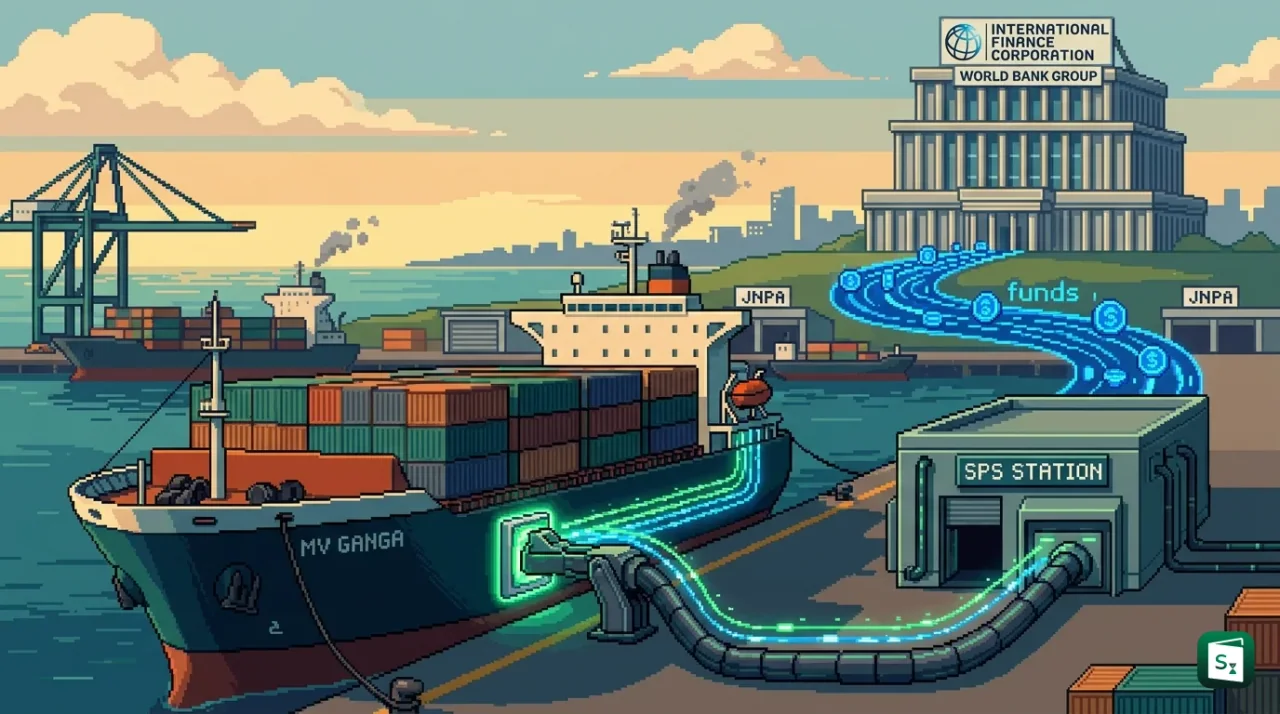
The Jawaharlal Nehru Port Authority has signed a $70 million loan agreement with the International Finance Corporation (IFC) in New Delhi to build shore power supply infrastructure across its terminals in Navi Mumbai. The 10-year dollar-linked borrowing is described as India’s first blue financing for the maritime sector and the first labelled blue financing for port infrastructure in Asia-Pacific. The project will allow berthed ships to switch off diesel engines and draw land-based electricity, cutting carbon emissions by 63 percent.
What Is JNPA and Where Is Nhava Sheva Port Located?
The Jawaharlal Nehru Port Authority (JNPA) is the statutory body that owns and manages the Nhava Sheva Port at Navi Mumbai in Raigad district, Maharashtra. JNPA is India’s premier container port, handling around 50 percent of containerised cargo across major ports of India, and it is connected to more than 200 ports around the world. The Jawaharlal Nehru Port in Maharashtra was commissioned on 26 May 1989 and is now ranked 23rd among the top 100 container ports in the world.
JNPA and Nhava Sheva refer to the same port complex. The name Nhava Sheva comes from the villages of Nhava and Sheva on the eastern shore of the Arabian Sea where the port stands. The older abbreviation JNPT stood for Jawaharlal Nehru Port Trust, while JNPA reflects its present status as an authority after port governance reforms. JNPA functions as India’s first 100 percent landlord major port, which means the authority owns the land and basic infrastructure and gives terminals to private operators for cargo handling.
Five container terminals currently operate at JNPA, along with a coastal berth, a shallow water berth for general cargo, and liquid cargo terminals. The Chairperson of JNPA is Gaurav Dayal (as of October 2026). The port also manages a multi-product Special Economic Zone (SEZ) on 277 hectares of its freehold land to attract manufacturing and logistics investment.
| JNPA Facility | Operator or Status |
|---|---|
| Nhava Sheva Freeport Terminal (NSFT) | Nhava Sheva Freeport Terminal Private Limited |
| Nhava Sheva International Container Terminal (NSICT) | DP World led consortium, India’s first privately managed container terminal commissioned in July 2000 |
| Gateway Terminals India (GTIPL) | Private operator terminal |
| Nhava Sheva International Gateway Terminal (NSIGT) | Operational since July 2016, capacity of 0.8 million TEUs |
| Bharat Mumbai Container Terminals (BMCT) | Newly commissioned large terminal, second phase expanding capacity |
| Coastal berth and Shallow Water Berth | Coastal cargo and general cargo handled with private participation |
| Liquid cargo terminals | BPCL IOCL consortium and JSW JNPT Liquid Terminal |
What Is the JNPA IFC Blue Financing Agreement?
The Jawaharlal Nehru Port Authority signed the loan agreement with the International Finance Corporation in New Delhi on 24 September 2026. The deal provides up to $70 million (about ₹672 crore) from IFC’s own account to meet the full capital cost of shore power infrastructure at JNPA. The loan does not carry a sovereign guarantee from the Government of India.
JNPA has estimated the shore power project cost at around ₹650 crore. The IFC disclosure places total project cost at about $70 million. The plan builds on an earlier pilot idea reported in 2024, when JNPA had considered spending about ₹100 crore at one terminal and about ₹600 crore with about 74 MW capacity for a full rollout. The new financing marks a large expansion of that plan to cover all major terminals at commercial scale.
The shore power rollout will happen in two phases over the next two to three years, with completion targeted by January 2028. The first phase will focus on one container terminal. The second phase will cover the remaining terminals, except the liquid cargo terminal. The system includes 33 kilovolt substations, cable systems, e-houses, frequency converters and onshore connection points at multiple berths.
| Project Fact | Detail |
|---|---|
| Lender | International Finance Corporation, World Bank Group |
| Borrower | Jawaharlal Nehru Port Authority |
| Loan amount | $70 million, about ₹672 crore |
| Tenure and form | 10-year United States Dollar linked External Commercial Borrowing |
| Guarantee | No sovereign guarantee |
| Use of funds | Capital expenditure for shore power supply across JNPA terminals |
| Implementation | Two phases over two to three years, target completion by January 2028 |
| Expected benefits | 63 percent cut in carbon emissions, up to 90 percent cut in harmful air pollutants, more than 400 jobs |
The agreement carries several firsts. JNPA describes the loan as India’s first blue financing for the maritime sector and the first labelled blue financing for port infrastructure in Asia-Pacific. The transaction is also described as the first investment by a development finance institution in India’s state-owned major port authorities and the first commercial borrowing by a port authority. IFC also helped JNPA prepare a Sustainable Finance Framework to raise more green and blue funds in future. The assurance firm DNV gave a second party opinion confirming that the framework lines up with the Loan Market Association Green Loan Principles and IFC Blue Finance Guidelines.
What Is Blue Finance and What Are Blue Bonds?
Blue finance is a dedicated part of green and sustainable finance where the borrowed money is used only for projects that protect oceans and improve water management. The blue economy is the sustainable use of ocean resources for economic growth, better livelihoods and jobs while keeping marine ecosystems and water resources healthy. Blue finance turns that idea into bankable projects in shipping, ports, fisheries, aquaculture, water supply, waste water treatment, plastic recycling, marine conservation and eco-tourism.
Blue bonds are fixed income instruments aligned with Green Bond Principles where the proceeds are used only to finance or refinance activities that protect oceans or improve water management. Blue loans follow the same logic for bank lending and are aligned with Green Loan Principles where the proceeds are used only for ocean protection or improved water management. IFC treats blue instruments as a thematic subcategory of green finance, so a blue bond must meet the four core parts of use of proceeds, project selection, management of proceeds and reporting, along with an external review.
The IFC Blue Finance Guidelines give the market a common rulebook for what counts as blue. IFC published the first version in 2022, building on the Green Bond Principles of the International Capital Market Association and the Green Loan Principles of the Loan Market Association and linking eligibility to Sustainable Development Goal 6 on clean water and sanitation and Goal 14 on life below water. IFC published Version 2.0 in September 2025 with wider coverage for water security, plastics recycling, shipping, aquaculture and marine conservation, plus guidance on sustainability linked instruments, performance indicators and impact reporting. Since 2020, IFC has provided more than $2 billion in blue loans and bonds to private institutions.
| Feature | Blue Finance | Green Finance |
|---|---|---|
| Primary focus | Ocean health, sustainable shipping, water and sanitation | Broad climate and environment goals including energy, transport and buildings |
| Global goals | Directly linked to Goal 6 and Goal 14 | Linked to several goals including climate action, clean energy and sustainable cities |
| Typical port project | Shore power, clean bunkering, ballast water control, plastic collection | Solar plants, energy efficient buildings, electric vehicles |
| Market standard | IFC Blue Finance Guidelines built on Green Bond and Green Loan Principles | Green Bond Principles and Green Loan Principles |
The JNPA project qualifies because cleaner ship power at berth cuts sulphur oxides, nitrogen oxides, particulate matter and greenhouse gases and improves coastal air and water quality. The Indian Ports Act, 2025 has introduced new Blue Finance guidelines, and the JNPA deal is described as among the first to line up with those national rules.
What Is External Commercial Borrowing and How Does the Loan Work?
External Commercial Borrowing (ECB) is a commercial loan raised by an eligible Indian entity from a recognised non-resident lender under the Foreign Exchange Management Act, 1999 and directions of the Reserve Bank of India (RBI). ECB covers bank loans, bonds, debentures, trade credits beyond three years and similar instruments, and it must meet RBI conditions on minimum maturity, end use and cost. The current RBI Master Direction on ECB was updated on 8 September 2026.
An ECB loan lets an Indian port, company or public body borrow in foreign currency or Indian rupees from abroad for capital spending, usually with a minimum average maturity of three years and up to $750 million per year under the automatic route. The RBI allows Port Trusts, units in Special Economic Zones, SIDBI and EXIM Bank to borrow, and it treats multilateral institutions where India is a member as recognised lenders.
The JNPA borrowing fits this rulebook cleanly. The Reserve Bank of India, which was established in 1935 under the RBI Act, 1934 and is headquartered in Mumbai, permits long tenure ECB for infrastructure such as sea ports, power and roads. The JNPA loan is a foreign currency ECB linked to the United States Dollar with a 10-year tenure, well above the three-year minimum. IFC qualifies as a recognised lender because India is a member country of IFC and the World Bank Group. RBI rules bar ECB money for real estate, equity investment, capital market speculation and on-lending for those purposes, while port equipment and clean power systems are permitted end uses for infrastructure.
What Is Shore Power Supply and How Does It Work?
Shore Power Supply (SPS), also called cold ironing or onshore power supply, is a system that lets a ship at berth plug into land-based electricity and switch off its diesel auxiliary engines. A berthed ship normally keeps diesel generators running for lights, cooling, pumps and cargo gear. Shore power replaces that onboard generation with power from the port grid. The ship connects through a shore side connection point, cables, frequency converters and a substation that match the voltage and frequency the vessel needs.
The JNPA system will use high voltage equipment to serve large container ships across several berths. Ships use different electrical frequencies, so frequency converters are needed to supply both 50 hertz and 60 hertz vessels safely. The Directorate General of Shipping has issued Recommended Standards for Shore to Ship Power Supply through Circular No. 09 of 2025, with port specific operating procedures and risk assessment for high voltage operations. When ships draw grid power instead of burning marine fuel at berth, local emissions of sulphur oxides, nitrogen oxides and particulate matter fall sharply and greenhouse gas emissions also drop if the grid mix gets cleaner.
No major Indian port has yet deployed shore power at full commercial scale. JNPA will become the first Indian port to do so. The early experience is meant to cut technology risk, build operating skills and show other ports a funding model that can be copied. The power will initially serve container terminals, where hotel load and reefer container demand is high, before wider use across the harbour.
Who Is IFC and What Is Its Role in the World Bank Group?
The International Finance Corporation (IFC) is the private sector investment arm of the World Bank Group. IFC offers loans, equity and advisory services to encourage private enterprise in developing countries. IFC was established in 1956 and is headquartered in Washington, D.C. in the United States. The Managing Director of IFC is Makhtar Diop (as of October 2026).
The World Bank Group has five institutions with a clear division of work. The International Bank for Reconstruction and Development and the International Development Association lend to governments, the Multilateral Investment Guarantee Agency gives political risk guarantees, and IFC finances private firms and commercially run public bodies without asking for government guarantees. That feature matters for JNPA, because the $70 million loan is a commercial borrowing without sovereign backing. IFC works in more than 100 countries and has built a large blue portfolio alongside its work in energy, transport, water and urban infrastructure. The JNPA investment also aims to create jobs, expand trade capacity and bring global operating practice to Indian ports.
JNPA Port Network, SEZ and Vadhavan Expansion
The Jawaharlal Nehru Port Authority sits at the centre of a wider port and logistics network in Maharashtra. The authority operates the Nhava Sheva complex in Navi Mumbai and is also the lead partner for the upcoming Vadhavan Port in Palghar district of Maharashtra. Vadhavan Port is planned as a deep draft offshore port with about 20 metres of natural depth, built on the landlord model through Vadhavan Port Project Limited, a special purpose vehicle with 74 percent holding by JNPA and 26 percent by the Maharashtra Maritime Board. The ground breaking for construction was done on 30 August 2024, and the port is expected to add large container capacity of about 23.5 million TEUs on full build out.
JNPA also runs dry ports at Jalna and Wardha to move cargo from its hinterland covering Maharashtra, Gujarat, Madhya Pradesh and north India. The 277 hectare JNPA Special Economic Zone supports manufacturing, warehousing and export services next to the harbour. Together, these links explain why cleaner power at JNPA has system wide value. Less fuel burn at India’s busiest container gateway lowers logistics emissions, protects workers and nearby coastal settlements from air pollution, and prepares the port cluster for stricter global shipping rules on carbon and sulphur.
| Network Element | Location and Role |
|---|---|
| Nhava Sheva Port, JNPA | Navi Mumbai, Raigad, Maharashtra, main container gateway handling about half of major port container cargo |
| JNPA SEZ | 277 hectares at Navi Mumbai for manufacturing and logistics |
| Dry ports | Jalna and Wardha, with more facilities planned for Sangli and Nashik |
| Vadhavan Port | Vadhavan near Dahanu, Palghar, Maharashtra, future deep draft mother port with 20 metre depth |
| Connectivity | Close to Delhi Mumbai freight corridor, National Highway 8 and the national railway grid |
Significance for Green Ports and the Blue Economy
The Ministry of Ports, Shipping and Waterways guides port decarbonisation through the Maritime India Vision 2030 and the Harit Sagar Green Port Guidelines issued in May 2023. Harit Sagar asks major ports to cut carbon emissions per tonne of cargo by 30 percent by 2030 and 70 percent by 2047, raise the share of renewable energy to more than 60 percent by 2030 and 90 percent by 2047, and provide shore to ship power in phases for port craft, coastal vessels and then foreign going vessels. The Directorate General of Shipping standards and the Green Port Performance Index launched in October 2025 give ports a common technical and rating system to track progress.
The JNPA shore power project directly serves those targets. Shore power is listed as a flagship step under Harit Sagar, and JNPA’s success would give other Indian ports a tested design, tariff learning and safety practice to follow. The environmental gain is large because auxiliary diesel engines at berth are a steady source of carbon dioxide, sulphur oxides, nitrogen oxides and fine dust in port cities. The economic gain comes from lower fuel use at berth, steadier power quality for reefers and cargo gear, and new work in installation, grid upgrades and maintenance that is expected to create more than 400 jobs. For lenders, the Sustainable Finance Framework opens a pipeline for more blue and green loans at JNPA and Vadhavan without repeated one off structuring.
Key Takeaways
- The JNPA IFC agreement signed on 24 September 2026 provides $70 million (about ₹672 crore) for shore power supply at Navi Mumbai.
- The loan is a 10-year dollar linked External Commercial Borrowing with no sovereign guarantee.
- The project will deliver Shore Power Supply with 33 kilovolt substations and frequency converters, targeted for completion by January 2028.
- Shore power is expected to cut carbon emissions by 63 percent, cut harmful air pollution by up to 90 percent and create more than 400 jobs.
- JNPA at Nhava Sheva, Maharashtra, commissioned on 26 May 1989, handles about 50 percent of containerised cargo across major ports and ranks 23rd globally.
- The International Finance Corporation, established in 1956 and headquartered in Washington, D.C., is the private sector arm of the World Bank Group.