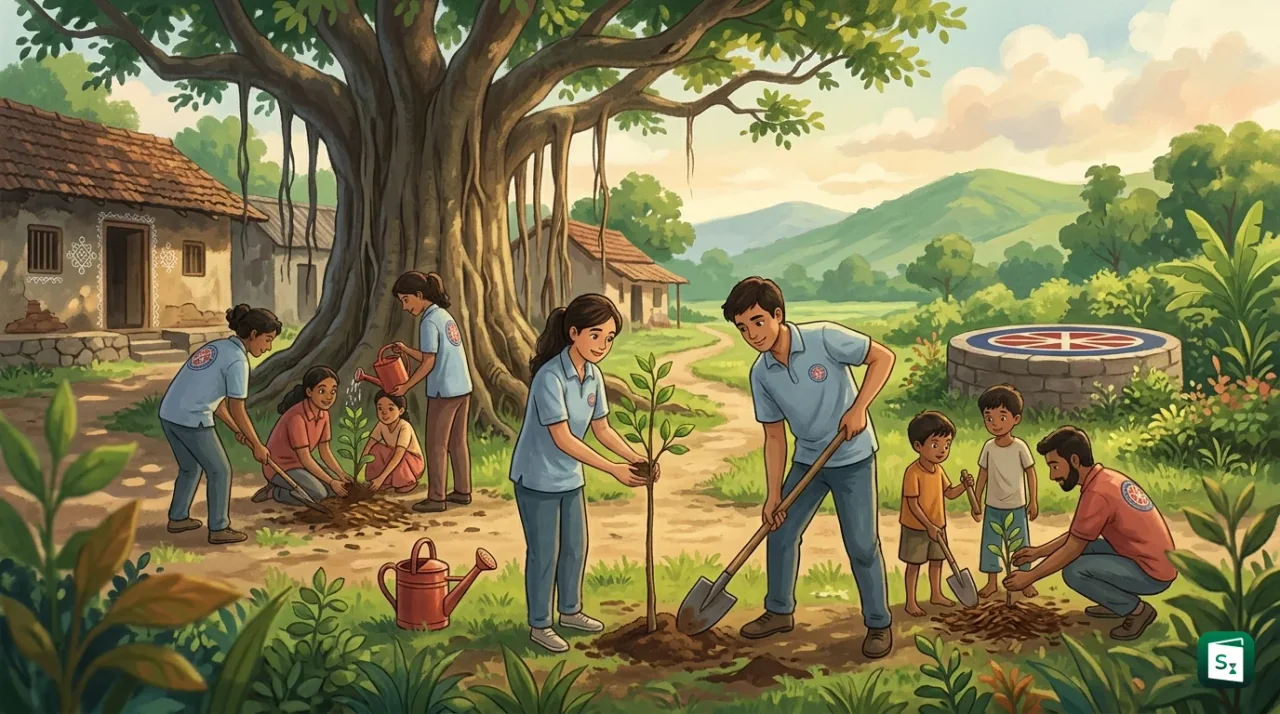
India observes National Service Scheme (NSS) Day every year on 24 September to mark the launch of the scheme in 1969 during the birth centenary year of Mahatma Gandhi. The day celebrates student volunteers in schools and colleges who give their time for community service under the motto Not Me But You. In 2026, colleges across the country marked the day with cleanliness drives, blood donation camps, poster exhibitions and pledge ceremonies.
What is NSS Day and Why is it Celebrated on 24 September
The National Service Scheme Day is observed on 24 September every year to remember the formal launch of the scheme on 24 September 1969. The launch took place in the birth centenary year of Mahatma Gandhi. Colleges celebrate the day to renew the spirit of student service to society.
The National Service Scheme was launched by Dr V. K. R. V. Rao, who was then the Union Education Minister. He started the programme in 37 universities covering all states and sought the support of state governments for its rollout. In the first year, about 40,000 student volunteers joined the scheme. The Planning Commission had approved an outlay of ₹5 crore for the scheme during the Fourth Five Year Plan and asked that it begin as a pilot in select institutions.
The choice of 1969 was deliberate. Mahatma Gandhi treated social service as a form of education, and his centenary gave the new programme a clear moral anchor. The idea of involving students in national service had been discussed for years before that. Earlier committees had suggested voluntary social work for students instead of compulsory service, and a national conference of students and educationists in May 1969 pushed for a structured scheme to promote national integration. The launch in September turned that long discussion into a working programme.
What is the National Service Scheme and How Does it Work
The National Service Scheme, known in Hindi as Rashtriya Seva Yojana, is a Central Sector Scheme of the Ministry of Youth Affairs and Sports. Its core idea is Education through Service. The scheme develops the personality of students by linking classroom learning with voluntary work in villages and urban slums. Its outlook draws directly from the ideals of Mahatma Gandhi.
Any regular student in Class 11 and 12, college or university can join as an NSS volunteer. Enrolment is voluntary and free. In college, a teacher takes charge as the Programme Officer and guides the unit. Each university has a Programme Coordinator who links all its college units to the State NSS Cell. Above the states, the Directorate of NSS in New Delhi and 15 Regional Directorates manage planning, funds and training. The scheme became fully centrally funded from 1 April 2016.
The scale of the scheme is large. More than 39 lakh volunteers are enrolled (as of October 2026) in about 39,695 NSS units spread across 391 universities and senior secondary councils, over 16,278 colleges and technical institutions and 12,483 senior secondary schools. The scheme first covered only undergraduate students. It was extended to senior secondary (+2) students in 1994, the silver jubilee year of NSS. Since 1969, more than 4.78 crore students have taken part.
Work under NSS has two parts. Under regular activities, a volunteer gives 120 hours of service in an academic year for two years. This includes orientation lectures and field visits, campus work and weekend service in an adopted village or slum. Under the special camping programme, each unit holds a seven day camp in its adopted area during vacations. About half the volunteers of a unit join a given camp, and every volunteer attends at least one special camp in two years. Camps focus on practical assets like village streets, drains, ponds and tree plantations, along with health checkups, literacy drives, awareness rallies, disaster relief work and support for flagship missions like Swachh Bharat and Digital India.
The name NSS can cause confusion, so the distinction is useful. The National Service Scheme is different from the National Scholarship Portal (NSP), which handles scholarships, and from the National Sample Survey, which collects socio economic data. In education, NSS always means the student service programme under the Ministry of Youth Affairs and Sports.
What is the Motto of NSS
The motto of the National Service Scheme is Not Me But You. It states that the welfare of a single person depends on the welfare of society as a whole. The motto asks volunteers to place community interest before self interest in daily work.
The sentence is short but carries the full philosophy of the scheme. It reflects democratic living. It upholds selfless service and respect for the views of others. In practice, it means a volunteer learns to listen to villagers, understand their needs and act with them instead of acting for personal credit. The Hindi version is often written as Main Nahin, Parantu Tum. The idea remains the same across languages. Service comes first, self comes later.
NSS Logo, Symbol, Badge and Song Meaning
The symbol of the National Service Scheme is based on the giant Rath wheel of the Konark Sun Temple in Odisha, also called the Black Pagoda. The wheel shows the cycle of creation, preservation and release. It stands for movement in life across time and space. For NSS, it signals continuity and change through steady work for social uplift.
The design is simple and easy to read. The wheel suggests motion and progress. The eight bars in the wheel stand for the 24 hours of the day. The badge carries the same symbol embossed on it. Volunteers wear the badge during camps and service work as a reminder to stay ready for service round the clock.
| Element | What it Represents |
|---|---|
| Rath wheel of Konark | Cycle of creation, preservation and release, and continuous striving for social change |
| Eight bars | 24 hours of the day, readiness to serve at all times |
| Red colour | Young blood that is lively, active and full of spirit |
| Navy blue colour | Cosmos of which NSS is a small part, ready to share work for human welfare |
The NSS song was composed in 1994 during the silver jubilee year of the scheme. Volunteers learn it and sing it at camps, orientations and NSS Day functions. Versions exist in Hindi, Tamil, Kannada and English, but the theme stays fixed on unity and service. The song builds a shared identity for volunteers from different states, languages and colleges when they meet at district, state and national camps.
What is NSS Certificate and What are its Benefits
The NSS certificate is issued by the university to a volunteer who completes 240 hours of regular service over two years and attends one seven day special camp. The certificate is signed by the programme authorities. Colleges treat it as proof of sustained community service and discipline.
Registration is simple. A student enrols with the college NSS unit under the Programme Officer. Many colleges now link enrolment and attendance to the MY Bharat portal, where the Programme Officer verifies participation and events. Regular work is recorded in a volunteer diary with hours and activities. This record forms the basis for the final certificate.
The certificate helps in concrete ways. Universities may give weightage to certificate holders in admission or other student benefits as per their own rules. It strengthens applications for jobs that value field experience, teamwork and leadership. Volunteers also gain access to higher level platforms. These include the National Integration Camp, the Republic Day Parade Camp in New Delhi, National Youth Festivals, state level adventure programmes and youth exchange delegations. The MY Bharat NSS Awards honour outstanding volunteers, Programme Officers and units each year with cash support, medals, trophies and citations.
NSS vs NCC: What is the Difference and Which is Best
The National Service Scheme (NSS) is a community service programme under the Ministry of Youth Affairs and Sports. The National Cadet Corps (NCC) is a uniformed youth organisation under the Ministry of Defence. NSS builds civic leadership through service, while NCC builds discipline through drill and defence training.
Students often compare the two because both work through schools and colleges and both value discipline and national unity. The difference lies in method and purpose. NSS centres on village adoption, health and literacy drives, environment work and relief support. NCC centres on parade, weapon familiarisation, map reading, disaster response drills and defence orientation. NSS has no military rank structure. NCC has a clear rank and certificate ladder with A, B and C certificates.
| Point | NSS | NCC |
|---|---|---|
| Full form | National Service Scheme | National Cadet Corps |
| Nodal ministry | Ministry of Youth Affairs and Sports | Ministry of Defence |
| Nature | Voluntary community service programme | Uniformed and drill based youth corps with Army, Navy and Air Force wings |
| Training style | Village surveys, camps, awareness rallies and asset creation | Parade, firing practice, adventure and leadership camps |
| Uniform | NSS badge worn during work, no daily military uniform | Prescribed uniform with badges and ranks |
| Certificate value | University NSS certificate after 240 hours and one special camp | A, B and C certificates linked to attendance, training and written tests |
Neither option is better in absolute terms. Students drawn to social work, field surveys and grassroots projects often prefer NSS. Students drawn to physical drill, uniformed life and defence careers often prefer NCC. Many colleges allow only one choice in the first year due to time limits, so interest and schedule should guide the decision.
How NSS Day is Celebrated Across India
The National Service Scheme marks NSS Day on 24 September with programmes at college, university, state and national levels. Colleges begin the day with the NSS song and a pledge based on the motto. Programme Officers brief new students on the history of the scheme, the meaning of the badge and the 120 hour annual work norm. Senior volunteers share field stories from adopted villages and slums to show how surveys turn into action.
The most visible activities are service led. Units organise blood donation camps, sapling plantations, campus and market cleaning drives and plastic collection walks. Many colleges hold poster making contests, slogan writing, street plays and short speeches in Hindi and English on themes like health, literacy and environment. District officials often join valedictory sessions and distribute certificates to active volunteers. At the national level, the period around NSS Day highlights major honours. The President of India presented the MY Bharat NSS Awards for 2022-23 at Rashtrapati Bhavan on 6 October 2025 to ten NSS units with their Programme Officers and to 30 NSS volunteers for outstanding community service. The awards carry ₹2 lakh for each unit for programme development and ₹1.5 lakh for each Programme Officer with a medal and citation.
Key Takeaways
- NSS Day is observed every year on 24 September to mark the formal launch of the scheme on 24 September 1969.
- The scheme was launched by Dr V. K. R. V. Rao in 37 universities with about 40,000 volunteers during the birth centenary year of Mahatma Gandhi.
- The motto of NSS is Not Me But You, which places community welfare above self interest.
- The NSS symbol is based on the Rath wheel of the Konark Sun Temple in Odisha, where eight bars represent 24 hours of readiness for service.
- NSS is a Central Sector Scheme under the Ministry of Youth Affairs and Sports, and the NSS certificate is issued after 240 hours of service and one seven day special camp.