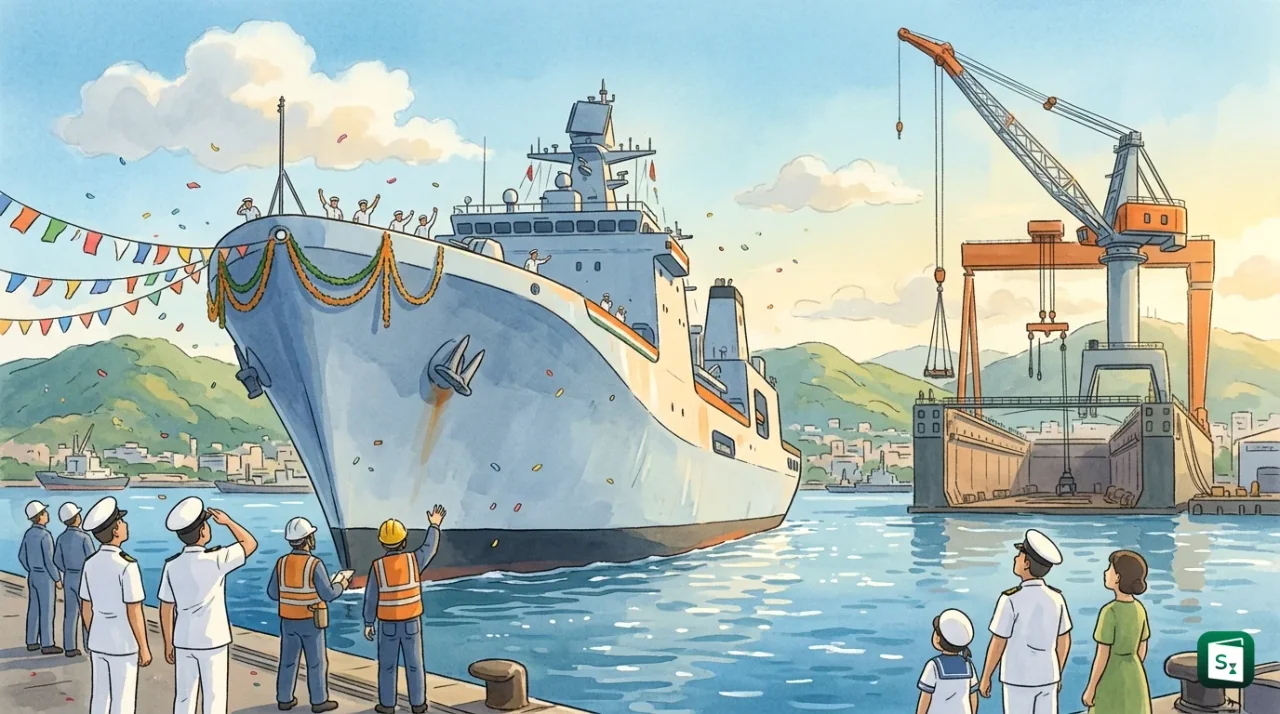
Defence Minister Rajnath Singh launched INS Surya (FSS-1), the first indigenously designed and built Fleet Support Ship of the Indian Navy, at Hindustan Shipyard Limited (HSL) in Visakhapatnam on 6 October 2026. At the same event, he laid the keel of the fifth ship in the series, FSS-5, and inaugurated the upgraded Slipway-4 and a 300-tonne Goliath Crane. Together, the three milestones signal a major jump in India’s ability to build very large naval auxiliaries at home and sustain warships far from shore.
What Is a Fleet Support Ship?
A Fleet Support Ship is a large naval auxiliary vessel that carries fuel, water, ammunition, food and spares to refuel and resupply warships while they remain at sea. The Indian Navy uses the term for its new class of replenishment tankers that extend fleet endurance without a return to harbour. INS Surya belongs to this category and will perform underway replenishment for frontline combatants.
A fleet itself is a group of warships operating under one command. Replenishment at sea, also called underway replenishment, is the method of passing liquids and solid stores between ships while both are moving. Fleet support vessels act like floating fuel stations and warehouses. They pump fuel oil and aviation fuel through hoses and rigs, transfer pallets of ammunition and provisions by high lines, and can move stores by helicopter.
The Indian version combines both roles in one hull. It carries large volumes of fuel and water in tanks and dry cargo in holds. It also has onboard workshops for first line repairs, a helicopter deck for multi-role helicopter operations, and self defence systems. In its secondary role, the ship can support humanitarian assistance and disaster relief, evacuation of people, and quick delivery of relief material during natural calamities.
What Happened at Visakhapatnam on 6 October 2026?
Defence Minister Rajnath Singh presided over three linked events at Hindustan Shipyard Limited in Visakhapatnam on 6 October 2026. He launched FSS-1, laid the keel of FSS-5, and inaugurated the upgraded Slipway-4 with the new 300-tonne Goliath Crane. Senior leadership including Chief of the Naval Staff Admiral Krishna Swaminathan (as of October 2026), Secretary (Defence Production) Sanjeev Kumar, Flag Officer Commanding-in-Chief Eastern Naval Command Vice Admiral Sanjay Bhalla, and HSL Chairman and Managing Director Rear Admiral C Raghuram (Retd) attended the ceremony.
INS Surya entered the waters of the Bay of Bengal after traditional honours performed by Laila Swaminathan, President of the Navy Wives Welfare Association. The launch came just 18 months after steel cutting, which underlines the pace of construction. The Defence Minister described the launch of FSS-1 as a symbol of achievement, the keel laying of FSS-5 as a symbol of resolve, and the new slipway as a symbol of growing capability.
Keel laying marks the formal start of a ship’s hull assembly on the building blocks. In shipbuilding tradition, it is counted among the four major milestones along with steel cutting, launching, and delivery. The steel cutting ceremony for the fifth and last ship of the series had been held at HSL on 8 May 2026. The keel laying of FSS-5 barely five months later shows the programme has moved into steady series production.
Specifications of the HSL Class Fleet Support Ships
The HSL class Fleet Support Ships are the largest naval auxiliaries ever planned for construction in India. Each ship displaces about 43,500 to 44,700 tonnes at full load and measures about 222.8 to 230 metres in length with a beam of about 31.5 metres. With this size, the ships will be heavier than the aircraft carriers INS Vikramaditya and INS Vikrant and will become among the largest vessels in the Indian Navy inventory.
The ships are designed for a top speed of about 20 knots and a range of about 12,000 nautical miles at 16 knots. Propulsion and replenishment systems include modern electric Replenishment at Sea equipment supplied by Kongsberg Maritime, which allows faster and safer transfer of fuel and stores while underway. Combat management systems, communications, and sensors are being supplied by Bharat Electronics Limited (BEL) under an order worth about ₹1,075 crore.
The table below summarises the programme basics.
| Feature | Detail |
|---|---|
| Total ships ordered | Five ships for the Indian Navy |
| Contract date and cost | 25 August 2023, about ₹19,000 crore with HSL |
| Approval | Cabinet Committee on Security cleared the project on 16 August 2023 |
| Design | Indigenous design by HSL in-house design team |
| Displacement | More than 40,000 tonnes, reported as 43,500 tonnes |
| Primary cargo | Fuel, water, ammunition and victual stores |
| Aviation facility | Helicopter deck and hangar for one multi-role helicopter such as HAL Dhruv |
| Delivery schedule | First ship from mid 2027, others at 10 to 12 month intervals over eight years |
| Construction model | Three ships at HSL Visakhapatnam, hull and part outfitting of two ships subcontracted to Larsen and Toubro (L and T) at Kattupalli |
| Employment impact | About 168.8 lakh man days over eight years |
Deliveries are scheduled to begin in mid 2027. Steel cutting of the first ship took place on 10 April 2024, its keel was laid on 14 November 2024, and the keel of the third ship was laid at the L and T yard at Kattupalli on 9 July 2025. The five new ships will add to the current fleet of four replenishment tankers, two of which will retire in the coming decade.
Hindustan Shipyard Limited and Upgraded Infrastructure
Hindustan Shipyard Limited is a central public sector shipyard located in Visakhapatnam, Andhra Pradesh. The yard was founded on 21 June 1941 as Scindia Shipyard by industrialist Walchand Hirachand as part of the Scindia Steam Navigation Company. The foundation stone was laid by Rajendra Prasad. The first ship built in independent India, Jala Usha, was launched from this yard in 1948 by Jawaharlal Nehru.
The Government of India took over the yard in 1952, nationalised it in 1961 as Hindustan Shipyard Limited, and transferred it from the Ministry of Shipping to the Ministry of Defence in 2010. HSL attained Mini Ratna Category 1 status in 2025 after recording profits in nine of the previous ten years. The yard builds and repairs ships and submarines and is now central to the Navy’s auxiliary and refit workload.
The infrastructure inaugurated on 6 October 2026 directly raises that capacity. Slipway-4 has been extended in length and strengthened in load bearing power. The new 300-tonne Goliath Crane, which spans Slipways 3 and 4, was designed and manufactured by L and T Geostructure with Konecranes in India. A Goliath crane, also called a gantry crane, is a very large overhead crane that moves on rails on both sides of a slipway and lifts complete ship blocks into position.
The crane uses programmable logic controls, variable frequency drives, tandem lifting, remote diagnostics and condition monitoring. This allows faster and more precise handling of heavier blocks for modern block construction, where a ship is built from large pre-outfitted sections. Together, the upgraded slipway and crane allow HSL to build and launch vessels of up to 45,000 Deadweight Tonnage (DWT). Deadweight tonnage is the total weight a ship can carry, including cargo, fuel, water, stores and crew.
How Many Fleets Are There in the Indian Navy?
The Indian Navy has two fleets. The Western Fleet is based at Mumbai under the Western Naval Command and the Eastern Fleet is based at Visakhapatnam under the Eastern Naval Command. Each fleet is commanded by a Rear Admiral designated as the Flag Officer Commanding the Fleet.
A fleet includes destroyers, frigates, corvettes, submarines, patrol vessels and support ships operating together under one authority. The Navy as a whole is organised into three commands. The Western Naval Command at Mumbai and the Eastern Naval Command at Visakhapatnam are operational commands for the Arabian Sea and the Bay of Bengal respectively. The Southern Naval Command at Kochi is the training command. Naval Headquarters in New Delhi is headed by the Chief of the Naval Staff.
Fleet Support Ships serve both fleets by sailing with task groups. They refuel destroyers and frigates, resupply aircraft carriers such as INS Vikrant, and support submarines and survey ships on long patrols. Without these tankers, warships must cut short deployments and return to ports at Mumbai, Visakhapatnam, Kochi, Karwar, Port Blair or abroad for fuel and food.
Why Fleet Support Ships Matter for Blue Water Operations
A blue water navy is one that can operate for long periods far from its own shores. The Indian Navy is steadily moving in that direction as its surface fleet tonnage grows and as deployments extend across the Indian Ocean Region. Ships now sail for anti-piracy patrols near the Gulf of Aden, goodwill visits to Southeast Asia and Africa, and joint exercises in distant waters. Every extra day at sea needs fuel for propulsion, aviation fuel for helicopters, fresh water, rations and ammunition.
Fleet Support Ships provide that staying power. They allow a carrier group or a group of destroyers to remain on station for weeks without entering a foreign port. This improves response time during crises, protects sea lanes that carry India’s trade and energy, and backs humanitarian missions. The ability to transfer fuel and solid stores at sea also reduces pressure on shore logistics in wartime.
The indigenous angle adds strategic value. These are the first ships of this size to be designed and built in India by an Indian yard with mostly Indian equipment and systems. The project supports self reliance in defence manufacturing under Make in India and Aatmanirbhar Bharat, creates work for micro, small and medium enterprises, and builds design skills that can be used for future tankers, landing ships and even merchant vessels. The Defence Minister stressed that self reliance must now lead to global competitiveness on quality, cost, technology, delivery and reliability.
Visakhapatnam as a Maritime Industrial Hub and the Way Forward
The Defence Minister called for Visakhapatnam to be developed as a major maritime industrial hub. The city already hosts the Eastern Naval Command, the Naval Dockyard, HSL and Visakhapatnam Port. This mix of naval expertise, shipbuilding capacity, engineering talent and port infrastructure gives it the base for an integrated maritime ecosystem.
The plan outlined at the launch links HSL closely with the wider economy of Andhra Pradesh. Local micro, small and medium enterprises can join the supply chain for parts and services. Universities can support research and skilled manpower. Technology firms can help with digital shipbuilding tools, while startups can develop maritime sensors and software. The goal is a complete local ecosystem backed by logistics, port links, research support and trained workers.
For HSL, the priorities spelled out are clear. Timely delivery must become routine practice. Design capability must grow through learning from leading global yards. Supply chains must stay resilient, costs must stay competitive, and lifecycle support from build to repair and refit must be offered from one place. Closer coordination between the Navy, HSL, the Defence Research and Development Organisation, industry and academia is central to that shift. Indian yards are also expected to look outward to ship repair, maintenance, and orders from friendly nations.
Key Takeaways
- INS Surya (FSS-1) was launched on 6 October 2026 at Hindustan Shipyard Limited, Visakhapatnam as India’s first indigenously designed Fleet Support Ship.
- The five-ship Fleet Support Ship contract worth about ₹19,000 crore was signed with HSL on 25 August 2023 after clearance by the Cabinet Committee on Security on 16 August 2023.
- Each Fleet Support Ship displaces about 43,500 tonnes and will replenish warships at sea with fuel, water, ammunition and stores to extend blue water endurance.
- Keel of the fifth ship FSS-5 was laid on the same day, while steel cutting of FSS-5 had taken place on 8 May 2026 and keel of FSS-1 on 14 November 2024.
- Upgraded Slipway-4 and the 300-tonne Goliath Crane enable HSL to build vessels up to 45,000 DWT using modern block construction.
- Hindustan Shipyard Limited, founded in 1941 as Scindia Shipyard and transferred to the Ministry of Defence in 2010, attained Mini Ratna Category 1 status in 2025.