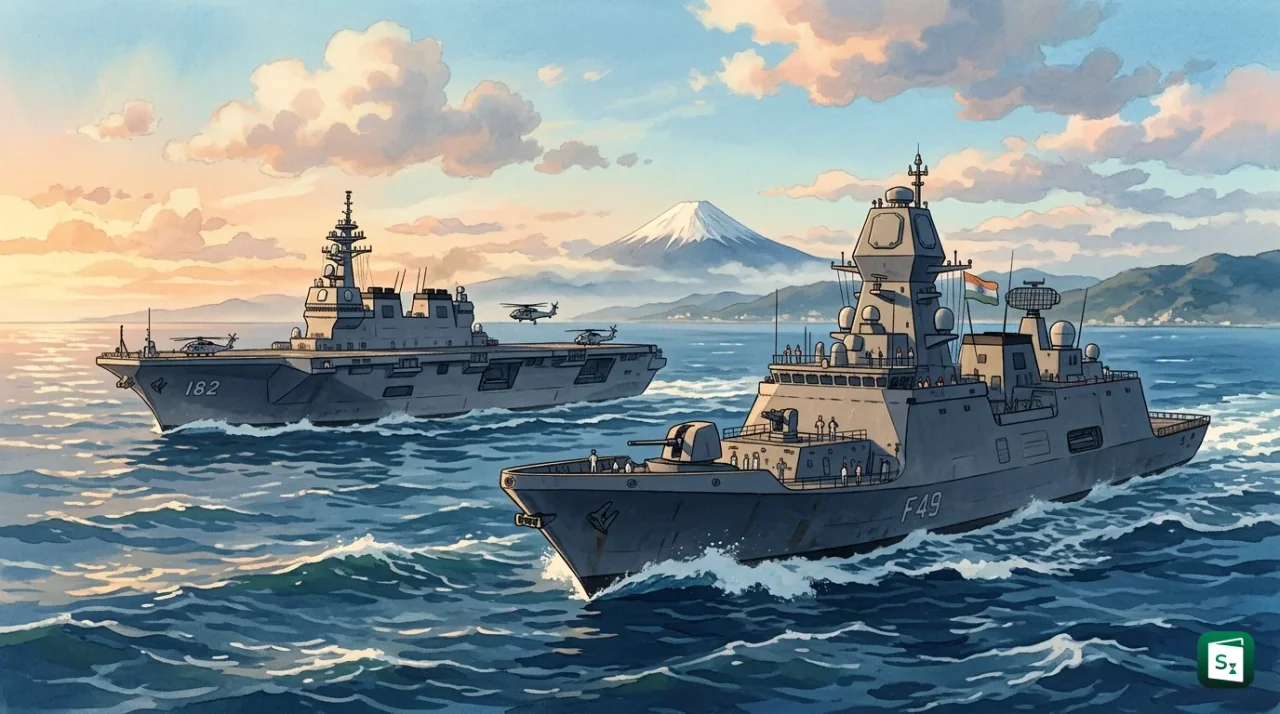
The Japan India Maritime Exercise 2026, called JAIMEX 2026, was held on 13 and 14 November 2026 in waters south of Honshu in Japan. The Indian Navy fielded its stealth frigate INS Sahyadri while the Japan Maritime Self-Defense Force fielded its helicopter destroyer JS Ise. The two day drill focused on coordinated manoeuvres at sea and came immediately after the multilateral Malabar 2026 exercise at Yokosuka.
What Is JAIMEX and Where Was JAIMEX 2026 Held?
JAIMEX stands for Japan India Maritime Exercise. It is the bilateral naval exercise between India and Japan, held between the Indian Navy and the Japan Maritime Self-Defense Force. JAIMEX 2026 was held on 13 and 14 November 2026 in the sea area south of Honshu, the largest island of Japan.
The full form is important because the older name JIMEX and the newer name JAIMEX mean the same exercise. JIMEX stood for Japan India Maritime Exercise and was used from the first edition in 2012 to 2024. From 2025, both navies have written it as JAIMEX, placing Japan first in the short form to match the official title Japan India Maritime Exercise.
The stated goals for JAIMEX 2026 were direct. The Japan Maritime Self-Defense Force listed two aims, to improve its tactical skills and to strengthen cooperation with the Indian Navy. The Indian Navy stated that the drill would build coordinated action at sea, improve operating procedures and deepen trust between the two forces.
How the Two Warships Exercised Together at Sea
The sea phase of JAIMEX 2026 involved only two major warships, one from each side. This kept the drill focused on basic interoperability, which means the ability of two different navies to sail, talk and operate helicopters together using common methods.
| Activity in JAIMEX 2026 | What the ships actually did |
|---|---|
| Tactical manoeuvring | Ships sailed in coordinated formations and practised common turns and screen positions |
| Communication exercise | Ships tested radio procedures and tactical data exchange between Indian and Japanese systems |
| Cross deck landings | Helicopters from one navy landed on the deck of the other navy ship |
| PHOTOEX | Ships held formation for a photographic exercise to record precise station keeping |
Tactical manoeuvring tests whether both bridge teams read the same movement orders in the same way. Communication drills test whether radios, signal codes and data links work across different equipment. Cross deck landings are more demanding because a pilot must land on a smaller and unfamiliar deck that moves with wind and swell, while the deck crew follows a different set of safety signals.
JAIMEX 2026 followed a tight schedule. INS Sahyadri had taken part in Malabar 2026 along with the navies of Japan, the United States and Australia. The Indian ship left the Yokosuka Naval Base on 12 November 2026 after Malabar ended. It then joined JS Ise for the bilateral drill on 13 and 14 November in waters south of Honshu.
Which Ships Took Part in JAIMEX 2026?
INS Sahyadri of the Indian Navy
INS Sahyadri carries pennant number F49. It is the third ship of the Shivalik class of guided missile stealth frigates. Stealth in this context means shaped hull surfaces and special coatings that reduce radar, heat and noise signatures.
The ship was built by Mazagon Dock Shipbuilders Limited in Mumbai and was commissioned on 21 July 2012. It serves under the Eastern Naval Command, which is headquartered at Visakhapatnam in Andhra Pradesh. The name Sahyadri comes from the Sahyadri hill ranges, also called the Western Ghats.
The frigate displaces about 6,200 tonnes at full load and measures 142.5 metres in length. It can reach speeds of more than 30 knots using a combined diesel and gas turbine propulsion system. Its weapons include BrahMos supersonic cruise missiles, Shtil-1 and Barak 1 surface to air missiles, a 76 mm naval gun, close in weapon systems and anti submarine rockets and torpedoes. It can carry two helicopters such as the Sea King or Dhruv.
INS Sahyadri has been a regular face in this series. The same ship took part in the sea phase of JAIMEX 2025 off Kyushu in October 2025, which shows how India uses long range deployments to sustain presence in the western Pacific.
JS Ise of the Japan Maritime Self-Defense Force
JS Ise carries pennant number DDH-182. It is the second ship of the Hyuga class of helicopter destroyers. Japan uses the term destroyer for this type, but the flat full length flight deck allows it to operate as a helicopter carrier for anti submarine warfare.
The ship was built by IHI Marine United in Yokohama. It was launched on 21 August 2009 and commissioned on 16 March 2011. Its home port is Sasebo in Nagasaki prefecture. The name comes from the old Ise province.
JS Ise is much larger than a frigate. It displaces 13,950 tonnes under standard load and about 19,000 tonnes at full load. It is 197 metres long with a beam of 33 metres and a crew of about 370 personnel. It sails at more than 30 knots using four gas turbines. Its combat system is called ATECS, the advanced technology command system. Its main weapons are a 16 cell Mk 41 vertical launch system for Evolved Sea Sparrow air defence missiles and anti submarine rockets, Phalanx close in weapon systems and triple torpedo tubes. It normally carries three SH-60K anti submarine helicopters and one MCH-101 transport helicopter, and can handle up to 11 helicopters.
From JIMEX to JAIMEX: How the Exercise Has Grown Since 2012
The Japan India Maritime Exercise began in 2012 with JIMEX 12 off Tokyo in the Sagami Bay. The second edition followed in December 2013 in the Bay of Bengal. The exercise is now a regular feature of the Special Strategic and Global Partnership that India and Japan established in 2014.
The table below tracks the recent editions that show how the venue alternates between the two countries and how the scope has changed.
| Edition | Year and venue | Indian ship | Japanese units |
|---|---|---|---|
| JIMEX 23, 7th edition | July 2023 off Visakhapatnam, India | Indian Navy ships including stealth frigate | JMSDF destroyer |
| JIMEX 24, 8th edition | June 2024 at Yokosuka and south of Kanto, Japan | INS Shivalik | Destroyer JS Yugiri with integral helicopters |
| JAIMEX 25 | 16 to 18 October 2025 west of Kyushu, plus harbour phase at Yokosuka on 21 October | INS Sahyadri | Destroyer JS Asahi, oiler JS Oumi, submarine Jinryu |
| JAIMEX 2026 | 13 to 14 November 2026 south of Honshu, Japan | INS Sahyadri | Helicopter destroyer JS Ise |
The pattern is clear. The name shifted from JIMEX to JAIMEX in 2025, but the numbering continued. Recent sea phases have tested harder skills such as anti submarine warfare, missile defence, flying operations and underway replenishment. In JAIMEX 25, for example, Japan added a submarine and support from ground and air surveillance units. The Indian Navy also links the bilateral drill with longer deployments, as seen when INS Sahyadri moved straight from Malabar 2026 into JAIMEX 2026.
How Does JAIMEX Differ From Dharma Guardian and Malabar?
India and Japan hold separate drills for the navy, army and air force, plus one large multilateral naval drill. Readers often mix up the names, so the distinction matters.
| Exercise | Forces involved | Nature | Focus |
|---|---|---|---|
| JAIMEX, earlier called JIMEX exercise | Indian Navy and Japan Maritime Self-Defense Force | Bilateral naval exercise since 2012 | Surface, sub surface and air operations at sea, interoperability between warships |
| Dharma Guardian | Indian Army and Japan Ground Self-Defense Force | Bilateral army exercise since 2018, held alternately in India and Japan | Counter terrorism, counter insurgency and joint operations in semi urban terrain |
| Malabar | Navies of India, Japan, the United States and Australia | Multilateral naval exercise, started in 1992 as India United States drill, Japan became permanent in 2015 | Large scale Indo-Pacific naval cooperation including anti submarine warfare and interdiction |
The 7th edition of Dharma Guardian was held from 24 February to 9 March 2026 at Chaubattia in Uttarakhand. About 120 personnel from each side took part, with Japan sending troops of the 32nd Infantry Regiment and India fielding troops from the Ladakh Scouts. Malabar 2026 was held off Japan with harbour and sea phases that covered anti submarine warfare, boarding drills, gunnery and replenishment at sea.
In short, JAIMEX builds navy to navy trust, Dharma Guardian builds army to army trust, and Malabar builds wider coordination among four Indo-Pacific partners.
Why JAIMEX 2026 Matters for Indo-Pacific Maritime Cooperation
The Indian Navy linked JAIMEX 2026 to a safe and stable Indo-Pacific. Japan linked it to the goal of a Free and Open Indo-Pacific, a term both governments use for open sea lanes, respect for international law and freedom of navigation.
The drill carries weight beyond the two ships. It supports navy to navy familiarity. Crews that have landed helicopters on each other decks and used common radio drills can respond faster during anti piracy patrols, disaster relief or a real maritime incident. It also fits a wider net of India Japan defence ties that already covers army drills, air drills such as Veer Guardian, coast guard drills and regular ministerial talks. Even a short two day passage exercise after a larger multilateral drill keeps Indian ships present in waters near Japan and keeps Japanese ships used to operating with Indian crews.
India frames such cooperation under its vision of MAHASAGAR, which stands for Mutual and Holistic Advancement for Security and Growth Across Regions. The idea places collaborative maritime security at the centre of engagement with partners across the Indian Ocean and Pacific Ocean regions.
Key Takeaways
- JAIMEX 2026 is the bilateral naval exercise between India and Japan, held on 13 and 14 November 2026 south of Honshu in Japan.
- INS Sahyadri (F49), a Shivalik class stealth frigate commissioned on 21 July 2012, represented the Indian Navy.
- JS Ise (DDH-182), a Hyuga class helicopter destroyer commissioned on 16 March 2011, represented the Japan Maritime Self-Defense Force.
- The drill covered tactical manoeuvring, communication drills, cross deck helicopter landings and PHOTOEX.
- The series began as JIMEX in 2012, with the 8th edition JIMEX 24 held in June 2024 and the name JAIMEX used from 2025.