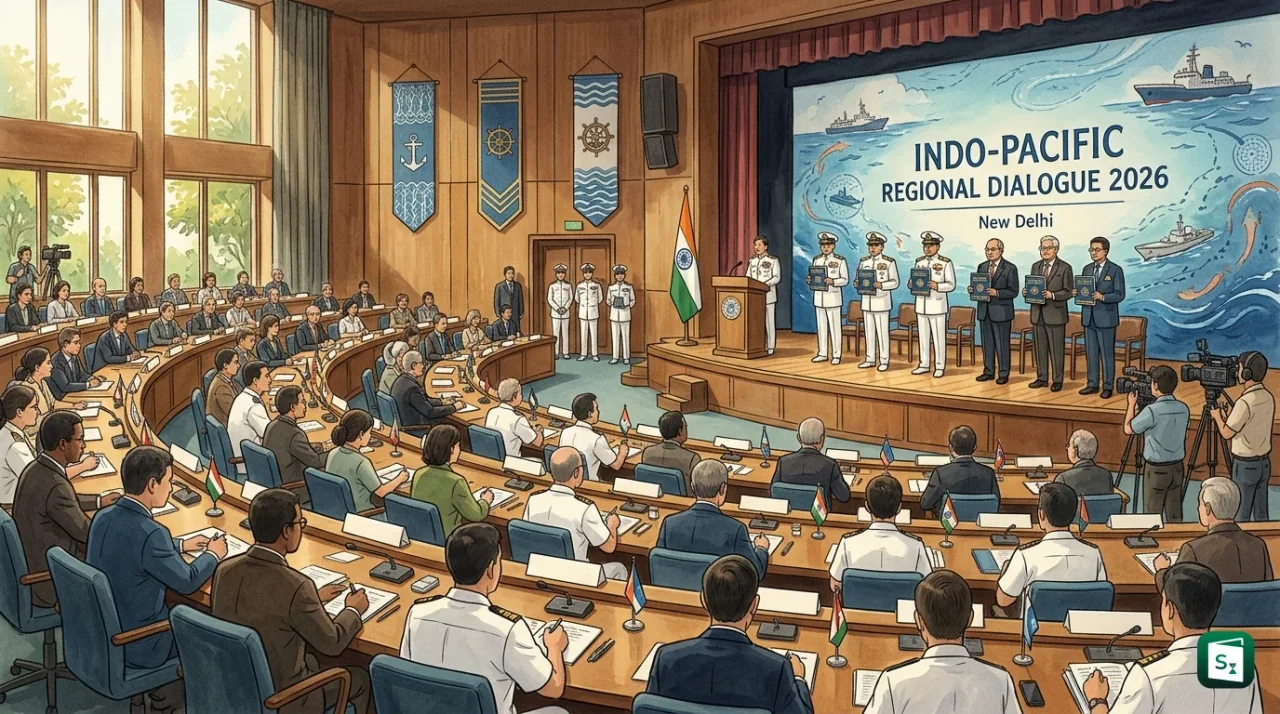
The Indian Navy and the National Maritime Foundation concluded the 8th Indo-Pacific Regional Dialogue 2026 on 5 November 2026 at the Manekshaw Centre in New Delhi. The three day conference brought together more than 40 experts and speakers from 20 countries on the theme of science, technology and academic cooperation in the Indo-Pacific. The discussions aimed to convert scientific research and university partnerships into practical steps for maritime security and regional resilience.
What Is the Indo-Pacific Regional Dialogue?
The Indo-Pacific Regional Dialogue (IPRD) is the Indian Navy annual apex level international conference on maritime strategy. The Navy conceived the dialogue in 2018 to discuss opportunities and challenges in the Indo-Pacific at the strategic level. The National Maritime Foundation (NMF) serves as the knowledge partner and chief organiser of every edition.
NMF is the first maritime think tank of India. It was established in 2005 and inaugurated on 15 February 2005 by then Defence Minister Pranab Mukherjee. The Foundation is an independent and autonomous body headquartered in New Delhi, and its work is supported by the Ministry of Defence and the Indian Navy. It studies naval security, blue economy, ocean governance and maritime heritage, and provides a platform where government officials, naval officers, scholars and industry meet. This Track 1.5 character, with both official and non official participation, shapes the nature of IPRD discussions.
The first two editions were held in New Delhi in 2018 and 2019. The 2020 edition was cancelled due to the COVID-19 pandemic, and the 2021 edition was held online. Since 2022, the dialogue has been held in physical form over three days at the Manekshaw Centre in New Delhi, and each edition has focused on one or more pillars of the Indo-Pacific Oceans Initiative. IPRD 2026 was the 8th edition, held from 3 to 5 November 2026.
| Edition | Year and Venue | Central Theme |
|---|---|---|
| IPRD 2018 | February 2018, Manekshaw Centre | Maritime trade, connectivity and role of industry |
| IPRD 2019 | March 2019, Manekshaw Centre | Free and open Indo-Pacific, blue economy and connectivity |
| IPRD 2021 | October 2021, online | Evolution of maritime strategy in the 21st century |
| IPRD 2022 | November 2022, Manekshaw Centre | Operationalising the Indo-Pacific Oceans Initiative |
| IPRD 2023 | November 2023, Manekshaw Centre | Geopolitical impacts on maritime trade and connectivity |
| IPRD 2024 | October 2024, Manekshaw Centre | Resource geopolitics and security |
| IPRD 2025 | October 2025, Manekshaw Centre | Capacity building and capability enhancement |
| IPRD 2026 | November 2026, Manekshaw Centre | Science, technology and academic cooperation |
What Is the Indo-Pacific and Why Does It Matter for India?
The Indo-Pacific is the combined maritime space of the Indian Ocean and the Pacific Ocean. The region stretches from the east coast of Africa to the west coast of the Americas, with India at its centre and ASEAN at its core. It carries a large share of world trade, energy shipments and fish catch, which makes stability in its sea lanes vital for global growth.
India views the Indo-Pacific as a free, open, inclusive and rules based space. This approach was outlined by India at the Shangri-La Dialogue in Singapore in 2018. It rests on respect for sovereignty, freedom of navigation and overflight, unimpeded lawful commerce and peaceful settlement of disputes under international law, especially the United Nations Convention on the Law of the Sea (UNCLOS) of 1982. India signed the agreement under UNCLOS on marine biodiversity beyond national jurisdiction in 2024, which shows support for a rules based ocean order.
The region matters deeply for India for three direct reasons. First, more than half of Indian trade passes through the Malacca Strait and the South China Sea, so open sea lines of communication protect energy imports and exports. Second, the Indian coastline of about 7,500 km, an Exclusive Economic Zone (EEZ) of about 2.4 million sq km and island territories in the Andaman and Nicobar and Lakshadweep groups give India both rights and duties in ocean governance. Third, coastal jobs, fisheries, ports and offshore resources link maritime security to daily livelihoods and climate safety.
The term Indo-Pacific differs from the older term Asia-Pacific. The older term centred on East Asia and the Pacific. The newer term adds the Indian Ocean and underlines the link between the two oceans.
| Feature | Asia-Pacific | Indo-Pacific |
|---|---|---|
| Core area | Pacific rim and East Asia | Indian Ocean plus Pacific Ocean |
| Central actor | Often focused on major Pacific economies | Places India, ASEAN and Indian Ocean states at the centre |
| Security focus | Largely trade and Pacific alliances | Maritime security, sea lanes, oceans initiative and maritime domain awareness across two oceans |
What Was Discussed at IPRD 2026 in New Delhi?
IPRD 2026 chose the theme of science, technology and academic cooperation in the Indo-Pacific. The organisers defined the scope as STEAM rather than STEM alone. The dialogue therefore covered physical sciences and engineering along with social sciences, life sciences, arts and humanities. The central question was how the region can turn scientific knowledge and new technology into lasting institutions, stronger maritime skills and shared resilience.
The conference ran from 3 to 5 November 2026 at Zorawar Hall in the Manekshaw Centre. The Indian Navy hosted the event. NMF organised the programme. More than 40 experts took part. The inaugural session included welcome remarks by Vice Admiral Pradeep Chauhan (Retd), Director General of NMF, an inaugural address by Admiral Dinesh Kumar Tripathi (Retd), Chairman of NMF and former Chief of the Naval Staff, and a special address by Vice Admiral Biswajit Dasgupta (Retd), National Maritime Security Coordinator. Defence Minister Rajnath Singh delivered the commemorative address on 4 November. Science and Technology Minister Jitendra Singh addressed a ministerial session on the same day. Chief of Defence Staff General N S Raja Subramani gave a special address on 5 November. Defence Secretary Rajesh Kumar Singh gave the valedictory address.
Five professional sessions formed the core of the programme.
| Session | Main Focus |
|---|---|
| Academic networks, research and human capital development | University links, think tank cooperation and training of maritime professionals |
| Maritime situational awareness and protection of critical maritime infrastructure | Information sharing, underwater domain awareness and safety of undersea cables and pipelines |
| Oceanographic science and climate resilience | Shared observation, ocean data, research vessels and support for island states such as Mauritius and Seychelles |
| Collaborative approaches to ocean governance and maritime resilience | Equitable research partnerships, disaster resilient infrastructure and links between science and shipping |
| Transformative maritime technologies and dual use implications | Artificial intelligence, quantum tools and responsible rules for technologies with civilian and military use |
Day one examined academic networks and maritime awareness. Speakers from France, Indonesia, Japan and Maldives discussed an Indian Ocean academic network and closer ties among universities, think tanks and governments. The maritime awareness session examined the Indo-Pacific Partnership for Maritime Domain Awareness (IPMDA), which Quad leaders launched in Tokyo in 2022 to track dark shipping and illegal fishing through commercial satellite and radio frequency data. Views from the Indian Ocean Commission added the perspective of island states on protection of critical infrastructure.
Day two focused on ocean science and climate response. Moderated by Commodore Abhinav Barve, the session discussed cooperative networks for climate resilience, translation of ocean science into policy and joint sharing of ocean data, observation systems and forecasting tools. The ministerial addresses stressed practical outcomes. The Defence Minister called for secure supply chains, reliable maritime infrastructure, stronger maritime awareness and joint research. He asked participants to move from listing problems to building partnerships, projects and measurable results.
Day three covered ocean governance and new technologies. A session moderated by Vice Admiral Sanjay Jasjit Singh (Retd), Director General of the United Service Institution of India, linked science with governance and industry. A final session moderated by Rear Admiral Guninder Singh Jawanda (Retd) examined dual use technologies. Speakers discussed cooperation on artificial intelligence and quantum systems, EU and Indo-Pacific rules for responsible use, and roadmaps to help small navies adopt new tools through Navy to Navy training.
What Are Sahyog Ka Samvaad and Perspectives from the Flag Bridge?
IPRD 2026 added two special interactions to the five technical sessions. The organisers used these formats to bring diplomatic and naval leadership views directly into the science and academic agenda.
Sahyog Ka Samvaad means dialogue for cooperation. The session was an ambassadorial interaction hosted and moderated by Vice Admiral Pradeep Chauhan (Retd). The panel included Mahishini Colonne, High Commissioner of Sri Lanka, Josel F Ignacio, Ambassador of the Philippines, and May-Elin Stener, Ambassador of Norway. The ambassadors shared how embassies, research agencies and navies can support joint projects, student exchanges and shared ocean observation. The format helped move the debate from expert papers to state level commitments.
Perspectives from the Flag Bridge brought together former naval chiefs from India and Sri Lanka. The session examined how the Indian Ocean Naval Symposium (IONS) can support science, technology and academic cooperation across the Indian Ocean. IONS is a voluntary forum of navies of Indian Ocean littoral states. The Indian Navy started the forum in 2008 to build cooperation, shared awareness and friendly ties among member navies. The forum now has 25 member states and several observers. The chair rotates every two years among members. Past chairs include India, UAE, South Africa, Australia, Bangladesh, Iran, France and Thailand. Work moves through three working groups on humanitarian assistance and disaster relief, maritime security, and information sharing and interoperability. The chiefs meet at a Conclave of Chiefs, while working groups, exercises and exchanges carry ideas into practice. The IPRD discussion linked this structure to joint research, common data standards and training of young officers and scientists.
Why Was the Monograph on Sea Blindness Released?
NMF released the monograph Sea Blindness and Maritime Heritage in India on the first day of IPRD 2026. The release took place at the end of the session on academic networks and human capital. The timing linked the research theme to the need for wider public awareness about the sea.
Sea blindness refers to a lack of awareness about the importance of the sea in national life. A sea blind society sees the sea only through narrow uses such as trade, tourism, fishing or naval conflict. It does not see the sea as a full force that shapes economy, culture, climate and strategy. NMF research argues that India has long faced this gap. Modern schools, institutions and public debate often reflect a continental outlook, even though India has ancient ports, seafaring links with West Asia, Southeast Asia and East Africa, and a long tradition of coastal trade, pilgrimage and cultural exchange.
The monograph connects this heritage to present policy. India has sites such as Lothal in Gujarat, a Harappan era dockyard that shows early skill in shipbuilding and tides. Later powers such as the Chola dynasty used sea routes to link South India with Southeast Asia. These histories support the idea of maritimity, which means a collective identity rooted in the sea. The study argues that formal state action alone cannot cure sea blindness. Schools, universities, museums, media and coastal communities must also carry maritime history and ocean knowledge into daily life. The release at IPRD placed academic cooperation at the centre of that task, from curriculum links to shared archives and underwater cultural research.
How Does IPRD Advance IPOI and MAHASAGAR Vision?
IPRD exists to turn the Indo-Pacific Oceans Initiative (IPOI) into specific proposals. Prime Minister Narendra Modi announced IPOI on 4 November 2019 at the 14th East Asia Summit in Bangkok. IPOI is an open and non treaty based initiative. It invites countries to work together under existing regional bodies such as the East Asia Summit. The initiative has seven pillars.
| Pillar | Focus |
|---|---|
| Maritime security | Safe sea lanes and cooperative security |
| Maritime ecology | Clean seas and control of marine plastic litter |
| Maritime resources | Sustainable use of fisheries, minerals and energy |
| Capacity building and resource sharing | Training, ships, hydrography and information support |
| Disaster risk reduction and management | Early warning and relief for cyclones, tsunamis and floods |
| Science, technology and academic cooperation | Joint research, data sharing and university links |
| Trade, connectivity and maritime transport | Ports, shipping and fair trade rules |
IPRD 2026 gave depth to the sixth pillar. The sessions on ocean data, climate resilience, ocean governance and dual use technology produced ideas for joint cruises, shared databases, compatible protocols and affordable tools for common use. Australia leads the maritime ecology pillar. Other partners lead other areas. The dialogue therefore supports a web of cooperation rather than a single treaty.
The work also carries forward MAHASAGAR. MAHASAGAR stands for Mutual and Holistic Advancement for Security and Growth Across Regions. The Prime Minister announced the vision in March 2025 in Mauritius. It builds on SAGAR, which stands for Security and Growth for All in the Region and was announced in Mauritius in March 2015. SAGAR focused on the Indian Ocean. MAHASAGAR widens the scope to the Global South. It covers trade for development, capacity building for sustainable growth and mutual security for a shared future, with support through technology sharing, concessional loans and grants. IPRD 2026 reflected this shift. The presence of island states, African and Southeast Asian scholars, Quad related initiatives such as IPMDA and links with the Information Fusion Centre Indian Ocean Region in India showed how science partnerships can strengthen security and growth together.
Key Takeaways
- The 8th Indo-Pacific Regional Dialogue 2026 was held from 3 to 5 November 2026 at the Manekshaw Centre, New Delhi on science, technology and academic cooperation.
- IPRD is the Indian Navy annual apex level dialogue organised with the National Maritime Foundation, established in 2005 and headquartered in New Delhi.
- The dialogue held five sessions and two special formats, Sahyog Ka Samvaad with ambassadors of Sri Lanka, the Philippines and Norway, and Perspectives from the Flag Bridge on IONS cooperation.
- NMF released the monograph Sea Blindness and Maritime Heritage in India to promote maritime consciousness beyond trade and naval roles.
- IPRD 2026 advanced the science pillar of the Indo-Pacific Oceans Initiative, launched on 4 November 2019 in Bangkok, and supported the MAHASAGAR vision announced in March 2025.