The Indian Navy is coordinating Sea Vigil 26, the fifth pan India coastal defence exercise, from 11 to 19 November 2026. The nine day drill covers India’s full coastline and Exclusive Economic Zone. It tests the coastal security system built after the 26/11 Mumbai attacks.
What Is the Sea Vigil Exercise?
The Sea Vigil exercise is India’s national level pan India coastal defence exercise coordinated by the Indian Navy as the lead agency. The Ministry of Defence announced Sea Vigil 26 as the fifth edition, to be held from 11 to 19 November 2026 across India’s coastline and Exclusive Economic Zone (EEZ). An EEZ is the sea area up to 200 nautical miles from the coast where India has special rights to explore and use marine resources.
Sea Vigil is not a bilateral drill between countries. It is a domestic multi agency exercise that brings together central agencies, coastal states and Union Territories, and fishing communities to test readiness against threats from the sea.
| Edition | Period | Key Feature |
|---|---|---|
| First | 22 to 23 January 2019 | Inaugural pan India drill with around 150 ships and 35 aircraft |
| Second | 12 to 13 January 2021 | Biennial cycle confirmed, linked to TROPEX war game |
| Third | 15 to 16 November 2022 | Over 500 surface assets and expanded maritime surveillance checks |
| Fourth | 20 to 21 November 2024 | Six ministries and 21 organisations, audit of over 950 coastal sites |
| Fifth, Sea Vigil 26 | 11 to 19 November 2026 | Longest edition at nine days, with separate audit and sea phases |
Two Phases of Sea Vigil 26: CDSRE and Sea Phase
Sea Vigil 26 runs in two clear stages. The Coastal Defence and Security Readiness Evaluation (CDSRE) runs from 11 to 17 November 2026. The Sea Phase follows on 18 and 19 November 2026, just before the anniversary of the 26/11 attacks.
What the CDSRE audit checks
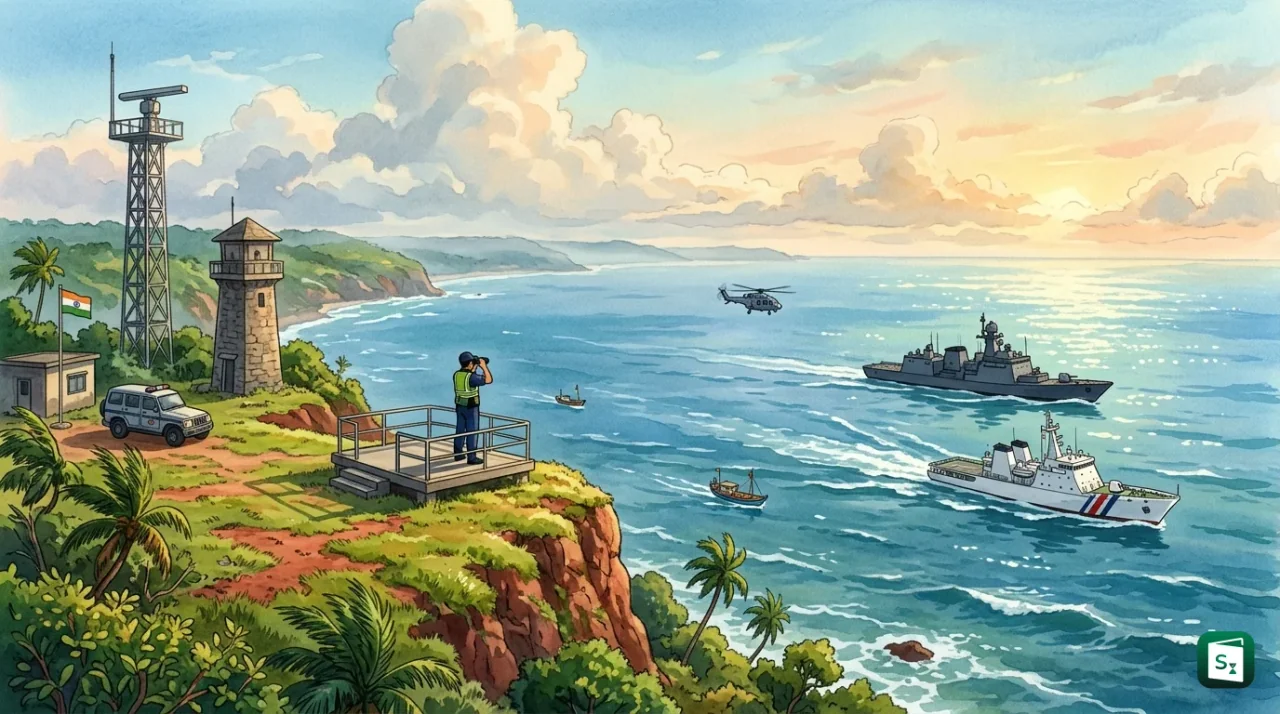
The Indian Navy’s Naval Officers-in-Charge in each coastal state lead the CDSRE. Joint audit teams include personnel from the Navy, Indian Coast Guard, Customs, Fisheries departments and State marine police. The teams visit fish landing centres, lighthouses, major and non major ports, coastal police stations and offshore assets.
The audit checks manpower, boats, communication links and standard operating procedures. In Sea Vigil 24, teams audited more than 950 critical locations including oil rigs, Single Point Moorings (SPMs) and cable landing points. An SPM is an offshore buoy system used to load and unload crude oil from tankers. Findings from the audit feed directly into the Sea Phase.
What happens in the Sea Phase
The Sea Phase is the tactical drill at sea. Security agencies deploy ships, aircraft and interceptor craft for joint patrolling and surveillance along the coast and in the EEZ. Past editions simulated infiltration by hostile boats, commandeering of merchant ships, attacks on ports and offshore installations, and hostage rescue by MARCOS commandos and the National Security Guard (NSG). MARCOS is the marine commando force of the Indian Navy.
The 2026 Sea Phase uses a red force versus blue force design. The red force acts as the attacker trying to breach the coast. The blue force includes all maritime stakeholders defending the coast. The aim is to detect, intercept and arrest intruders before they reach shore.
Who Participates in the Pan India Coastal Defence Exercise?
Sea Vigil 26 spans India’s revised coastline of 11,098.81 km and an EEZ of about 2.4 million sq km. The coastline figure was updated from the old 7,516.6 km estimate after fresh measurement by the National Hydrographic Office and the Survey of India using high resolution charts and GIS software. The longer length reflects better mapping of creeks, bays and islands, not new territory.
| Area Covered | Detail |
|---|---|
| Coastline | 11,098.81 km, including island territories |
| Maritime zone | EEZ up to 200 nautical miles or 370 km from shore |
| States and Union Territories | All nine coastal states and four coastal Union Territories |
| Community layer | Fishing and coastal communities as eyes and ears |
The Indian Coast Guard, established in 1978 and headquartered in New Delhi, plays a central role alongside the Navy. The Coast Guard is responsible for coastal security in territorial waters, which extend up to 12 nautical miles from shore. Assets of the Navy, Coast Guard, Coastal Security Police, Customs and port authorities take part.
Five Union ministries facilitate the drill. They are Defence, Home Affairs, Ports, Shipping and Waterways, Petroleum and Natural Gas, and Fisheries, Animal Husbandry and Dairying. Central agencies, state governments, the fishing community, NCC cadets and Bharat Scouts and Guides also join. NCC stands for National Cadet Corps, the youth training organisation. This wide net matters because a hostile boat can hide among thousands of daily fishing movements.
Why Sea Vigil Was Created After the 26/11 Mumbai Attacks
Exercise Sea Vigil was conceptualised in 2018 to validate the coastal security reforms made after the 26/11 Mumbai terror attacks of 2008. On 26 November 2008, ten attackers crossed the Arabian Sea from Karachi, hijacked the Indian fishing vessel Kuber, and came ashore in Mumbai using inflatable boats. The four day attack killed 166 people and exposed gaps in sea surveillance.
The Cabinet Committee on Security reviewed coastal security in February 2009. The Indian Navy was designated as the authority for overall maritime security, covering both coastal and offshore areas. The Indian Coast Guard was given added responsibility for coastal security in territorial waters.
Several new layers were built after 2009:
- Joint Operations Centres (JOCs) were set up at Mumbai, Visakhapatnam, Kochi and Port Blair. These centres are jointly manned by the Navy and Coast Guard and collect inputs from many agencies.
- The Sagar Prahari Bal was raised as a Navy patrol force with fast interceptor craft and over 1,000 personnel to guard harbours and vital assets.
- A coastal radar chain and Automatic Identification System (AIS) network was built to track vessels. AIS is an automatic radio signal that shares a ship’s identity and position.
- The Information Management and Analysis Centre (IMAC) was set up at Gurugram in 2014 as the nodal hub for fusing maritime data. IMAC anchors the National Command Control Communication and Intelligence (NC3I) network, which links Navy and Coast Guard stations into a common operational picture.
- The Coastal Security Scheme funded marine police stations, check posts, boats and training. More than 200 coastal police stations were operationalised in two phases.
Together these steps created a three tier guard. State marine police watch shallow waters near shore, the Coast Guard patrols from 12 nautical miles to 200 nautical miles, and the Navy watches beyond the EEZ. Sea Vigil tests whether this chain works as one system.
How Sea Vigil Links to TROPEX and Coastal Security of India
Sea Vigil is the build up to TROPEX, the Navy’s capstone war game. TROPEX stands for Theatre Level Operational Readiness Exercise. It is a biennial inter service exercise with the Indian Army, Indian Air Force, Indian Navy and Indian Coast Guard. While Sea Vigil focuses on the coast and EEZ, TROPEX tests combat readiness on the high seas.
TROPEX 2025 was held from January to March 2025 across the Indian Ocean, from the Strait of Hormuz in the west to the Sunda and Lombok Straits in the east. It deployed about 65 to 70 naval ships, 9 to 10 submarines and over 80 aircraft. Together, Sea Vigil and TROPEX cover the full range of maritime challenges, from infiltration near shore to fleet operations far at sea.
The stakes are high. About 90 percent of India’s trade by volume moves by sea. Ports, oil rigs, Single Point Moorings, cable landing stations and nuclear facilities at places like Kalpakkam sit close to the water. A single breach can hit energy supply, trade and public safety.
Sea Vigil also builds coastal awareness. Fishing communities report unknown boats and suspicious movement. Students, NCC cadets and Bharat Scouts and Guides take part in outreach. This people layer adds daily vigilance between major exercises.
Key Takeaways
- The Sea Vigil 26 exercise is being held from 11 to 19 November 2026 under the coordination of the Indian Navy.
- The drill covers India’s 11,098.81 km coastline and 2.4 million sq km Exclusive Economic Zone.
- The CDSRE phase runs from 11 to 17 November 2026 and the Sea Phase runs on 18 and 19 November 2026.
- Exercise Sea Vigil was conceptualised in 2018 after the 26/11 Mumbai attacks that killed 166 people.
- Sea Vigil serves as a build up to the biennial TROPEX war game with the Army, Air Force, Navy and Coast Guard.