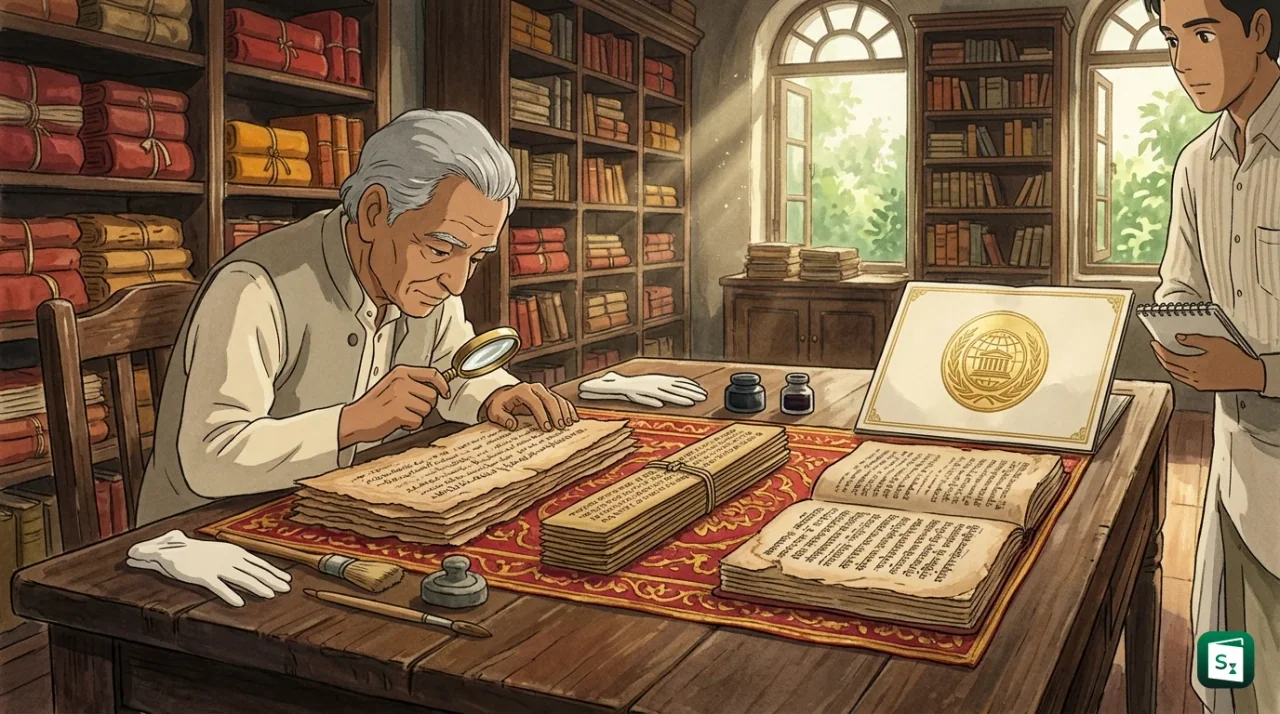
Three manuscripts from India have entered UNESCO’s Memory of the World Asia Pacific Regional Register. The manuscripts are Kalhana’s Rajatarangini, the Mahabharata and Kautilya’s Arthashastra, preserved in Srinagar, Pune and Mysuru. The Memory of the World Committee for Asia and the Pacific, known as MOWCAP, approved the inclusions at its 11th session in Jakarta on 5 November 2026.
What Is the Memory of the World Asia Pacific Register?
The Memory of the World Programme is a UNESCO initiative launched in 1992 to protect documentary heritage and make it accessible to all. Documentary heritage means written, printed or recorded material such as manuscripts, archives, inscriptions and audio visual records that carry the shared memory of humanity. The programme maintains lists, called registers, at international, regional and national levels.
MOWCAP is the regional committee for Asia and the Pacific. UNESCO set up MOWCAP in 1998 at its first general meeting in Beijing, China. It covers 43 countries of the Asia Pacific region. MOWCAP maintains the Asia Pacific Regional Register for documentary heritage of regional influence. Nominations are normally invited every two years, in alternate years to the International Register.
With the 2025 to 2026 cycle, the Regional Register now holds 106 items from 29 countries. In this cycle alone, MOWCAP added 21 new inscriptions, including first time entries from Kazakhstan and Turkmenistan. In India, the Indira Gandhi National Centre for the Arts (IGNCA) acts as the nodal centre for the programme since 2014. IGNCA prepares nomination dossiers, spreads awareness and supports conservation of rare manuscripts.
What Happened at the 11th MOWCAP Session in Jakarta?
The 11th general meeting of MOWCAP took place in Jakarta, Indonesia, from 2 to 5 November 2026. The National Archives of Indonesia (ANRI) hosted the meeting. Member states reviewed nominations for the 2025 to 2026 cycle and approved 21 items for the Regional Register. The Ministry of Culture announced India’s three inscriptions on 5 November 2026.
The IGNCA prepared the nomination dossiers for all three Indian manuscripts. Sachchidanand Joshi, Member Secretary of IGNCA, announced the outcome. The Ministry of External Affairs described the recognition as global honour for India’s timeless wisdom. The inclusions received wide public attention after the Culture Ministry shared images of the UNESCO certificates.
The three entries were recorded under their official titles with their custodians:
| Official Title in Register | Work | Preserved At |
|---|---|---|
| The Manuscript of Rajatarangini by Kalhana: A Twelfth Century Chronicle of Kashmir | Rajatarangini | Oriental Research Library, Sri Pratap Singh Library Complex, Srinagar |
| The Birch-bark Manuscript of Mahabharata: A Perennial Epic of South Asia | Mahabharata | Bhandarkar Oriental Research Institute, Pune |
| Kautilya’s Arthashastra, Ancient Palm-leaf Manuscript on Governance and Statecraft | Arthashastra | Oriental Research Institute, Mysuru |
What Is Rajatarangini by Kalhana?
The Rajatarangini is a Sanskrit verse chronicle of Kashmir written by Kalhana in 1148 to 1149 CE. The title means river of kings. Kalhana wrote it during the reign of King Jayasimha, who ruled Kashmir from 1128 to 1149. It is regarded as one of the earliest systematic historical works from ancient India.
Kalhana was a Kashmiri scholar and son of Kanpaka, a minister at the Kashmir court. This access gave him close knowledge of court politics. For earlier periods, he studied 11 earlier chronicles, the Nilamata Purana, temple inscriptions, land grants, coins and royal records. He also recorded oral traditions. His method of comparing sources and noting doubts gives the work a distinct place in Indian historiography.
The nominated manuscript is written in the Sharada script and is preserved at the Oriental Research Library in Srinagar. It is a direct copy of a lost archetype and formed the basis for the critical edition by scholar Marc Aurel Stein. The text has 7,826 verses in eight books, called tarangas, and blends poetry, known as kavya, with history.
The early books mix legend with history. Book I traces Kashmir’s kings to epic lore and names Gonanda as the first king. It also mentions Ashoka, Jalauka, the Kushan rulers Hushka, Jushka and Kanishka, and the Huna king Mihirakula. From Book IV, with the rise of the Karkota dynasty, the account becomes a dependable political narrative. The work then covers the Utpala dynasty founded by Avantivarman in 855, the passing of power to the Lohara line in 1003, the death of King Harsha in 1101 and the events leading to Jayasimha’s rule. Later writers such as Jonaraja, Srivara, Prajyabhatta and Suka continued the chronicle tradition after Kalhana.
What Is the Mahabharata Birch Bark Manuscript?
The Mahabharata is one of the two great Sanskrit epics of India, the other being the Ramayana. Tradition attributes it to the sage Vyasa. In its present form it took shape around 400 CE. With nearly 100,000 couplets in 18 sections, called parvans, plus the supplement Harivamsha, it is the longest epic in world literature. It tells the story of the struggle for power between the Kauravas and Pandavas, which ends in the battle at Kurukshetra, and explores dharma, duty, justice, power and human relationships.
The manuscript honoured by MOWCAP is a rare 400 year old birch bark, or burjapatra, copy written in the Sharada script. The Bhandarkar Oriental Research Institute (BORI) in Pune, Maharashtra, preserves it. Indologist Georg Buhler acquired it in Kashmir in 1875. MOWCAP describes it as the most authentic surviving witness of the old Kashmiri version and as a codex archetype, which means a base copy from which the study of other copies can proceed.
The epic’s influence spread far beyond India. Its scenes appear in the stone reliefs of Angkor Wat in Cambodia. It shaped the Indonesian Bharatayuddha and the shadow puppet theatre Wayang, the Thai tale of Krishna, narrative traditions in Mongolia and even the Japanese Kabuki play Naru-kami. For this reason, MOWCAP calls it a shared cultural memory of Asia.
What Is Arthashastra by Kautilya?
The Arthashastra is an ancient Sanskrit treatise on statecraft, economics, law, diplomacy and military strategy. Tradition attributes it to Kautilya, also known as Chanakya or Vishnugupta, the adviser who helped Chandragupta Maurya found the Maurya Empire in the late fourth century BCE. The word artha means material gain or purpose, and shastra means treatise.
The work is organised into 15 books, called adhikaranas, 150 chapters and 180 sections. Book I trains the king and tests ministers. Book II, the longest, lists state departments for treasury, mines, trade, tolls, weaving, agriculture and ships. Later books cover civil law, crime, secret conduct, foreign policy, war, fortresses and the organisation of knowledge. Its core ideas include the saptanga theory of seven parts of the state, the mandala circle of neighbouring states, the shadgunya six measures of foreign policy and the four upayas of sama, dana, bheda and danda.
The MOWCAP inscription concerns a complete 16th century palm leaf copy in Grantha script at the Oriental Research Institute in Mysuru, Karnataka. Grantha is a script once used in the south to write Sanskrit sounds. Librarian R. Shamasastry found and identified the text in 1905 among manuscripts handed over by a scholar from the Tanjore district. He published the Sanskrit edition in 1909 and the English translation in 1915. Before this find, the work was known only through references in the writings of Dandin, Bana and Vishnusarma. Scholars still debate its date, placing the surviving form between the third century BCE and the third century CE.
How India’s Total Inscriptions in the Register Rose to Six
India entered the MOWCAP Regional Register for the first time in the 2024 cycle. At the 10th MOWCAP meeting in Ulaanbaatar, Mongolia, in May 2024, three Indian works were inscribed. The new 2026 entries take the total to six. The full set is shown below.
| Year of Inscription | Work | Broad Theme |
|---|---|---|
| 2024 | Illustrated Manuscripts of Ramcharitmanas of Tulsidas | Devotion and retelling of the Ramayana in Awadhi |
| 2024 | 15th Century Manuscript of the Panchatantra Fables | Animal fables on conduct and wisdom |
| 2024 | Manuscript of Sahridayaloka Locana | Sanskrit poetics and the theory of dhvani, or suggested meaning |
| 2026 | Rajatarangini of Kalhana | History of Kashmir |
| 2026 | Mahabharata birch bark manuscript | Epic, ethics and dharma |
| 2026 | Arthashastra of Kautilya | Governance and statecraft |
The Regional Register is separate from UNESCO’s International Memory of the World Register. The International Register lists documentary heritage of world significance and holds more than 570 entries. India’s entries there include the IAS Tamil Medical Manuscript Collection inscribed in 1997, the Saiva Manuscripts of Pondicherry in 2005, the Rigveda in 2007, the Tarikh e Khandan e Timuriyah in 2011, the Abhinavagupta manuscripts in 2023 and the Bhagavad Gita and Natyashastra manuscripts in 2025.
Key Takeaways
- MOWCAP inscribed the Rajatarangini, Mahabharata and Arthashastra manuscripts in the Asia Pacific Regional Register on 5 November 2026 in Jakarta.
- Kalhana wrote the Rajatarangini in Sanskrit in 1148 to 1149 CE with 7,826 verses in eight tarangas, and its manuscript is kept in Srinagar.
- The honoured Mahabharata copy is a 400 year old birch bark manuscript in Sharada script kept at BORI in Pune.
- The honoured Arthashastra copy is a 16th century palm leaf manuscript in Grantha script kept at the Oriental Research Institute in Mysuru.
- With the three new entries, India’s total inscriptions in the MOWCAP Regional Register rose to six, after the Ramcharitmanas, Panchatantra and Sahridayaloka Locana entries in 2024.