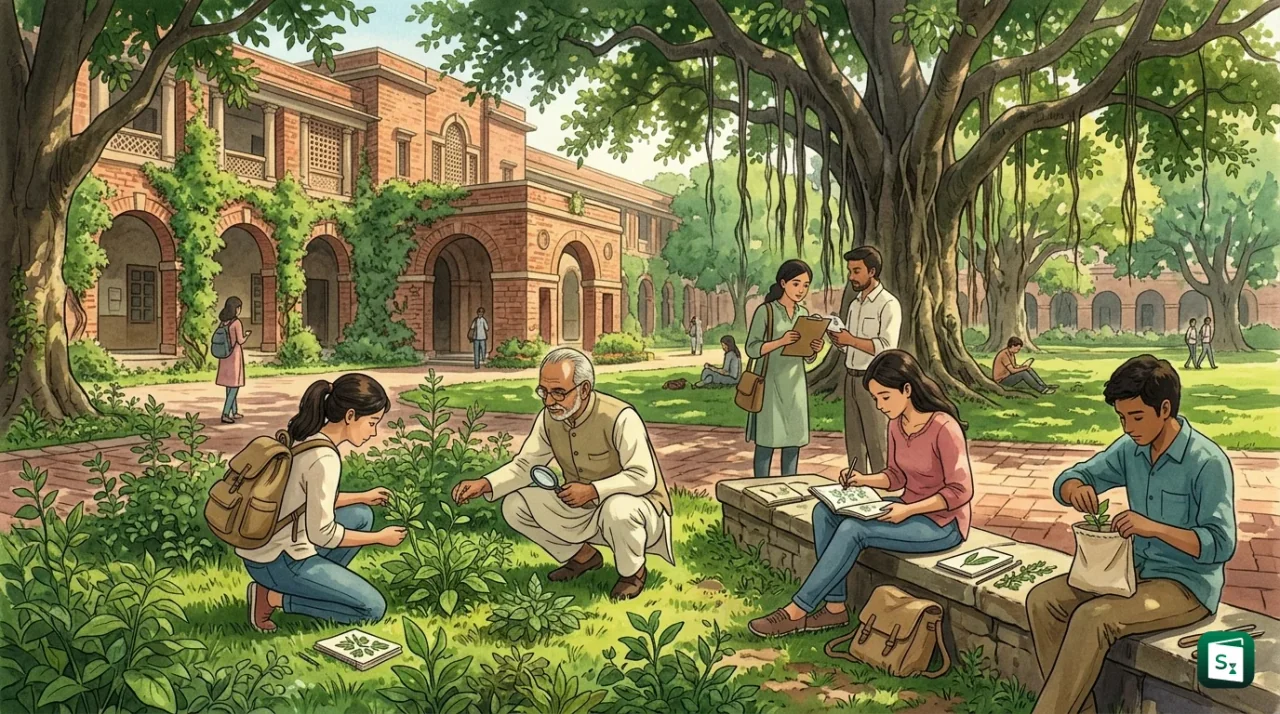
The Central Council for Research in Ayurvedic Sciences through its Central Ayurveda Research Institute in New Delhi signed an agreement with the University of Delhi on 10 November 2026. The project will prepare an inventory of phyto-diversity of medicinal importance used in Ayurveda across the 250 to 300 acres of the Delhi University North Campus. It will combine field surveys, herbarium records, QR code boards and a pictorial book to support conservation and research.
What Is CCRAS and How Does Ayurveda Work?
The Central Council for Research in Ayurvedic Sciences (CCRAS) is the apex research body in India for Ayurveda. It is an autonomous body under the Ministry of Ayush. It plans, funds and coordinates scientific research in Ayurveda and the Sowa Rigpa system of medicine.
CCRAS was created in March 1978 after the bifurcation of the Central Council for Research in Indian Medicine and Homoeopathy, which had been set up in 1969. The Ministry of Ayush, its parent ministry, was formed on 9 November 2014. The Ministry grew out of the Department of Indian System of Medicine and Homoeopathy created in March 1995, which was renamed as the Department of AYUSH in November 2003. AYUSH stands for Ayurveda, Yoga and Naturopathy, Unani, Siddha and Homoeopathy.
CCRAS works through a network of 30 institutes, centres and units across India. Its work covers medicinal plant surveys, drug standardisation, pharmacology, clinical research, literary research and tribal health care. It also runs outpatient and inpatient services through many of its institutes. It collaborates with universities, hospitals and research institutes for joint studies.
Ayurveda means the science of life. It is a traditional Indian system of medicine with a history of more than 3,000 years. Its main texts include the Charaka Samhita and the Sushruta Samhita. Ayurveda diagnoses imbalance in the body and then uses plant based formulations, diet and daily routine to correct it.
Plants form the base of this system. About 90 percent of Ayurveda formulations are plant based. India has about 17,000 to 18,000 flowering plant species, and more than 7,000 of them are recorded as medicinal plants. The Ayurvedic Pharmacopoeia of India lists 621 single botanical drugs sourced from 393 plant species. This is why correct identification, quality testing and conservation of medicinal plants are central to Ayurveda research.
What Does the New MoU with Delhi University Cover?
The Central Ayurveda Research Institute (CARI), New Delhi and the University of Delhi signed the Memorandum of Understanding on 10 November 2026. The Ministry of Ayush announced the agreement on 12 November 2026. The signing took place at the Vice Chancellor Office in the North Campus in New Delhi.
The agreement is for a collaborative project titled Inventory of Phyto-diversity of Medicinal Importance Used in Ayurveda of North Campus of Delhi University. Phyto-diversity means the variety of plant species growing in a given area. In this project, the focus is only on plants that have medicinal use described in Ayurveda texts.
| Project Detail | Fact |
|---|---|
| Implementing CCRAS institute | CARI, New Delhi |
| Academic partner | University of Delhi |
| Date of signing | 10 November 2026 |
| Place of signing | Vice Chancellor Office, North Campus, New Delhi |
| Signed by | Prof. (Vd.) Rabinarayan Acharya, Director General of CCRAS, and Dr. Vikas Gupta, Registrar of Delhi University |
| Study area | 250 to 300 acres of North Campus |
| Principal investigators | Dr. Sakshi Sharma of CARI and Prof. Suresh Kumar of Cluster Innovation Centre |
Senior officials attended the event. They included Prof. K. Ratnabali, Dean of Academic Affairs of Delhi University, Prof. Shobha Bagai, Director of the Cluster Innovation Centre, Dr. Hemanta Panigrahi, Director in charge of CARI New Delhi, and Prof. Vandana of the Department of Chemistry at Dyal Singh College.
Why Does Phyto-Diversity of Medicinal Importance Matter for Ayurveda?
India is one of the 17 mega diverse countries. It contributes about 7 percent of world biodiversity. Yet medicinal plant resources face pressure. More than 75 percent of herbal raw drugs are still collected from the wild. About 1,178 species are in active trade, and 242 species are traded in quantities above 100 metric tonnes per year. Destructive harvesting of roots, bark, fruits and whole plants damages regeneration.
Systematic documentation helps solve this problem. A verified list tells researchers which species grow where, in what number and in what condition. It supports both in situ conservation on the campus itself and ex situ steps like herbarium records and seed reference. It also helps industry and farmers plan cultivation instead of depending only on wild collection.
A university campus is a good site for such work. The North Campus spreads over a large green area in the heart of Delhi. It holds old avenue trees, gardens, lawns and undisturbed patches that shelter many species. Students walk past these plants every day without knowing their Ayurvedic value. A scientific inventory turns this everyday green cover into a documented learning resource. It raises awareness among students and teachers and promotes sustainable use of local plant wealth.
How Will the Survey, Herbarium and QR Code Boards Work?
The project will start with comprehensive field surveys across the North Campus. Teams from CARI New Delhi and Delhi University will visit different blocks, gardens and roadside patches in different seasons. Seasonal visits matter because many plants flower or fruit only for short periods. Each plant will be photographed, geo tagged and identified using Ayurvedic texts and botanical keys.
The teams will then prepare herbarium specimens. A herbarium is a collection of dried and pressed plant samples mounted on sheets with scientific labels. Each sheet records the botanical name, family, local name, place of collection, date and medicinal part used. These sheets act as permanent proof of identity. They allow future researchers to verify the species without depending only on photos.
The third step is public display. The project will install QR code enabled name boards near the documented plants. A QR code is a square barcode that a mobile phone can scan to open a web page. Scanning the board will show the plant name, its Ayurvedic properties and its uses. This makes the campus itself a teaching garden.
The final outputs will be an illustrated pictorial book on the medicinal flora of the North Campus and joint research publications. The book will carry photos, botanical descriptions and Ayurvedic references for each species. The research papers will share the methods and findings with the wider scientific community. The AYUSH Research Portal of the Ministry of Ayush provides online access to such Ayurveda research papers, articles and project data.
Who Will Implement the Project at CARI New Delhi and North Campus?
CARI New Delhi was established in 1979. Its main mandate is clinical research in Ayurveda. It also provides health care through outpatient services to the public. The institute is located at Road No. 66 in Punjabi Bagh in New Delhi on a rented premises of about 2 acres.
The institute is now building a new campus at FC-5, Block A, Sector 28 in Rohini. The foundation stone for the new building was laid on 5 January 2025. The new campus spreads over 2.92 acres with an investment of ₹187.15 crore. It will house administrative, outpatient, inpatient and treatment blocks with special clinics for geriatrics, paediatrics, ENT, arthritis, preventive cardiology and eye care, along with Panchakarma and Kshara Sutra facilities. Outpatient services at the Rohini campus started on 11 August 2026. CARI also runs satellite Ayurveda units at Safdarjung Hospital, Lady Hardinge Medical College, Ram Manohar Lohia Hospital, the President Estate and the Supreme Court.
The University of Delhi was established in 1922. It is one of the largest central universities in India with 16 faculties and 86 departments. Its North Campus houses the Vice Chancellor Office, science faculties and historic colleges.
The university side of the project will be anchored by the Cluster Innovation Centre. The Centre was set up in 2011 to connect classroom learning with real world problem solving. It is located in the University Stadium complex in North Campus and is headed by Director Shobha Bagai. The Centre already works on interdisciplinary projects with industry and civic bodies. This background makes it a natural partner for a field based biodiversity inventory.
This is not the first Ayush and Delhi University partnership in 2026. In July 2026, the National Medicinal Plants Board, an autonomous body under the Ministry of Ayush, signed a separate agreement with the university through Bhaskaracharya College of Applied Sciences to promote research, product development and sustainable use of medicinal plants.
Key Takeaways
- CARI New Delhi and the University of Delhi signed an MoU on 10 November 2026 for an inventory of phyto-diversity of medicinal importance used in Ayurveda.
- The study will cover 250 to 300 acres of the Delhi University North Campus through field surveys and documentation.
- The project will create herbarium specimens, QR code enabled name boards, an illustrated pictorial book and joint research papers.
- The Central Council for Research in Ayurvedic Sciences, set up in March 1978, is the apex Ayurveda research body under the Ministry of Ayush.
- CARI New Delhi, established in 1979, is building a new 2.92 acre campus in Rohini with an investment of ₹187.15 crore.