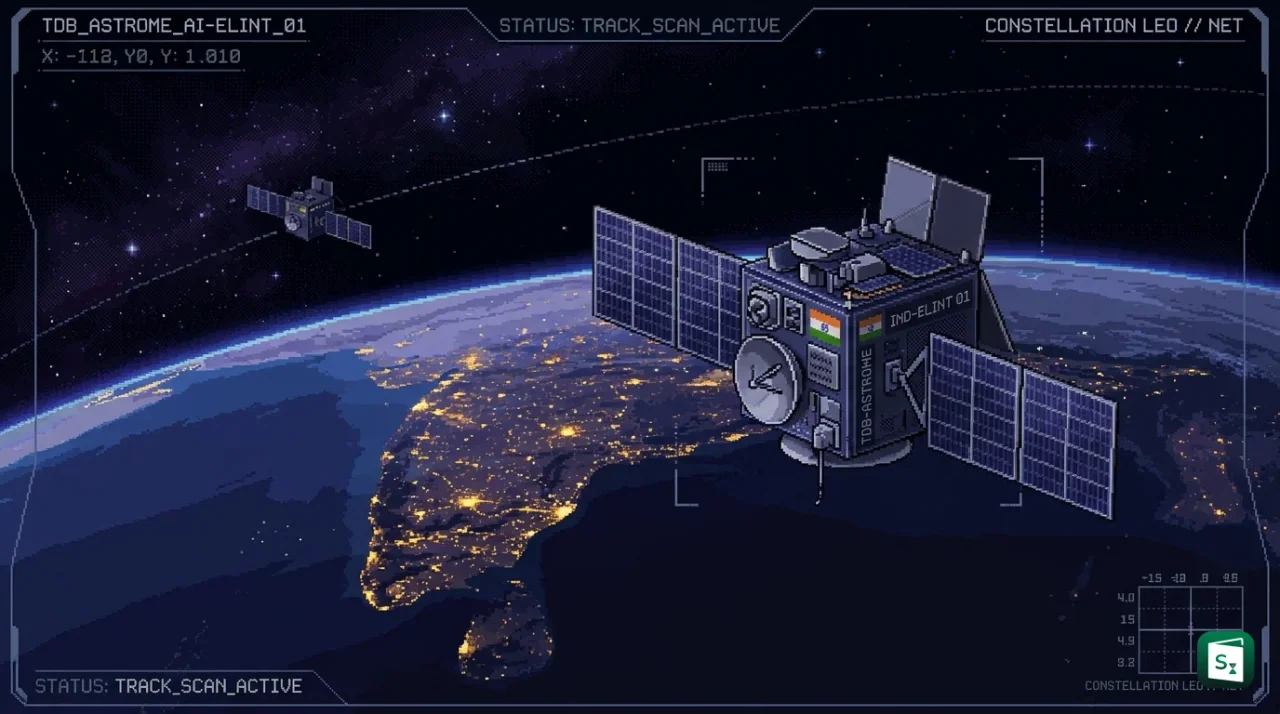
The Technology Development Board (TDB) signed an agreement on 12 November 2026 with Bengaluru based Astrome Technologies Pvt Ltd to build a sovereign space based AI enabled intelligence system. TDB will provide ₹64.05 crore under the Research, Development and Innovation (RDI) Fund for the ₹128.11 crore project. The project will develop an Artificial Intelligence enabled Electronic Intelligence (AI-ELINT) satellite constellation for national security uses.
What Did TDB Agree to Fund Under the RDI Fund?
The agreement was signed on 12 November 2026 between TDB, which works under the Department of Science and Technology (DST), and Astrome Technologies. TDB will meet nearly half the total project cost. The remaining amount will be arranged by the company through its own resources.
The support will be given as Optionally Convertible Debt (OCD). OCD is a loan that starts as debt and can later be converted into company shares if decided under the agreed terms. This structure gives public funds a safety option while supporting a high risk deep tech project.
The project falls under the Deep Technology sector, with space technology as the sub sector. It aims to move three core systems from Technology Readiness Level 4 to Technology Readiness Level 9. Level 4 means the technology has been tested in a laboratory. Level 9 means the complete system has been proved in actual operational conditions.
| Project Fact | Detail |
|---|---|
| Total project cost | ₹128.11 crore |
| TDB support under RDI Fund | ₹64.05 crore |
| Funding instrument | Optionally Convertible Debt (OCD) |
| Technology jump targeted | TRL-4 to TRL-9 |
| Satellite type | Microsatellites of about 50 kg each |
| Orbit | Low Earth Orbit (LEO) |
| Work involved | Technology development, engineering, integration, testing and validation |
What Is ELINT and How Will the AI Enabled Constellation Work?
Electronic Intelligence (ELINT) is intelligence gathered from electronic signals that do not carry speech or text. These include signals from radars, missiles, aircraft, air defence systems and other electronic equipment. The purpose is to find the location, capability and operating pattern of such equipment.
The Astrome project brings together three linked technologies. First, an indigenous ELINT payload on the satellite will detect and analyse signals across a broad frequency range. Second, AI based ground processing software will process the large volume of data sent by the satellites quickly and accurately. Third, inter satellite communication links will allow satellites to exchange information with each other and work as one integrated network.
The system will use microsatellites weighing about 50 kg each. A satellite constellation is a group of satellites that work together in a coordinated path to cover a large area. These satellites will operate in Low Earth Orbit (LEO), which is the region of space up to about 2,000 km above Earth. LEO satellites move fast and return over the same area frequently, so more satellites mean wider coverage and more frequent observation.
As more satellites are added, the network will improve its revisit rate and support persistent watch over selected areas. Persistent watch means repeated and regular observation of the same location to track changes over time.
ELINT vs COMINT vs SIGINT
Signals Intelligence (SIGINT) is the larger group that includes both ELINT and Communications Intelligence (COMINT). COMINT comes from messages between people, such as voice calls, radio conversations and text data. ELINT comes only from non communication electronic emissions, such as radar pulses.
| Type | Full Form | What It Collects | Example Source |
|---|---|---|---|
| SIGINT | Signals Intelligence | All intercepted electronic signals | Radars plus phone and radio messages |
| ELINT | Electronic Intelligence | Non communication electronic signals | Enemy radar, missile guidance signal, aircraft emitter |
| COMINT | Communications Intelligence | Speech and text communications | Voice call, radio message, data message |
What Is the RDI Fund of India?
The Research, Development and Innovation (RDI) Fund is a ₹1 lakh crore national fund to push private sector research in strategic and sunrise sectors. The Union Cabinet approved the RDI Scheme on 1 July 2025. The Prime Minister launched the fund at the Emerging Science and Technology Innovation Conclave (ESTIC 2025) on 3 November 2025. The Department of Science and Technology (DST) is the nodal department for the scheme.
The fund is set up as a Special Purpose Fund within the Anusandhan National Research Foundation (ANRF). ANRF was established under the ANRF Act, 2023, with provisions that came into force on 5 February 2024. The government provides the corpus to ANRF as a 50 year interest free loan. The scheme will operate over six years, with ₹20,000 crore earmarked in 2025-26.
The RDI Fund does not give money directly to companies in most cases. It uses a two level system. At the first level, ANRF holds the corpus through its fund manager unit. At the second level, Second Level Fund Managers select projects and pass funds to eligible Indian companies, including startups. TDB and the Biotechnology Industry Research Assistance Council (BIRAC) were designated as such fund managers in early 2026 and issued project calls in February 2026.
Support is given mainly as long term unsecured loans at low or nil interest, with long repayment periods suited to research. Equity support is possible, especially for startups. Contributions to a Deep Tech Fund of Funds are also allowed. The fund does not provide grants or short term loans. Normally, it finances up to 50 percent of the total assessed project cost, as seen in the Astrome case where ₹64.05 crore is about half of ₹128.11 crore. This limit can be relaxed in exceptional or strategic cases with higher approval.
Only projects at Technology Readiness Level 4 and above are eligible. The goal is to help laboratory validated ideas cross the risky middle stage and reach market ready products. The focus areas include energy security and transition, quantum technologies, robotics, space, artificial intelligence and its use in agriculture, health and education, biotechnology, biomanufacturing, pharma, medical devices and the digital economy. Technologies needed for self reliance and economic security are also covered.
| RDI Fund Feature | Detail |
|---|---|
| Corpus | ₹1 lakh crore over six years |
| Nodal department | DST |
| Custodian | Special Purpose Fund in ANRF |
| Second Level Fund Managers | TDB, BIRAC, plus fund managers selected through application |
| Eligible level | TRL-4 and above |
| Instruments | Long term low interest loans, equity for startups, Fund of Funds |
| Not allowed | Grants, short term loans |
| Normal funding cap | Up to 50 percent of project cost |
Who Are TDB and Astrome Technologies?
TDB stands for the Technology Development Board. It is a statutory body under DST, set up under the Technology Development Board Act, 1995. The Act received presidential assent on 16 December 1995, and TDB started functioning on 1 September 1996. Its mandate is to support Indian industry in developing and using indigenous technology for commercial purposes.
The Board is chaired by the Secretary of DST in an ex officio role. Its members include the Secretaries of expenditure, industrial policy, scientific and industrial research, defence research and development, and rural development, along with four nominated experts. TDB provides equity capital and loans to industrial units and financial help to research institutions working on commercial use of home grown technology. It was the first government body created mainly to take the results of Indian research to the market.
Astrome Technologies Pvt Ltd is a Bengaluru based deep tech company founded in 2015 and incubated at the Indian Institute of Science (IISc), Bengaluru. Its founders, Neha Satak and Prasad Bhat, are IISc alumni. The company works on millimetre wave wireless and satellite communication products.
Its best known product is GigaMesh, a multi beam E band radio that packs several point to point links in one compact unit with a phased array flat panel antenna and software defined modem. The product has been used for rural broadband backhaul and 5G support and has also served defence users, including the Indian Army and Navy. Astrome has built indigenous antenna design, beam steering software and satellite modems covering S band to V and W bands. The new AI ELINT project builds on this base in space to ground, ground to space and space to space links.
Why a Sovereign Space Based System Matters for National Security
Sovereign space capability means India can build, control and operate the system with its own technology. It reduces dependence on foreign satellites or ground stations for sensitive intelligence tasks. The project uses indigenous ELINT payloads, Indian AI software and Indian inter satellite links.
Space based ELINT adds what aircraft and ground stations cannot easily give. Satellites can cover large areas repeatedly without airspace limits. A constellation improves this further because several small satellites pass over areas of interest more often than one large satellite. For national security planning, frequent and reliable data on radar activity and electronic emissions helps track movements and prepare countermeasures.
The project also shows how the RDI Fund is meant to work. Deep tech space systems need years of design, testing and validation before launch. Private firms often struggle to get long term low cost money for this stage. Patient capital through OCD helps them survive this long period and reach operational readiness. TDB has stated that the project reflects the ability of Indian deep tech firms to combine engineering, artificial intelligence and next generation communications for strategic needs.
Key Takeaways
- TDB signed an agreement on 12 November 2026 to give ₹64.05 crore to Astrome Technologies for a ₹128.11 crore AI ELINT constellation project.
- The project will build 50 kg class microsatellites in Low Earth Orbit with an ELINT payload, AI ground software and inter satellite links.
- ELINT collects non communication electronic signals like radar emissions, while COMINT collects speech and text and both form part of SIGINT.
- The RDI Fund is a ₹1 lakh crore scheme approved on 1 July 2025, with DST as nodal department and ANRF as custodian through a Special Purpose Fund.
- TDB, set up on 1 September 1996 under the TDB Act, 1995, is acting as a Second Level Fund Manager along with BIRAC to fund TRL-4 and above projects.