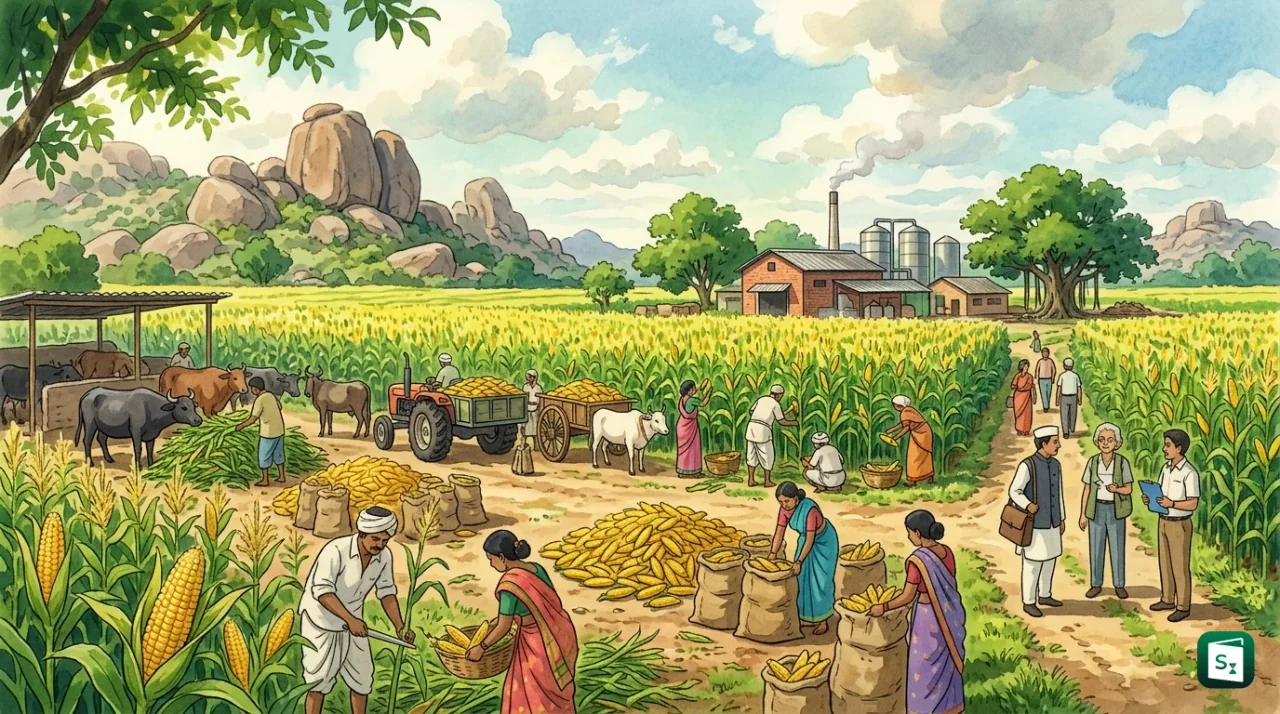
The 1st International Maize Conference 2026 was held at the JD Convention Centre in Hyderabad from 2 to 4 November 2026 on the theme Maize Revolution for Food, Feed, Fodder, Fuel and Sustainability in the Changing World (M4FS). The Indian Council of Agricultural Research (ICAR) announced that India’s maize production has reached about 55.09 million tonnes and set a target of 75 million tonnes over the next decade with higher productivity. The conference expanded the traditional 4F framework of Food, Feed, Fodder and Fuel into 5F by placing Farmers at the centre.
What Is Maize and Why Is It Called the Queen of Cereals?
Maize is a cereal grain with the scientific name Zea mays. It belongs to the grass family Poaceae and was domesticated in Central America from a wild grass called teosinte. Maize and corn refer to the same crop, with corn being the common name used in the United States.
Maize is called the queen of cereals because it has the highest genetic yield potential among all cereals. It is a C4 plant, which means it converts sunlight into grain more efficiently in warm conditions. It is a monocot and a cross pollinated crop, so pollen from one plant fertilises another plant.
In India, maize is the third most important cereal after rice and wheat. It is mainly a kharif crop sown with the onset of the monsoon in June and July, though it is now also grown in rabi and spring seasons. About 78 percent of maize area in India is under kharif, while rabi maize gives higher yields because it grows under assured moisture.
| Basic Fact About Maize | Detail |
|---|---|
| Scientific name | Zea mays |
| Family | Poaceae |
| Chromosome number | 2n equal to 20 |
| Common types | Flint, dent, sweet corn, baby corn, popcorn, waxy corn, quality protein maize |
| Season in India | Mainly kharif, also rabi and spring |
| Origin | Central America, ancestor teosinte |
First International Maize Conference in Hyderabad: Dates, Theme and Organisers
The 1st International Maize Conference (IMC 2026) was held from 2 to 4 November 2026 at the JD Convention Centre in Hyderabad, Telangana. The conference theme was Maize Revolution for Food, Feed, Fodder, Fuel and Sustainability in the Changing World (M4FS). It brought together more than 500 delegates from over 40 countries, including scientists, policymakers, industry leaders, farmer producer organisations, startups and students.
The conference was jointly organised by six partners. The Maize Technologists Association of India (MTAI) took the lead with the Professor Jayashankar Telangana Agricultural University (PJTAU) in Hyderabad. The other partners were the Indian Council of Agricultural Research (ICAR) in New Delhi, the Trust for Advancement of Agricultural Sciences (TAAS), the International Maize and Wheat Improvement Center (CIMMYT) and the ICAR Indian Institute of Maize Research (IIMR) at Ludhiana.
CIMMYT is a non profit international research centre headquartered at El Batan near Texcoco in Mexico. It is part of the CGIAR network and holds the world largest maize and wheat germplasm bank. ICAR-IIMR is the nodal maize research institute of India.
The Hyderabad meeting set five clear aims. These were faster breeding of climate resilient hybrids, better management of pests and water stress, use of precision farming and artificial intelligence, stronger maize based ethanol and starch value chains, and deeper partnership among Asian, African and Latin American research systems. The expected outcomes were a Hyderabad Declaration on sustainable maize bio economies, a strategic roadmap for climate smart maize and a compendium of scalable technologies. Scientific publications were released and awards were presented to senior maize researchers during the programme.
From 4F to 5F: How Farmers Were Placed at the Centre
The traditional 4F framework describes the four main uses of maize. Food covers direct human consumption such as flour, grits, popcorn and breakfast cereals. Feed covers poultry and animal feed, which is the largest use in India. Fodder covers green stover fed to cattle and dairy animals. Fuel covers ethanol for petrol blending and emerging uses such as biogas and sustainable aviation fuel.
At Hyderabad, M. L. Jat, Secretary of the Department of Agricultural Research and Education and Director General of ICAR, called for expanding this 4F vision to 5F by adding Farmers. The 5F framework means research must be judged by higher farm profit and better livelihoods, not by yield alone. It links laboratory work on seeds to affordable seed supply, mechanisation, drying and storage, and assured contracts with feed mills and distilleries.
Jat pressed for a systems science approach. Under this approach, maize expansion should fit specific seasons and agro ecological zones without cutting area under oilseeds and pulses. He also stressed affordable quality seed, with a stronger role for public sector hybrids and a robust seed system.
D. K. Yadav, Deputy Director General for Crop Science in ICAR, said 329 maize hybrids were developed in the last five years. He called for strengthening the All India Coordinated Research Project on Maize (AICRP on Maize) and for breeding for higher yield, better nutrition and tolerance to biotic and abiotic stresses. R. S. Paroda, former Director General of ICAR, stressed safe grain with control of aflatoxin, a toxin that affects food and feed quality. World Food Prize laureate S. K. Vasal advocated simple low cost breeding methods suited to farmer needs.
India Maize Production at 55 MT and the 75 MT Target for Next Decade
India produced a record 55.09 million tonnes of maize in 2025-26, as per the Third Advance Estimates released by the Ministry of Agriculture and Farmers Welfare. This was 11.68 million tonnes higher than the 43.41 million tonnes produced in 2024-25. Maize area stood at 14.40 million hectares with an average yield of 3.82 tonnes per hectare.
The rise marks a sharp climb from 1.73 million tonnes in 1950-51 and about 22.57 million tonnes in 2015-16. Production has grown at about 6 percent in recent years, supported by single cross hybrids and better crop management. ICAR has now set a target of 75 million tonnes over the next decade along with a 1.5 fold rise in productivity. Longer projections point to about 86 million tonnes by 2047, while total demand could reach 64 to 72 million tonnes by 2030.
Globally, maize covers about 210 million hectares with annual output above 1.2 billion tonnes and average productivity of about 5.8 tonnes per hectare across more than 160 countries. The United States is the largest producer, followed by China. India ranks fourth in area and sixth in production with about 4.1 percent of world output. India averages 3.82 tonnes per hectare against 10.9 tonnes in the United States, which shows the size of the yield gap that better seed and management can close.
Where Maize Is Grown in India: Top States, Seasons and Yield
Maize is grown across 27 states in all seasons, but kharif remains dominant. Kharif maize accounts for about 78 percent of area and is largely rainfed, so its yield swings with the monsoon. Rabi maize covers about 22 percent of area but gives much higher yields of above 5.7 tonnes per hectare because it grows under assured moisture and cooler grain filling conditions.
Madhya Pradesh is the largest producer by total output in 2025-26, while Karnataka has led in several earlier years. Andhra Pradesh records the highest yield among major states. The table below shows the leading states.
| State | Production in 2025-26 | Share of India | Yield |
|---|---|---|---|
| Madhya Pradesh | 10.04 MT | 18.24 percent | 3.47 tonnes per hectare |
| Karnataka | 6.55 MT | 11.89 percent | 3.35 tonnes per hectare |
| Maharashtra | 5.69 MT | 10.34 percent | 2.56 tonnes per hectare |
| Bihar | 5.57 MT | 10.12 percent | 6.20 tonnes per hectare |
| Andhra Pradesh | 5.48 MT | 9.96 percent | 7.44 tonnes per hectare |
| Telangana | 5.44 MT | 9.89 percent | 5.83 tonnes per hectare |
The price support for the crop is fixed through the Minimum Support Price (MSP). The Cabinet Committee on Economic Affairs approved an MSP of ₹2,410 per quintal for maize for Kharif Marketing Season 2026-27 on 13 May 2026. This was only ₹10 higher than the previous year. The Commission for Agricultural Costs and Prices had estimated production cost at about ₹1,544 per quintal.
Why Feed, Starch and Ethanol Demand Is Shaping Maize Policy
Maize use in India is led by industry rather than direct food use. About 54 percent goes to poultry and animal feed, about 25 percent to ethanol, about 14 percent to starch and only about 7 percent to food and food processing. Maize grain contains 68 to 72 percent starch, which makes it valuable for feed, starch, paper, textile and pharma products.
Ethanol blending has changed the market fast. Maize diverted for ethanol rose from 0.83 million tonnes in 2022-23 to 7.54 million tonnes in 2023-24 and 13.1 million tonnes in 2024-25. Ethanol now absorbs about one fourth of domestic maize use. Maize based ethanol accounted for 1,140.4 crore litres of bids for supply year 2026-27, the largest share among all feedstocks. The government supports this shift through assured prices for maize ethanol to oil marketing companies.
The Hyderabad discussion linked this demand to farm strategy. Higher ethanol and feed demand can raise farm incomes, but supply must keep pace without hurting food security. ICAR plans to lift kharif yields from about 2.9 to 4 tonnes per hectare and rabi yields to 6.5 tonnes, add 2 to 3 million hectares in rice fallows, expand single cross hybrids that already cover 55 to 60 percent of area, and promote water saving tools such as zero tillage, drip fertigation and legume intercropping.
Key Takeaways
- The 1st International Maize Conference 2026 was held from 2 to 4 November 2026 at the JD Convention Centre in Hyderabad on the theme M4FS.
- India’s maize output reached a record 55.09 million tonnes in 2025-26, with a national target of 75 million tonnes in the next decade.
- The conference expanded the 4F framework of Food, Feed, Fodder and Fuel into 5F by adding Farmers at the centre.
- CIMMYT, the International Maize and Wheat Improvement Center headquartered in Mexico, co organised the event with ICAR, MTAI, PJTAU, TAAS and ICAR-IIMR.
- The MSP for maize for 2026-27 is ₹2,410 per quintal, while Madhya Pradesh is the top producing state and Andhra Pradesh records the highest yield of 7.44 tonnes per hectare.