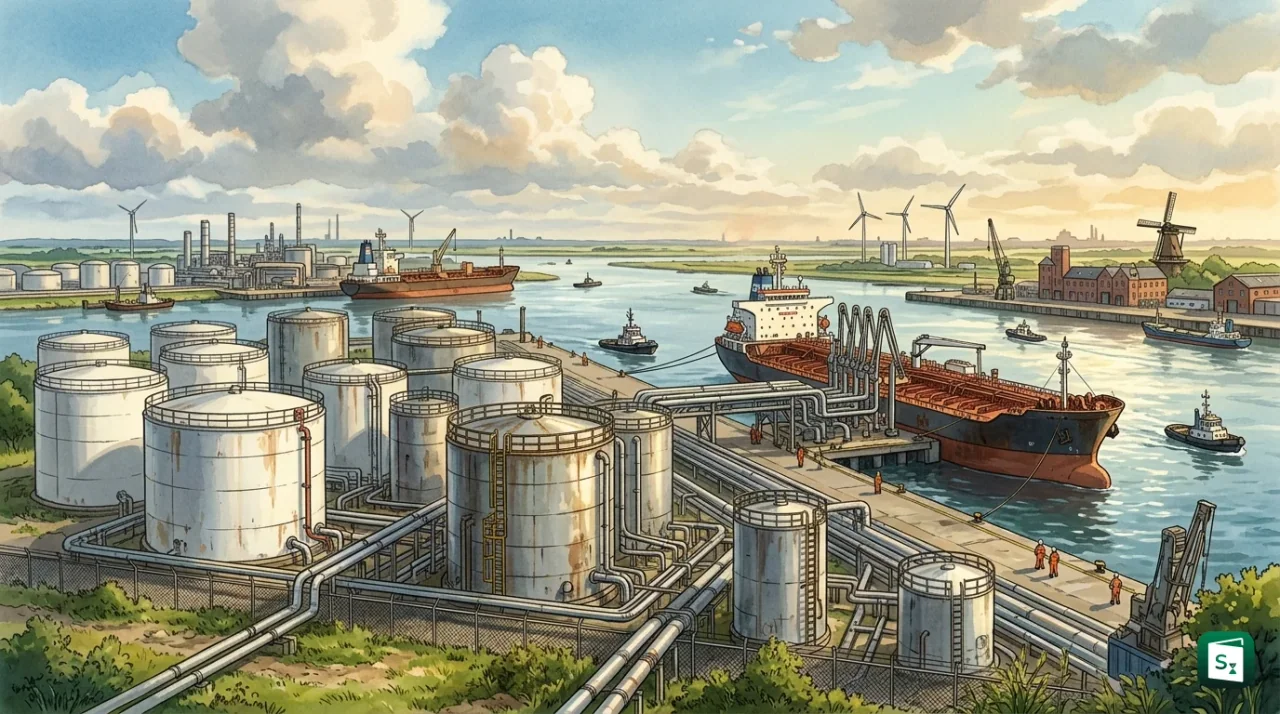
Adani Ports and Special Economic Zone (APSEZ) agreed on 5 November 2026 to acquire 100% of Netherlands based Evos BV from Igneo Infrastructure Partners for 2.56 billion euros (about $2.88 billion). Evos is Europe’s second largest independent liquid storage operator with eight port terminals in five countries. The all cash deal gives APSEZ its first large liquids platform in Europe and expands its global network to 28 ports and terminals across 10 countries.
What Is APSEZ and What Has It Agreed to Buy?
APSEZ stands for Adani Ports and Special Economic Zone Limited. It is India’s largest private port developer and operator and part of the Adani Group. The company started operations at Mundra Port in Gujarat in 1998 and now operates around 15 ports and terminals in India along with international assets in Israel, Tanzania, Sri Lanka and Australia.
APSEZ has agreed to buy the full 100% stake in Evos BV from Igneo Infrastructure Partners. Evos BV is a private company registered in the Netherlands. BV is short for Besloten Vennootschap, which is the Dutch term for a private limited company. Igneo Infrastructure Partners is an infrastructure investor team under First Sentier Group that has managed Evos since 2019.
Evos is an independent liquid bulk storage company. That means it does not own the oil or chemicals itself. It owns large tank farms at ports and charges customers for storing, blending and moving their liquids. Evos customers include global energy majors, chemical firms and commodity traders.
Inside the 2.56 Billion Euro Deal Structure
APSEZ announced the agreement on 5 November 2026 after a competitive bidding process. The enterprise value is 2.56 billion euros (about $2.88 billion). Enterprise value means the total value of the company including its debt and equity. The equity value is 1.18 billion euros. The gap of about 1.37 billion euros reflects net debt and similar items already on Evos books, including shareholder loans.
The valuation equals 11.7 times Evos earnings for calendar year 2025. In that year Evos reported revenue of 392 million euros and operating earnings before interest, tax, depreciation and amortisation (EBITDA) of 219 million euros. Its EBITDA margin was 56%, which points to a high margin and cash generating business.
APSEZ will pay in cash and fund the deal with debt. MUFG Bank is the sole underwriter and has committed financing of up to 2.8 billion euros. APSEZ said its combined net debt to EBITDA would rise to 2.76 times after the deal and fall back to around 2.5 times by financial year 2027. The deal still needs regulatory approvals and a works council consultation process in Europe, which has already started. Linklaters and Cyril Amarchand Mangaldas are acting as legal advisers.
Eight Terminals Across Five Countries
APSEZ will get eight port based tank terminals with total storage capacity of 6.3 million cubic metres. The network has 452 storage tanks and 63 vessel and barge berths. Evos handled 37 million metric tonnes (MMT) of throughput in calendar year 2025. Average commercial occupancy was 99%, with a large share of revenue under take or pay contracts and inflation linked pricing.
Take or pay means the customer pays for reserved capacity even if it stores less liquid. Inflation linked pricing means storage fees rise with the consumer price index. Both features give stable and predictable cash flow.
The terminals sit in key energy hubs, including the Amsterdam Rotterdam Antwerp (ARA) region, Hamburg and the Mediterranean:
| Terminal | Country and Port | Capacity (cubic metres) | Key Role |
|---|---|---|---|
| Amsterdam East | Netherlands, Amsterdam | 1,700,000 | Gasoline, gasoil, jet fuel and biofuels, pipeline linked |
| Amsterdam West | Netherlands, Amsterdam | 1,200,000 | Gasoline and diesel blending hub in the largest gasoline port in the world |
| Ghent | Belgium, Ghent | 988,000 | Gasoline, chemicals, biofuels and jet fuel with rail and pipeline links |
| Hamburg | Germany, Hamburg | 683,000 | Gasoil, marine fuels, chemicals and biofuels, rail and truck loading |
| Terneuzen | Netherlands, Terneuzen | 537,000 | Naptha, chemical feedstocks and speciality chemicals between Rotterdam and Antwerp |
| Algeciras | Spain, Algeciras | 403,000 | Marine fuels and bunkering hub at the Strait of Gibraltar |
| Malta | Malta, Malta | 568,000 | Gasoline, gasoil and marine fuels for Mediterranean flows |
| Rotterdam | Netherlands, Rotterdam | 257,000 | Ethanol, methanol and e-methanol hub with deep sea access |
Evos also has integrated pipeline connections to customers, Schiphol airport and the Central Europe Pipeline System. All Evos operations are classed as critical infrastructure for energy security in Europe.
What Evos Stores: Conventional Fuels and Transition Fuels
A liquid storage terminal stores liquid cargo in large tanks before it moves by ship, barge, pipeline, rail or truck. Evos handles two broad groups of liquids.
The first group is conventional fuels. These include gasoline, gasoil and diesel, marine fuels, jet fuel and chemical feedstocks such as naphtha. These fuels still form the core of European transport and industry demand.
The second group is transition fuels. These are lower carbon liquids that support the shift to cleaner energy. Evos stores sustainable aviation fuel (SAF), biodiesel such as hydrotreated vegetable oil, bioethanol, methanol, biomethanol and e-methanol. The Rotterdam terminal is the largest bioethanol storage provider in Europe and a dedicated biomethanol hub.
This mix matters for the future. APSEZ management has noted that Europe is currently around 80% conventional and 20% sustainable liquids, with a shift toward a 50-50 mix over the next 15 to 20 years. Sustainable fuels often earn higher storage fees. Evos was founded in 2019 and expanded in 2021 when it bought four terminals in Amsterdam East, Terneuzen, Ghent and Malta. It now employs about 700 people and holds an investment grade credit rating.
Why This Acquisition Matters for Adani Ports
The Evos purchase fits the international expansion plan of Adani Ports and SEZ. APSEZ already operates Haifa Port in Israel, Container Terminal 2 in Dar es Salaam in Tanzania, the Colombo West International Terminal in Sri Lanka and the North Queensland Export Terminal (NQXT) in Australia. NQXT, with 50 million tonnes per annum capacity, was fully acquired in December 2025. Evos is the next step, adding a European liquids platform in stable euro markets.
Scale is the first gain. APSEZ currently holds about 5.5 million cubic metres of liquid storage in India, mainly at Mundra Port and Hazira Port. Evos adds 6.3 million cubic metres. That more than doubles the liquid portfolio to about 11.8 million cubic metres and balances cargo between containers, dry bulk and liquids.
The second gain is earnings quality. Evos brings euro denominated revenue from long term customers with 99% occupancy. APSEZ expects the asset to add to revenue and profit from the start without lowering group margins. It also lifts hard currency income, which helps manage currency risk.
The third gain is technology and energy transition. Evos brings skills in handling methanol, SAF and biofuels, plus pipeline and blending systems. APSEZ plans to use this knowledge in India as demand for green fuels grows. Management targets a double digit return on capital employed from Evos by 2031, driven by better tank turnaround, operating efficiency and growth in high value green liquids.
For India Europe trade, APSEZ sees extra value if the proposed India Europe free trade agreement moves forward. APSEZ chief executive Ashwani Gupta said the deal also strengthens links along the East West trade corridor that connects India, the Middle East and Europe.
Key Takeaways
- APSEZ agreed on 5 November 2026 to acquire 100% of Evos BV from Igneo Infrastructure Partners for an enterprise value of 2.56 billion euros.
- Evos is Europe’s second largest independent liquid storage operator with 6.3 million cubic metres of capacity across eight terminals in five countries.
- Evos reported 392 million euros in revenue and 219 million euros in EBITDA in calendar year 2025 with a 56% margin.
- The all cash deal will be funded by debt, with MUFG committing up to 2.8 billion euros in financing.
- After the deal, APSEZ will operate 28 ports and terminals across 10 countries, more than doubling its liquid storage base.