The Central Government has declared Raniwas Mound at Kesariya in East Champaran, Bihar, a site of national importance. The Ministry of Culture issued final notification S.O. 6017(E) on 4 November 2026 under the AMASR Act, 1958. The 1.63 acre site lies next to the Kesariya Buddha Stupa.
What Is Raniwas Mound and Where Is Kesariya Located
Raniwas Mound is a low archaeological mound at Kesariya town in East Champaran district of Bihar. The mound is also written as Ranivas Mound or Ranivas Tila, since tila means mound. It lies about 110 kilometres from Patna and about 55 kilometres northwest of Vaishali.
The final notification describes the site in exact revenue terms. It covers Plot No. 2905 under Khata No. 19 in Kesariya village. The total protected area is 1.63 acres. Ownership remains with the Government of Bihar.
The notification also fixes the boundaries of the protected area. This clarity helps field staff identify the land and stop encroachment.
| Detail | Recorded Fact |
|---|---|
| State | Bihar |
| District | East Champaran |
| Locality | Kesariya |
| Site name | Raniwas Mound |
| Plot and khata number | Plot No. 2905, Khata No. 19 |
| Area | 1.63 acres |
| Ownership | Government of Bihar |
Why Is Kesariya Stupa Famous
The Kesariya Buddha Stupa is famous for two reasons. It marks a moving event in the last journey of the Buddha. It is also regarded as the tallest and largest Buddhist stupa in the world.
Tradition holds that the Buddha announced his approaching Mahaparinirvana at Vaishali. He then set out toward Kushinagar in present day Uttar Pradesh, where he attained Mahaparinirvana. A large group of Licchavis, the people of Vaishali, followed him and refused to turn back.
At Kesariya, then called Kessaputta, the Buddha persuaded them to return. To console them, he gave them his alms bowl as a memorial. The Licchavis later built a stupa at the spot to honour that gift. For this reason, scholars describe Kesariya as a paribhogik stupa, which means a memorial stupa, and not a saririka stupa, which means a stupa built over bodily relics.
Two Chinese travellers recorded the site. Faxian, who visited India in the 5th century CE, wrote about a stupa built over the alms bowl of the Buddha by the Licchavis of Vaishali. Xuan Zang, who visited in the 7th century CE, described a stupa about 200 li northwest of Vaishali. Historians link both accounts to Kesariya.
Size adds to its fame. The stupa stands about 104 feet (about 32 metres) high with a circumference of nearly 400 feet (about 120 metres). Its base diameter is about 123 metres. Recent excavations have found an additional lower terrace and a circular outer wall about 18 metres from the base. This suggests the original complex was even larger. Before the 1934 Bihar earthquake, its visible height was about 123 feet.
Who Built Kesariya Stupa and Who Found It
The Kesariya Stupa was not built in one period. It grew in layers over many centuries.
The earliest structure was probably a small mud stupa raised by the Licchavis of Vaishali soon after the Buddha. The first brick phase is dated to the time of Ashoka in the 3rd century BCE. Excavators found remains of the capital of an Ashokan pillar at the site. This supports a Mauryan link.
A second phase belongs to the Sunga and Satavahana period around the 1st and 2nd century CE. It used large bricks measuring about 36 x 21 x 6 centimetres. The present grand form belongs mainly to the Gupta period between 200 CE and 750 CE, with the fullest work dated to the 5th and 6th century CE. Gupta builders expanded the mound upward and outward, added moulded bricks, shrine cells and stucco images of the Buddha. Finds of gold coins linked to Kanishka, the Kushan ruler of the 1st to 2nd century CE, also point to long and continued activity at the site.
For many years local people did not see it as a stupa. They called the high mound Raja Ben ka Deora or Raja Ben ka Garh, meaning the temple or fort of a legendary king Bena.
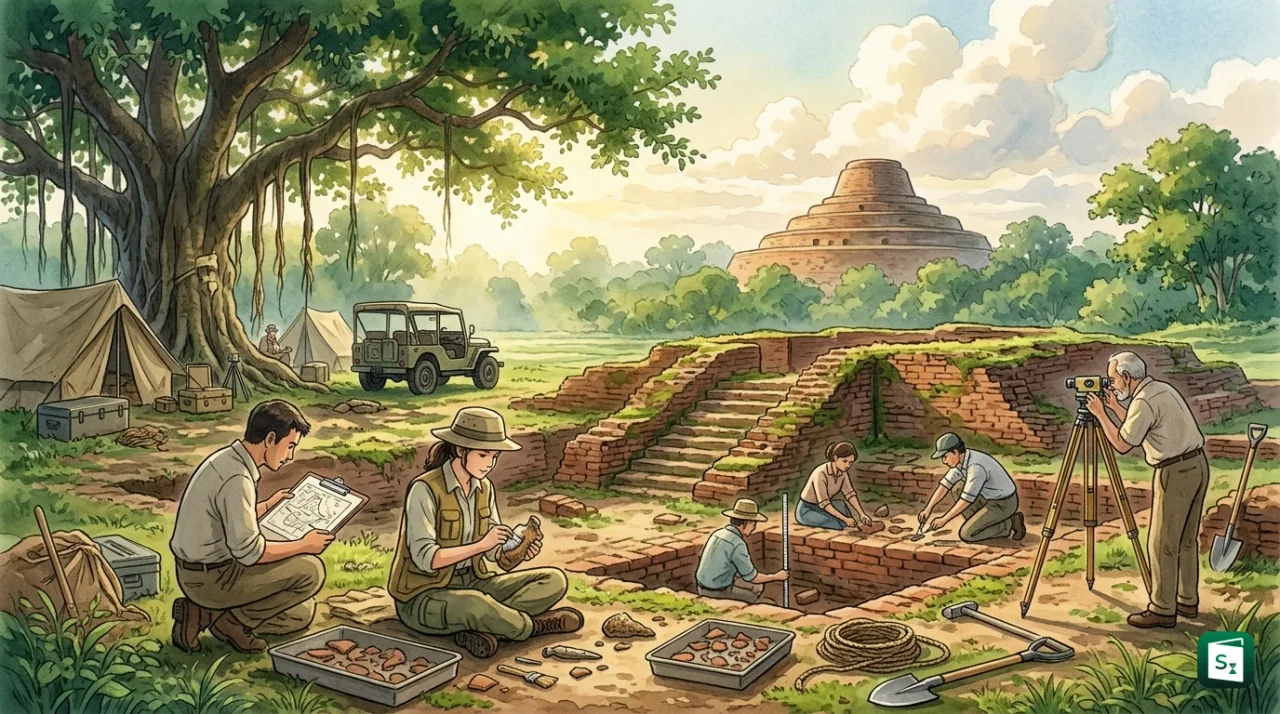
Modern notice began with Colin Mackenzie in 1814. Alexander Cunningham then recorded Kesariya in detail during 1861 to 1862. Cunningham did not dig the main mound in depth. He cut a small trench at the nearby Raniwas Mound. He found walls of a small temple, about 10 feet square inside, and the head and shoulders of a colossal Buddha image with curled hair. He described Raniwas as a vihara, which means a Buddhist monastery, with cells traceable on the eastern side. He also suggested that this monastery had a link with the main stupa.
Later work confirmed his guess. The Archaeological Survey of India (ASI) took up systematic excavation of the main stupa in 1998 under archaeologist K. K. Muhammed. Work resumed through the Patna Circle and Excavation Branch in 2018 to 2019 and again from 2024. Excavators exposed six terraces, rows of cells, polygonal designs, an outer circumambulatory path, drains and rammed floors. At Raniwas, a 2018 trench exposed walls, rooms, corridors, a pillared veranda and a courtyard of a monastic complex.
How Raniwas Mound Became a Site of National Importance
The Central Government declared Raniwas Mound a site of national importance in two legal steps under Section 4 of the Ancient Monuments and Archaeological Sites and Remains Act, 1958.
The process began at the field level. The Patna Circle of the ASI sent a proposal to ASI headquarters in New Delhi in 2021, with a formal protection proposal in November 2022. Earlier, the mound was not centrally protected, while the main Kesariya Stupa already enjoyed that status. The aim was to protect the monastery remains and allow large scale scientific excavation around the main stupa.
The steps were as follows.
| Date | Action |
|---|---|
| November 2022 | Patna Circle sends formal proposal for protection |
| 8 June 2026 | Preliminary notice S.O. 2888(E) issued; intention to declare the site of national importance |
| 8 June 2026 | Copy of notice fixed at a conspicuous place near the site and made available to the public |
| June to August 2026 | Two month period for objections under Section 4(1); no objection received |
| 4 November 2026 | Final declaration S.O. 6017(E) issued under Section 4(3) by Director General Yadubir Singh Rawat |
| 7 November 2026 | Gazette notification made public |
The final notification states clearly that no person objected to the declaration. The declaration is therefore conclusive proof of national importance under the Act unless it is withdrawn.
What Protection Means Under the AMASR Act, 1958
The Ancient Monuments and Archaeological Sites and Remains Act, 1958 is the central law for preserving ancient monuments and sites of national importance. It came into force on 15 October 1959. The Archaeological Survey of India and the National Monuments Authority function under this law.
An ancient monument means any structure, mound, cave, sculpture, inscription or place of burial of historical or artistic interest that has existed for at least 100 years. An archaeological site and remains means any area that holds or is believed to hold ruins or relics older than 100 years. Once notified under Section 4, such a place becomes a protected monument or a protected area.
Protection brings strict controls. No person, including the owner, can build, mine, quarry, excavate or blast inside the protected area without permission of the Central Government. Cultivation that digs more than one foot is also barred.
Two further zones apply around every protected site.
- A prohibited area extends 100 metres in all directions from the protected limit. No new construction is allowed there except by an archaeological officer or under a special order for public work.
- A regulated area extends a further 200 metres beyond the prohibited area. Construction here needs prior permission from the competent authority on the recommendation of the National Monuments Authority.
The tag does not change ownership. The schedule records Raniwas Mound as land of the Government of Bihar. National importance status also differs from a UNESCO World Heritage listing. The Kesariya protection is a national legal step and not an entry into any international list.
How the Archaeological Survey of India Protects the Site
The Archaeological Survey of India (ASI) is the nodal agency for survey, excavation and upkeep of protected heritage. It works under the Ministry of Culture and is headquartered in New Delhi.
The roots of Indian archaeology go back to the Asiatic Society, founded by William Jones in Calcutta in 1784. The ASI itself was founded in 1861. Alexander Cunningham became its first Archaeological Surveyor in December 1861 under Viceroy Lord Canning. The survey was suspended between 1866 and 1871 for lack of funds. It was revived as a separate department in 1871, with Cunningham as the first Director General. He held charge till 1885.
Cunningham shaped field method in India. He followed the route of Xuan Zang, mapped Buddhist sites, and reported on places such as Bharhut, Sankisa, Sravasti and Kaushambi. His four reports for 1862 to 1865 include the first detailed account of the Kesariya region after his exploration in 1861.
Today the ASI works through regional circles. Centrally protected places in Bihar fall under the Patna Circle, one of the oldest circles. The ASI maintains about 3,686 monuments and archaeological sites across India. Bihar had 70 such places before this order. These include the Vikramashila monastery at Antichak, the Ashokan pillars at Lauriya Areraj, Lauriya Nandangarh and Rampurwa, the relic stupa at Vaishali and Raja Vishal ka Garh. Raniwas Mound now joins that list. Protection means regular conservation, fencing, inspection and control of construction under the National Conservation Policy, 2014.
Key Takeaways
- The Raniwas Mound at Kesariya in East Champaran, Bihar, was declared a site of national importance by final notification S.O. 6017(E) on 4 November 2026.
- The protected site covers 1.63 acres under Plot No. 2905, Khata No. 19, with ownership recorded in the name of the Government of Bihar.
- The nearby Kesariya Buddha Stupa, about 104 feet high, is regarded as the tallest and largest Buddhist stupa in the world.
- Tradition links Kesariya to the Buddha giving his alms bowl to the Licchavis of Vaishali on the way to Kushinagar.
- Alexander Cunningham, the first head of the Archaeological Survey of India founded in 1861, explored the Kesariya region in 1861 and identified Raniwas as a monastery.