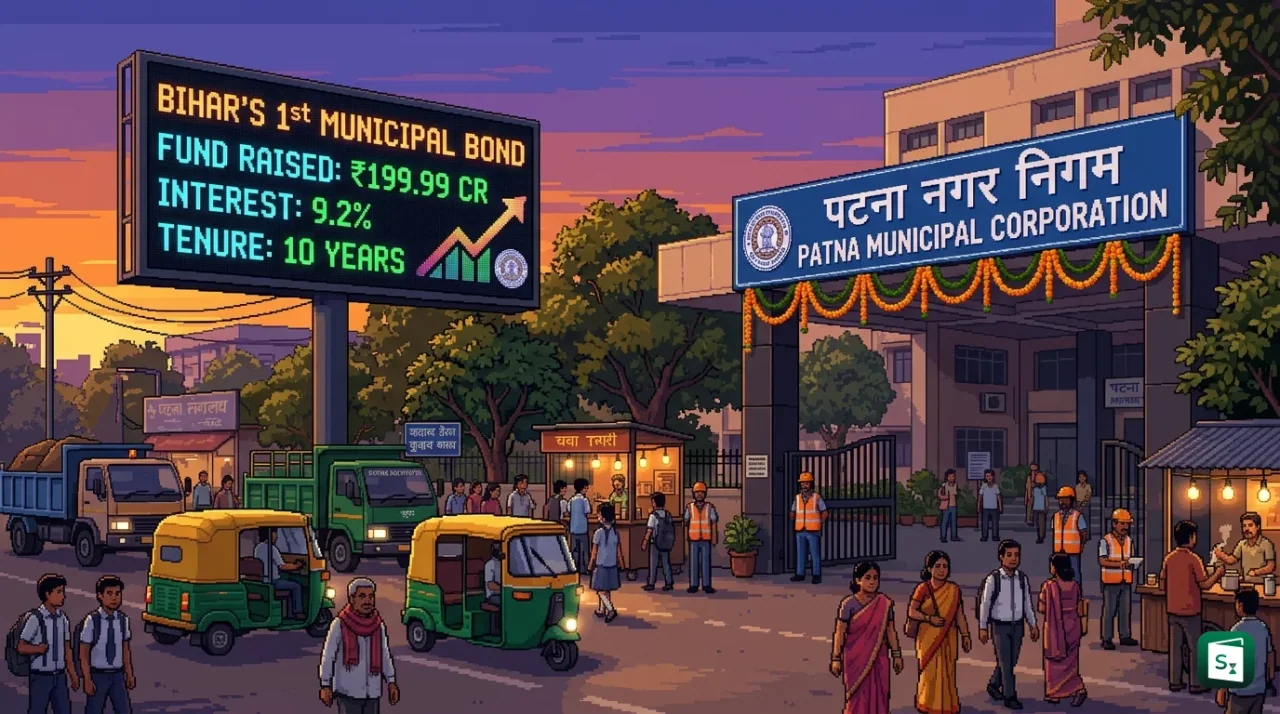
The Patna Municipal Corporation has raised ₹199.99 crore through its first municipal bond, becoming the first urban local body in Bihar to borrow directly from the capital market. The bonds were issued on 30 October 2026 through private placement on the National Stock Exchange (NSE) electronic platform and listed on 10 November 2026. They carry a fixed coupon rate of 9.2 percent per year with a total tenure of 10 years.
What Is a Municipal Bond and How Does It Work?
A municipal bond is a debt paper issued by a city government to raise money from investors for public infrastructure. The city promises to pay fixed interest at regular intervals and return the principal on fixed dates. It creates a loan from investors to the city and gives no ownership in the civic body.
A municipal corporation is an urban local body formed under Article 243Q of the Constitution. The 74th Constitutional Amendment Act of 1992 gave constitutional status to such bodies as the third tier of government. Patna Municipal Corporation functions under the Bihar Municipal Act of 2007 and is responsible for water supply, roads, sanitation, markets and other civic services in the state capital.
Municipal bonds in India are mainly of two types. General obligation bonds are backed by the taxing power of the city and are serviced from general taxes such as property tax. Revenue bonds are serviced from income of a specific project such as market rent, parking fees or water charges. Most Indian issues use a hybrid structure where project income is the first source and general city revenues act as backup.
Investors receive a coupon rate, which is the fixed annual interest fixed at the time of issue. Interest on most Indian municipal bonds is taxable at the slab rate of the investor unless a specific issue is notified as tax free. Repayment is protected through an escrow account, a separate bank account where earmarked city revenues are deposited first and used only for interest and principal payments.
What Patna Has Raised Through Its First Municipal Bond
The Patna Municipal Corporation issued its maiden bond on 30 October 2026 through private placement on the NSE Electronic Bidding Platform. The base issue size was ₹100.03 crore with a greenshoe option of ₹99.96 crore. Bidding took place between 9.30 am and 11 am and drew offers of more than ₹205 crore, or over twice the base size.
The corporation retained the full subscription and mobilised ₹199.99 crore. The allotment date was 3 November 2026. The securities were admitted to trading on the NSE capital market segment from 5 November 2026 and were formally listed on 10 November 2026 at a ceremony in Patna. Bihar Chief Minister Samrat Choudhary rang the ceremonial bell to mark the listing.
The issue was arranged by A K Capital Services as sole merchant banker. Vistra ITCL (India) acts as debenture trustee. The bonds received IND AA/Stable from India Ratings and Research and ACUITE AA/Stable from Acuite Ratings and Research. The ratings indicate a high degree of safety for timely payment of interest and principal. Patna’s issue is the first municipal bond of the current financial year. The previous issue was by Nashik Municipal Corporation in March 2026.
Where the ₹199.99 Crore Will Be Used in Patna
The Patna Municipal Corporation will use the bond proceeds for infrastructure works at 15 locations across the city. Civic officials have listed 18 development works under the plan. The focus is on assets that improve public convenience and also generate regular income for the corporation.
The project list includes organised vending zones, redevelopment of New Market and other commercial hubs around Patna Junction, new shopping complexes, basement parking, marriage halls, a hotel and a community building. Plans also include better circulation space to reduce congestion, fire safety systems, sanitation and solid waste facilities, rainwater harvesting and solar power units.
| Project Group | What Will Be Built | Income Source for the Corporation |
|---|---|---|
| Markets and vending | 12 vending zones and redeveloped markets near Patna Junction | Shop rent and vending fees |
| Commercial assets | Shopping complex, hotel and commercial building | Lease rent and commercial charges |
| Civic amenities | Parking facility, two marriage halls and community building | Parking fees and booking charges |
The Chief Minister has directed that the money be invested only in projects that keep earning after the debt is repaid. The idea is to create municipal assets that serve citizens daily while adding rental income, user charges and fees to city revenues. The corporation is expected to receive around ₹26 crore as central incentive under the Atal Mission for Rejuvenation and Urban Transformation (AMRUT) for issuing the bond. This amount is linked to 13 percent of the issue size and will be used to support project and debt costs.
How the Patna Bonds Are Structured, Rated and Repaid
The Patna Municipal Corporation bonds carry a fixed coupon rate of 9.2 percent per year with quarterly payouts. The overall tenure is 10 years. The face value of each bond is ₹10,000 and trading lot on the NSE is one bond.
The bonds are split into seven Separately Transferable and Redeemable Principal Parts (STRPPs). STRPPs are parts of one bond issue that mature on different dates and can be traded separately. These seven parts mature one year apart between 3 November 2030 and 3 November 2036. Investors get only interest during the first four years. Repayment of principal in quarterly instalments starts after that along with interest.
Repayment is secured through a structured payment system. All earmarked revenues flow first into an escrow account. From there money moves into an Interest Payment Account and a Sinking Fund Account, which is a reserve built over time to repay principal. A Debt Service Reserve Account (DSRA) equal to four quarterly interest payments is maintained as extra cover. The AMRUT incentive from the central government will be kept as fixed deposits marked to the debenture trustee and used for coupon payments over the tenure.
Are Patna municipal bonds tax free
Patna Municipal Corporation bonds are taxable. Interest is added to the income of the investor and taxed at the slab rate. The price in the secondary market decides the actual yield. Retail investors can buy the listed bonds through stockbrokers or through online bond platforms such as IndiaBonds and Grip Invest. Units are credited to the demat account on a T plus 1 basis.
The credit assessments rest on the city’s own revenues. The corporation’s own source income rose from ₹96.26 crore in 2021-22 to ₹179 crore in 2024-25. Rating agencies track property tax collection, rental income from municipal properties, fees and user charges. Arrears and weak enforcement remain the main risk to timely debt service.
How India Regulates Municipal Bonds
Municipal bonds in India are regulated by the Securities and Exchange Board of India (SEBI). SEBI is the capital market regulator established in 1988 and given statutory powers through the SEBI Act of 1992. It is headquartered in Mumbai. The framework for city bonds is the SEBI (Issue and Listing of Municipal Debt Securities) Regulations of 2015.
The regulations set clear conditions. An urban body must be legally allowed to borrow, must follow the National Municipal Accounts Manual or state manual for accounts, and must not have defaulted on bank or bond dues in the previous 365 days. A credit rating from at least one SEBI registered agency, a registered debenture trustee and dematerialised holding are compulsory. Listing on a recognised stock exchange is mandatory.
Public issues can be made only through revenue bonds with minimum tenure of three years and maximum tenure of 30 years. Private placement, which Patna used, can be of revenue bonds or general obligation bonds. The issuer must create an escrow account for debt service and use proceeds only for objects stated in the offer document.
India’s municipal bond journey started in 1997 when Bengaluru Municipal Corporation raised ₹125 crore with state guarantee for roads and drains. In 1998, Ahmedabad Municipal Corporation raised ₹100 crore without state guarantee, the first such issue in Asia. Activity stayed low for two decades. Growth returned after the 2015 regulations and central incentives.
SEBI data shows 31 municipal bond issues raised ₹4,540.34 crore between 2017 and 30 September 2026. These were made by 22 municipal bodies in seven states. With Patna’s debut, Bihar has become the eighth state to enter the market. Other active issuers include Pune, Hyderabad, Indore, Surat, Lucknow, Ahmedabad and Nashik. Under AMRUT, a city gets ₹13 crore for every ₹100 crore raised in its first issue, capped at ₹26 crore. Later green bond issues get ₹10 crore per ₹100 crore, capped at ₹20 crore.
| Feature | Municipal Bonds | Corporate Bonds | Government Securities |
|---|---|---|---|
| Issued by | City government or municipal body | Private or public company | Central or state government through the Reserve Bank of India |
| Backing | City taxes and project revenues with escrow cover | Company cash flows and assets | Sovereign promise with no credit risk |
| Interest level | Higher than government bonds due to city risk, near 7.6 to 10.2 percent in recent issues | Depends on company rating, often higher than city bonds | Lower, linked to market benchmark, 10 year yield near 7.44 percent in October 2026 |
| Tax treatment | Mostly taxable unless notified tax free | Mostly taxable | Mostly taxable with some special tax free options |
Why Patna’s Debut Matters for Urban Finance in India
Urban bodies in India handle growing civic duties but depend heavily on state transfers and grants. Patna reflects this pattern. Its own revenues have improved yet remain below potential due to property tax arrears and weak enforcement. Grants from the state urban development and housing department still fund a large share of spending. Such dependence makes long term planning difficult because work moves with the timing of government releases.
A bond changes this link. The corporation gets a fixed pool of money for fixed projects and accepts a legal duty to repay from its own income. Market borrowing forces better accounts, timely audits, ring fenced revenues and close tracking by trustees, rating agencies and investors. Patna Commissioner Yashpal Meena said strong demand showed confidence in city finances. Mayor Sita Sahu called it a step to strengthen financial capacity and civic services.
The wider market is also expanding. The Reserve Bank of India, set up in 1935 and headquartered in Mumbai, has noted in its municipal finance reports that better own revenues and credit ratings are vital for bond growth. Kanpur Nagar Nigam plans to raise ₹125 crore soon. Ahmedabad, Brihanmumbai, Navi Mumbai and Thane are preparing issues. For Patna, the real test starts now. It must improve tax collection, complete the 15 site projects on time and ensure shops, parking and halls earn steady rent to meet quarterly payments till 2036.
Key Takeaways
- The Patna Municipal Corporation became the first urban body in Bihar to raise ₹199.99 crore through a municipal bond issued on 30 October 2026.
- The bond carries a fixed coupon rate of 9.2 percent with quarterly interest and a total tenure of 10 years through seven STRPPs maturing from 2030 to 2036.
- The bonds were privately placed on the NSE Electronic Bidding Platform and listed on the NSE on 10 November 2026 with AA/Stable ratings.
- Proceeds will fund 18 works at 15 locations in Patna, including vending zones, New Market redevelopment, commercial complexes, parking and marriage halls.
- Municipal bonds in India are regulated under SEBI (Issue and Listing of Municipal Debt Securities) Regulations, 2015, with 31 issues raising ₹4,540.34 crore till September 2026.