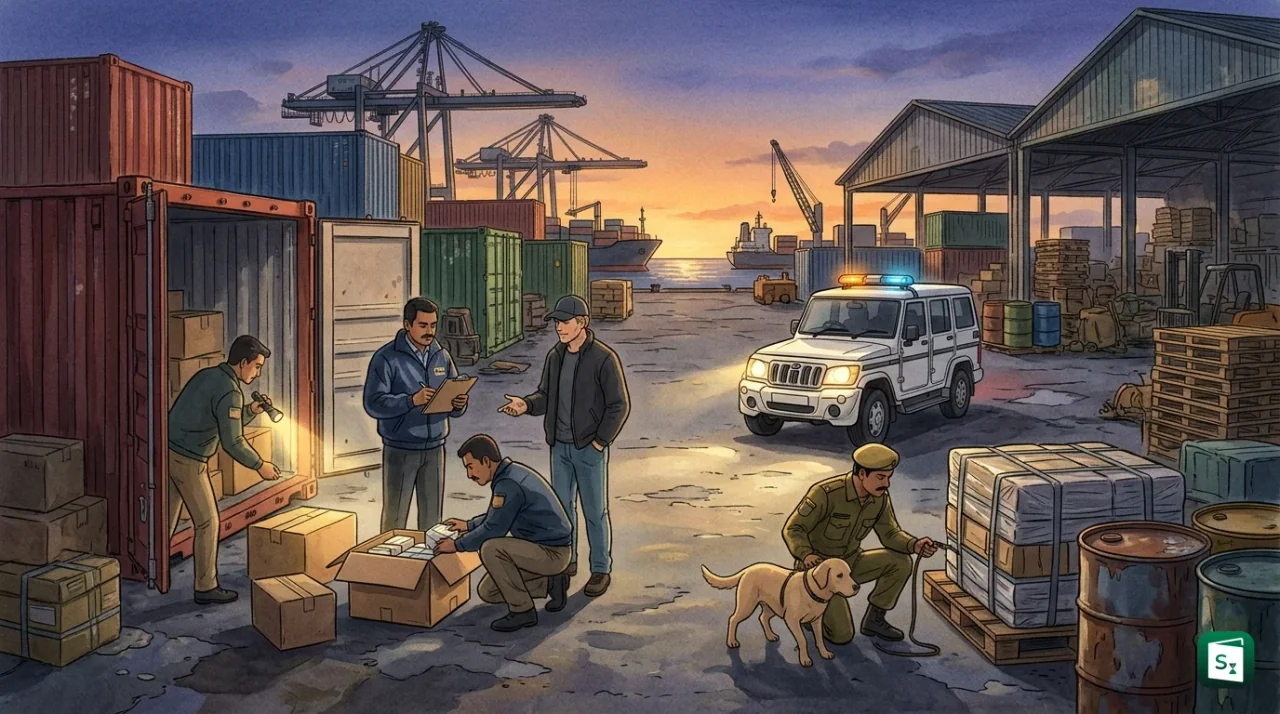
The India US Drug Policy Executive Working Group met in New Delhi on 2 and 3 November 2026. The Narcotics Control Bureau and the US Office of National Drug Control Policy reviewed intelligence sharing, precursor control and demand reduction. Operation MedMax and Operation WIPE were presented as models of enforcement.
What Did the Second India US Drug Policy Meeting Decide?
The Narcotics Control Bureau (NCB) hosted the meeting in New Delhi. The NCB works under the Ministry of Home Affairs. The Indian team was led by Anurag Garg, Director General of the NCB. The US team was led by Debbie Seguin, Acting Deputy Director of the Office of National Drug Control Policy (ONDCP).
The talks were held under the US India Drug Policy Framework. This framework was launched through a memorandum of understanding signed in September 2024. The first Executive Working Group meeting under it was held in Washington, D.C. on 20 and 21 January 2026. That meeting was led by Debbie Seguin and Monika Ashish Batra, Deputy Director General of the NCB.
The New Delhi meeting reviewed cooperation against illicit drug trafficking. The two sides fixed five priority areas for joint work. These were intelligence sharing, coordinated enforcement action, precursor control, pharmaceutical supply chain integrity and drug demand reduction.
| Meeting | Date and Venue | Led By |
|---|---|---|
| First Executive Working Group meeting | 20 and 21 January 2026, Washington, D.C. | Debbie Seguin for the US, Monika Ashish Batra for India |
| Second Executive Working Group meeting | 2 and 3 November 2026, New Delhi | Debbie Seguin for the US, Anurag Garg for India |
Anurag Garg explained the India Vision Roadmap 2026 to 2029. The roadmap was released on 26 June 2026. It guides central agencies, states and union territories for three years. It rests on four pillars. These are enforcement with intelligence and operations, precursors and synthetic drugs control, demand and harm reduction, and capacity building with coordination.
India said it has moved to a network centric approach. This means agencies do not stop with a seizure. They trace financiers, suppliers, facilitators and logistics networks behind each case. The ONDCP said such cross border partnership is vital to disrupt trafficking networks and stop synthetic drugs and chemical precursors from reaching global markets.
What Is Operation MedMax?
Operation MedMax is a joint India US enforcement operation against illegal online sale of controlled medicines. The NCB launched it after intelligence jointly developed with the US Drug Enforcement Administration (DEA). It is now cited as a model for cross border coordination.
The case began on 25 May 2025 near Mandi House in Delhi. The NCB team stopped a car and seized 3.7 kg of Tramadol tablets from two occupants. Both were pharmacy graduates. Their questioning exposed a network that sold pharmaceutical pills to buyers in the US, Europe and Australia through a major Indian business to business platform.
The probe found a call centre in Udupi in Karnataka with about 10 staff. It handled global orders. A stockist in Roorkee and associates in Mayur Vihar in Delhi and Jaipur managed supply and logistics. Orders were taken online without valid prescriptions. Payments came in cryptocurrency, PayPal and Western Union. International reshippers completed last mile delivery. The group never shipped within its own country and used Telegram and anonymous drop shippers to hide tracks. Repeat buyers were groomed as new stockists.
Data from Udupi pointed to 50 international consignments. This included 29 parcels moved within the US, 18 within Australia, and one each to Estonia, Spain and Switzerland. The NCB shared the inputs with foreign partners and Interpol. The DEA arrested reshipper Joel Hall in Alabama and seized more than 17,000 tablets of controlled medicines. Five parcels with about 700 grams of Zolpidem were also intercepted. An Indian American associate faces indictment in the US as a money launderer. Police in Australia dismantled a linked pill factory. The kingpin was traced to the United Arab Emirates (UAE). Coordination with UAE agencies is continuing.
In total, the network spread across four continents and more than 10 countries. Eight persons were arrested in India. The operation also exposed crypto wallets and hawala channels. It showed how digital platforms, call centres and crypto payments now drive illicit pharma trade.
What Is Operation WIPE?
Operation WIPE stands for Web based Illicit Activities Prevention and Enforcement. The NCB launched it on 26 April 2026. It targets misuse of online platforms for illegal sale of pharmaceutical drugs regulated under drug law.
The operation builds on lessons from Operation MedMax. MedMax acted after drugs had moved. WIPE tries to stop listings before they turn into trafficking. Teams track the surface web with advanced tools. The work uses inputs from the International Narcotics Control Board (INCB) programme called SNOOP. SNOOP stands for Scanning Novel Opioids on Online Platforms. It helps governments detect online offers of synthetic drugs.
Under WIPE, the NCB found 122 instances involving 62 substances. These included commonly misused drugs such as Clonazepam, Diazepam and Fentanyl. Of these, 58 substances fall under the NDPS Act and four are classified as controlled substances.
The NCB sent notices to concerned online platforms and shared a full list of regulated substances. This helps platforms identify and remove illegal listings on their own. After verification, platforms such as IndiaMART, TradeIndia and Dial4Trade removed flagged products and suspended suspicious vendors. Technical teams continue to scan the open web for new threats.
What Is the NDPS Act and How Does It Punish Drug Offences?
The NDPS Act stands for the Narcotic Drugs and Psychotropic Substances Act, 1985. It is the main Indian law against drug trafficking and misuse. Parliament passed it on 16 September 1985. It came into force on 14 November 1985. It was made to meet treaty duties under the Single Convention on Narcotic Drugs, the Convention on Psychotropic Substances and the UN Convention Against Illicit Traffic in Narcotic Drugs.
Narcotic drugs cover substances such as cannabis, opium and coca derivatives. Psychotropic substances cover mind altering drugs such as Tramadol, Zolpidem, Clonazepam, Diazepam and Fentanyl when used without licence. The Act also controls precursor chemicals under Section 9A through the Regulation of Controlled Substances Order. Precursor chemicals are legal chemicals that can be diverted to make drugs.
Punishment depends on quantity. The central government notifies small and commercial quantities for each drug.
| Quantity Involved | Punishment Under the Act |
|---|---|
| Small quantity | Rigorous imprisonment up to one year, or fine up to ₹10,000, or both |
| More than small but less than commercial quantity | Rigorous imprisonment up to 10 years and fine up to ₹1 lakh |
| Commercial quantity | Rigorous imprisonment of 10 to 20 years and fine of ₹1 lakh to ₹2 lakh |
Consumption has separate punishment. Use of cocaine, morphine, diacetyl morphine or notified drugs can draw rigorous imprisonment up to one year or fine up to ₹20,000. Use of other drugs can draw imprisonment up to six months or fine up to ₹10,000. Attempt, abetment and criminal conspiracy attract the same punishment as the main offence. Repeat offences attract higher penalty.
Is the NDPS Act bailable? Section 37 says every offence under the Act is cognizable and non bailable. For offences involving commercial quantity, and for offences under Sections 19, 24 and 27A, bail follows a strict twin test. The public prosecutor must get a chance to oppose bail. If opposed, the court must find reasonable grounds that the accused is not guilty and is unlikely to commit any offence while on bail.
Narcotics Control Bureau Under Which Ministry?
The Narcotics Control Bureau works under the Ministry of Home Affairs. It was created on 17 March 1986 under Section 4 of the NDPS Act. Its headquarters is at West Block No. 1, R.K. Puram in New Delhi. It coordinates action under the NDPS Act, the Customs Act, 1962 and the Drugs and Cosmetics Act, 1940. It also carries out treaty duties and helps foreign drug agencies. Its officers come from the police, revenue and paramilitary services besides direct recruits.
How Is India Tightening Precursor Control and Supply Chain Security?
Precursor chemicals are chemicals with legal industrial and pharma uses that can also make synthetic drugs. India is a large producer, user and exporter of such chemicals. The Delhi talks treated secure supply chains as a core goal. Strong rules must stop diversion without blocking legitimate trade.
India controls scheduled precursors under Section 9A of the NDPS Act and the Regulation of Controlled Substances Order, 2013. The list includes 46 controlled precursors notified till June 2026. The NCB also tracks a watch list of 82 high and medium risk chemicals that are not yet scheduled but show diversion risk.
In June 2026 the NCB launched a Voluntary Code of Conduct for preventing diversion of precursor chemicals in Ahmedabad. The code asks makers, traders, stockists, transporters, warehouse operators, importers, exporters and online sellers to adopt self checks. Key steps include Know Your Customer checks, end use verification, secure storage with CCTV and stock audits, e invoicing with correct codes, GPS tracking of sensitive consignments and prompt reporting of suspicious enquiries. Firms are asked to name a nodal officer, keep process flow charts and input output ratios, and retain records for audit. Industry groups are asked to spread awareness and training.
The US side is led in this work by the ONDCP. The Office of National Drug Control Policy was created by the Anti Drug Abuse Act of 1988 and started functioning in 1989. It is part of the Executive Office of the President in Washington, D.C. Its head, Sara Carter, is called the Drug Czar. The office frames the National Drug Control Strategy, coordinates federal agencies and runs the High Intensity Drug Trafficking Areas and Drug Free Communities programmes. The 2026 US strategy treats trafficking networks as global logistics businesses and calls for cross border action to protect legal supply chains.
Both countries agreed to keep sharing best practices on targeted enforcement, precursor scheduling and demand reduction. They stressed timely intelligence exchange and sustained institutional contact as traffickers shift routes and methods.
Key Takeaways
- The second India US Drug Policy Executive Working Group meeting was held on 2 and 3 November 2026 in New Delhi and was hosted by the Narcotics Control Bureau.
- The Indian team was led by NCB Director General Anurag Garg and the US team by ONDCP Acting Deputy Director Debbie Seguin under the framework signed in September 2024.
- Operation MedMax began with a 3.7 kg Tramadol seizure in Delhi in May 2025 and exposed a network across four continents and more than 10 countries.
- Operation WIPE, launched on 26 April 2026, identified 122 instances involving 62 substances, of which 58 fall under the NDPS Act.
- The NDPS Act, 1985 came into force on 14 November 1985, and the Narcotics Control Bureau set up on 17 March 1986 works under the Ministry of Home Affairs.