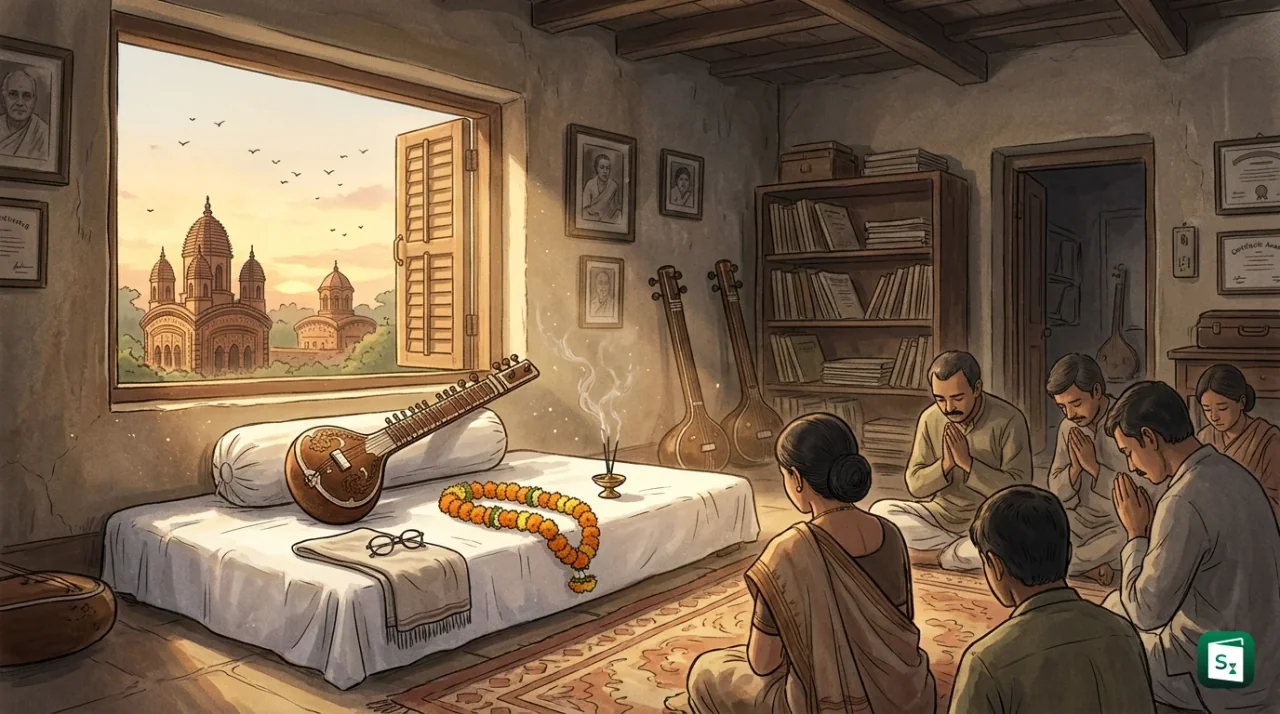
Sitar maestro Pandit Manilal Nag died in Kolkata on 10 November 2026 at the age of 87 after age related illness. A leading exponent of the Bishnupur Gharana of Hindustani classical music, he was the first musician from the gharana to receive both the Sangeet Natak Akademi Award and the Padma Shri. His passing ends a direct link to a nearly 300 year old Bengal tradition that blends Dhrupad depth with sitar lyricism.
Who Was Pandit Manilal Nag?
Pandit Manilal Nag was an Indian classical sitar player and the most widely recognised instrumental face of the Bishnupur Gharana of Bengal. In Hindustani music, a maestro means a master performer and teacher with complete command over a tradition, and Nag earned that title through seven decades on stage and in the classroom.
He was born on 16 August 1939 in Bankura district of West Bengal. He learned sitar from his father, Sangeetacharya Gokul Nag, himself a noted sitarist of the same gharana. The family traces its music back five generations to the temple town of Bishnupur.
Nag gave his first major public recital at the All India Music Conference in 1953 at the age of 14, accompanied on tabla by Samta Prasad. In 1954 he was graded as an A Grade artist of All India Radio. From then he appeared regularly in the National Programme of Music and the Akashvani Sangeet Sammelan.
Through the Indian Council for Cultural Relations (ICCR), the cultural arm of the Government of India, he toured the United States and Europe in 1973. In 1979 the Government of India sent him to Australia as a delegate for the Indian Ocean Arts Festival. From 2005 to 2011 he taught in the Instrumental Music Division of the ITC Sangeet Research Academy in Kolkata, a leading training and research institution set up by ITC Ltd.
On stage he played with tabla legends such as Samta Prasad, Kishan Maharaj, Anokhelal, Keramatullah Khan and Mahapurush Mishra. He was close to vocalists such as Amir Khan and Girija Devi. His last major public concert was in Kolkata in 2014. His daughter, Mita Nag, is a sixth generation sitarist of the gharana and announced his death. He is survived by his wife, daughter and son, and taught more than 5,000 students in India and abroad.
Where Is Bishnupur Located and What Is It Famous For?
Bishnupur is a historic temple town in Bankura district of West Bengal, about 200 km from Kolkata. The name means city of Vishnu in Bengali. The area was once called Mallabhum and was ruled by the Malla kings, who were devotees of Vishnu and great patrons of music.
Bishnupur is famous for three things that often appear together in general knowledge. The first is its terracotta temples built by the Malla rulers, known for detailed baked clay panels. The second is its crafts such as Baluchari sarees, terracotta work and bell metal craft. The third is the Bishnupur Gharana, the only Hindustani classical vocal gharana to have developed in Bengal.
This cultural mix matters for the story of Manilal Nag. He was born in the same Bankura soil and carried its Dhrupad rooted temple music from a small Bengal town to concert halls in Europe, America and Australia.
What Is the Bishnupur Gharana of Hindustani Music?
A gharana is a school of Hindustani classical music with a distinct style passed from teacher to disciple. The Bishnupur Gharana took shape in the late 18th century in the court of King Raghunath Singh II of Bishnupur. The king invited Ustad Bahadur Khan, a descendant of Tansen of the Senia tradition, to settle in Bishnupur.
Bahadur Khan taught local musicians such as Gadadhar Chakraborty and Ramshankar Bhattacharya. Ramshankar Bhattacharya is treated as the founder figure who gave the style a clear and separate form. His disciples included Anantalal Bandyopadhyay, Kshetra Mohan Goswami and Jadu Bhatta, whose music also influenced the young Rabindranath Tagore.
The Bishnupur style keeps a strong base in Dhrupad, the oldest and most austere form of Hindustani vocal music known for slow, meditative elaboration without words. It also sings Khayal, Dhamar and devotional songs with a mood of devotion. The alaap, or slow opening without rhythm, is calm and restrained. Ornamentation is simple. There is limited use of heavy gamak, or deep oscillations, and the focus stays on purity of raga and clarity of words.
How Bishnupur Differs From Other Gharanas
| Feature | Bishnupur Gharana | Maihar and Etawah Gharanas |
|---|---|---|
| Region | Bengal, centred on Bishnupur and Bankura | Central and North India, spread across the country |
| Main base | Dhrupad with Khayal | Khayal and instrumental gayaki ang, or singing style on instrument |
| Vocal or instrumental focus | Only vocal gharana of Bengal, later strong on sitar and surbahar | Largely instrumental sitar and sarod traditions |
| Famous sitar names | Gokul Nag, Manilal Nag, Mita Nag | Ravi Shankar and Nikhil Banerjee of Maihar, Vilayat Khan of Etawah |
| Patronage | Malla kings, later Tagore family of Jorasanko | Princely courts such as Maihar, later All India Radio and global stages |
Tagore took lessons from Bishnupur musicians and used their Dhrupad based tunes and notation system while shaping Rabindra Sangeet. That link makes Bishnupur important not only for classical music but for modern Bengali culture.
How Is the Sitar Played in Hindustani Classical Music?
The sitar is a long necked plucked string instrument and one of the main instruments of Hindustani classical music, the classical system of North India. Hindustani music differs from Carnatic music, the classical system of South India, in its greater stress on slow improvisation and on gharanas shaped by Mughal and regional courts.
A standard sitar is about four feet long with a gourd resonator, a wooden soundboard and 19 to 20 movable frets. It has seven main playing strings and 11 to 13 sympathetic strings that vibrate on their own and add echo. The player sits on the floor, plucks with a wire plectrum called a mizrab on the right forefinger, and pulls the string sideways with the left hand to produce meend, or glides between notes.
Nag was known for a meditative alaap, fluid meend and a distinct, fast paced jhala, the closing rhythmic section played with rapid strumming. Colleagues noted that his alaap followed the Dhrupad model. It built the raga slowly and kept a sense of calm even in fast taans, or rapid note patterns.
Famous Sitar Players of India: Where Does Manilal Nag Stand?
India has produced many great sitar players, but three names dominated the second half of the 20th century. Pandit Ravi Shankar of the Maihar Gharana took the sitar to the world stage, composed for films, won the Bharat Ratna in 1999 and won multiple Grammy Awards. Ustad Vilayat Khan of the Etawah or Imdadkhani Gharana refined the gayaki ang and made the sitar sound like the human voice. Pandit Nikhil Banerjee, also of Maihar, was admired for precise technique and deep inward expression.
Manilal Nag built his career beside these giants without copying them. While Ravi Shankar and Vilayat Khan worked with royal and later global patronage, Nag stayed rooted in Bengal and held to the restrained Bishnupur idiom. Critics describe his playing as serene and devotional, with less display and more stress on raga purity.
His role was therefore distinct. He did not seek film fame or fusion projects. He preserved a regional school, recorded for radio for five decades, and passed it to thousands of students. That is why his Padma Shri in 2020 was seen as recognition not only of one artist but of a 300 year old gharana that had remained outside the national spotlight.
Which Honours Did Manilal Nag Receive?
The Padma Shri is the fourth highest civilian award of India, after the Bharat Ratna, the Padma Vibhushan and the Padma Bhushan. It was instituted on 2 January 1954 and is announced every year on the eve of Republic Day. Nag received it in 2020 for art from West Bengal. He was the first musician from the Bishnupur Gharana to receive it.
The Sangeet Natak Akademi Award is the highest national honour for practising artists in music, dance and drama. It is given by the Sangeet Natak Akademi, the national academy for performing arts set up in 1953 and housed at Rabindra Bhavan in New Delhi under the Ministry of Culture. The award carries ₹1,00,000, a shawl and a brass plaque. Nag received it in 2001, again the first from his gharana.
Other honours show the same steady recognition:
| Year | Honour | Awarding Body |
|---|---|---|
| 2001 | Sangeet Natak Akademi Award | Sangeet Natak Akademi, New Delhi |
| 2005 | Senior Fellowship | Ministry of Culture, Government of India |
| 2008 | Honorary Gold Medal | Asiatic Society, Kolkata |
| 2012 | Alauddin Puraskar | Government of West Bengal |
| 2015 | Banga Bibhushan | Government of West Bengal |
| 2020 | Padma Shri | Government of India |
The West Bengal government kept his mortal remains at the State Sangeet Academy in Kolkata for public tribute. Tributes noted his mastery, his teaching and his role as president of the All India Music and Culture Council.
Key Takeaways
- Pandit Manilal Nag died in Kolkata on 10 November 2026 at the age of 87.
- He was born on 16 August 1939 in Bankura, West Bengal and trained under his father Gokul Nag.
- He was the leading sitar exponent of the Bishnupur Gharana, the only Hindustani vocal gharana of Bengal.
- He was the first musician from the gharana to receive the Sangeet Natak Akademi Award in 2001 and the Padma Shri in 2020.
- Bishnupur in Bankura district is famous for terracotta temples and its Dhrupad rooted gharana founded under Raghunath Singh II.