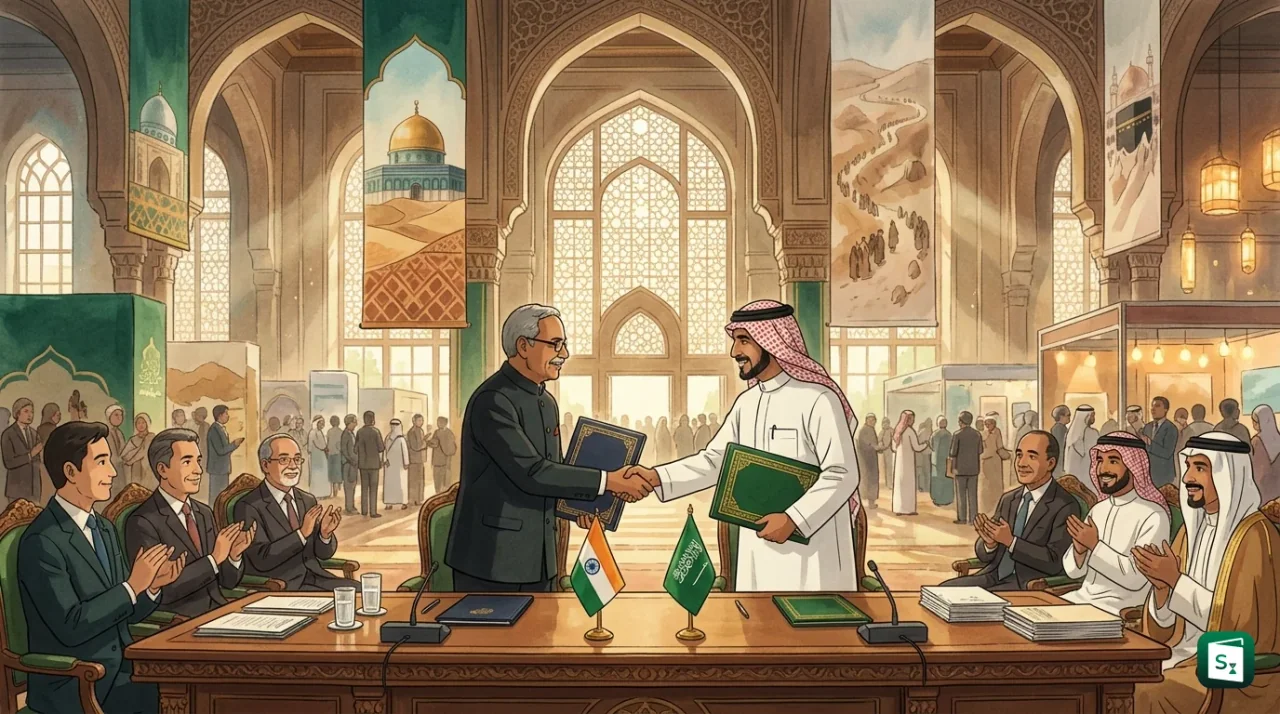
India and Saudi Arabia signed the Bilateral Haj Agreement for 2027 in Jeddah on 9 November 2026, fixing India’s Haj quota at 1,75,025 pilgrims. Union Minister for Minority Affairs Kiren Rijiju signed the agreement with Saudi Minister of Hajj and Umrah Tawfiq bin Fawzan Al-Rabiah during Rijiju’s visit from 6 to 9 November. The signing, held alongside the 6th Hajj Conference and Exhibition, locks in the number of Indians who can perform the annual pilgrimage next year.
What Did India and Saudi Arabia Sign for Haj 2027?
The Bilateral Haj Agreement for 2027 is the annual pact between India and Saudi Arabia that sets the terms for the Haj pilgrimage from India. The Ministry of Minority Affairs, which is the nodal ministry for Haj in India, signed the pact with Saudi Arabia’s Ministry of Hajj and Umrah. The agreement confirms India’s country quota at 175,025 pilgrims for 2027, unchanged from 2025 and 2026.
Kiren Rijiju held a bilateral meeting with Tawfiq bin Fawzan Al-Rabiah at the Jeddah Superdome on 9 November 2026 before the signing. The meeting was attended by India’s Ambassador to Saudi Arabia and the Joint Secretary in charge of Haj in the Minority Affairs Ministry. Both sides reviewed preparations for Haj 2027 and discussed safety, housing, transport and coordination for Indian pilgrims.
The agreement matters because no Indian pilgrim can perform Haj without a place inside the national quota. Saudi Arabia fixes a quota for each country every year because space at the holy sites in Makkah, Mina, Arafat and Muzdalifah is limited. The quota is broadly linked to the size of each country’s Muslim population and is finalised after talks between Saudi authorities and each government.
What Is Hajj and How Is It Different From Umrah?
Hajj is the annual pilgrimage to the holy city of Makkah in Saudi Arabia. It is the fifth pillar of Islam, which means every adult Muslim who is physically fit and can afford the journey must perform it at least once in life. The pilgrimage takes place in Dhul Hijjah, the 12th month of the Islamic lunar calendar, and the main rites are completed over five to six days.
Pilgrims enter a pure state called ihram, circle the Kaaba seven times in a rite called tawaf, and walk seven times between the hills of Safa and Marwa in a rite called sai. They then gather at the plain of Arafat on 9 Dhul Hijjah, which is the central and compulsory rite of Haj. After sunset they move to Muzdalifah, collect pebbles, and then stay in Mina where they throw pebbles at three pillars, sacrifice an animal, and shave or trim the hair.
Umrah is often called the lesser pilgrimage. It involves a visit to Makkah and some shared rites such as ihram, tawaf and sai, but it does not include the stay at Arafat, Muzdalifah and Mina and the stoning rite. The key practical difference is timing and obligation.
| Feature | Hajj | Umrah |
|---|---|---|
| Religious status | Compulsory for those who can afford it | Optional and highly recommended |
| Time | Only during Dhul Hijjah, once a year | Can be done at almost any time of year |
| Main sites | Makkah, Mina, Arafat, Muzdalifah | Mainly the Grand Mosque in Makkah |
| Key rites | Ihram, tawaf, sai, stay at Arafat, night in Muzdalifah, stoning in Mina, sacrifice | Ihram, tawaf, sai, hair cut |
| Duration | Five to six days of fixed rites | Usually completed in a few hours |
How Is the Haj Quota for India Decided and Shared?
The Haj quota for India is the total number of pilgrim seats Saudi Arabia allots to India for one Haj season. It is written into the bilateral agreement signed each year. For Haj 2027, the total is 175,025 seats. India sends one of the largest national groups for Haj each year, so early confirmation of the number helps the government plan flights, housing and medical support on fixed Saudi timelines.
India’s quota has grown sharply over the past decade and has stayed stable in recent years.
| Year | Indian Haj quota |
|---|---|
| 2014 | 1,36,020 |
| 2017 | 1,70,025 |
| 2018 to 2019 | 1,75,025 |
| 2020 to 2021 | No Haj for foreign pilgrims due to Covid |
| 2022 | 79,237 |
| 2024 to 2027 | 1,75,025 |
Inside India, the total quota is shared between two streams in a 70 to 30 ratio. About 1,22,518 seats go to the Haj Committee of India route and about 52,507 seats go to private Haj Group Organisers. This split was kept unchanged under Haj Policy 2027. The government has said it will keep trying to raise the overall quota.
Private operators face an extra Saudi rule on size. Saudi guidelines allow only entities handling at least 2,000 pilgrims. India therefore groups smaller private operators into Combined Haj Group Organisers so that each legal entity meets the 2,000 mark. This combined model started with Haj 2025 and continues for Haj 2027 to ensure quality and compliance with the bilateral pact.
What Is the Haj Committee of India?
The Haj Committee of India is the statutory body that organises the government quota of Haj pilgrims from India. It was set up under the Haj Committee Act, 2002 and works under the Ministry of Minority Affairs. The word statutory means the body is created by a law passed by Parliament. Its headquarters is at Haj House in Mumbai, at Baitul Hujjaj on M R A Marg.
The Committee invites online applications for Haj each year, selects pilgrims through a digital draw called Qurrah when applications exceed seats, collects payments in instalments, and arranges training, flights, housing and welfare in Saudi Arabia. It works with the Consulate General of India in Jeddah, the Ministry of Civil Aviation, State Haj Committees and health authorities. Every state and union territory has its own State Haj Committee that carries out the central policy, helps pilgrims travel from their home state to the embarkation point, and runs training camps.
Pilgrims on the Committee route use the Haj Suvidha App and the Committee portal for forms, flight details, emergency help and complaints. Two Indian offices support pilgrims on the ground in Saudi Arabia, the Indian Haj Pilgrims Office in Makkah and a branch in Madinah. The system also includes State Haj Inspectors who assist groups during travel and stay.
What Happened at the 6th Hajj Conference and Exhibition in Jeddah?
The 6th Hajj Conference and Exhibition was held from 8 to 11 November 2026 at the Jeddah Superdome under the theme From Makkah to the World. Saudi Arabia’s Ministry of Hajj and Umrah organised it with the Pilgrim Experience Program, which is part of Saudi Vision 2030. More than 200,000 visitors, over 150 countries and more than 520 entities took part, a sharp rise from about 14,000 visitors at the first edition in 2022.
Rijiju attended the inaugural ceremony on 8 November and joined the ministerial meeting chaired by Tawfiq bin Fawzan Al-Rabiah. He conveyed India’s appreciation for Saudi care for pilgrims and reaffirmed close cooperation for Haj 2027. He also joined other visiting ministers in a meeting with Prince Saud bin Mishaal bin Abdulaziz Al Saud, Deputy Governor of the Makkah region.
The conference focused on three tracks, which were infrastructure and operations, empowerment and integration, and sustainable development. Sessions covered transport, housing, food, crowd control, health, safety, digital services and training of workers. A major theme was the shift to all inclusive service packages, tighter contracts, better quality checks and wider use of data tools, artificial intelligence and the Saudi Nusuk app, which now has more than 65 million users and offers over 100 services.
On the sidelines, Rijiju chaired a review with officials of the Consulate General, the Minority Affairs Ministry and the Haj Committee to assess readiness for Haj 2027. He also attended the Noor-e-Diwali celebration at India House in Jeddah and met members of the Indian community. His visit ran from 6 to 9 November and ended with the signing of the bilateral agreement on the final day of talks.
What Does Haj Policy 2027 Change for Pilgrims?
The Haj Policy 2027 was announced on 22 June 2026 by the Minority Affairs Ministry after a review of Haj 2026. It keeps the 70 to 30 split between the Haj Committee and private operators. Applications for the Committee quota are filed online through the Committee portal and the Haj Suvidha App, with each family cover limited to one to five adults.
The policy improves ground support by raising the number of State Haj Inspectors from one for every 150 pilgrims to one for every 135 pilgrims. It gives preference to the top 20 percent of waitlisted applicants from Haj 2026 to clear backlogs fairly. It continues the 20 day Short Haj Package and adds Kolkata as an embarkation point due to strong demand from eastern India.
Medical rules are now more closely aligned with Saudi health guidelines, with stricter checks to stop people with serious chronic illness from travelling in the interest of safety. The Ministry is also adding artificial intelligence tools for form checking, document checks, flight planning across embarkation points, and real time tracking of complaints. A conversational AI helper in Hindi, Urdu and major regional languages is planned to guide first time and elderly pilgrims, with future links to the Nusuk platform. These steps build on Haj 2026 measures such as sofa cum beds in Mina, train travel between Makkah and Madinah, and hotel style stay in Makkah, which helped the Indian Haj Mission win two Labbaytum Awards for coordination and communication.
What Is Haj Subsidy in India?
Haj subsidy was government support for Haj travel, given mainly as a discount on airfare for pilgrims travelling through the Haj Committee. It began in expanded form in 1954 with flights between Mumbai and Jeddah and was reshaped in 1973 when sea travel was stopped and air travel became the norm. The subsidy amount rose as fares and pilgrim numbers grew, reaching about ₹685 crore in 2011.
In May 2012, the Supreme Court directed the central government to phase out the subsidy within 10 years and use the funds for education and social development of the community. The Court noted that the Quran lays the duty of Haj only on those who can afford the journey. The government reduced the amount every year and fully withdrew the subsidy from 2018. The released funds were earmarked for education programmes, especially for girls from minority communities. At present, pilgrims bear the full cost, with Committee packages generally reported in the range of ₹3.5 lakh to ₹5 lakh and private packages costing more.
Key Takeaways
- India and Saudi Arabia signed the Bilateral Haj Agreement for 2027 on 9 November 2026 in Jeddah.
- India’s Haj quota for 2027 is fixed at 1,75,025 pilgrims, unchanged from 2025 and 2026.
- The quota is shared in a 70 to 30 ratio, with 1,22,518 seats for the Haj Committee of India and 52,507 seats for private Haj Group Organisers.
- The Haj Committee of India, set up under the Haj Committee Act, 2002 and headquartered in Mumbai, manages the government quota.
- The 6th Hajj Conference and Exhibition was held from 8 to 11 November 2026 at the Jeddah Superdome under the theme From Makkah to the World.