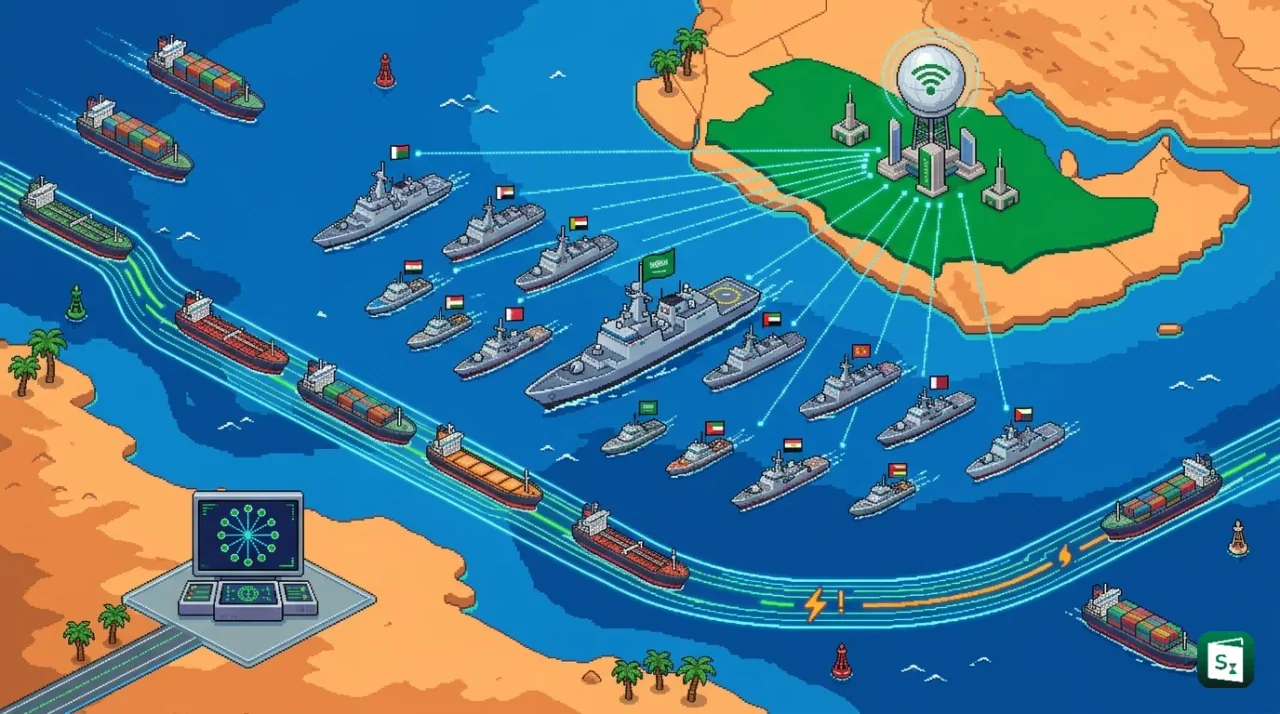
Saudi Arabia has formally launched the Multinational Maritime Defence Coalition (MMDC), a 14-nation military alliance aimed at safeguarding critical trade and energy corridors in the Red Sea, the Bab al-Mandeb Strait, and the Gulf of Aden. The coalition’s charter was signed on August 13, 2026, at the Western Fleet Command in Jeddah, following the alliance’s third planning meeting attended by representatives from 39 countries. This marks one of the most significant shifts in Middle Eastern security architecture in recent decades, as regional states take direct control of maritime security rather than relying on Western-led forces.
What Is the Multinational Maritime Defence Coalition?
The Multinational Maritime Defence Coalition (MMDC) is a regionally anchored military alliance established to protect freedom of navigation and secure vital maritime corridors in the Red Sea, the Bab al-Mandeb Strait, and the Gulf of Aden. The coalition was formally announced on July 30, 2026, when Saudi Arabia and 13 other nations issued a joint statement declaring the creation of a framework to strengthen collective maritime defence cooperation.
The MMDC is described as an “open international coalition” that welcomes countries aligning with its goals and principles. The alliance represents a strategic pivot toward regional self-reliance, enabling coastal states along the Red Sea and Gulf of Aden to lead security operations rather than depending on non-regional naval forces. This shift comes in the wake of sustained threats from Houthi forces operating along the Yemeni coastline, which have disrupted commercial shipping and energy transport routes since late 2023.
The coalition’s mandate includes exchanging information and intelligence, developing operational planning, conducting joint naval exercises and drills, building military capabilities, and carrying out joint naval operations. The charter explicitly defines the alliance as purely defensive and fully compliant with international law and United Nations Charter principles.
Who Are the Founding Members?
The founding 14-country military bloc spans West Asia, North Africa, South Asia, and the Horn of Africa:
| Region | Member States |
|---|---|
| Gulf Cooperation Council and West Asia | Saudi Arabia, Bahrain, Qatar, Kuwait, Jordan |
| North and East Africa | Egypt, Djibouti, Somalia, Sudan, Comoros |
| South Asia | Pakistan, Bangladesh |
| Eurasia | Turkey |
| Yemen | Internationally recognised Government of Yemen |
A total of 15 countries signed the joint founding declaration, with 13 completing their national procedures and formally acceding as full active military partners by August 13, 2026. The remaining signatory nations are finalising their internal legislative ratifications to complete full operational integration. Representatives from 39 countries attended the coalition’s third planning meeting in Jeddah, signalling broad international interest in the alliance.
Command Structure and Leadership
The institutional framework of the MMDC includes the following key appointments and decisions:
- Coalition Commander: Rear Admiral Abdullah bin Salem Al-Shehri of the Royal Saudi Naval Forces, appointed to lead operational planning and maritime task force deployments.
- Deputy Coalition Commander: A senior flag officer from the Pakistan Navy, representing Pakistan’s leadership rotation during the coalition’s inaugural term.
- Headquarters: Western Fleet Command, Jeddah, Kingdom of Saudi Arabia.
The coalition’s headquarters houses the Joint Command, the Command and Control Centre, the Combined Maritime Operations Center (CMOC), and the General Secretariat. The CMOC establishes direct, real-time intelligence feeds connecting Gulf radar networks, Horn of Africa maritime patrol units, and South Asian naval intelligence.
The Mecca Pact: A Foundation for Regional Security
The institutional activation of the MMDC follows the tripartite defence pact signed between Saudi Arabia, Turkey, and Pakistan on August 7, 2026, in the holy city of Mecca. Informally dubbed the “Mecca Pact”, this landmark mutual defence agreement established that an armed attack on any one of the three nations would be treated as an attack on all three.
The Mecca Joint Defence Agreement was signed by Saudi Crown Prince Mohammed bin Salman, Turkish President Recep Tayyip Erdogan, and Pakistani Prime Minister Shehbaz Sharif. The pact aims to “strengthen collective deterrence against any act of aggression” and provides for the enhancement of all aspects of defence cooperation among the three states. While the agreement does not specify exact military obligations, a Turkish official confirmed it is “purely defensive in nature” and not directed at any specific actor.
The strategic alignment between Riyadh, Ankara, and Islamabad provides the heavy naval muscle, intelligence depth, and defence-industrial backing for the broader 14-nation coalition. Turkey brings NATO’s second-largest military and a rapidly growing defence industry, Pakistan contributes the Muslim world’s only nuclear deterrent and significant naval experience, and Saudi Arabia offers financial muscle and strategic influence as the world’s top oil exporter.
The negotiations for this pact began after the October 7, 2023 Hamas attack on Israel and gained pace amid the ongoing US-Israel war on Iran, which has seen Iranian missile and drone strikes on Gulf states. The agreement reflects a shared concern among these three major Sunni Muslim powers about regional instability and the need for a new security architecture independent of Western guarantees.
Why Is the Red Sea Alliance Needed?
The Houthi Threat to Global Shipping
The immediate catalyst for forming the MMDC was the volatile security environment in the Southern Red Sea, the Bab al-Mandeb Strait, and the Gulf of Aden. Since late 2023, Houthi forces operating from Yemen have launched sustained attacks on commercial shipping using weaponised uncrewed surface vessels, anti-ship ballistic missiles, aerial attack drones, and uncrewed underwater vehicles.
The Houthi campaign has had devastating consequences for global trade:
| Impact Area | Data |
|---|---|
| Daily vessel transits through Bab al-Mandeb | Collapsed from approximately 70 per day to roughly 35 per day (50% reduction) |
| Suez Canal container transits | Declined by 90% between December 2023 and March 2024 |
| Red Sea overall traffic | Fell from 4.0 million metric tons per day to 1.7 million metric tons per day |
| Freight rate increases | 100-350% on primary Asia-Europe routes during peak disruption |
| Additional transit time via Cape of Good Hope | 10-14 days longer than the Red Sea route |
The attacks have targeted vessels from more than 40 nations, killing at least three sailors and causing significant damage to commercial ships. The disruption forced major shipping companies to reroute around the Cape of Good Hope, adding millions of dollars in additional costs per vessel and contributing to global supply chain delays.
Strategic Importance of the Bab al-Mandeb Strait
The Bab al-Mandeb Strait is one of the world’s most critical maritime chokepoints. Situated between Yemen on the Arabian Peninsula and Djibouti and Eritrea in the Horn of Africa, the strait narrows to just 18 miles (29 kilometres) at its narrowest point. It serves as the sole direct maritime access connecting the Red Sea to the Indian Ocean via the Gulf of Aden, functioning as the southern gateway to the Suez Canal.
The economic weight of this waterway is enormous:
- Approximately 10-12% of global seaborne trade passes through the strait annually
- Nearly 30% of global container traffic transits the Red Sea corridor
- Between 8.7 and 9.2 million barrels per day of crude oil and refined products transit the strait, originating from the Persian Gulf
- 20% of global rice exports and 15% of global wheat exports flow through the Bab al-Mandeb corridor
- An estimated 90% of undersea fibre optic cables linking Europe and Asia pass through the Red Sea
The Red Sea corridor connecting the Indian Ocean to the Mediterranean Sea via the Suez Canal is the shortest and fastest maritime route between Europe and Asia, bypassing circumnavigation around Africa. For shipping companies, the choice is stark: traverse the Red Sea and Suez Canal in approximately 14 days (Asia to Europe), or reroute around the Cape of Good Hope over 21-24 days.
Why Are the UAE and Oman Absent?
Among the Gulf Cooperation Council (GCC) member states, the United Arab Emirates (UAE) and Oman are notably absent from the coalition. Both nations opted not to join due to differing regional priorities.
The UAE has increasingly focused on independent maritime security operations, maintaining separate littoral bases in Somaliland and East Africa while avoiding direct integration into Saudi-led command structures. Abu Dhabi has pursued its own bilateral security arrangements and prefers to maintain operational flexibility rather than committing to a multilateral coalition framework.
Oman maintains its traditional diplomatic role as an unaligned mediator between Gulf nations, Iran, and Yemeni factions. Muscat has historically positioned itself as a neutral broker in regional disputes and seeks to avoid participation in military coalitions that could escalate regional tensions. Notably, Oman played a key role in brokering the 2025 ceasefire between the United States and the Houthis, reinforcing its image as a diplomatic intermediary.
Their absence does not necessarily indicate opposition to the coalition’s goals. Rather, it reflects different strategic calculations and foreign policy approaches within the GCC, where member states increasingly pursue independent security arrangements alongside collective frameworks.
How Does MMDC Compare to Western-Led Maritime Coalitions?
The formation of the MMDC represents a strategic shift from relying on Western-led maritime security operations to establishing regionally anchored alliances. Two major Western-led coalitions have previously operated in the same waters:
Operation Prosperity Guardian was a United States-led multinational operation launched in December 2023 to respond to Houthi attacks on shipping in the Red Sea. The operation involved more than 20 nations, including the United Kingdom, Bahrain, Canada, France, Italy, Netherlands, Norway, and others. Despite significant naval deployments, including carrier strike groups and advanced destroyers, the operation struggled to fully deter Houthi attacks. The US-Houthi ceasefire brokered by Oman in May 2025 led to the retirement of Operation Prosperity Guardian.
Operation Aspides was a European Union naval mission launched in February 2024 to protect commercial shipping in the Red Sea and Gulf of Aden. The EU operation focused primarily on defensive escort missions rather than offensive strikes against Houthi positions.
Both operations demonstrated the limitations of relying on distant naval forces to secure regional waterways. The MMDC addresses these limitations by leveraging the geographic proximity of member states, who control the coastline surrounding the waterway. Unlike Western navies operating thousands of miles from home ports, MMDC member states provide land-based radar coverage, naval airfields, logistical supply lines, and rapid-response ports along the entire Red Sea littoral.
The coalition also benefits from the heavy naval assets of its core members. Egypt brings Mistral-class amphibious assault ships and modern FREMM frigates, Turkey contributes MILGEM-class stealth frigates and advanced naval drone platforms, and Pakistan brings Zulfiquar-class frigates and sub-surface surveillance assets.
Key Takeaways
- The Multinational Maritime Defence Coalition (MMDC) was formally established on August 13, 2026, with 14 founding nations signing the coalition charter at the Western Fleet Command in Jeddah, Saudi Arabia.
- The coalition is headquartered in Jeddah and commanded by Rear Admiral Abdullah bin Salem Al-Shehri of Saudi Arabia, with Pakistan providing the deputy commander for the inaugural term.
- The Mecca Joint Defence Agreement between Saudi Arabia, Turkey, and Pakistan, signed on August 7, 2026, forms the strategic backbone of the broader MMDC alliance.
- The Bab al-Mandeb Strait handles approximately 10-12% of global seaborne trade and nearly 30% of global container traffic, making it one of the world’s most critical maritime chokepoints.
- The UAE and Oman are notably absent from the MMDC, with Abu Dhabi pursuing independent maritime operations and Muscat maintaining its traditional neutral mediator role.
- The MMDC represents a shift from Western-led security frameworks like Operation Prosperity Guardian (US-led, ended May 2025) and Operation Aspides (EU-led) to regionally anchored maritime defence.