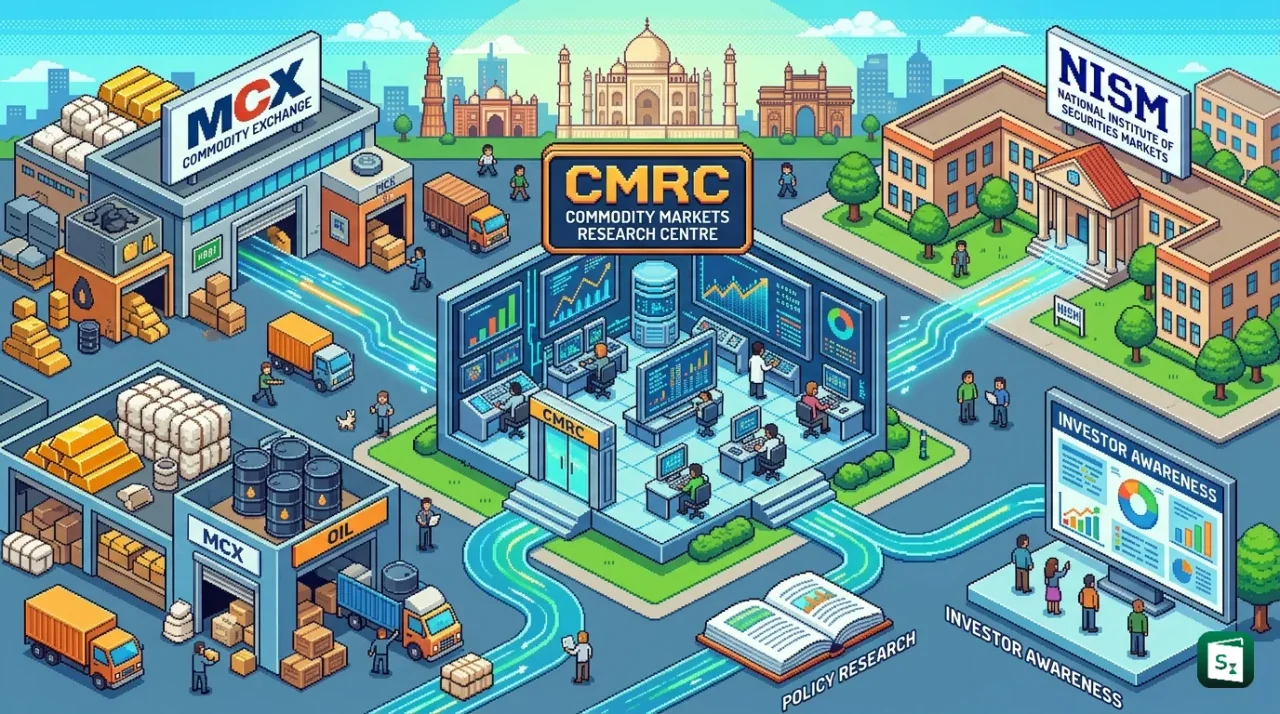
The Multi Commodity Exchange of India Ltd (MCX) and the National Institute of Securities Markets (NISM) have signed a Memorandum of Understanding (MoU) to establish the MCX-NISM Centre for Commodity Markets. The agreement was signed at the Global Commodity Conclave 2026 in Mumbai, bringing together the exchange’s market expertise and NISM’s academic infrastructure. The new centre will focus on research, professional training, and investor awareness to strengthen India’s fast-growing commodity derivatives ecosystem.
What Is the MCX-NISM Centre for Commodity Markets?
The MCX-NISM Centre for Commodity Markets is a joint platform created by the country’s leading commodity exchange and SEBI’s training and research institute. It will be housed at NISM and will combine MCX’s industry and market experience with NISM’s academic and research infrastructure. The centre is designed to become a dedicated hub for building professional capability, conducting applied research, and encouraging responsible participation in India’s commodity markets.
The agreement was signed during the Global Commodity Conclave 2026, a flagship commodity markets event hosted in Mumbai. While the two institutions have not disclosed details on the centre’s funding, programme timelines, or specific research projects, they have outlined its broad mandate. The emphasis is on practical knowledge and informed participation, rather than only theoretical study.
Commodity Derivatives and Why They Matter
A commodity derivative is a contract whose value is linked to a commodity such as gold, crude oil, or guar seed. The two main uses are price discovery (finding a transparent market price) and hedging (protecting against price swings). For a farmer, a jeweller, or a factory that uses metals, these contracts help lock in prices and manage risk. India trades derivatives across bullion, energy, base metals, and agricultural commodities, and this market is now regulated by SEBI after a historic regulatory merger in 2015.
The Two Partners Behind the Centre
The centre brings together two very different but complementary institutions. One runs the market; the other builds the people who understand it.
MCX: India’s Largest Commodity Exchange
The Multi Commodity Exchange of India Ltd (MCX) is India’s largest commodity derivatives exchange and the world’s fourth largest exchange by the number of commodity derivative contracts traded, according to the Futures Industry Association’s 2025 survey. It was incorporated in 2002 and began operations on 10 November 2003. The exchange is headquartered in Mumbai and is a publicly listed company, having completed its initial public offering in 2012, which made it India’s first listed exchange.
MCX offers trading in bullion, energy, metals, and agricultural commodities. It runs on the regulatory framework of SEBI and provides a neutral, transparent platform for price discovery and risk management. As of 31 March 2026, MCX had 583 members, about 32,044 authorised participants, and roughly 4.65 crore unique client codes. The exchange is led by Praveena Rai, its Managing Director and Chief Executive Officer, who signed the MoU on behalf of MCX.
NISM: SEBI’s Capacity Building Arm
The National Institute of Securities Markets (NISM) is a public trust established in 2006 by the Securities and Exchange Board of India (SEBI), India’s securities market regulator. Its mandate is to carry out capacity building for the securities markets through financial literacy, professional education, better governance standards, and policy research. NISM is governed by a Board of Governors and works under six schools of excellence that cover certification, regulatory studies, investor education, and securities information, among others.
NISM is headquartered in Mumbai, with its registered office at Bandra Kurla Complex. Its 70 acre campus at Patalganga (Raigad district, near Mumbai) was inaugurated by Prime Minister Narendra Modi on 24 December 2016. The institute is led by Sashi Krishnan, its Director, who signed the MoU on behalf of NISM. Under the new centre, NISM will provide the academic and research infrastructure, while MCX will contribute its market expertise for content development, instructional design, and assessments.
Why the Centre Matters Now
India’s commodity derivatives market has grown rapidly in recent years. According to SEBI, futures turnover in the segment rose 133 per cent to ₹166.4 lakh crore in 2025-26, while options premium turnover more than doubled to ₹16.8 lakh crore. In the first four months of 2026-27 alone, turnover had already reached about 65 per cent of the previous full year’s level. New products such as electricity futures, base metal options, and index options have widened the market.
As the market gets more sophisticated, it needs specialists who understand hedging, compliance, and risk management. The two institutions argue that a strong commodity market depends on a steady supply of well-trained professionals and on research that is rigorous and grounded in Indian market realities. The centre is meant to fill exactly that gap, at a time when SEBI is also pushing to widen participation by mutual funds, foreign portfolio investors, and even farmers and farmer producer organisations.
The timing is also important because the regulator is actively redrawing the rules. At the same conclave, SEBI Chairman Tuhin Kanta Pandey announced a consultation paper to allow Foreign Portfolio Investors (FPIs) wider access to commodity derivatives, including physically settled non-agricultural contracts. A centre that produces research and trained professionals will help the market absorb these changes responsibly.
Focus Areas and Activities
The centre has outlined four broad pillars of work. These cover the full chain from training a working professional to producing research that can shape policy.
The programmes will serve market participants, corporates, investors, and the wider academic community. Training will cover hedging, corporate risk management, ethical conduct, suitability, compliance, and good market practices. The aim is to sharpen understanding of how commodity derivatives help manage market risk.
| Focus Area | What the Centre Will Do |
|---|---|
| Capacity building and professional development | Run training, joint certification, and specialised workshops for market professionals |
| Applied research | Produce policy and white papers on commodity market issues |
| Investor awareness | Spread practical knowledge for informed and responsible participation |
| Academic engagement | Faculty development, doctoral fellowships, visiting scholars, and academic symposia |
Beyond short courses, the centre plans a sustained talent pipeline. It will run faculty development programmes, doctoral fellowships, visiting scholar initiatives, and academic conferences. MCX will help break down market knowledge into structured learning with clear outcomes, while NISM provides the research base. Together, these activities are expected to support industry-academia collaboration across India’s commodity markets.
The Regulatory Backdrop: How SEBI Came to Regulate Commodities
Understanding this partnership requires a quick look at how India’s commodity markets are supervised today. For decades, commodity futures were regulated by the Forward Markets Commission (FMC), which was set up in 1953. That changed with the Union Budget for 2015-16, when the government proposed merging the FMC with SEBI to strengthen regulation and reduce wild speculation.
The merger was formalised on 28 September 2015. The Forward Contracts (Regulation) Act, 1952 was repealed, and the regulation of commodity derivatives shifted to SEBI under the Securities Contracts (Regulation) Act, 1956. SEBI then created a dedicated Commodity Derivatives Market Regulation Department to handle exchange administration, market policy, risk management, and products. This is why a SEBI institution like NISM is the natural home for a commodity markets research centre.
SEBI’s Push to Deepen the Market
Since the merger, SEBI has steadily opened the market to new participants. Mutual funds can now take part in exchange-traded commodity derivatives, except on sensitive commodities, and Portfolio Managers and FPIs also have defined access. In August 2026, SEBI issued a consultation paper to widen FPI access further, including to physically settled non-agricultural contracts such as crude oil, natural gas, gold, silver, and base metals. The goal is to improve liquidity, market depth, and price discovery, and to bring India’s commodity market closer to global benchmarks.
The Way Forward
The centre is a long-term institutional build rather than a one-time event. By combining NISM’s research strengths with MCX’s live market experience, it is positioned to produce white papers that inform regulation, certification courses that skill professionals, and awareness drives that protect retail investors. As SEBI opens the market to foreign and institutional money, such a knowledge base becomes essential to keep growth orderly.
The partnership also signals a maturing of India’s commodity ecosystem, where exchanges and regulators invest in human capital and evidence-based policy. If the centre delivers on its stated pillars, it could become the reference point for commodity market education and research in the country, much like NISM already is for the broader securities market.
Key Takeaways
- MCX and NISM signed an MoU at the Global Commodity Conclave 2026 in Mumbai to establish the MCX-NISM Centre for Commodity Markets.
- The centre will be housed at NISM and will focus on capacity building, applied research, investor awareness, and academic engagement.
- MCX is India’s largest commodity derivatives exchange, incorporated in 2002 and operational since 10 November 2003, and is headquartered in Mumbai.
- NISM is a public trust established in 2006 by SEBI, with its main campus at Patalganga, Raigad district, Maharashtra, inaugurated by Prime Minister Narendra Modi on 24 December 2016.
- Commodity derivatives in India have been regulated by SEBI since 28 September 2015, when the Forward Markets Commission (FMC) merged with SEBI and the Forward Contracts (Regulation) Act, 1952 was repealed.
- India’s commodity futures turnover rose 133 per cent to ₹166.4 lakh crore in 2025-26, underlining the need for skilled professionals and research highlighted by the new centre.