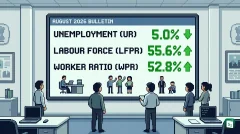
India\u2019s unemployment rate for persons aged 15 years and above rose to 5.4% in the April-June 2026 quarter, up from 5.0% in the preceding January-March 2026 quarter, according to the Periodic Labour Force Survey (PLFS) Quarterly Bulletin released by the National Statistical Office (NSO). The overall Labour Force Participation Rate (LFPR) also slipped to 54.6% from 55.5%, driven primarily by a sharp fall in rural participation and a noticeable decline in female workforce engagement. The data paints a mixed picture of India\u2019s labour market, with urban indicators holding relatively steady while rural and female participation weaken.
What Is the Periodic Labour Force Survey?
The Periodic Labour Force Survey (PLFS) is India\u2019s principal official household survey for measuring employment and unemployment conditions across the country. Conducted by the National Statistical Office (NSO), which operates under the Ministry of Statistics and Programme Implementation (MoSPI), the PLFS replaced the older quinquennial Employment-Unemployment Surveys of the National Sample Survey Organisation (NSSO). The NSSO had conducted these five-yearly surveys until 2011-12, leaving a significant gap in timely employment data.
The PLFS was launched in April 2017 on the recommendation of the Amitabh Kundu Committee and the Standing Committee on Labour. Its primary objective was to provide more frequent labour market data. Initially, the survey produced annual estimates for both rural and urban areas, and quarterly estimates only for urban areas.
Key Indicators Measured
The PLFS tracks three core indicators:
- Labour Force Participation Rate (LFPR): The percentage of the population aged 15 years and above that is either working or actively seeking and available for work. A higher LFPR means more people are engaged in or looking for economic activity.
- Worker Population Ratio (WPR): The percentage of the population aged 15 years and above that is actually employed. This measures the share of the population contributing to production.
- Unemployment Rate (UR): The percentage of persons in the labour force who are not working but are seeking and available for work. This is calculated as a proportion of the labour force, not the total population.
Usual Status vs Current Weekly Status
PLFS reports employment status under two frameworks. The Usual Status uses a reference period of the last 365 days and counts anyone with at least 30 days of productive activity as employed. The Current Weekly Status (CWS) uses a reference period of just seven days preceding the survey date. A person is classified as employed under CWS only if they worked for at least one hour during that reference week. The CWS framework is used for the monthly and quarterly bulletins because it captures short-run and seasonal movements in the labour market more effectively.
April-June 2026: Key Quarterly Findings
The PLFS Quarterly Bulletin for April-June 2026 is the fifth in the series to provide estimates for both rural and urban India under the revised methodology. The earlier quarterly bulletins, released up to December 2024, presented data only for urban areas. The revision in January 2025 extended quarterly coverage to rural areas as well.
Labour Force Participation Rate
The overall LFPR for persons aged 15 years and above stood at 54.6% during April-June 2026, down from 55.5% in the previous quarter (January-March 2026). This decline was driven by a sharp fall in rural participation.
| Indicator | April-June 2026 | January-March 2026 | Change |
|---|---|---|---|
| Overall LFPR | 54.6% | 55.5% | -0.9 pp |
| Rural LFPR | 56.9% | 58.2% | -1.3 pp |
| Urban LFPR | 50.2% | 50.2% | No change |
| Female LFPR | 33.2% | 34.7% | -1.5 pp |
The rural LFPR fell by 1.3 percentage points in a single quarter, dropping from 58.2% to 56.9%. This seasonal dip is partly linked to the agricultural cycle, as the April-June quarter falls between the rabi (winter) harvest and the kharif (monsoon) sowing season, reducing demand for farm labour.
Urban LFPR, by contrast, remained completely unchanged at 50.2%, though urban male LFPR edged up slightly from 75.0% to 75.3%. The stability in urban participation suggests that non-farm employment conditions in cities held up during the quarter.
Worker Population Ratio and Unemployment Rate
The overall Worker Population Ratio (WPR) declined from 52.8% in January-March 2026 to 51.7% in April-June 2026. The urban WPR remained broadly stable at 46.8%, while the rural WPR dipped as agricultural activity slowed.
The unemployment rate told a more concerning story. The overall UR rose from 5.0% in the previous quarter to 5.4% in April-June 2026. The urban unemployment rate inched up from 6.6% to 6.7%, while the rural unemployment rate increased from 4.3% to 4.8%.
| Indicator | April-June 2026 | January-March 2026 | Change |
|---|---|---|---|
| Overall WPR | 51.7% | 52.8% | -1.1 pp |
| Urban WPR | 46.8% | 46.9% | -0.1 pp |
| Overall UR | 5.4% | 5.0% | +0.4 pp |
| Urban UR | 6.7% | 6.6% | +0.1 pp |
| Rural UR | 4.8% | 4.3% | +0.5 pp |
A notable point is that the urban unemployment rate remained broadly stable at 6.7%, and urban female unemployment actually declined from 9.1% to 8.7% during the quarter. The rise in the overall unemployment rate was driven mainly by the rural segment, where seasonal factors played a larger role.
Sectoral and Employment Shifts
The PLFS bulletin also reveals important changes in the sectoral distribution of employment and the type of work people are engaged in.
Rural Employment: Agriculture Still Dominates, but Shifts Are Visible
Agriculture continued to account for the largest share of rural employment, but its dominance is gradually weakening. The share of workers in agriculture fell from 55.8% in January-March 2026 to 52.9% in April-June 2026. At the same time, the secondary sector (which includes manufacturing, construction, and mining) saw its share rise from 22.6% to 24.4%, and the tertiary sector (services) grew from 21.7% to 22.7%.
This pattern suggests that even in rural India, a slow but visible structural shift is underway. Workers are gradually moving from farm to non-farm activities, though the transition remains gradual and uneven across regions.
Urban Employment: Services Dominate
In urban areas, the tertiary sector accounted for 62.0% of employment, up from 61.7% a year ago. The secondary sector contributed 31.9%, while agriculture made up just 6.1%. Urban India\u2019s employment profile remains heavily skewed towards services, reflecting the dominance of trade, transport, communication, and other service industries in city economies.
Rise in Salaried Employment
One positive signal from the data is the growing share of regular wage or salaried employment. In rural areas, this share rose from 15.5% to 16.1% compared to the previous quarter, and from 15.4% in the same quarter a year earlier. In urban areas, it increased from 48.9% to 49.3%.
The shift towards regular salaried work, even if modest, signals a gradual improvement in the quality of employment. Salaried workers typically enjoy greater job security, regular income, and access to social security benefits compared to self-employed or casual workers. However, the overall share of informal employment remains high, particularly in rural India.
Female Labour Force Participation: A Persistent Challenge
One of the most striking findings in the April-June 2026 bulletin is the sharp decline in female labour force participation. The overall female LFPR fell from 34.7% in January-March 2026 to 33.2% in April-June 2026, a drop of 1.5 percentage points in a single quarter.
Within urban areas, the female WPR stood at just 22.8%, down from 23.1% in the previous quarter. While the urban female unemployment rate did decline from 9.1% to 8.7%, this improvement is misleading. A falling unemployment rate combined with falling participation often means that women are not finding jobs and have stopped looking altogether, pushing them out of the labour force entirely.
India\u2019s female LFPR has historically been among the lowest in the world. The PLFS 2025 annual report (usual status) showed an overall female LFPR of around 33-34%, which, while an improvement over the 2017-18 levels of roughly 17-18%, still trails behind the global average of about 47%. The April-June 2026 quarterly data suggests that the gains in female participation may be stalling, raising concerns about the sustainability of the upward trend observed over the past few years.
Structural barriers such as limited access to childcare, inadequate public transport and safety concerns, social norms, and a mismatch between available skills and job requirements continue to weigh on female workforce participation. The quarterly dip could also reflect seasonal factors, as women in rural areas may reduce work during certain agricultural phases.
The Revised PLFS Methodology: What Changed in 2025?
The April-June 2026 bulletin must be understood in the context of a significant methodological overhaul that took effect from January 2025. Prior to this revision, the PLFS produced quarterly estimates only for urban areas. Rural quarterly data was not available, which meant policymakers had to wait for annual reports to assess rural labour market conditions.
Under the revised design:
- The PLFS now produces monthly estimates of LFPR, WPR, and UR for both rural and urban India at the all-India level.
- Quarterly estimates are now available for both rural and urban areas, not just urban.
- A rotational panel sampling design has been implemented, where each selected household is visited four times in four consecutive months in urban areas, and twice in rural areas.
- Data collection uses Computer Assisted Personal Interviewing (CAPI), which improves data quality and reduces entry errors.
This revision makes the PLFS one of the most high-frequency official employment surveys in the developing world. However, it also means that the data from the redesigned series is not strictly comparable with earlier quarterly bulletins that covered urban areas only. Users should exercise caution when making direct comparisons across the old and new series.
The first quarterly bulletin under the new methodology covered April-June 2025, making the April-June 2026 bulletin the fifth in the expanded series.
Reading the Data: What It Means for Policy
The April-June 2026 PLFS data sends a few important signals for economic and labour market policy.
First, the rising unemployment rate must be read alongside the falling LFPR. A stable or declining unemployment rate is not necessarily good news if it is driven by people leaving the labour force entirely. When discouraged workers stop looking for work, they are no longer counted as unemployed, which artificially lowers the headline rate. The fact that both LFPR and UR moved in adverse directions in this quarter warrants close monitoring.
Second, the rural-urban divergence highlights the importance of targeted policy interventions. Rural India needs more productive non-farm employment opportunities, investment in agro-processing and rural enterprises, and better implementation of programmes like the Mahatma Gandhi National Rural Employment Guarantee Act (MGNREGA). Urban India, while more stable, faces its own challenges with urban unemployment holding at 6.7%, which is significantly above the rural rate of 4.8%.
Third, the decline in female participation is perhaps the most worrying trend. Policies focused on job creation alone will not suffice. Improving female LFPR requires coordinated action on childcare infrastructure, safe public transport, flexible work arrangements, and access to market-relevant skills. The demographic dividend that India aims to harness cannot be fully realised if nearly two-thirds of the working-age female population remains outside the labour force.
Finally, the growing share of regular salaried employment, while still modest, is an encouraging sign. Continued progress on labour formalisation, supported by the four Labour Codes (on Wages, Industrial Relations, Social Security, and Occupational Safety), could help improve employment quality over time.
Key Takeaways
- The Periodic Labour Force Survey (PLFS) is conducted by the National Statistical Office (NSO) under the Ministry of Statistics and Programme Implementation (MoSPI). It was launched in April 2017 on the recommendation of the Amitabh Kundu Committee.
- India\u2019s overall Unemployment Rate for persons aged 15 years and above rose to 5.4% in the April-June 2026 quarter, up from 5.0% in the previous quarter.
- The overall Labour Force Participation Rate (LFPR) declined to 54.6% from 55.5% in the preceding quarter, with the rural LFPR falling from 58.2% to 56.9%.
- The urban unemployment rate remained broadly stable at 6.7%, while the rural unemployment rate increased from 4.3% to 4.8%.
- The overall female LFPR fell sharply from 34.7% to 33.2% in a single quarter, raising concerns about the sustainability of gains in women\u2019s workforce participation.
- The PLFS methodology was revised from January 2025 to provide monthly and quarterly estimates for both rural and urban India using the Current Weekly Status (CWS) framework, replacing the earlier urban-only quarterly coverage.
- The share of regular wage or salaried employment rose to 16.1% in rural areas and 49.3% in urban areas, signalling a gradual shift towards more formal employment.