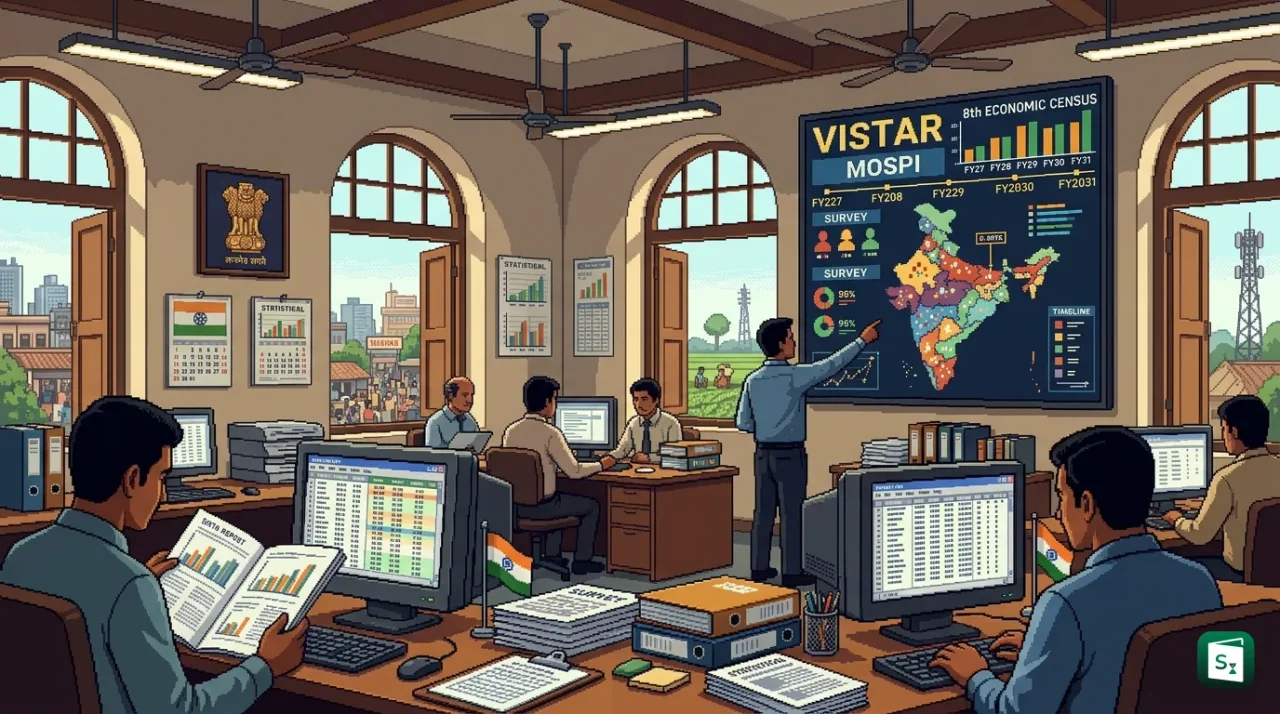
The Union Cabinet chaired by Prime Minister Narendra Modi approved the Viksit Bharat Initiative for Statistical Transformation, Analytics and Research (VISTAR) on 4 November 2026 with an outlay of ₹4,371.1 crore for FY27 to FY31. The central sector scheme brings all statistical and data work of the Ministry of Statistics and Programme Implementation (MoSPI) under one umbrella for the 16th Finance Commission cycle. It aims to build a real time, AI ready statistics system to guide policy for the Viksit Bharat 2047 goal of a developed India by 2047.
What Is the VISTAR Scheme?
The VISTAR Scheme is a central sector scheme. This means the Union Government funds the full cost from its budget, with no state share required. The scheme covers the five year period from 1 April 2026 to 31 March 2031, which is the same as the award period of the 16th Finance Commission. The total approved cost is ₹4,371.1 crore.
MoSPI will use VISTAR to run all its large surveys, data systems and research work under one plan. Earlier, surveys and support programmes were approved separately. Now MoSPI can shift money and staff quickly to urgent data needs. The goal is faster data, finer local detail and datasets that computers can read and link easily.
The scheme has three parts:
| Component | What It Covers |
|---|---|
| Comprehensive Statistical Operations and Strengthening of Ecosystem | 59 national surveys, new indices, digital systems, use of AI and alternate data |
| Support for Statistical Strengthening (SSS) | Help to states and Union Territories to improve their statistical capacity |
| Economic Census (EC) | 8th Economic Census with states and Union Territories |
59 Surveys During the 16th Finance Commission Cycle
Under the first component, MoSPI will conduct 59 surveys during the 16th Finance Commission cycle. In the previous cycle, MoSPI conducted 43 major surveys. The larger survey programme aims to fill data gaps in services, informal enterprises and fast changing consumption patterns.
The 16th Finance Commission is the constitutional body that recommends how central taxes are shared with states. The Commission headed by Arvind Panagariya recommended that states receive 41 percent of the divisible pool of central taxes for FY27 to FY31. MoSPI has aligned its survey calendar with this same five year period so that policy data matches the finance cycle.
Two new indicators are planned. The Headline Index of Services Production will track output of the services sector, which now forms the largest part of Indian GDP. The Index of Unincorporated Sector Enterprises will track small firms that are not registered as companies. Both will help measure parts of the economy that current indices capture poorly.
MoSPI will also change how it collects and checks data. End to end digital collection will replace paper schedules. Artificial Intelligence (AI) and Machine Learning (ML) will be used for data processing, validation and analysis. MoSPI will add alternate sources such as mobile phone records, scanner data from retail stores and e commerce transactions to support traditional surveys. This should reduce the burden on respondents and give faster results.
The component also includes support for young researchers. MoSPI will run an Internship Scheme for students and invite research proposals from academic institutions. The aim is to build skills and improve methods for future surveys such as the Periodic Labour Force Survey (PLFS), the Household Consumption Expenditure Survey (HCES), the Annual Survey of Unincorporated Sector Enterprises (ASUSE) and the Annual Survey of Industries (ASI).
What Is Economic Census and Why the 8th Census Matters?
The Economic Census is a complete count of all non farm business units in India and the workers they employ. It covers shops, factories, offices, transport units and service providers outside crop production and plantation. It is conducted by MoSPI together with state Directorates of Economics and Statistics.
Seven Economic Censuses have been completed so far. The first was held in 1977 and covered only non agricultural units with hired workers. Later rounds expanded coverage and improved methods. The table below gives the sequence:
| Census | Year |
|---|---|
| 1st Economic Census | 1977 |
| 2nd Economic Census | 1980 |
| 3rd Economic Census | 1990 |
| 4th Economic Census | 1998 |
| 5th Economic Census | 2005 |
| 6th Economic Census | 2013 to 2014 |
| 7th Economic Census | 2019 to 2021 |
The 8th Economic Census will be the next count. It will record activity details of every non farm establishment down to gram panchayat level in villages and ward level in towns. Enumerators will visit each unit and collect data through mobile devices with Computer Assisted Personal Interviewing.
The results will serve three clear uses. First, they will give a fresh picture of the unorganised sector, which employs crores of workers but is poorly measured. Second, they will help estimate the share of this sector in Gross Domestic Product (GDP), which is the total value of goods and services produced in the country. Third, they will form the base for a National Statistical Business Register. This register is a live list of businesses that MoSPI can use to select samples for enterprise surveys and targeted support.
How Support for Statistical Strengthening Will Help States
The Support for Statistical Strengthening (SSS) is an ongoing sub scheme that helps states and Union Territories build their own data systems. It is run through state Directorates of Economics and Statistics. The scheme started in 2010 to improve collection, compilation and release of reliable statistics at the state level.
Under VISTAR, SSS will run in a redesigned form called SSS 2.0. Funds will be linked to clear outputs. A state will receive money only after it completes agreed tasks such as publishing an indicator or building a database. This deliverable linked model aims to improve quality and timely release.
MoSPI will give both money and technical help. The focus is on granular data for local policy. MoSPI will help states prepare district level estimates and estimates for million plus cities in flagship surveys such as PLFS, HCES and ASUSE. It will also support compilation of State GDP, District GDP and State level Index of Industrial Production (IIP). The IIP is a monthly index that tracks output of mining, manufacturing and electricity.
SSS 2.0 also pushes common standards. States will adopt uniform classifications, data cataloguing and privacy safeguards. This will allow central and state datasets to be linked. Better district data will help target welfare, plan infrastructure and track Sustainable Development Goals at the local level.
What Is MoSPI and How It Runs Indian Statistics?
MoSPI stands for the Ministry of Statistics and Programme Implementation. It is the nodal ministry for official statistics in India. The ministry came into existence on 15 October 1999 after the merger of the Department of Statistics and the Department of Programme Implementation. It is headquartered in New Delhi.
MoSPI has two wings. The Statistics Wing is called the National Statistical Office (NSO). The NSO was formed by merging the Central Statistics Office (CSO) and the National Sample Survey Office (NSSO). The CSO handles national accounts, GDP, Index of Industrial Production and Consumer Price Index. The NSSO conducts large household surveys such as employment, consumption and enterprise surveys. The Programme Implementation Wing monitors infrastructure projects and the Members of Parliament Local Area Development Scheme.
Two bodies support this work. The National Statistical Commission (NSC) was set up in 2005 and became functional in 2006 to advise on standards and methods. The Indian Statistical Institute (ISI), declared an institute of national importance by an Act of 1959 and headquartered in Kolkata, provides research and training support.
Training is led by the National Statistical Systems Training Academy (NSSTA). The academy was established in February 2009 and is located at Knowledge Park II in Greater Noida, Uttar Pradesh. It trains central and state statistical staff in survey methods, data analytics and digital tools. Under VISTAR, NSSTA will play a larger role in capacity building for AI ready data systems.
Why Accurate Statistics Matter for Viksit Bharat 2047
Viksit Bharat 2047 is the government vision to make India a developed nation by 2047, when the country completes 100 years of independence. The vision rests on rapid growth, removal of poverty, quality education and health for all, skilled jobs and strong participation of women and farmers in the economy.
Good statistics are the base for this plan. GDP growth, inflation, jobs and poverty can only be tracked if surveys are timely and cover the right groups. At present, services and unregistered firms are under measured. District GDP is compiled by only about 23 states. The results of the 7th Economic Census, conducted during 2019 to 2021, faced delays over data quality concerns. VISTAR aims to close these gaps before the next finance cycle ends.
The scheme also prepares India for the next round of large counts. The Census 2027 India exercise will update population data. The Socio Economic and Caste Census 2011 remains the last detailed source on rural deprivation for many welfare lists. Updated business and population frames will help link people, firms and places. With harmonised codes, machine readable files and privacy by design, ministries can share data safely and use AI tools for faster decisions from Delhi down to the district.
Key Takeaways
- The Cabinet approved the VISTAR Scheme on 4 November 2026 with an outlay of ₹4,371.1 crore for FY27 to FY31.
- MoSPI will conduct 59 surveys in the 16th Finance Commission cycle, up from 43 major surveys in the previous cycle.
- The 8th Economic Census will count all non farm establishments down to gram panchayat and ward level and build the National Statistical Business Register.
- Seven Economic Censuses have been held since the first in 1977, with the 7th held during 2019 to 2021.
- MoSPI, formed on 15 October 1999 and based in New Delhi, runs statistics through the NSO, with training at NSSTA Greater Noida set up in February 2009.