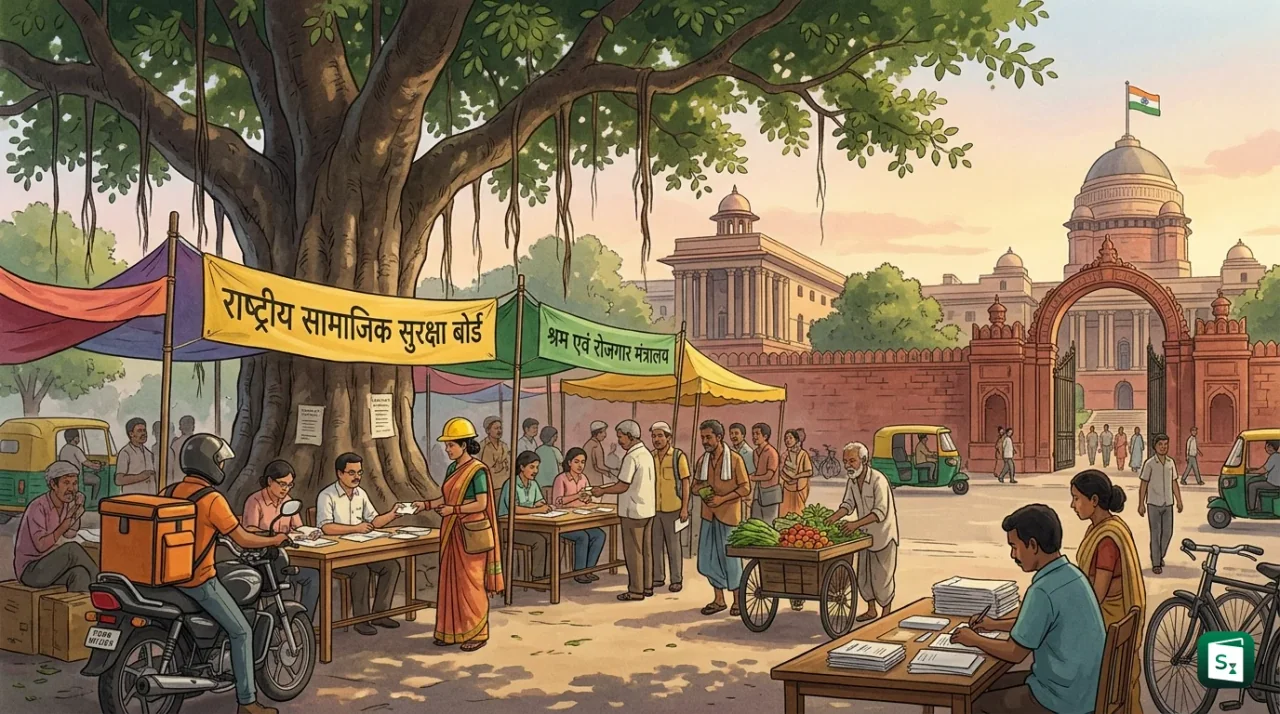
The Ministry of Labour and Employment notified the constitution of two National Social Security Boards on 30 October 2026 for unorganised workers and for gig and platform workers under the Code on Social Security 2020. The boards will recommend, monitor and review welfare schemes for millions of informal and app based workers across India. The move gives statutory backing to social protection for gig work for the first time in the country.
What Are the Two National Social Security Boards Notified on 30 October 2026?
The Ministry of Labour and Employment issued the notification for the two boards on 30 October 2026. The boards are set up under the Code on Social Security 2020, which came into force on 21 November 2025. They create a permanent statutory forum to plan welfare for workers outside regular employer linked benefits.
The notification creates two separate boards with different size and focus.
| Feature | Board for Unorganised Workers | Board for Gig and Platform Workers |
|---|---|---|
| Full name | National Social Security Board for Unorganised Workers | National Social Security Board for Gig and Platform Workers |
| Total strength | 40 members | 22 members |
| Main focus | Traditional informal workers such as farm labourers, street vendors, domestic workers and construction workers | Workers who earn through apps and digital platforms such as ride sharing, food delivery and home services |
| Legal basis | Section 6 of the Code on Social Security 2020 | Section 114(6) of the Code on Social Security 2020 |
The unorganised workers board follows the composition laid down in Section 6. The gig and platform workers board uses the same parent board but with a different membership mix prescribed for gig related matters. This design allows one law to serve both traditional informal work and new forms of app based work.
Who Chairs the Boards and Who Are the Members?
The Union Minister for Labour and Employment Mansukh Mandaviya chairs both boards. The Secretary in the Ministry of Labour and Employment Chandra Bhushan Kumar serves as Vice Chairperson. Kumar is a 1996 batch officer who took charge as Labour Secretary in August 2026 after serving as Chief Secretary of the Andaman and Nicobar Islands. The tenure of both boards is three years.
Membership brings the government, companies and workers to the same table. Central ministries, state labour departments, aggregator companies, employers, civil society groups, unions and gig associations are all represented. Labour department officers from Maharashtra, Uttar Pradesh, West Bengal, Andhra Pradesh and Gujarat are included as state members.
The composition differs for the two boards.
- The 40 member unorganised workers board includes seven representatives each of unorganised workers, employers and civil society. It also includes two members from the Lok Sabha and one from the Rajya Sabha, ten members from central ministries and departments, five members from state governments and one from the Union Territories. The Director General of Labour Welfare acts as Member Secretary.
- The 22 member gig and platform workers board includes five representatives of aggregators and five representatives of gig and platform workers. Aggregators named in the notification include Eternal Group (Zomato), Swiggy, Zepto, Urban Company and Rapido. Worker side bodies include the Bharatiya Mazdoor Sangh, the Indian Federation of App Based Transport Workers (IFAT) and the National Front of Indian Trade Unions. It also includes the Director General of the Employees State Insurance Corporation, the Central Provident Fund Commissioner, expert members, five state government representatives and a Joint Secretary in the Labour Ministry as Member Secretary.
The boards must meet at least three times in a year. They will follow the rules of procedure for transaction of business as prescribed by the central government.
What Will the National Social Security Boards Do?
The boards do not pay benefits directly. They act as the top advisory and monitoring body for social security planning. Their work guides which schemes the central government frames and how central schemes are tracked.
The Code assigns six main functions to the boards.
- Recommend to the central government suitable schemes for different sections of unorganised workers, gig workers and platform workers.
- Advise the central government on matters arising from administration of the Code when such matters are referred to the boards.
- Monitor social welfare schemes for unorganised, gig and platform workers that are run by the central government.
- Review record keeping functions performed at the state level.
- Review expenditure from the social security fund and accounts.
- Take up any other function assigned by the central government.
In practice, this means the boards will identify gaps in life cover, accident cover, health care and old age protection. They will suggest new schemes for groups such as street vendors, domestic workers, delivery riders and cab drivers. They will also check if states maintain correct worker records and if fund money is spent properly.
What Is the Code on Social Security 2020?
The Code on Social Security 2020 is the law under which the two boards are formed. Parliament passed the Code on 28 September 2020. The central government brought most of its provisions into force on 21 November 2025 along with three other labour codes.
The four labour codes together replace 29 older central labour laws. The four codes are the Code on Wages 2019, the Industrial Relations Code 2020, the Code on Social Security 2020 and the Occupational Safety, Health and Working Conditions Code 2020.
The Social Security Code alone merges nine older laws into one framework.
| Merged Law | What It Covered |
|---|---|
| Employees Compensation Act 1923 | Compensation for injury at work |
| Employees State Insurance Act 1948 | Health insurance and medical benefits |
| Employees Provident Funds and Miscellaneous Provisions Act 1952 | Provident fund and pension |
| Employment Exchanges Act 1959 | Job vacancy reporting |
| Maternity Benefit Act 1961 | Leave and benefits for working mothers |
| Payment of Gratuity Act 1972 | Gratuity on retirement or exit |
| Cine Workers Welfare Fund Act 1981 | Welfare of film workers |
| Building and Other Construction Workers Cess Act 1996 | Cess for construction worker welfare |
| Unorganised Workers Social Security Act 2008 | Welfare of unorganised workers |
The Code is run by the Ministry of Labour and Employment, which is headquartered at Shram Shakti Bhawan on Rafi Marg in New Delhi. It extends social protection to organised, unorganised, gig and platform workers under one umbrella. It also sets a single definition of wages, expands Employees State Insurance Corporation cover and allows gratuity for fixed term staff after one year.
Detailed working rules are laid down in the Social Security (Central) Rules 2026, notified on 8 May 2026. The Rules require real time registration of gig and platform workers on the central portal, sharing of worker data by aggregators through application programming interface and clear eligibility conditions for benefits.
What Are Gig Workers, Platform Workers and Unorganised Workers?
The Code on Social Security 2020 defined gig workers and platform workers in Indian law for the first time. These definitions decide who can claim benefits under the new boards and the Social Security Fund.
A gig worker is a person who earns outside a traditional employer and employee relationship and is paid per task or assignment. A platform worker is a type of gig worker who finds customers through an online app or digital platform and is paid for that platform based work. A delivery rider for Swiggy or Zomato, a cab driver for Ola or Uber, a home service professional for Urban Company and a freelance designer who takes short projects are common examples of gig workers.
An unorganised worker is a person who works in the unorganised sector, including self employed workers, home based workers, domestic workers, street vendors and daily wage earners. These workers were earlier covered by the Unorganised Workers Social Security Act 2008. That 2008 law has now been merged into the 2020 Code.
The gig economy is the wider job market where short term tasks, freelance projects and platform based services replace long term fixed jobs. Work is split into small gigs. Workers can log in to one or more apps, accept tasks and move across platforms. NITI Aayog, the public policy think tank headquartered in New Delhi and formed in 2015, calls this the gig and platform economy.
| Worker Type | How Work Is Found | Employer Link | Example |
|---|---|---|---|
| Gig worker | Direct clients, contractors or apps | No long term employer, paid per task | Freelance electrician, casual construction worker |
| Platform worker | Only through an online platform of an aggregator | Work is routed and rated by the app | Food delivery rider, ride share driver |
| Unorganised worker | Local markets, households, informal sites | Self employed or informal wage work | Street vendor, farm labourer, domestic helper |
Gig workers may be formal or informal in economic terms, but the Code treats them as a separate category for welfare. This matters because platform workers switch apps often. Each worker gets a single Aadhaar linked identity through registration, so benefits remain portable when the worker changes platforms.
How Will Social Security for Gig and Platform Workers Be Funded?
The Code allows the central government to notify suitable schemes for gig and platform workers under Section 114. The schemes can cover life and disability cover, accident insurance, health and maternity benefits, old age protection, creche facilities and any other benefit decided by the government. Each scheme will spell out how it is run, which agency implements it, the role of aggregators and the source of money.
Funding can come from several channels.
- Fully funded by the central government.
- Shared between the central government and state governments.
- Fully funded by aggregator contributions.
- Shared between governments, aggregator contributions and worker contributions.
- Funded from company social responsibility funds under the Companies Act 2013.
- Funded from any other notified source.
The main new source is the Social Security Fund. Aggregators that fall in the categories listed in the Seventh Schedule must pay between 1 percent and 2 percent of their annual turnover into this fund. The payment cannot exceed 5 percent of the amount paid or payable by the aggregator to gig and platform workers in a year. Annual turnover for this calculation does not include tax, levy and cess paid to the central government. The central government can exempt any aggregator or class of aggregators by notification.
Registration is the gateway to benefits. Every unorganised, gig or platform worker above 16 years of age must register with a self declaration and Aadhaar. Registration takes place on the central government portal and the e-Shram portal, which was launched on 26 August 2021 to build the National Database of Unorganised Workers. Registered workers receive a Universal Account Number (UAN). The Code also provides for toll free helplines and facilitation centres to help workers register and join schemes.
Why Do Unorganised and Gig Workers Need Statutory Welfare Boards Now?
India has one of the largest informal workforces in the world. More than 31.78 crore unorganised workers were registered on e-Shram by July 2026. Uttar Pradesh, Bihar and West Bengal account for the highest registrations. More than half the registrants are women. The e-Shram One Stop Solution, launched on 21 October 2024, links 14 central schemes such as Pradhan Mantri Suraksha Bima Yojana, Pradhan Mantri Jeevan Jyoti Bima Yojana, Ayushman Bharat Pradhan Mantri Jan Arogya Yojana and Pradhan Mantri Street Vendors Atmanirbhar Nidhi to a single login.
The gig segment is growing fast but remains outside traditional employer benefits like provident fund and employee insurance. NITI Aayog estimated 77 lakh gig workers in 2020-21. It projects over 1 crore workers in 2024-25 and 2.35 crore workers by 2029-30. About 47 percent of gig work is in medium skilled jobs, with the rest in low and high skilled roles.
Policy support has built up in stages. The Union Budget for 2025-26 announced registration of platform workers on e-Shram, issue of identity cards and health cover under Ayushman Bharat Pradhan Mantri Jan Arogya Yojana, which gives ₹5 lakh per family per year for hospital care in over 31,000 public and private hospitals. Three special registration drives were held in April, May and August to September 2025 with states and Union Territories. By July 2026, over 10.65 lakh platform workers were registered on e-Shram. Twelve aggregators, including Zomato, Blinkit, Urban Company, Uber, Ola, Amazon, Swiggy, Rapido and Zepto, joined the e-Shram aggregator module.
The new boards give this process a legal anchor. They will advise on scheme design, track enrolment, check state records and review fund use. Worker groups have said the real test will be quick rollout of life, health and pension benefits and fair representation on the boards. The government view is that a single statutory board for both traditional and platform work will close the social security gap as informal and digital jobs expand together.
Key Takeaways
- The Ministry of Labour and Employment notified two National Social Security Boards on 30 October 2026 for unorganised and gig and platform workers.
- The boards have 40 members and 22 members respectively, a tenure of three years and a mandate to meet at least three times a year.
- Both boards are chaired by Mansukh Mandaviya, with Labour Secretary Chandra Bhushan Kumar as Vice Chairperson.
- The boards are set up under Section 6 and Section 114(6) of the Code on Social Security 2020, which came into force on 21 November 2025 and merged nine labour laws.
- Aggregators must pay 1 percent to 2 percent of annual turnover to the Social Security Fund, capped at 5 percent of payouts to gig and platform workers.