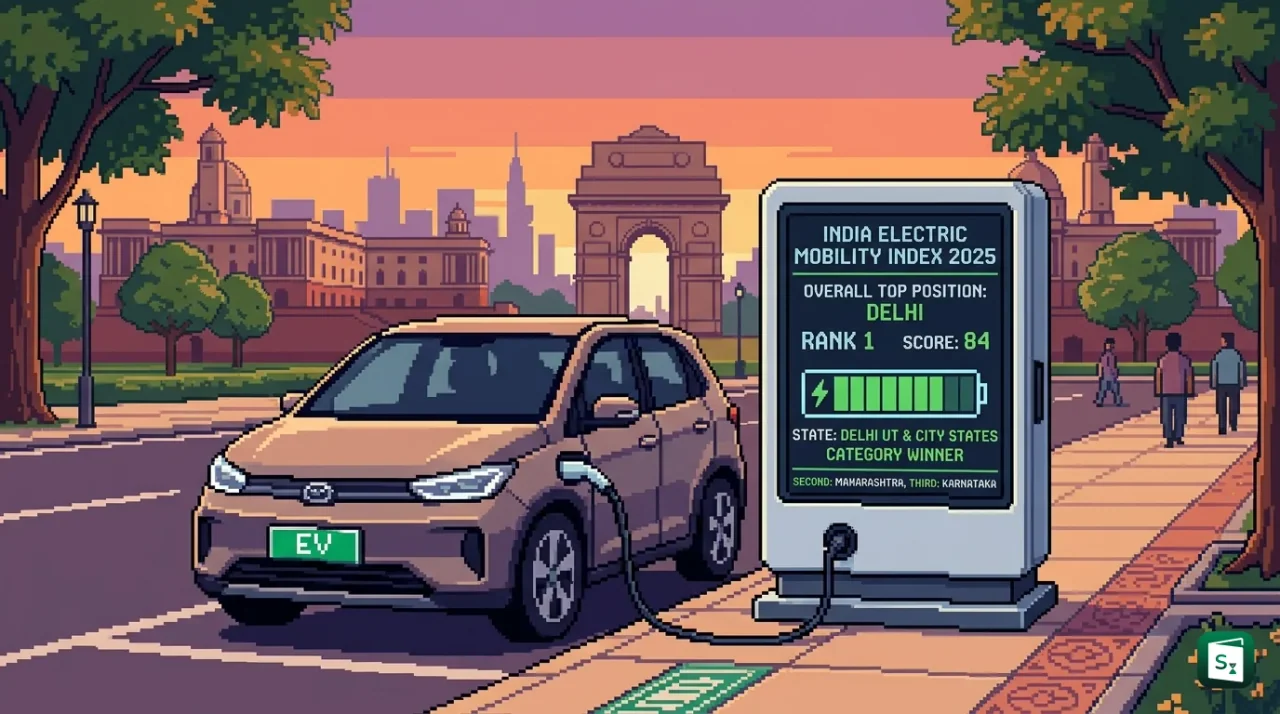
NITI Aayog released the second edition of the India Electric Mobility Index 2025, titled Tracking Electric Mobility Trends in Indian States, in collaboration with WRI India. Delhi retained the top position in the overall ranking with a score of 84, followed by Maharashtra at 78 and Karnataka at 73. The index, which covers data for January to December 2025, shows rising competition among states as 29 states and Union Territories have now notified dedicated electric vehicle policies.
What Is Electric Mobility and What Is the Electric Mobility Index?
Electric mobility means the use of vehicles that run on electricity instead of petrol or diesel. It includes electric two wheelers, three wheelers, cars, buses and goods carriers, along with charging stations, batteries and related services. It helps cut fuel imports, air pollution and carbon emissions from road transport.
The India Electric Mobility Index (IEMI) is a score out of 100 developed by NITI Aayog with WRI India to track electric mobility progress in 28 states and 8 Union Territories. It compares states on adoption of electric vehicles, charging infrastructure and research and innovation. A higher score shows stronger overall performance across these three areas.
NITI Aayog, which stands for the National Institution for Transforming India, is the apex public policy think tank of the Government of India. It was set up on 1 January 2015 through a Union Cabinet resolution and works to promote cooperative federalism by involving states in economic policy making. WRI India, registered as the India Resources Trust, is the India arm of the World Resources Institute. Its work in India started in 2008 and it was formally established in 2011, with offices in Mumbai, Bengaluru and New Delhi.
The first edition of the index, IEMI 2024, was launched in August 2025. The IEMI 2025 report is the second edition. It builds on the 2024 framework and adds state categories, more data points and feedback received from states and Union Territories. The IEMI dashboard is available at iemi.niti.gov.in and allows users to compare states, view state profiles and study market insights on electric vehicle sales.
NITI Aayog Report 2025: Release and Institutional Context
NITI Aayog released the India Electric Mobility Index 2025 report on 16 September 2026 at a national workshop on state electric vehicle policies in New Delhi. NITI Aayog member Rajiv Gauba launched the index. Senior officials from the Ministry of Heavy Industries and state transport departments took part in the discussion on how state policies can support national goals.
The IEMI 2025 report assesses performance for the period from January to December 2025 across all 28 states and 8 Union Territories. It is the second annual cycle after IEMI 2024. The report notes that 29 of 36 states and Union Territories have now notified dedicated electric vehicle policies, which shows wider policy acceptance in one year.
Overall performance improved over the first edition. The highest overall score rose from 77 in IEMI 2024 to 84 in IEMI 2025. The median score for all states and Union Territories increased from 36 to 40. NITI Aayog linked this shift to stronger demand incentives, growth in charging networks and clearer state level targets. At the launch, NITI Aayog described the move to electric vehicles as an economic, environmental and strategic need for the Viksit Bharat 2047 vision, pointing to high crude oil import dependence and the large role of the automobile sector in jobs and output.
How the Index Measures States: Three Themes and 16 Indicators
The India Electric Mobility Index tracks, evaluates and scores every state and Union Territory out of 100 across 16 indicators grouped under three core themes. The IEMI score is the weighted composite of the three themes. A higher score means stronger adoption of electric vehicles, better charging availability and a stronger local innovation base.
| Theme | What It Captures | Weightage |
|---|---|---|
| Transport Electrification Progress | Demand side adoption of electric two wheelers, three wheelers, cars, buses and goods carriers, along with policy support and incentives | 50% |
| Charging Infrastructure Readiness | Availability of public charging stations, related power supply, nodal agency and approval systems for chargers | 30% |
| EV Research and Innovation Status | Supply side strength such as research activity, startups, patents and ecosystem support for manufacturing | 20% |
The 16 indicators include both enablers and outcomes. Enablers record whether a state has specific actions in place, such as a notified electric vehicle policy, purchase incentives, road tax exemption, a single window system for charger approvals and a nodal agency for charging. Outcomes record actual results, such as share of electric vehicles in new registrations, number of public chargers per lakh population and growth in the startup base.
IEMI 2025 groups states and Union Territories into three categories for fair comparison. The categories are Large States, UTs and City States, and Hilly and Northeastern States. This grouping was introduced while building on the IEMI 2024 framework. It helps compare states with similar size, terrain and transport needs. The report also places states in performance bands such as top performer, frontrunner and emerging performer based on their composite scores.
India Electric Mobility Index 2025: Overall Scores and State Rankings
Delhi recorded the highest overall score in the country at 84, followed by Maharashtra (78), Karnataka (73), Chandigarh (71) and Goa (65). Delhi improved from 77 to 84 and kept the first rank. Maharashtra also kept the second rank while raising its score from 68 to 78. Karnataka moved up one position to third with 73 and pushed Chandigarh to fourth, even though Chandigarh improved from 65 to 71.
| Overall Rank | State or Union Territory | IEMI 2025 Score | Change Over IEMI 2024 |
|---|---|---|---|
| 1 | Delhi | 84 | Up from 77 |
| 2 | Maharashtra | 78 | Up from 68 |
| 3 | Karnataka | 73 | Moved up one rank |
| 4 | Chandigarh | 71 | Up from 65 |
| 5 | Goa | 65 | Climbed 10 positions |
The report notes that progress was uneven. Tamil Nadu improved from 59 to 61 but slipped one place to sixth because Goa rose faster. Madhya Pradesh made the biggest jump, climbing 16 positions from 23rd to 7th, with its score rising from 31 to 59. Goa climbed 10 positions to fifth. Puducherry also climbed 10 places to 17th with a score of 41. Bihar rose eight positions to 18th with 40, while Assam moved up three places to 24th with 35. Some states and Union Territories recorded falls in rank or score, which shows that gains in adoption, infrastructure and innovation are not spread evenly.
Large States Ranking and Maharashtra Electric Vehicle Policy Push
In the Large States category, Maharashtra ranked first, followed by Karnataka and Tamil Nadu. Maharashtra and Karnataka were the only two large states placed in the top performer band. Eight other large states were placed as frontrunners. These were Tamil Nadu with 61, Madhya Pradesh with 59, Odisha with 55, Andhra Pradesh with 52, and Telangana, Haryana, Rajasthan and Uttar Pradesh with 51 each.
Maharashtra benefits from a large vehicle market, an early electric vehicle policy and a growing charging network in Mumbai, Pune and the Mumbai Pune Expressway corridor. Karnataka benefits from a strong manufacturing and startup base in Bengaluru, along with sustained support for research and innovation. Tamil Nadu, with manufacturing clusters around Chennai and Hosur, remains a key production hub even though its overall rank slipped in 2025.
Hilly and Northeastern States: Manipur Leads
In the Hilly and Northeastern States category, Manipur topped with 46, followed by Tripura with 36 and Assam with 35. Manipur, Tripura and Assam were classed as emerging performers. The report notes that half the states in this group face research and innovation as the main constraint, which reflects limited manufacturing units, fewer startups and difficult terrain for charging networks.
Assam improved to 35 and moved up three ranks. Jammu and Kashmir rose seven places to 27th with a score of 31, which the report lists among the notable gains. The grouping helps highlight local needs such as small demand pools, hilly roads and higher logistics costs, where central support and shared charging models matter more.
UTs and City States: Delhi, Chandigarh and Goa
In the UTs and City States category, Delhi ranked first with 84, followed by Chandigarh with 71 and Goa with 65. All three were placed in the top performer band. Puducherry with 41 was the sole emerging performer in this group. Small area, high vehicle density and greater scope for public charging help city administrations score better on adoption and infrastructure per capita.
Delhi Electric Vehicle Policy: Why Delhi Retains the Top Rank
Delhi, the National Capital Territory and the national capital, has led both editions of the index. The IEMI 2025 report records that Delhi scored 94 in the EV Research and Innovation Status theme, the highest theme score for any state. Delhi also led in Transport Electrification Progress along with Chandigarh and Maharashtra, which were the only three states and Union Territories to cross a high threshold in that theme.
Policy continuity is a key reason. Delhi notified its first Delhi Electric Vehicle Policy in 2020. The Delhi Cabinet approved the next phase, the Delhi Electric Vehicle Policy 2.0 for 2026 to 2030, which took effect on 1 July 2026. The policy carries an outlay of about ₹3,954 crore in the draft stage, with reports of a larger ₹15,000 crore investment plan over four years to cut vehicular pollution and build the ecosystem.
The 2.0 policy gives 100% exemption from road tax and registration fees till 31 March 2030 for electric vehicles registered in Delhi. Electric cars with ex showroom price up to ₹30 lakh get full exemption, while strong hybrid cars in the same price band get 50% relief. Purchase incentives taper over three years to reward early buyers. Electric two wheelers priced up to ₹2.25 lakh can get up to ₹30,000 in year one, ₹20,000 in year two and ₹10,000 in year three. Electric three wheelers can get ₹50,000, ₹40,000 and ₹30,000 over the same period, while small electric goods carriers in the N1 category can get up to ₹1 lakh in year one. Scrapping linked support includes up to ₹1 lakh for cars and ₹25,000 for three wheelers when an old Delhi registered BS IV or older vehicle is scrapped and replaced with an electric vehicle.
The policy also sets clear mandates. Delhi is the first state or Union Territory to mandate 100% electrification of new autorickshaws and light commercial vehicles from 1 January 2027 and of new two wheelers from 1 April 2028. Fleet aggregators cannot add new petrol or diesel vehicles in covered segments from 2026, government departments will buy or lease only electric vehicles, and school bus fleets must move in stages toward 30% electric by 2030. As of February 2026, Delhi was operating 4,286 electric buses, the largest electric bus fleet in India. The report also notes that Delhi was the first state to provide subsidies for electric cycles.
Electric Vehicle Landscape in India and Policy Impact
Electric vehicles in India are led by two wheelers and three wheelers. At the IEMI 2025 launch, officials noted that India sold about 21 million two wheelers in the previous year, of which about 1.4 million were electric, a share of around 7.65%. India ranks behind only China in electric two wheelers, holds the first position in electric three wheelers and has the third largest market for electric cars. Electric two wheelers and three wheelers together account for most new electric vehicle sales, while electric cars and buses are growing from a smaller base.
Central support works through schemes such as the Faster Adoption and Manufacturing of Electric Vehicles (FAME) scheme, the Electric Mobility Promotion Scheme (EMPS) 2024 and the PM Electric Drive Revolution in Innovative Vehicle Enhancement (PM E-DRIVE) scheme. These schemes give demand incentives linked to battery capacity, support charging infrastructure and aim to build domestic manufacturing. State policies add road tax relief, purchase subsidies and scrapping incentives on top of central support.
The stakes are large. India imports nearly 89% of its crude oil needs, so wider use of electric vehicles can lower the fuel import bill and improve energy security. The automobile sector contributes about 7.1% of gross domestic product (GDP) and supports nearly 19 million jobs, so keeping factories, suppliers and workers aligned with the global shift to electric models matters for growth. Better charging access also shapes results. Power consumption data for public charging shows Delhi and Maharashtra drawing the largest shares, which matches their lead in the index.
The Way Forward
The IEMI 2025 report points to three clear tasks for states. First, states that are still emerging need to notify or update electric vehicle policies and set up a nodal agency with a single window system for charger approvals. Second, charging networks must grow beyond large cities to highways, smaller towns and hilly areas, with concessional land and reliable power supply for public stations. Third, research and manufacturing need stronger links between industry, startups and technical institutes, especially in the Northeast where innovation is the main gap.
The index will be updated every year based on quarterly assessments. The score can be read as the percentage of electric mobility goals achieved by a state. Continued tracking, sharing of best practices among states and steady funding for incentives and chargers will decide whether the rise in the median score from 36 to 40 becomes a sustained national trend.
Key Takeaways
- The India Electric Mobility Index 2025 is the second edition of the index developed by NITI Aayog with WRI India for data from January to December 2025.
- Delhi retained the overall first rank with a score of 84, followed by Maharashtra (78) and Karnataka (73).
- In the Large States category, Maharashtra ranked first, followed by Karnataka and Tamil Nadu.
- Manipur topped the Hilly and Northeastern States category with 46, followed by Tripura (36) and Assam (35).
- In the UTs and City States category, Delhi ranked first, followed by Chandigarh (71) and Goa (65).
- The index scores states out of 100 across 16 indicators under three themes weighted at 50% for Transport Electrification, 30% for Charging Infrastructure and 20% for Research and Innovation.