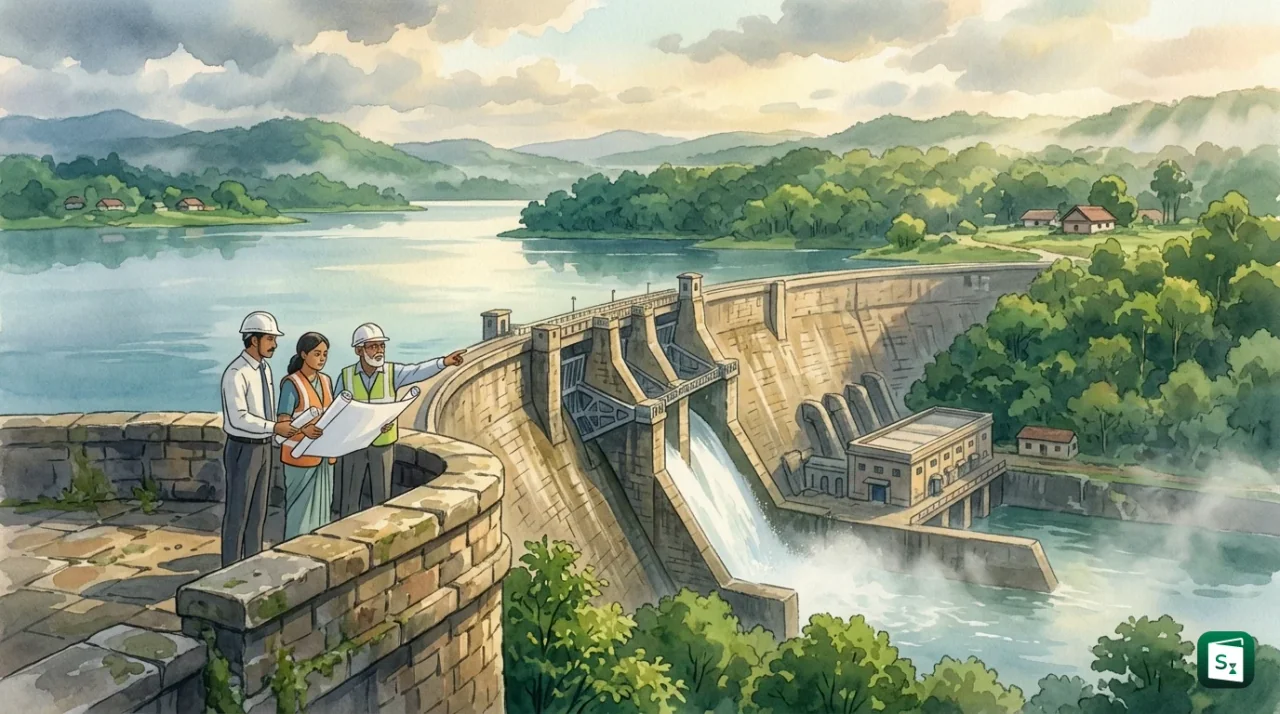
India observes National Engineers Day every year on 15 September to honour the birth anniversary of Sir Mokshagundam Visvesvaraya. In 2026 the day fell on a Tuesday and marked the 165th birth anniversary of the engineer statesman. It celebrates the role of engineers in building dams, industries, cities and digital systems that shape daily life.
Why Is Engineers Day Celebrated on 15 September in India?
National Engineers Day in India is celebrated in the memory of Sir Mokshagundam Visvesvaraya, and 15 September is his birth anniversary. India has observed the day on this date every year since 1968 to honour his work in dams, irrigation, flood protection and public administration.
The date was chosen because Visvesvaraya is widely seen as a model engineer who combined technical skill with service to society. He was born on 15 September 1861 at Muddenahalli in present day Chikkaballapura district of Karnataka. He lived for more than a hundred years and worked for nearly six decades as an engineer, administrator and adviser. The Government of India decided in 1968 that his birthday would be observed as Engineers Day, so that young people remember what engineering can do for the country.
The day has a wider meaning beyond one person. It recognises the work of all engineers, from civil and mechanical to electrical, electronics and computer science. It reminds citizens that clean drinking water, safe roads, electricity, bridges, ports, factories and mobile networks all depend on engineering design and care. Schools, colleges, government departments and professional bodies use the day to discuss new ideas in sustainability, energy, water and digital growth.
Who Was Mokshagundam Visvesvaraya?
Mokshagundam Visvesvaraya, popularly known as Sir M V or Sir MV, was an Indian civil engineer, scholar and statesman. Civil engineering is the branch of engineering that deals with roads, bridges, dams, water supply and public buildings. Visvesvaraya is remembered as the architect of modern irrigation and industrial growth in Mysore State and as the 19th Diwan of Mysore. Diwan was the chief minister and top administrator of a princely state during British rule.
Early Life and Education
Visvesvaraya was born in a Telugu speaking family that had settled in Mysore region many years earlier. His father, Mokshagundam Srinivasa Shastry, was a Sanskrit scholar, and his mother was Venkatalakshmiamma. He lost his father at a young age and paid for part of his studies by giving tuitions to other children.
He completed his primary schooling in Chikkaballapura and Bengaluru and earned a Bachelor of Arts degree from Central College, Bengaluru, affiliated to the University of Madras, in 1881. He then studied civil engineering at the College of Engineering, Pune (COEP), which was then linked to the University of Bombay. He secured first rank and received a Diploma in Civil Engineering in 1883. The College of Engineering, Pune later installed a statue in his honour.
Engineering Career and Public Service
Visvesvaraya joined the Public Works Department of the Bombay Presidency in 1885 as an Assistant Engineer. The Public Works Department is the government agency that builds roads, bridges, dams and public buildings. He worked in Nashik, Khandesh, Pune and Surat and became known for careful planning and honest use of public money.
In 1894 his services were lent to the municipality of Sukkur in present day Pakistan, where he designed waterworks for the town. In 1906 to 1907 the Government of India sent him to Aden in present day Yemen to study water supply and drainage. He also served as a consulting engineer to Hyderabad State after the Musi River floods of 1909 and guided flood protection works for the city.
He retired from British service in 1909 and joined Mysore State as Chief Engineer and Secretary. In 1912 Maharaja Krishnaraja Wodeyar IV appointed him Diwan of Mysore. He held the post till 1918 and turned the state into a model of planned growth.
Major Contributions and Honours of Visvesvaraya
Visvesvaraya believed that dams, factories, schools and banks must grow together. His best known technical invention was a system of automatic weir water floodgates. A weir is a small barrier across a river that controls the flow of water. His gates closed and opened on their own with water pressure and stopped wastage of stored water. They were first installed at the Khadakvasla Reservoir near Pune in 1903 and later used at the Tigra Dam in Gwalior and the Krishna Raja Sagara (KRS) Dam in Mysore.
The KRS Dam across the Cauvery River in Mandya district is his most famous project. The dam, named after Maharaja Krishnaraja Wodeyar, created one of the largest reservoirs in Asia at that time and turned dry land in Mandya into fertile farmland. As Chief Engineer, Visvesvaraya guided the project from design to opening in 1924. He also introduced the Block System of irrigation in the Deccan, a method that supplied fixed amounts of water to separate blocks of farmland to reduce waste.
As Diwan, he promoted industry and education with equal energy. He helped set up the Mysore Soap Factory, the Mysore Iron and Steel Works at Bhadravati (now called Visvesvaraya Iron and Steel Plant), the State Bank of Mysore, the University of Mysore in 1916 and the Government Engineering College in Bengaluru in 1917. The engineering college is now known as the University Visvesvaraya College of Engineering (UVCE). He also supported new railway lines, chambers of commerce and town planning, including the planned layout of Jayanagar in Bengaluru.
| Area | Key Work | Year or Place |
|---|---|---|
| Irrigation invention | Automatic sluice and floodgates, patented system | Khadakvasla, 1903 |
| Large dam | Design and construction of Krishna Raja Sagara Dam across Cauvery | Mandya, Mysore, 1924 |
| Flood protection | Plan for Musi River floods and protection of Hyderabad city | Hyderabad, 1909 |
| Port protection | System to protect Visakhapatnam Port from sea erosion | Visakhapatnam |
| Industry | Mysore Iron and Steel Works at Bhadravati, Mysore Soap Factory | Mysore State, 1912 to 1918 |
| Education and finance | University of Mysore, Government Engineering College, State Bank of Mysore | 1916 and 1917 |
For his public service, the British government appointed him a Companion of the Order of the Indian Empire in 1911 and knighted him as Knight Commander of the Order of the Indian Empire (KCIE) in 1915. After Independence, India honoured him with the Bharat Ratna in 1955. Bharat Ratna is India’s highest civilian award. He also received honorary doctorates from eight universities and served as president of the Indian Science Congress in 1923. The Indian Science Congress is the annual meeting of Indian scientists. He died on 14 April 1962 in Bengaluru at the age of 100.
How Is National Engineers Day Observed in 2026?
National Engineers Day 2026 was observed in India on Tuesday, 15 September 2026. Engineering colleges, schools, government departments, public sector units and private companies organised seminars, workshops, project exhibitions and talks on the role of technology in daily life. Many institutions honoured senior engineers and held competitions to build interest in science, technology, engineering and mathematics, which is commonly called STEM.
The focus theme highlighted for 2026 is Smart engineering for a sustainable future through innovation and digitalization. The theme links two urgent needs of the present. The first is sustainable growth, which means meeting present needs without harming the ability of future generations to meet their needs. The second is digital change, which includes artificial intelligence, clean energy, semiconductors, space systems and safe infrastructure. The theme asks engineers to use digital tools to build systems that are efficient, inclusive and friendly to the environment.
In New Delhi, the Prime Minister paid tribute to Visvesvaraya and greeted engineers for driving innovation and helping the goal of a developed India by 2047. Similar greetings were shared by ministers, governors and industry bodies across states. In Karnataka, the birthplace of Visvesvaraya, the day is also observed as Visvesvaraya Jayanti. Jayanti means birth anniversary in Indian languages. Programmes are held at Muddenahalli, Mysuru and Bengaluru, including at the memorial and museum dedicated to him.
How Is National Engineers Day Different From World Engineers Day?
Many readers confuse National Engineers Day in India with World Engineers Day. The two days have different origins, dates and organisers, though both celebrate the same profession.
World Engineering Day for Sustainable Development is a global day proclaimed by the United Nations Educational, Scientific and Cultural Organization (UNESCO) in 2019. UNESCO is headquartered in Paris, France and works for education, science and culture. The world day is celebrated every year on 4 March and is coordinated with the World Federation of Engineering Organizations (WFEO). WFEO is the global body of national engineering institutions. The 2026 world celebration was held in Jakarta, Indonesia. The 2025 celebration in Paris focused on unleashing the power of engineers to advance the Sustainable Development Goals. Sustainable Development Goals are the 17 global targets set by the United Nations for 2030 on poverty, health, water, energy, climate and growth.
| Point | National Engineers Day, India | World Engineering Day for Sustainable Development |
|---|---|---|
| Date | 15 September every year | 4 March every year |
| Started | Observed since 1968 | Proclaimed in 2019, observed since 2020 |
| Honours | Birth anniversary of Sir M Visvesvaraya | Role of engineers in meeting global goals |
| Led by | Schools, colleges, governments and industry in India | UNESCO with WFEO and member institutions |
| 2026 focus | Smart engineering for a sustainable future through innovation and digitalization | Same global theme discussed at Jakarta meet |
India also shares its date with Sri Lanka and Tanzania, where 15 September is observed in memory of Visvesvaraya. The American term Professional Engineers Day and the branch term Civil Engineer Day are sometimes searched online, but they are not the official Indian observance. In India the correct name is National Engineers Day on 15 September.
Institutions That Preserve the Visvesvaraya Legacy
The name of Visvesvaraya lives on in universities, colleges, museums and plants across India. The Visvesvaraya Technological University (VTU), headquartered at Belagavi in Karnataka, was established in 1998 and affiliates most engineering colleges in the state. The Visvesvaraya National Institute of Technology (VNIT) at Nagpur in Maharashtra is one of the 31 National Institutes of Technology. National Institutes of Technology are central government funded technical institutes. The University Visvesvaraya College of Engineering in Bengaluru, founded in 1917, is Karnataka’s first engineering college and fifth oldest in India.
The Visvesvaraya Industrial and Technological Museum (VITM) in Bengaluru was established in memory of Visvesvaraya. It works under the National Council of Science Museums of the Ministry of Culture and stands on Kasturba Road near Cubbon Park. The foundation stone was laid on 15 September 1958 and the museum was opened by Prime Minister Jawaharlal Nehru on 14 July 1962. The museum displays engines, industrial products and science models and receives more than a million visitors in many years.
His ideas on planning also survive in books. His well known works include Reconstructing India, published in 1920, and Planned Economy for India, published in 1936. In these books he argued that India must use science, industry and village development together to remove poverty and unemployment. The Government of India also runs the Visvesvaraya PhD Scheme for Electronics and IT, which supports research in electronics and information technology. Electronics is the study of small electrical parts like chips, while information technology deals with computers and software.
Key Takeaways
- National Engineers Day in India is observed every year on 15 September to mark the birth anniversary of Sir M Visvesvaraya.
- India has observed Engineers Day since 1968, and the 2026 observance marked the 165th birth anniversary of Visvesvaraya.
- Sir M Visvesvaraya was born on 15 September 1861 at Muddenahalli in Karnataka and served as Diwan of Mysore from 1912 to 1918.
- Visvesvaraya designed automatic floodgates first installed at Khadakvasla in 1903 and guided the Krishna Raja Sagara Dam opened in 1924.
- Visvesvaraya received the Bharat Ratna in 1955 and was knighted as KCIE in 1915 for public service.
- World Engineering Day for Sustainable Development, proclaimed by UNESCO in 2019, is observed globally on 4 March and is different from India’s 15 September observance.