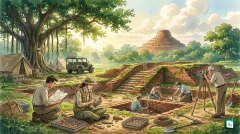
The Ministry of Culture signed a Memorandum of Understanding with Google Arts and Culture on 5 November 2026 to digitally preserve, document and share the cultural heritage of India. The agreement was signed at a virtual ceremony by Culture Secretary Vivek Aggarwal and Google Arts and Culture Vice President and Founder Amit Sood. It places the upcoming Yuge Yugeen Bharat Museum in New Delhi at its centre and extends to monuments, museums, manuscripts and living traditions across the country.
What Is Google Arts and Culture and How Will It Be Used?
Google Arts and Culture is a free online platform run by Google that hosts high resolution images, videos and virtual tours of artworks and cultural objects from partner museums and institutions around the world. The Ministry of Culture will use it to make Indian collections freely searchable and viewable on any device and in Indian languages for education, research and public enjoyment.
The platform began on 1 February 2011 as the Google Art Project. It was started by the Google Cultural Institute with 17 art museums, including the National Gallery in London, the Metropolitan Museum of Art in New York and the Uffizi in Florence. It combined Street View style indoor tours of 385 gallery rooms with super high resolution gigapixel images of 1,061 artworks by 486 artists.
Over 15 years the platform has expanded to thousands of partners in more than 40 countries. It lets users walk through museums virtually, zoom into brushwork and inscriptions, build personal collections and watch curator talks and performances. Access is free on web and mobile app, and collections remain open for students, teachers and researchers.
In India, Google Arts and Culture has worked for more than a decade with the Archaeological Survey of India (ASI), the National Museum in New Delhi and the National Gallery of Modern Art (NGMA). Recent projects include the 3D mapping of the Elephanta Caves in Maharashtra with ASI and CyArk using LiDAR scanners, and Talking Tours of more than 200 sites such as the Red Fort, Taj Mahal, Hampi and Rani ki Vav. The new MoU widens this work from selected projects to a whole of Ministry approach.
What the Ministry of Culture and Google Agreed To Do
The Ministry of Culture is the nodal central ministry for preservation and promotion of tangible and intangible heritage. Culture Secretary Vivek Aggarwal signed the MoU for the Ministry. Amit Sood, Vice President and Founder of Google Arts and Culture, signed for Google.
The MoU does not transfer ownership of any object or site. It provides for digital documentation, high resolution imaging, virtual tours and online exhibitions using advanced digital tools. The stated goals are preservation through lasting digital records, wider public access and growth of the creative economy through enduring partnerships.
The coverage reflects the full range of institutions under the Ministry:
| Heritage Group | What Will Be Digitised |
|---|---|
| ASI protected places | 3,685 monuments and archaeological sites of national importance and the collections held by site museums |
| National museums | Paintings, sculptures, archaeological objects and other artefacts in the National Museum, NGMA and other national collections |
| Manuscript heritage | Fragile texts being surveyed and conserved under Gyan Bharatam |
| Living traditions | Crafts, handloom skills, folk music, dance forms, theatre and community practices supported by zonal cultural centres and akademis |
The Ministry said the content will be made available in Indian languages and on desktops, tablets and mobile phones. This focus on language and device access is important because physical visits remain difficult for many citizens. Digital copies also serve as backup records that can guide future restoration, research and teaching if originals are damaged.
Yuge Yugeen Bharat Museum at the Centre of the Partnership
The Yuge Yugeen Bharat Museum is the centrepiece of the MoU. The Ministry said digitisation will create a lasting record of the historic buildings and the wealth of artefacts they will house. It will also give the public an early window into one of the largest museum projects in the world while work is still under way.
Prime Minister Narendra Modi first announced the museum on 18 May 2023. The Cabinet Committee on Economic Affairs approved the project on 11 November 2026 at a cost of ₹3,230 crore. The Ministry of Culture is the nodal agency for implementation.
The museum will come up in the North Block and South Block on Raisina Hill in New Delhi. The two blocks were built between 1912 and 1931 as the Secretariat of the new imperial capital. They were designed by Herbert Baker as part of the Delhi plan associated with Edwin Lutyens. After Independence the South Block housed the Prime Minister’s Office through 16 Prime Ministers, while the North Block housed the Home and Finance Ministries. The offices have now shifted to Seva Teerth and the Kartavya Bhavans, freeing the blocks for cultural use.
The plan uses adaptive reuse. Facades and original character will be retained. Courtyards, corridors, verandas and rooms will be converted into galleries. A tunnel is proposed to link the two blocks for visitor movement.
Key project figures released by the Ministry:
| Feature | Detail |
|---|---|
| Built up area | About 1,78,509 sq metres across both blocks |
| Display area | More than 1 lakh sq metres, larger than the Louvre, British Museum and Hermitage |
| Collection pool | About 18 lakh objects identified from Ministry museums, 52 ASI site museums, state museums and private collections |
| Visitor capacity | 30,000 per day and 1 crore per year with timed entry |
| Timeline | Phased development from 2026-27 to 2030-31, first gallery on Adornment in North Block in late 2027 |
The museum will present 5,000 years of Indian civilisation, from the Indus Valley cities to the present, through thematic galleries on art, knowledge systems, science, cities and daily life. In December 2024 the National Museum had signed a technical cooperation agreement with France Museums Developpement for this project. The Google partnership adds the digital layer of high resolution records, virtual previews and global exhibitions.
Manuscripts Under Gyan Bharatam and Collections of Museums and Monuments
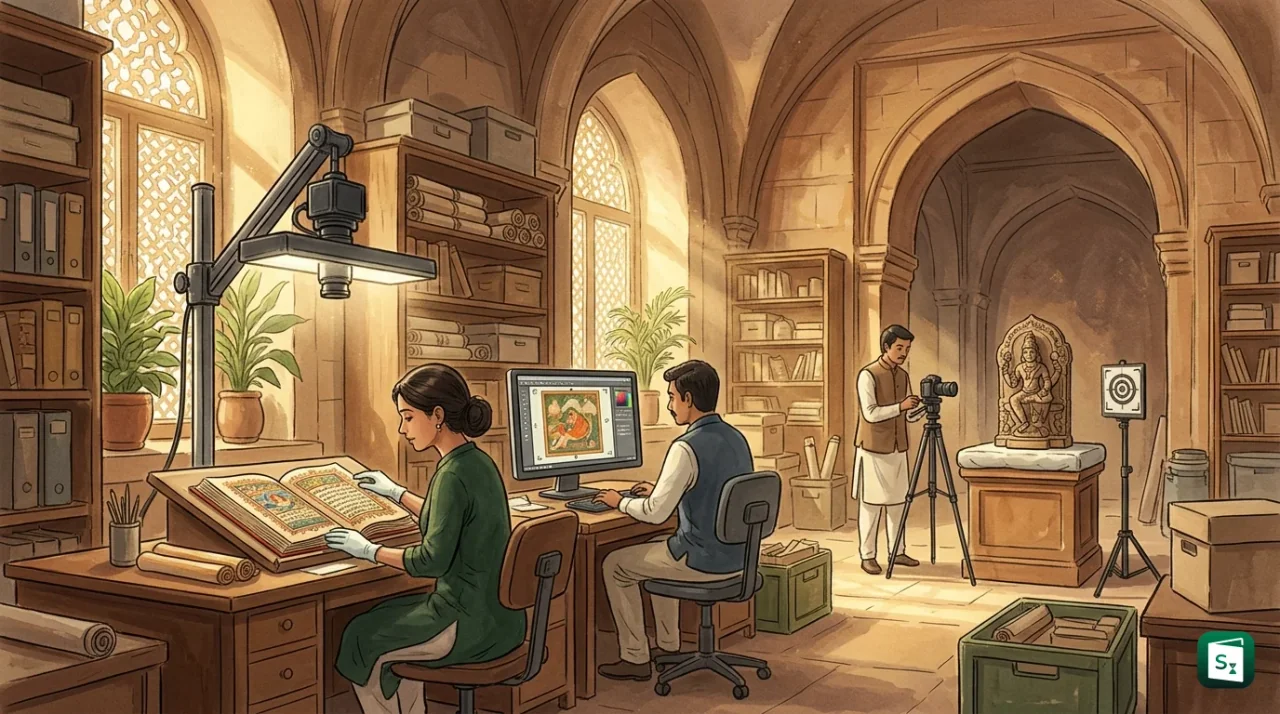
Manuscript heritage forms a major part of the MoU. Manuscripts are handwritten texts on palm leaf, birch bark and paper that record centuries of learning in philosophy, mathematics, astronomy, medicine, literature and governance. Digital heritage refers to the conversion of such physical records into lasting digital form for study and safekeeping.
Gyan Bharatam is the flagship manuscript mission of the Ministry of Culture. It was announced in the Union Budget 2025-26 and launched by the Prime Minister on 11 September 2025. It builds on the earlier National Mission for Manuscripts. The mission aims to survey, conserve, digitise and publish manuscripts held by libraries, temples, monasteries, universities and private families.
The mission has a sanctioned outlay of ₹491.66 crore for 2025 to 2031. Its target is to catalogue and digitise 1 crore manuscripts. A National Manuscript Survey began on 16 March 2026 to build a geo-tagged inventory of repositories. More than 8 lakh manuscripts have already been digitised in different formats, and more than 4.4 lakh are available in view mode on the National Digital Repository. The mission uses overhead scanners, AI assisted transcription, cloud backup and LTO-9 tapes for long term storage. Grassroots volunteers called Pandulipi Mitras are being trained in about 100 districts for survey work.
Museum and monument collections add the second layer. The ASI, established in 1861 by Alexander Cunningham, protects 3,685 monuments and sites of national importance. The National Mission on Monuments and Antiquities, set up in 2007, has documented 11,406 built heritage sites and more than 12.41 lakh antiquities. The National Museum, opened in 1949 in New Delhi, holds the premier central collection.
This background explains the scale of the new task. India had 44 UNESCO World Heritage properties after the inscription of the Maratha Military Landscapes in July 2025, rising to 45 with the inscription of the Ancient Buddhist Site of Sarnath in 2026. Thousands of other monuments, museum objects and manuscripts have never been seen online. The MoU seeks to close that gap by bringing ASI sites, national museum objects, Gyan Bharatam texts and living crafts together on one global platform.
How Digital Access Fits With the Indian Culture Portal and Related Efforts
The Google MoU is part of a wider digital push by the Ministry. The main national platform is the Indian Culture Portal. It was developed as part of the National Virtual Library of India project to host cultural data from repositories across the country.
Version 2.0 of the portal was launched in March 2026. It uses a modern scalable design with React and Drupal 10, works as a Progressive Web Application for phones, tablets and desktops, and offers content in 22 Indian languages through integration with BHASHINI. An AI chatbot called Bharti helps users search and discover content. The portal aggregates metadata through APIs from museums, libraries, archives and monuments, including the National Museum, National Archives of India, ASI site museums and state archives.
The National Mission on Monuments and Antiquities feeds this system with standardised records of sites and antiquities, which helps scholars and also checks illicit trafficking through public documentation. The Museum Grant Scheme supports creation and upgrade of museums, while the National Culture Fund mobilises public and private funds for conservation. Together with Gyan Bharatam for manuscripts, these programmes build the physical documentation and conservation base. The Google partnership builds the public showcase layer on top, with immersive tours, high resolution views and stories that can reach classrooms and homes in any language and on any device.
Key Takeaways
- The Ministry of Culture signed an MoU with Google Arts and Culture on 5 November 2026 at a virtual ceremony attended by Vivek Aggarwal and Amit Sood.
- The Yuge Yugeen Bharat Museum in the North and South Blocks, approved at ₹3,230 crore, is the centrepiece with over 1 lakh sq metres of planned display space.
- The pact covers 3,685 ASI protected monuments, national museum collections, manuscripts under Gyan Bharatam and living crafts and performing arts.
- Gyan Bharatam, launched in 2025 with an outlay of ₹491.66 crore, targets survey and digitisation of 1 crore manuscripts through a National Digital Repository.
- Google Arts and Culture, launched as the Google Art Project on 1 February 2011, is a free platform offering virtual tours and gigapixel images from global partners.