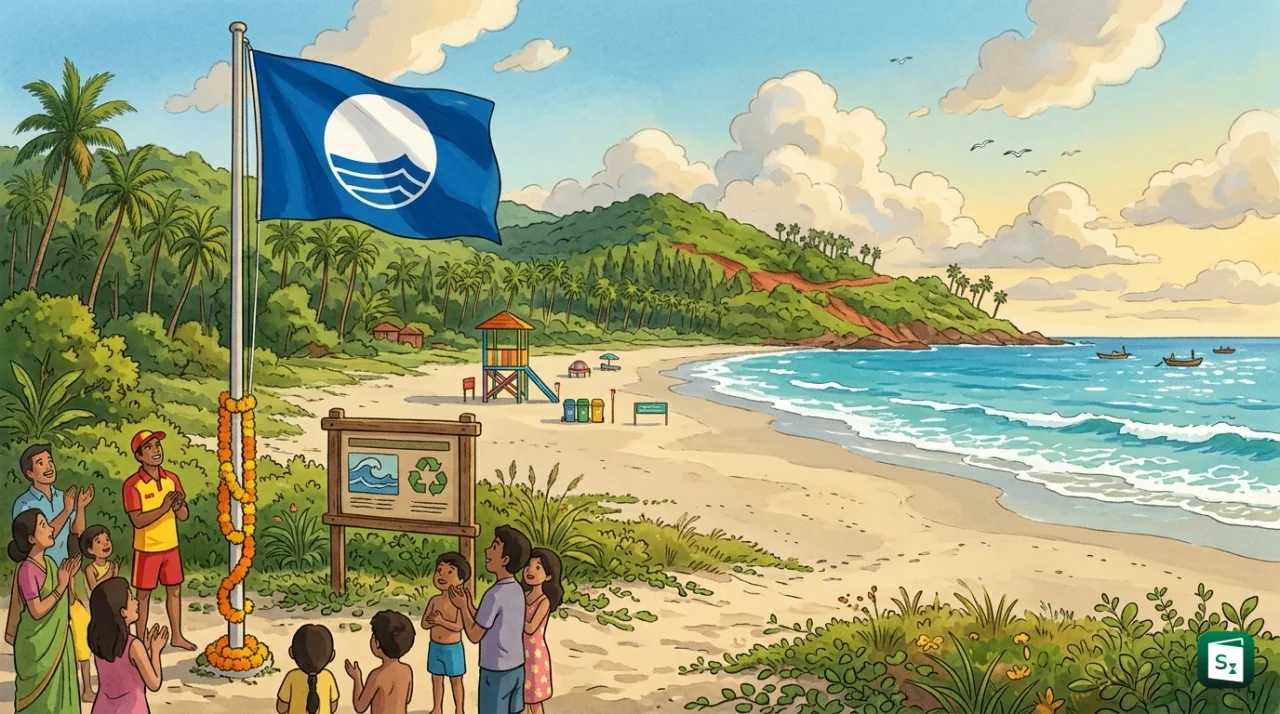
The International Blue Flag Jury has awarded the Blue Flag certification to three Maharashtra beaches, Ladghar and Guhagar in Ratnagiri district and Shrivardhan in Raigad district, for the 2026-27 season. The announcement in November 2026 marks the first time any beach from Maharashtra has received this global eco-label for clean, safe and sustainably managed beaches. The Blue Flag season at the three beaches begins on 15 November 2026.
What Is a Blue Flag Beach?
A Blue Flag beach is a beach that has earned an international eco-label for meeting high standards of cleanliness, water quality, environmental management, safety and public information. The label is voluntary and is given only for one season at a time, so a beach must apply again and prove compliance every year.
The programme is run by the Foundation for Environmental Education (FEE), a non-profit organisation headquartered in Copenhagen, Denmark. It started in France in 1985, spread across Europe in 1987 and became global in 2001 when South Africa joined. For the 2026 Northern Hemisphere season, FEE recognised 5,274 sites in 53 countries, including 4,371 beaches, 745 marinas and 158 tourism boats.
Which Maharashtra Beaches Won the Award for 2026-27?
The three winners are all located on the Konkan coast along the Arabian Sea. Two are in Ratnagiri district and one is in Raigad district.
| Beach | District | Location Note |
|---|---|---|
| Ladghar Beach | Ratnagiri | Near Dapoli, known locally as Tamas Teertha for its reddish sand at sunset and calm shallow water |
| Guhagar Beach | Ratnagiri | A long stretch of clean white sand lined with casuarina plantations, known for safe bathing water |
| Shrivardhan Beach | Raigad | A calm, crescent shaped shoreline with a gentle slope, popular for swimming and family visits |
The State Environment and Climate Change Department announced the result on 11 November 2026. It said the beaches had met international standards for environmental conservation, beach cleanliness, water quality, biodiversity protection, tourist safety, basic infrastructure and sustainable tourism management.
The Blue Flag season at the three sites starts on 15 November 2026. The official Blue Flag emblems are being brought from the Netherlands and will be handed over to the state department. Flag hoisting ceremonies will then be organised with the district administrations.
The state has credited coordinated work by the Environment and Climate Change Department, the Tourism Department, district collectors and district administrations, local bodies, gram panchayats, beach management committees and local communities. Environment and Climate Change Minister Pankaja Munde said the recognition will give Maharashtra a new identity on the global tourism map and support local jobs and businesses.
How Many Blue Flag Beaches Does India Have Now?
India has 22 Blue Flag beaches for the 2026-27 season. This total includes 13 beaches whose certifications were renewed and 9 newly certified beaches. The three Maharashtra beaches are part of the nine new entries.
The basic calculation is simple. Renewed beaches plus new beaches make the total.
| Category for 2026-27 | Number |
|---|---|
| Renewed certifications | 13 |
| New certifications | 9 |
| Total recognised beaches | 22 |
| New beaches from Maharashtra | 3 |
To place this in context, India entered the programme only recently. India joined in 2018 and won its first 8 certifications in October 2020 for beaches such as Shivrajpur in Gujarat, Ghoghla in Diu, Kasarkod and Padubidri in Karnataka, Kappad in Kerala, Rushikonda in Andhra Pradesh, Golden Beach in Puri in Odisha and Radhanagar in Andaman and Nicobar Islands. India was the first country to win eight flags in a single attempt and the first in the Asia Pacific region to achieve the feat in about two years.
The network then expanded in stages. Kovalam near Chennai in Tamil Nadu and Eden Beach in Puducherry joined in 2021. Minicoy Thundi and Kadmat in Lakshadweep joined in 2022. Chal Beach in Kannur in Kerala and Sunapur in Ganjam in Odisha were added later. With the 2026-27 additions, Maharashtra has joined this national list for the first time.
What Criteria Must a Beach Meet for Blue Flag Certification?
A beach must meet 33 strict criteria grouped under four heads. Most criteria are mandatory. If a beach fails to maintain them during the season, the flag can be withdrawn.
The four groups are environmental education and information, bathing water quality, environmental management and conservation, and safety and services.
Environmental education and information
The beach must display details about the Blue Flag programme, bathing water quality, the local ecosystem and sensitive natural areas, facilities available and the code of conduct for visitors. It must organise at least five environmental education activities for the public, preferably during the season. Staff must be trained and local stakeholders must be involved.
Bathing water quality
This is the most critical test. The beach must achieve excellent bathing water quality and prove it through regular sampling. At least five water samples must be taken during the season, with no more than 31 days between two samples. Tests check for bacteria such as Escherichia coli and intestinal enterococci. No sewage, industrial discharge or other pollution may affect the bathing area.
Environmental management and conservation
The beach must have a beach management committee, a clean shoreline, proper waste bins, segregation and recycling facilities, and safe sewage disposal. Sensitive habitats, sand dunes, mangroves and local biodiversity must be protected. Unauthorised camping, driving and dumping are not allowed. Buildings and equipment must be well maintained and sustainable transport must be promoted.
Safety and services
The beach must provide lifeguards or lifesaving equipment, first aid, emergency plans for pollution or accidents, and regular patrolling. It must offer clean toilets, changing facilities and potable drinking water. Access and toilet facilities for persons with disabilities are required. A map showing different facilities must be displayed.
Who Gives the Blue Flag Certification?
The final decision is taken by the International Blue Flag Jury. The jury brings together experts from organisations working on environment, tourism, water quality, safety and coastal management. Its members have included the United Nations Environment Programme (UNEP), UNESCO, UN Tourism, the International Union for Conservation of Nature (IUCN), the International Lifesaving Federation and FEE itself.
In India, the process runs through national bodies before reaching the international jury. Applications are first checked at the national level and only approved cases are forwarded for global review.
The national work is led by the Society of Integrated Coastal Management (SICOM) under the Union Ministry of Environment, Forest and Climate Change (MoEFCC). SICOM runs a flagship programme called Beach Environment and Aesthetics Management Services (BEAMS) under the Integrated Coastal Zone Management project. BEAMS helps beaches reduce pollution, build clean toilets, changing rooms, drinking water points, first aid posts and waste systems, and meet the 33 criteria. A National Jury of experts, government representatives and civil society members examines each beach. FEE representatives also conduct monitoring visits and audits during the season.
How India Built Its Blue Flag Network Since 2018
India started its Blue Flag journey in 2018. SICOM identified 13 pilot beaches, one in each coastal state and Union Territory, for development to global standards. The early list included Bhogve in Sindhudurg in Maharashtra, Miramar in Goa, Rushikonda in Andhra Pradesh, Golden Beach in Odisha and Radhanagar in Andaman and Nicobar Islands.
On World Environment Day in June 2018, the ministry launched the I AM SAVING MY BEACH campaign for intensive cleaning and environmental education at these pilot sites. Volunteers, school children, fishing communities, the Coast Guard, tourism and forest departments and local bodies joined the drive. Large quantities of solid waste, mostly plastic, were collected, segregated and recycled.
The first success came in October 2020, when the International Jury awarded Blue Flag status to all eight beaches recommended by India. India also won third prize for international best practices in pollution control in coastal regions. The government then set a goal of developing 100 Blue Flag beaches in the next five years.
For Maharashtra, the early pilot was Bhogve, but the first actual certifications have come for Ladghar, Guhagar and Shrivardhan. The state government now plans to use the same BEAMS model to upgrade other eligible beaches.
Why the Award Matters for Maharashtra’s Konkan Coast
Maharashtra has a coastline of about 720 km along the Arabian Sea, spread across Palghar, Mumbai, Raigad, Ratnagiri and Sindhudurg districts. Ratnagiri alone accounts for about 167 km and Raigad for about 240 km. The Konkan belt is known for clean sandy beaches, casuarina groves, small fishing villages, sea forts such as Murud Janjira and Suvarnadurg, and turtle nesting sites such as Velas in Ratnagiri district.
International recognition helps in three ways. First, it signals to domestic and foreign tourists that the water is clean, lifeguards and first aid are available, and waste is managed. This can increase footfall at Ladghar, Guhagar and Shrivardhan and nearby towns such as Dapoli and Harihareshwar. Second, it creates local work in lifesaving, cleaning, maintenance, food stalls, homestays and transport. Third, it protects fragile coastal habitats by forcing strict control of plastic, sewage and construction in the Coastal Regulation Zone.
The state Tourism Department has listed Blue Flag and similar green ratings as a tool in its coastal tourism plan, along with basic amenities, waste management, solar power, community training and involvement of self help groups. Officials have said the programme will now be extended to other eligible beaches to balance development with conservation of dunes, mangroves and marine life.
Key Takeaways
- Ladghar and Guhagar in Ratnagiri and Shrivardhan in Raigad won the Blue Flag for 2026-27, the first such honour for Maharashtra.
- India has 22 Blue Flag beaches for 2026-27, with 13 renewals and 9 new certifications.
- The Blue Flag season at the three Maharashtra beaches starts on 15 November 2026, with official flags being brought from the Netherlands.
- The award is given by the Foundation for Environmental Education (FEE) in Copenhagen, Denmark, through the International Blue Flag Jury that includes UNEP, UNESCO, UN Tourism and IUCN.
- A beach must meet 33 criteria under four heads of education, water quality, environmental management and safety, supported in India by SICOM and the BEAMS programme of the Environment Ministry.