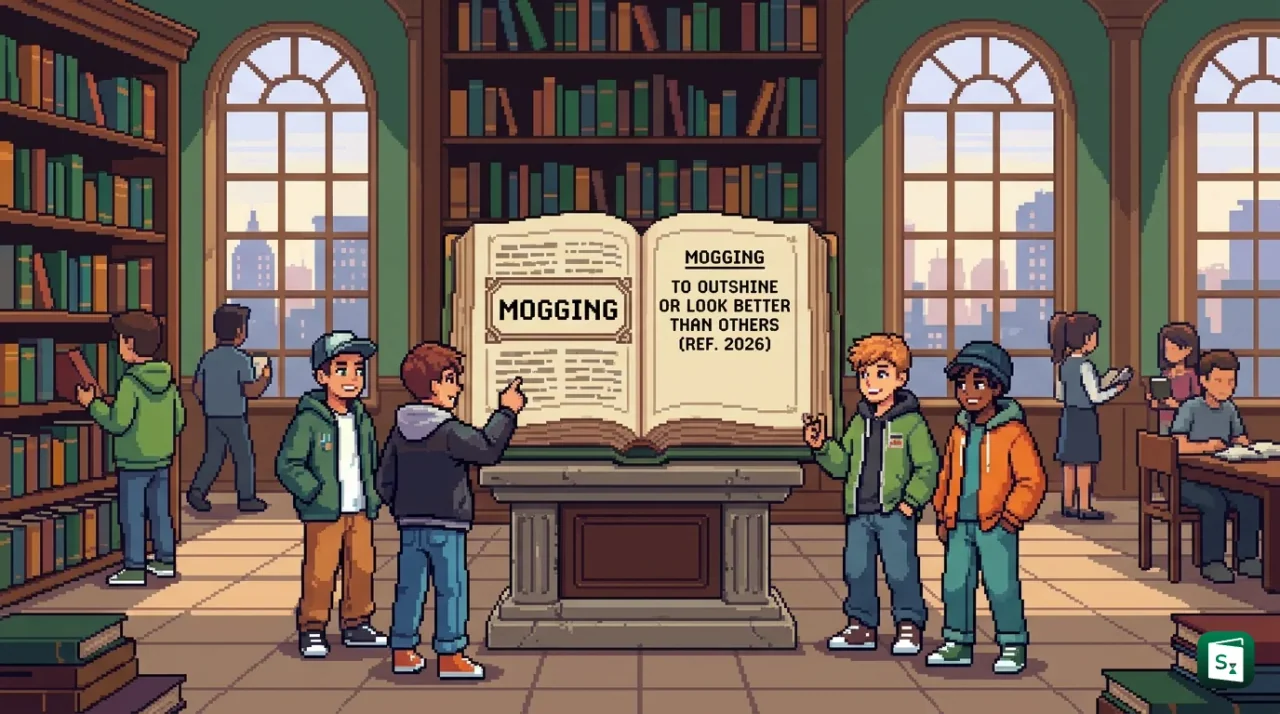
Collins Dictionary named mogging as its Word of the Year 2026 on 3 November 2026. Collins defines mogging as the act of outshining or outperforming someone or something else, often in looks, confidence or status. The choice reflects a 210 percent rise in usage during 2026, driven by Generation Z and Generation Alpha on social media.
What Is Mogging?
Collins Dictionary defines mogging as the act of outperforming or outshining someone or something else by making them look inferior in appearance, confidence or status. The word works as both a noun and a verb, and Collins lists it as playful and ironic in current use.
In everyday use, mogging almost always involves comparison. A student who looks sharper than friends in a group photo is said to be mogging them. A new video game that makes an older favourite look dull is said to mog it. The comparison can cover looks, style, height, confidence or even objects such as cars and food.
The meaning shifts slightly with context. As praise, to say someone is mogging can mean they look commanding or impressive, similar to saying they slay. As teasing, to say someone got mogged means they were upstaged. Common extensions include face mog for looks, height mog for height, stylemogging for clothes and lifemogging for leading a more impressive life overall.
Where Did the Word Mogging Come From?
Collins traces mogging to AMOG, short for alpha male of the group. The acronym appeared in pickup artist forums on Usenet as early as 2000, where AMOGging meant dominating a rival man in a social group. By 2005 the spelling amogging appeared in British forums, and by 2016 the clipped form mogging appeared on fitness boards such as Reddit and 4chan.
In the 2010s the word lived mainly in two linked online worlds. Bodybuilders used mog as a noun for the most physically dominant man in the gym. Forums grouped around dating advice, self improvement and later the manosphere turned mog into a verb for defeating a rival in looks or sexual appeal. The term spread with related slang such as maxxing and looksmaxing.
The mainstream break came on TikTok and Instagram in 2023 and 2024. Jokes, memes and short tutorials carried mogging from closed forums to school classrooms and celebrity pages. In early 2026 a viral post that described streamer Clavicular as brutally frame mogged by a larger student pushed the term to a much wider audience. Public figures then used it lightly. Vogue captioned an actor as mogging at an awards show, and athletes used it to mean simply performing strongly.
Language experts say this journey changed the tone. The competitive core remains, but most young users now employ it as teasing or praise rather than as an attack. Collins notes that the older dictionary entry for mog, which can mean to move away slowly or a variant of moggy for cat, is unrelated to this new sense.
How Collins Chose Mogging as Word of the Year 2026
Collins announced mogging on 3 November 2026 through its official Word of the Year blog. A team of lexicographers tracks the Collins Corpus, a database of about 27 billion words drawn from books, newspapers, websites and social media. The team looks at frequency and at how usage patterns shift across the year.
Collins reported that use of mogging rose by 210 percent in 2026. The rise was strongest among Generation Z, people born roughly between 1997 and 2012, and Generation Alpha, people born after 2013, both online and in daily speech. Collins Managing Director Alex Beecroft said the choice shows how each generation leaves its mark on language, with young users turning an older niche term into shared humour.
Collins has named a Word of the Year every year since 2013. The list aims to capture the mood and conversation of the year rather than to add a formal new entry alone. Words qualify when they show a sharp increase, wide spread and clear cultural link.
Nine Words on the Collins 2026 Shortlist
Collins released a ten word shortlist with mogging as the winner. The other nine words show a common thread. Most describe one thing outdoing another, from larger cars to hotter summers to stronger artificial intelligence.
| Word | What Collins Says It Means |
|---|---|
| Carspreading | The trend of car makers building models that are longer, wider and heavier each year. Collins links it to manspreading and notes that SUVs formed well over half of new car sales in 2025. |
| Manchesterism | A political idea linked to Andy Burnham that combines devolution of power to regions with economic growth and social progress. Collins notes Burnham revived the 19th century term in January 2026 and replaced Keir Starmer as prime minister in July. |
| Firewave | Several wildfires breaking out close together over a short period, often in towns and cities after long hot and dry weather. Researchers at Imperial College London coined the term in 2025. |
| Hydration break | A short pause in sport so players can drink fluids. Collins notes the break featured in every match of the 2026 FIFA World Cup hosted by the United States, Mexico and Canada. |
| Ghost job | A job advertisement posted with no plan to hire. A British study cited by Collins found about one in three advertised roles were of this type. |
| Friendslop | Low budget independent video games made to be played with friends, where fun matters more than graphics. The game Peak, released in June 2025, sold more than 10 million copies and helped popularise the label. |
| Fricy | Food or drink that is both fruity and spicy, such as mango or pineapple hot sauce. The word blends fruity and spicy. |
| Bixie | A haircut shorter than a bob but longer than a pixie. Collins notes stars such as Zendaya, Jessie Buckley and Helen Mirren wore the style in 2026. |
| P(doom) | An estimate, given as a percentage, of the chance that artificial intelligence will cause the collapse of human civilisation. The P stands for probability. The term began on the forum LessWrong in 2009 and spread among AI builders. |
From Vibe Coding to Mogging: Collins Words Over the Years
Collins selected vibe coding as Word of the Year 2025. The term describes software development in which a person describes the goal in plain language and artificial intelligence writes the code. Former Tesla AI director and OpenAI engineer Andrej Karpathy coined it in February 2025, and usage surged through the year.
The shift from vibe coding to mogging marks a move from AI tools to youth culture. The 2025 list focused on technology, with words such as clanker for robots, glaze for excessive praise, aura farming for cultivating charisma and broligarchy for powerful tech owners. The 2026 list focuses on comparison, status and daily pressures.
| Year | Collins Word of the Year | Core Meaning |
|---|---|---|
| 2026 | Mogging | To outshine or outperform someone or something |
| 2025 | Vibe coding | Using AI to turn plain language into computer code |
| 2024 | Brat | A confident, independent and bold attitude popularised by singer Charli XCX |
| 2023 | AI | Artificial intelligence, after rapid spread of tools such as ChatGPT |
| 2022 | Permacrisis | A long period of instability and insecurity |
| 2021 | NFT | Non-fungible token, a unique digital record of ownership |
| 2020 | Lockdown | Strict limits on travel and social contact during COVID-19 |
| 2019 | Climate strike | Protest by skipping school or work to demand climate action |
| 2018 | Single-use | Products meant to be used once, linked to plastic pollution debate |
| 2017 | Fake news | False sensational information presented as news |
| 2016 | Brexit | Withdrawal of the United Kingdom from the European Union |
| 2015 | Binge-watch | Watching several episodes of a series in one sitting |
Mogging vs Mewing vs Looksmaxing vs Maxxing
Mogging belongs to a family of internet slang around looks and self improvement. Readers often mix up these terms, but Collins and other dictionaries treat them as distinct.
| Term | What It Means | How It Differs From Mogging |
|---|---|---|
| Mewing | A term for resting the tongue against the roof of the mouth, linked to British orthodontist Mike Mew and his idea of orthotropics. Online groups claim it sharpens the jawline, though there is no strong proof that it changes adult bone structure. | Mewing describes a personal habit. Mogging describes beating someone else in comparison. |
| Looksmaxing | The project of making oneself as physically attractive as possible through grooming, fitness, style and skincare. Online groups divide it into softmaxxing such as haircuts and hardmaxxing such as surgery. | Looksmaxing is the effort to improve. Mogging is the result of outshining another person. |
| Maxxing | The practice of pushing any activity or trait to its peak. Dictionary.com named maxxing its Word of the Year 2026 on 26 October 2026. | Maxxing can apply to study, money or fitness. Mogging always needs a rival who looks lesser by comparison. |
| Aura farming | Acts meant to build a cool and admired persona, often for social media. Cambridge Dictionary added the term in 2026. Collins shortlisted it in 2025. | Aura farming seeks admiration. Mogging seeks dominance over a specific person or thing. |
The overlap explains the confusion. A person may try looksmaxing or mewing to gain an edge, practise aura farming to appear cool, and then be said to mog a rival in a photo. Mental health experts note that constant ranking by looks can harm confidence, even when the words are used as jokes.
Why Other Dictionaries Picked Different Words in 2026
Each major dictionary uses its own data and method, so winners often differ. The 2026 results show two themes running together. One is playful youth slang. The other is anxiety about artificial intelligence.
Cambridge Dictionary named human as Word of the Year 2026 on 18 November 2026. Cambridge defines human as having the qualities, faults and feelings that people have, as opposed to gods, animals or machines. The editors said use of compounds such as human made, human written and human generated rose as people sought to separate people from machines. Cambridge also added aura farming and looksmaxing to the dictionary in 2026.
Dictionary.com named maxxing as Word of the Year 2026 on 26 October 2026. It defines maxxing as pursuing an activity to the fullest or improving one part of life to its peak. The choice sits close to mogging, since looksmaxxing and mogging come from the same online culture.
Oxford has not yet named a final winner for 2026. Oxford University Press released a four word shortlist on 17 November 2026 from its 32 billion word corpus. The list includes doomerism for extreme pessimism about AI or climate disaster, microdrama for very short vertical phone dramas, post-literate for decline in reading and writing, and slopaganda for low quality AI made propaganda spread online. Public voting closed on 24 November, with the winner due on 1 December. In 2025 Oxford had chosen rage bait and Cambridge had chosen parasocial.
Key Takeaways
- Collins Dictionary named mogging as Word of the Year 2026 on 3 November 2026.
- Collins defines mogging as outperforming or outshining someone or something in looks, confidence or status.
- Use of mogging rose by 210 percent in 2026, tracked through the 27 billion word Collins Corpus.
- Mogging comes from AMOG, short for alpha male of the group, first seen in pickup artist forums around 2000 and in bodybuilding slang around 2016.
- Collins named vibe coding, the use of AI to turn plain language into code, as Word of the Year 2025.