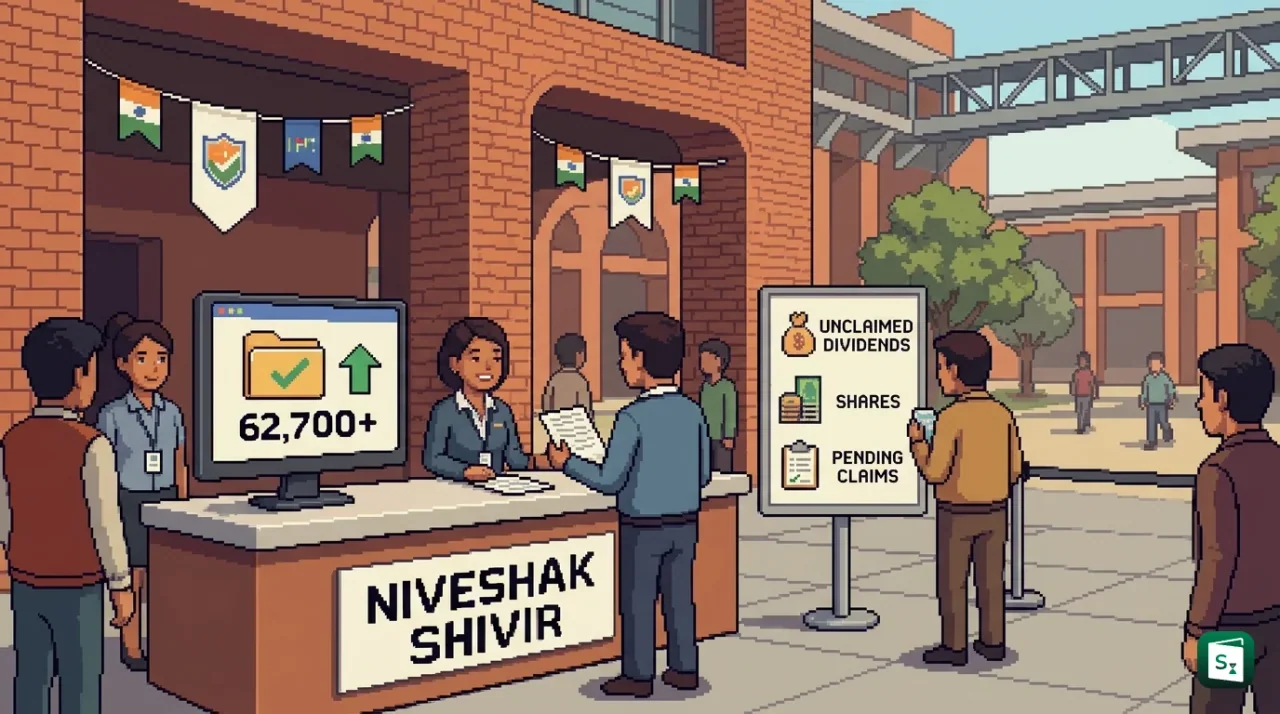
The Investor Education and Protection Fund Authority (IEPFA), with the Securities and Exchange Board of India (SEBI) and market infrastructure institutions, organised the eighth Niveshak Shivir at Jacaranda Hall, India Habitat Centre, New Delhi on 17 November 2026. Over 310 investors attended the one-day camp for face-to-face help on unclaimed dividends, unclaimed shares and pending IEPF claims. The Delhi camp extends a series that began in Pune in 2025 and has assisted more than 2,500 investors in person so far.
What Is Niveshak Shivir?
The Niveshak Shivir is a one-day investor facilitation camp organised by the Investor Education and Protection Fund Authority (IEPFA) with the Securities and Exchange Board of India (SEBI). In Hindi, niveshak means investor and shivir means camp. The Shivir works as a single window where investors meet officials face to face to resolve problems without intermediaries.
The Delhi Niveshak Shivir brought regulators, companies and service agencies to the same hall. Market Infrastructure Institutions (MIIs) are the core market utilities that run trading, clearing and holding of securities. In Delhi, the participating MIIs were the National Stock Exchange (NSE), BSE, National Securities Depository Ltd (NSDL) and Central Depository Services Ltd (CDSL). Registrar and Transfer Agents (RTAs) are private agencies that maintain company shareholder records and handle dividends, transfers and address changes. The Delhi camp included KFin Technologies, MUFG Intime, Bigshare Services, Datamatics Business Solutions and Purva Sharegistry, among others.
For the first time in the series, companies with large unclaimed dividend accounts joined directly. Representatives of Reliance Industries, ICICI Bank, Hindustan Unilever, Jio Financial Services and JK Lakshmi Cement sat at service desks with IEPFA, SEBI, depositories and RTAs. Minister of State for Corporate Affairs Harsh Malhotra attended as chief guest, along with IEPFA Chief Executive Officer Sumit Garg. The Minister interacted with claimants at the booths and said money belonging to citizens must be returned to its rightful owners.
What Is IEPFA and How Does the IEPF Work?
The Investor Education and Protection Fund Authority (IEPFA) is a statutory body under the Ministry of Corporate Affairs. The Government established IEPFA on 7 September 2016 under Section 125 of the Companies Act, 2013. IEPFA functions from Jeevan Vihar Building, Sansad Marg, New Delhi. The Secretary of the Ministry of Corporate Affairs is the ex officio Chairperson of IEPFA, and a Chief Executive Officer handles daily management.
IEPFA administers the Investor Education and Protection Fund (IEPF). IEPF is the common pool where unclaimed investor money and shares are held safely until rightful owners claim them. IEPFA also refunds shares, unclaimed dividends, matured deposits and debentures, and runs investor awareness programmes across India.
The seven-year rule explains how money reaches IEPFA. When a company declares a dividend, any amount that remains unpaid or unclaimed for 30 days must move to a special Unpaid Dividend Account in a scheduled bank. If the owner does not claim it for seven years from that transfer, the company must transfer the amount to IEPF. All shares for which dividend has not been paid or claimed for seven consecutive years must also move to IEPF in demat form. Voting rights on such shares stay frozen until the owner reclaims them.
| Stage | What Happens | Time Limit |
|---|---|---|
| Dividend declared | Company pays shareholders | Within 30 days of declaration |
| Unpaid amount parked | Balance moves to Unpaid Dividend Account | Within 7 days after the 30-day period |
| Investor can still claim from company | Company holds details on its website | For 7 years from transfer to unpaid account |
| Transfer to IEPF | Unclaimed amount and linked shares move to IEPF | After 7 years of remaining unclaimed |
A legal heir or original investor does not lose ownership after the transfer. The claimant can apply online to IEPFA in Form IEPF-5 and then submit signed documents to the company for verification. IEPFA releases the amount or shares after the company confirms the claim. IEPFA approved more than 62,700 claims in the last financial year, which shows the scale of unclaimed investments held in the system.
What Services Did the New Delhi Shivir Offer?
The New Delhi Niveshak Shivir was held on 17 November 2026 from 10 am to 4 pm at Jacaranda Hall, India Habitat Centre, Lodhi Road. Entry was through Gate No. 3 on Vardhaman Marg. Shareholders and their authorised representatives carried official identity documents such as Aadhaar, PAN card, voter identity card or driving licence, along with share certificates and dividend records linked to their cases.
The Shivir focused on five types of investor problems. First, it helped investors recover unpaid dividends held by companies for up to seven years before transfer to IEPF. Second, it allowed on-the-spot updating of Know Your Customer (KYC) details and nomination in company records. KYC is the process by which a financial institution verifies the identity and address of an investor. Nomination is the facility by which a shareholder names the person who will receive the securities after the death of the holder. Third, it guided legal heirs on transmission of securities, which is the transfer of shares to heirs after the death of the owner. Fourth, it cleared pending IEPFA claims for amounts and shares already transferred to the fund. Fifth, it helped holders of lost or damaged paper certificates to seek duplicate certificates.
The Securities and Exchange Board of India (SEBI), the co-organiser, is the regulator for the securities and commodity market in India. SEBI was first set up on 12 April 1988 as a non-statutory body and became a statutory body on 30 January 1992 under the SEBI Act, 1992. SEBI works under the administrative domain of the Ministry of Finance and has its head office at Bandra Kurla Complex, Mumbai, with regional offices in New Delhi, Kolkata, Chennai and Ahmedabad. In the Shivir model, SEBI links investor protection rules with on-ground grievance handling, while depositories and RTAs complete record corrections at the same desk.
From Pune to New Delhi: Eight Cities in the Shivir Series
The New Delhi camp was the eighth in the national Niveshak Shivir series. The series began in Pune in 2025 and then moved to cities with large volumes of unclaimed investments. The camps before Delhi were held in Hyderabad, Amritsar, Jaipur, Bengaluru, Bhubaneswar and Bhopal. Each camp brings IEPFA, SEBI, the four MIIs and major RTAs to one venue, so investors do not need to visit multiple offices in different cities.
The Delhi edition drew more than 310 investors and claimants from nearby regions. Earlier camps in the series together assisted more than 2,500 investors in person. The model is deliberately direct. An investor can show documents to the company, the RTA and the depository at adjacent desks, correct KYC or nomination on the spot, and get clarity on whether the amount still lies with the company or has already moved to IEPFA. IEPFA has said the Shivirs will extend to more cities, with priority to places where company records show high pending unclaimed amounts.
Saksham Niveshak and Niveshak Didi: Wider Investor Outreach
The Niveshak Shivir is part of a larger set of IEPFA outreach programmes. The Saksham Niveshak campaign was a 100-day national drive from 28 July to 6 November 2025. Saksham means capable in Hindi. The campaign asked companies to contact shareholders directly and help them recover dividends still lying with the company. Its three aims were to clear unclaimed dividend cases before transfer to IEPF, to complete KYC and nomination updates, and to restart direct dividend payouts to the correct bank accounts.
The Niveshak Didi initiative follows a women for women model for financial literacy. IEPFA runs it with India Post Payments Bank (IPPB), which works under the Department of Posts. Women postal workers and community leaders are trained as Niveshak Didis, or investor guides, who hold camps in anganwadis, self-help groups, panchayat halls and homes. The first floating financial literacy camp under the initiative was held on Dal Lake in Srinagar in 2022, with sessions in the local language.
Phase 1 of Niveshak Didi reached more than 55,000 beneficiaries, with about 60 percent women and two out of three participants from deep rural areas. Phase 2 began on 7 April 2025 after a formal agreement on 8 April 2025 between IEPFA and IPPB. The phase plans about 4,000 camps led by nearly 40,000 women postal workers, with lessons on safe investing, fraud prevention, savings habits and digital banking tools such as UPI. Together, Saksham Niveshak, Niveshak Didi and Niveshak Shivir show a clear sequence. Awareness creates demand, company outreach clears records early, and Shivirs resolve the remaining hard cases face to face.
Key Takeaways
- The eighth Niveshak Shivir was held on 17 November 2026 at Jacaranda Hall, India Habitat Centre, New Delhi by IEPFA with SEBI.
- The Shivir acted as a single window for unclaimed dividends, unclaimed shares, KYC and nomination updates, transmission and pending IEPF claims.
- IEPFA was set up on 7 September 2016 under Section 125 of the Companies Act, 2013 and works under the Ministry of Corporate Affairs from New Delhi.
- Unclaimed dividends move to the Unpaid Dividend Account and then to IEPF after seven years, while linked shares move after seven consecutive years of unclaimed dividend.
- The Shivir series began in Pune in 2025 and New Delhi became the eighth city, with over 62,700 IEPFA claims approved in the last financial year.