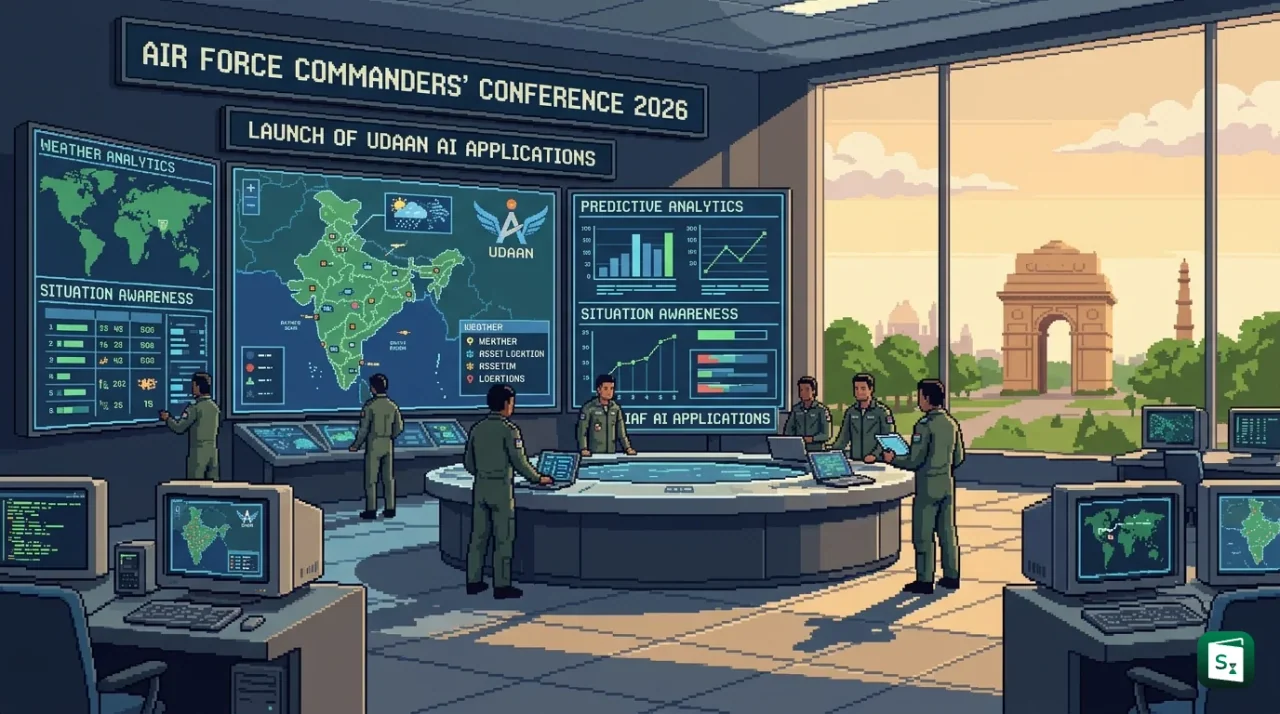
Defence Minister Rajnath Singh launched a suite of indigenous Artificial Intelligence applications for the Indian Air Force on 12 November 2026 in New Delhi. The tools were built in house by the AI Centre of Excellence under UDAAN, the Unit for Digitisation, Automation, Artificial Intelligence and Application Networking. Deployed on the Air Force secure network, they will automate tasks in operations, administration and aerospace safety.
What Are the UDAAN AI Applications Launched for the Indian Air Force?
The UDAAN AI applications are indigenous software tools built for the Indian Air Force to automate and speed up data heavy tasks. The Ministry of Defence said the suite was developed in house and deployed on the Air Force secure network for daily use.
Defence Minister Rajnath Singh launched the suite on 12 November 2026. The builder is the AI Centre of Excellence functioning under UDAAN, the Unit for Digitisation, Automation, Artificial Intelligence and Application Networking. The launch underlines a shift. The Air Force is now building its own digital tools instead of depending only on outside vendors.
The applications cover three broad domains:
| Domain | What It Covers |
|---|---|
| Operations | Faster processing of operational data, planning support and decision aids |
| Administration | Automation of routine files, records, personnel and logistics work |
| Aerospace safety | Data analysis to spot risks, improve maintenance and prevent accidents |
Running these tools on an air gapped secure network matters. Military data stays inside the force system. This reduces dependence on public internet platforms and lowers the risk of leaks.
The Ministry of Defence has not disclosed the names, number or technical details of the individual applications. That is normal for operational systems. The key fact for readers is the direction. Artificial Intelligence is moving from pilot projects to regular use inside Air Force headquarters, commands and stations.
What Is UDAAN and How Does It Differ From the UDAN Scheme?
Military AI refers to the use of computer systems that learn from data to help in defence tasks such as surveillance, planning, maintenance and decision support. The Indian Air Force created a dedicated body for this work. UDAAN stands for the Unit for Digitisation, Automation, Artificial Intelligence and Application Networking.
The Air Force set up its AI cell in 2019. UDAAN was formed in 2021, and its AI Centre of Excellence was inaugurated on 10 July 2022 at Air Force Station Rajokri in New Delhi. The centre has a big data analytics and AI platform for machine learning, natural language processing, neural networks and deep learning. It uses high end graphics processing unit servers for heavy computing. Applications are built by Air Force engineers in house, with support from public sector units, small firms and academic institutions. Earlier products included systems for campaign planning and analysis and for electronic inspection and monitoring.
UDAAN is often confused with UDAN because the names sound alike. The two are completely different:
| Feature | UDAAN (Air Force) | UDAN (Civil Aviation) |
|---|---|---|
| Full form | Unit for Digitisation, Automation, Artificial Intelligence and Application Networking | Ude Desh ka Aam Nagrik, which means let the common citizen fly |
| Nodal body | Indian Air Force | Ministry of Civil Aviation |
| Started | 2021, with AI Centre in 2022 | Launched in October 2016 under the National Civil Aviation Policy, first flight on 27 April 2017 between Shimla and Delhi |
| Purpose | Build secure AI tools for air operations and administration | Improve regional air connectivity through the Regional Connectivity Scheme |
| Key feature | Runs on the Air Force secure network | Caps fare at about ₹2,500 for a one hour flight of about 500 km on supported seats |
This distinction matters because the names are easy to confuse. UDAAN serves defence digitisation. UDAN serves affordable civilian flights to underserved airports.
What Happened at the Air Force Commanders Conference 2026?
The Air Force Commanders Conference (AFCC) is the top level meeting of the Indian Air Force leadership. It brings together commanders to review operations, maintenance and administration and set priorities. The AFCC 2026 inaugural session was held in New Delhi on 12 November 2026. It was a two day conference hosted at Air Headquarters, Vayu Bhawan.
The theme for 2026 was The Year of Empowerment: Maximising Efficiency Through Decentralisation. The idea is to push decision powers to lower levels so units can act faster and use resources better.
The inaugural session was addressed by Defence Minister Rajnath Singh. It was attended by Minister of State for Defence Sanjay Seth, Chief of the Air Staff Air Chief Marshal Ashutosh Dixit, Defence Secretary Rajesh Kumar Singh, Secretary (Defence Production) Sanjeev Kumar and Secretary (Defence Finance) Vishvajit Sahay. All Air Officers Commanding in Chief of commands, all Principal Staff Officers and all Directors General took part. Dixit had taken charge as the 29th Chief of the Air Staff on 31 October 2026.
Singh laid out three priorities for future readiness:
- Keep the element of surprise in both offensive and defensive forms. Offence means striking in a way that leaves the adversary no time to react. Defence means stronger intelligence and surveillance so India is never caught off guard. Surprise can be conventional and electronic, including jamming and deception of enemy signals.
- Build technological superiority. Modern conflict now extends to missiles, drones and non contact warfare. Singh cited the Russia-Ukraine and Israel-Hamas conflicts to show how drones and air defence shape outcomes. He asked the Air Force to prepare for kamikaze drones, surveillance drones and counter drone tasks, and to write dedicated doctrines for electronic, cyber and space warfare.
- Deepen jointness. The Army, Navy and Air Force must plan and fight as one team. Singh praised their synergy during Operation Sindoor and said joint planning must guide all future action. He said victory will depend less on the number of aircraft and more on technology, speed of response and precision.
Singh also praised the Air Force for training its personnel in new technologies and for using the skills of young recruits. He said the decision on a second tour of duty for Agniveers was taken after feedback from the services.
For background, the Indian Air Force was raised on 8 October 1932. Air Force Day is observed on 8 October every year. Its headquarters is Vayu Bhawan in New Delhi. Its motto is Nabhah Sprisham Deeptam, which means touch the sky with glory and is taken from the eleventh chapter of the Bhagavad Gita.
How Is Artificial Intelligence Used in Military Operations?
Artificial Intelligence in defence means software that finds patterns in large volumes of data and helps humans decide faster. The final decision stays with humans. The Indian Air Force follows this human plus machine approach for operations.
AI helps the military in practical ways:
- Intelligence and surveillance. AI scans satellite images, radar tracks and drone video to flag unusual movement. This shortens the time from sensing a threat to responding to it.
- Operations and planning. AI tools combine weather, logistics and threat data to support campaign planning. They also convert voice and documents into searchable text for faster briefing.
- Maintenance and safety. AI studies engine data and past faults to predict failures before they happen. This improves aircraft availability and aerospace safety.
- Air defence and drones. AI assists in tracking multiple aerial targets and in managing unmanned systems and counter drone action.
- Administration and training. AI automates file work and records. It also powers simulators and learning systems for air warriors.
AI warfare is the wider term for conflict where these capabilities shape outcomes. Speed matters. The side that processes data faster can get inside the adversary response cycle and gain surprise. That is why the Air Force wants AI built into its thinking, planning and daily processes, not limited to one laboratory.
How Does Defence AI Fit Into India’s Wider AI Strategy?
The UDAAN launch is part of a larger defence AI framework. In 2018 the Ministry of Defence set up a multi stakeholder task force under N. Chandrasekaran. Based on its report, the ministry created two bodies through an order dated 8 February 2019.
The Defence AI Council (DAIC) works under the chairmanship of the Raksha Mantri. It gives strategic direction for AI adoption, data sharing, industry partnership and safe use. The Defence AI Project Agency (DAIPA) works under the Secretary (Defence Production). It handles project selection, standards, funding milestones and delivery. Funds of ₹100 crore per year were earmarked for AI enabled projects.
Progress was showcased on 11 July 2022, when 75 AI products were launched at the first AI in Defence symposium in New Delhi. The products covered automation, unmanned systems, command and control, surveillance, cyber security, logistics, maintenance and speech analysis. Each defence public sector unit also prepared an AI roadmap with dozens of projects.
This defence push runs parallel to the national IndiaAI Mission. The Union Cabinet approved the mission on 7 March 2024 with an outlay of ₹10,371.92 crore for five years. It is implemented by the IndiaAI division under the Digital India Corporation of the Ministry of Electronics and Information Technology. The mission builds computing capacity of more than 10,000 graphics processing units, indigenous models, a datasets platform, application development, future skills, startup financing and safe and trusted AI.
India also hosted the India AI Impact Summit 2026 from 16 to 20 February 2026 at Bharat Mandapam in New Delhi. It was the first global AI summit hosted in the Global South. The summit focused on making AI work for people, planet and progress, with attention to compute access, data, skills and responsible use.
Seen together, these layers connect clearly. National compute and startup support create the base. DAIC and DAIPA set defence rules and funds. Service units like UDAAN turn that support into secure tools for operations, administration and aerospace safety.
Key Takeaways
- Defence Minister Rajnath Singh launched indigenous UDAAN AI applications for the Indian Air Force on 12 November 2026 at AFCC 2026 in New Delhi.
- UDAAN stands for the Unit for Digitisation, Automation, Artificial Intelligence and Application Networking, and its AI Centre of Excellence was set up at Rajokri on 10 July 2022.
- The AFCC 2026 theme was The Year of Empowerment: Maximising Efficiency Through Decentralisation.
- UDAAN is an Air Force digitisation unit, while UDAN (Ude Desh ka Aam Nagrik) is a Ministry of Civil Aviation scheme launched in 2016 for regional air connectivity.
- The Defence AI Council and Defence AI Project Agency were created in 2019 on the N. Chandrasekaran task force report, while the IndiaAI Mission was approved on 7 March 2024 with an outlay of ₹10,371.92 crore.