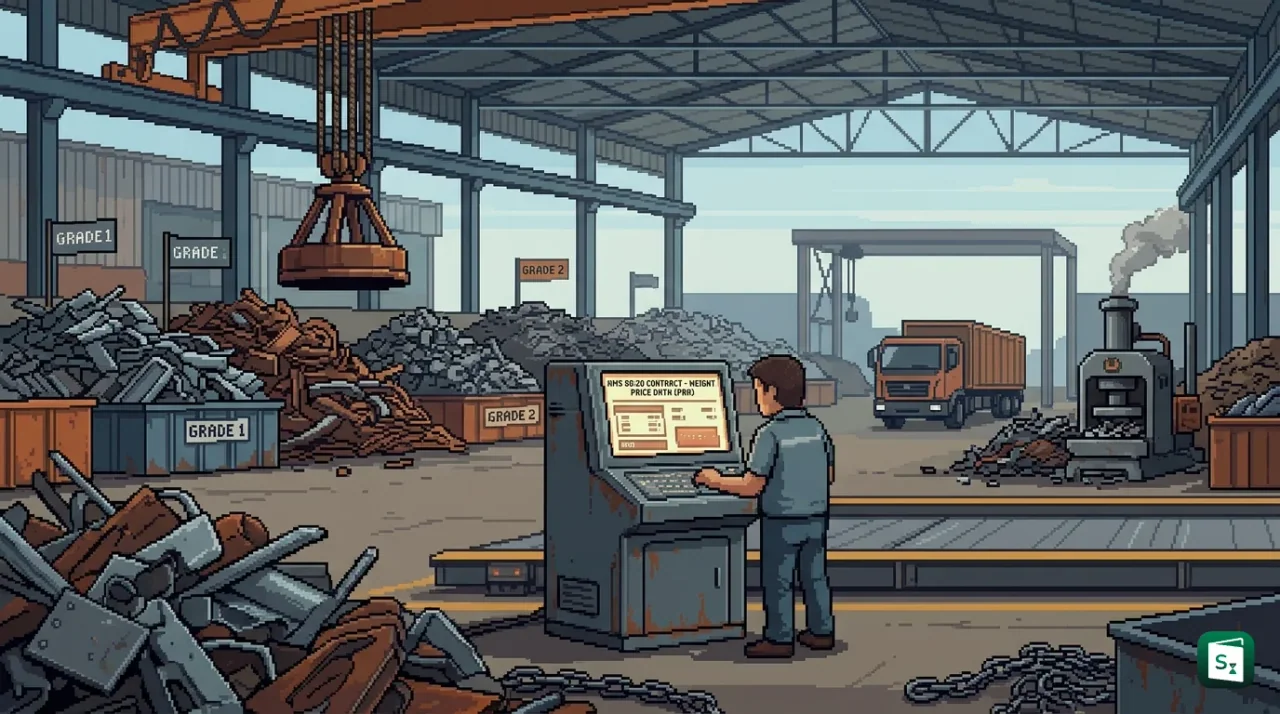
NCDEX Ltd announced India’s first Price Reporting Agency based steel scrap futures contract on 11 November 2026 in Mumbai. The NCDEX steel futures contract is based on Heavy Melting Scrap 80:20 and will use daily price assessments from BigMint Technologies for cash settlement. It gives steel makers, traders and recyclers a regulated tool to manage sharp swings in steel scrap prices for the first time.
What Is the NCDEX Steel Scrap Futures Contract?
The NCDEX steel scrap futures contract is a standardised exchange traded derivative that tracks the price of Heavy Melting Scrap 80:20. A futures contract is an agreement to buy or sell a fixed quantity of a commodity at a fixed price on a future date. Buyers and sellers do not exchange physical scrap under this contract. They settle the profit or loss in cash on expiry.
NCDEX received approval from the Securities and Exchange Board of India (SEBI) for the contract. SEBI has regulated commodity derivatives in India since 28 September 2015, after the merger of the Forward Markets Commission with SEBI. Trading in the new contract will start on 3 December 2026. The first three contracts will expire in January, February and March 2027. The exchange will add further monthly expiries as per its launch calendar.
The contract carries the trading symbol STEELSCRAP. It is India’s first futures contract in the steel scrap segment that settles against a Price Reporting Agency (PRA) benchmark. A PRA is an independent agency that collects market data and publishes a daily reference price using a fixed method. NCDEX signed a three year memorandum of understanding with BigMint Technologies Pvt Ltd on 5 November 2026 for this role. BigMint will act as the price reference agency for final settlement.
What Is Steel Scrap and What Is HMS 80:20?
Steel scrap is discarded steel recovered from old products and factory waste that is melted again to make new steel. It comes from demolished buildings, vehicles, railways, ships, machinery, household goods and offcuts from steel plants. Steel scrap is called ferrous scrap because iron is its main element. It is the main raw material for Electric Arc Furnace (EAF) and Induction Furnace (IF) steel making.
Heavy Melting Scrap (HMS) is thick and dense recyclable steel and wrought iron used for furnace charging. The Institute of Scrap Recycling Industries (ISRI) of the United States defines its grades. HMS Grade 1 is heavier scrap with thickness of at least 6.35 mm and no galvanised or blackened steel. HMS Grade 2 is lighter scrap with thickness of at least 3.175 mm and may include galvanised steel and properly prepared automobile scrap.
HMS 80:20 is a blend with 80% HMS Grade 1 and 20% HMS Grade 2. The blend ensures high density, easy charging and efficient melting. HMS 80:20 is widely traded across Asian markets and serves as a benchmark import grade. NCDEX has chosen this grade because domestic prices move closely with international prices and freight, currency and demand factors affect it in a similar way.
How the PRA Based Settlement and Contract Specifications Work
The NCDEX steel scrap futures contract uses BigMint’s daily spot price for Mandi Gobindgarh as the reference. Mandi Gobindgarh in Punjab is a major steel and re-rolling cluster and the price basis is ex-Mandi Gobindgarh exclusive of Goods and Services Tax (GST). On expiry, all open positions are closed in cash. There is no physical delivery of scrap.
The final settlement price is the simple average of BigMint’s polled spot prices for HMS 80:20 on the last three trading days. The price used is the Delivered at Place (DAP) Mandi Gobindgarh HMS 80:20 assessment. If a day’s price is not available, the exchange uses the average of the available prices from the expiry day and the three previous days as per its circular.
| Specification | Detail |
|---|---|
| Underlying | Steel scrap HMS 80:20 |
| Trading symbol | STEELSCRAP |
| Unit of trading | 10 MT |
| Maximum order size | 500 MT |
| Quotation | Rs per MT |
| Tick size | Rs 10 per MT |
| Basis centre | Ex-Mandi Gobindgarh, exclusive of GST |
| Settlement | Cash settlement, no physical delivery |
| Expiry | 20th of delivery month |
| Trading hours | Monday to Friday, 10 AM to 9 PM |
| Daily price limit | 6 percent, extendable to 9 percent after pause |
| Minimum initial margin | 8 percent |
| Transaction charge | Rs 5.80 per lakh of turnover value |
Client position limit is 30,000 MT or 5 percent of market wide open interest, whichever is higher. Member limit is 1,50,000 MT or 20 percent of market wide position, whichever is higher. Genuine hedgers can seek exemption under the exchange hedge policy.
Why Steel Scrap Matters for India’s Steel Value Chain
India is the world’s second largest crude steel producer. Output reached about 168.4 million tonnes in April to March 2025-26, a growth of 10.7 percent over the previous year. Global crude steel output fell by about 2 percent in the same period. Domestic scrap generation rose by 22 percent to 32 million tonnes, while ferrous scrap imports fell by 20 percent.
Scrap is central to this growth because it feeds secondary steel making through EAF and IF units. As on March 2019, India had 47 Electric Arc Furnaces and 1,128 Induction Furnaces that largely depend on scrap. The National Steel Policy 2017 aims for 300 million tonnes of capacity by 2030, with 35 to 40 percent from the EAF and IF route. Scrap demand could rise from about 30 million tonnes now to more than 70 million tonnes by 2030.
Scrap based production uses less energy and emits less carbon than the Blast Furnace Basic Oxygen Furnace route. Scrap can be reused and recycled many times, so it supports a circular economy. The Steel Scrap Recycling Policy 2019, notified by the Ministry of Steel on 7 November 2019, promotes scientific collection, dismantling and processing through metal scrapping centres. It follows a hub and spoke model and promotes the 6Rs of Reduce, Reuse, Recycle, Recover, Redesign and Remanufacture.
NCDEX said the contract will support steel clusters in Delhi NCR, Punjab, Rajasthan, Gujarat, Maharashtra, West Bengal, Chhattisgarh, Odisha and Tamil Nadu. These regions face fragmented pricing because scrap prices vary by grade and location.
How Steel Makers and Traders Can Use the New Hedge
Commodity futures help firms lock in prices and protect margins when raw material prices move sharply. A buyer takes a long position to guard against a price rise. A seller takes a short position to guard against a price fall. Gains or losses on the futures position offset changes in the physical market.
NCDEX said one scrap contract can cover several products because their prices move together. BigMint data shows a price correlation of 90 percent between HMS 80:20 and billet and 89 percent with wire rod. This link makes the contract useful beyond scrap dealers.
- Steel makers that need scrap later can buy futures to fix their purchase cost in advance.
- Billet and wire rod makers and traders that hold stock can sell futures to reduce losses if finished prices fall before sale.
- Sponge iron producers can use the same contract to manage the risk of a fall in linked steel prices.
The contract also improves price discovery. A single exchange price, linked to an independent assessment, gives all regions a common reference. Transparent pricing can narrow regional gaps and help small recyclers, stockists and importers plan purchases.
What Is NCDEX and How Does It Differ From MCX?
NCDEX stands for National Commodity and Derivatives Exchange Limited. The exchange now uses the name NCDEX Limited after members approved the change on 18 July 2026 to reflect its move into equity and mutual fund segments. The exchange was incorporated on 23 April 2003 and started operations on 15 December 2003. It is headquartered in Mumbai and regulated by SEBI.
NCDEX mainly offers futures and options in agricultural and selected non agricultural commodities. NCDEX prices serve as benchmark references in many mandis. The Multi Commodity Exchange of India (MCX), also set up in 2003 and based in Mumbai, mainly focuses on metals, bullion and energy. After integration from 1 October 2018, one exchange can operate equity, commodity derivatives, currency and interest rate segments. The National Stock Exchange (NSE) and BSE also offer commodity derivatives.
NCDEX said the new contract follows an International Organization of Securities Commissions (IOSCO) compliant framework for financial benchmarks. IOSCO is the global body of securities regulators headquartered in Madrid in Spain. A compliant method requires clear data collection, grade normalisation and governance, which builds trust in the final price.
Key Takeaways
- NCDEX launched India’s first PRA based steel scrap futures contract on 11 November 2026 with BigMint Technologies as price reporting agency.
- The contract tracks HMS 80:20, a blend of 80 percent HMS Grade 1 and 20 percent HMS Grade 2 widely used across Asian markets.
- Trading starts on 3 December 2026 with a lot size of 10 MT, tick size of Rs 10 per MT and cash settlement against ex-Mandi Gobindgarh prices.
- India produced about 168.4 million tonnes of crude steel in 2025-26 and domestic scrap generation rose 22 percent to 32 million tonnes.
- The Steel Scrap Recycling Policy 2019 of the Ministry of Steel promotes scientific scrapping centres to meet the 300 million tonnes by 2030 steel capacity goal.