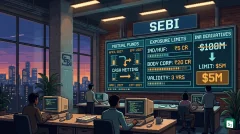
The Securities and Exchange Board of India (SEBI) issued two circulars on 2 November 2026 allowing Real Estate Investment Trusts (REITs) and Infrastructure Investment Trusts (InvITs) to issue depository receipts backed by their units for listing at GIFT City. These foreign currency instruments will trade on India INX and NSE International Exchange. The move creates a new dollar route to bring foreign capital into Indian property and infrastructure.
What Are REITs and InvITs and How Do They Work?
Real Estate Investment Trusts (REITs) and Infrastructure Investment Trusts (InvITs) are pooled investment vehicles regulated by SEBI that collect money from investors and invest it in income generating assets. REITs own office parks, malls and warehouses, while InvITs own roads, power lines, pipelines and renewable plants. Investors buy listed units and receive regular payouts.
A REIT is set up as a trust registered with SEBI under the SEBI (Real Estate Investment Trusts) Regulations, 2014. An InvIT is set up under the SEBI (Infrastructure Investment Trusts) Regulations, 2014. Each trust has a sponsor who creates it, a trustee who holds assets for unitholders, and a manager who runs daily operations. For InvITs, the manager role is split into an investment manager and a project manager.
Both vehicles earn mainly from rent, tolls, transmission charges or similar cash flows. They must distribute at least 90 percent of Net Distributable Cash Flows to unitholders, at least once every six months. Units trade on stock exchanges like shares, so small investors can get exposure to large property or highway portfolios without buying the asset directly.
There are two listing routes for InvITs. Publicly listed InvITs are open to all investors with a small trading lot of one unit and must have at least 20 investors. Privately listed InvITs have a high trading lot of ₹25 lakh in the secondary market, so participation is limited largely to institutions, companies and wealthy individuals. This structure keeps trading thin and affects how sale rules apply to them.
What Are Depository Receipts?
Depository receipts (DRs) are foreign currency instruments issued abroad against securities held in India. An Indian trust issues or transfers its units to a domestic custodian, the custodian confirms it holds them, and a foreign depository then issues dollar denominated receipts to overseas buyers. The receipts represent an interest in the underlying units.
The concept comes from the Depository Receipts Scheme, 2014 of the central government, which replaced the 1993 scheme for foreign currency bonds and shares. Under that scheme, a DR is a foreign currency instrument issued by a foreign depository in a permissible jurisdiction on the back of eligible securities deposited with a domestic custodian. It includes Global Depository Receipts defined in Section 2(44) of the Companies Act, 2013. Well known types are American Depository Receipts (ADRs) in the United States and Global Depository Receipts in Europe and other markets.
For investors, DRs offer exposure to Indian assets without trading directly on Indian exchanges and without rupee settlement. For issuers, DRs are a way to tap foreign savings before or without a full overseas listing. The units behind the DRs remain in India, while the receipts trade on an international exchange. Reissue after cancellation under two way fungibility is allowed and is not treated as a fresh issue.
What SEBI Has Allowed for REIT and InvIT Depository Receipts at GIFT City?
The Securities and Exchange Board of India issued two separate circulars on 2 November 2026, one for REITs and one for InvITs, laying out how these trusts can create DRs. The SEBI Board had approved the enabling change to the REIT and InvIT regulations on 24 September 2026, after public consultation in August 2026 and inputs from the Hybrid Securities Advisory Committee. The framework took effect immediately.
The SEBI circulars permit REITs and InvITs registered with SEBI to issue fresh units, or to allow existing unitholders to transfer their units, to a foreign depository for DR creation. The DRs must be listed only on the two international exchanges in the International Financial Services Centre (IFSC) at GIFT City, namely India International Exchange (India INX) and NSE International Exchange (NSE IX). Listings must meet the highest standard that the exchange applies to foreign issuers.
How Fresh Issues and Approvals Will Work
Any fresh issue of DRs, whether by issuing new units or by transferring existing units, needs prior approval of unitholders. At least 75 percent of the total votes cast must be in favour. This base was also changed in September 2026 from 75 percent of all outstanding units to 75 percent of votes cast, in line with the Companies Act, to address low voter turnout.
No separate approval is needed when a trust makes its initial offer in India together with a simultaneous DR issue, because that DR plan is part of the initial offer approval. Further DR offerings within an overall limit already approved also need no fresh vote. When DRs are created from existing units, the manager must give every existing unitholder a chance to tender units for the offer.
Other safeguards are strict. DR holders, including their beneficial owners under the Prevention of Money Laundering rules, must not be persons resident in India. Units deposited for DRs count as non public holding for minimum public unitholding calculation. The price for DR units cannot be lower than the price for the matching domestic issue, preferential allotment or institutional placement. Disclosures made abroad must also be filed with Indian exchanges within 24 hours, and DR holders vote on underlying units only through the foreign depository on their own instructions.
The trust must file the initial offer document through a merchant banker, who oversees compliance and places a compliance report before the board of the manager. SEBI aims to give comments within 7 working days, and the Indian exchange decides on in principle approval within 15 working days. The foreign depository cannot issue DRs until the domestic custodian confirms receipt of the units. For privately placed InvITs, fresh DRs can be subscribed only by permitted foreign institutions and corporate bodies, and each DR must meet the minimum investment threshold.
What Is GIFT City and Why Were DRs Limited to Its Exchanges?
GIFT City stands for Gujarat International Finance Tec-City, an integrated township near Gandhinagar in Gujarat. Its financial zone is the International Financial Services Centre (IFSC), which works like an offshore centre inside India where business is done in foreign currency. The zone is regulated by a single unified body, the International Financial Services Centres Authority (IFSCA), set up on 27 April 2020 under the IFSCA Act, 2019 and headquartered at GIFT City.
The two permitted venues are India INX, a subsidiary of BSE inaugurated on 9 January 2017, and NSE IX, set up on 5 June 2017 as a subsidiary of the National Stock Exchange. Both trade for long hours and list shares, debt, REITs, InvITs and depository receipts in foreign currency.
SEBI has limited REIT and InvIT DRs to these two exchanges for a clear policy reason. A dollar line listed in GIFT City stays under Indian supervision through IFSCA and SEBI, with Indian custodians, Indian disclosure filings and Indian pricing rules. It does not open access to deeper overseas markets such as Singapore or London at this stage. The approach lets foreign investors, including non resident Indians in the initial SEBI plan, buy Indian property and infrastructure exposure in dollars while keeping settlement, record keeping and oversight onshore.
REITs vs InvITs: How Do They Differ?
The two trusts are often mixed up because both use the same trust and unit model. The core difference is the asset class and the law that governs it.
| Feature | REITs | InvITs |
|---|---|---|
| Full form | Real Estate Investment Trust | Infrastructure Investment Trust |
| Main assets | Offices, malls, hotels, warehouses and related commercial property | Roads, power transmission lines, gas pipelines, renewables, ports |
| Governing rules | SEBI REIT Regulations, 2014 | SEBI InvIT Regulations, 2014 |
| Parties | Sponsor, trustee, manager | Sponsor, trustee, investment manager, project manager |
| Income source | Rent and lease income plus property sales | Tolls, tariffs, transmission charges and annuity payments |
| Payout rule | At least 90 percent of Net Distributable Cash Flows every six months | At least 90 percent of Net Distributable Cash Flows every six months |
| Investor base | Public offers open to all, one unit trading lot | Public InvITs open to all, private InvITs limited by ₹25 lakh lot |
In simple terms, a REIT makes a large office park divisible into small units, while an InvIT makes a highway or power line divisible into small units. Both give regular cash payouts and a chance of price gains, but their risks follow property cycles for REITs and traffic, tariffs and concession periods for InvITs.
What Is an Offer for Sale and Why Was the Cooling Off Period Cut for Private InvITs?
An Offer for Sale (OFS) is a stock exchange window where sponsors and large unitholders sell listed units to other investors through bidding. The seller announces the sale a day earlier with a floor price, bids are collected during trading hours, and shares are allotted by the exchange. It is a transparent way to dilute holdings and meet public holding norms.
A cooling off period is a quiet period before and after an OFS during which the seller must avoid other purchases or sales of the same units. SEBI links the length to liquidity because thinly traded securities move more on small trades. The general rule is 2 weeks for most liquid shares, 4 weeks for liquid shares and 12 weeks for illiquid shares.
For illiquid privately listed InvITs, SEBI has cut the period to 8 weeks on each side of the OFS through a circular dated 2 November 2026. The change amends paragraph 19.2 of the Master Circular for Stock Exchanges and Clearing Corporations dated 30 December 2024 and applies with immediate effect.
The reason is structural. The ₹25 lakh trading lot for private InvITs limits buyers to institutions and large investors, so volumes stay thin and units often fall in the illiquid category even without any concern about quality. Market participants, including the Bharat InvITs Association, told SEBI that a 12 week gap was too long for such trusts. The Hybrid Securities Advisory Committee supported a shorter period to improve ease of doing business.
The relaxation is narrow. It covers only illiquid units of privately listed InvITs, not all REITs, InvITs or shares. OFS for such InvITs stays open for only one trading day, the trading lot remains the same as in the secondary market, and retail investor provisions do not apply because retail investors do not take part. The shorter gap lets a unitholder plan an OFS four weeks earlier and resume other dealings four weeks sooner, but success still depends on price and buyer demand.
Key Takeaways
- SEBI issued two circulars on 2 November 2026 allowing REITs and InvITs to issue depository receipts backed by their units for listing at GIFT City.
- DRs will list only on India INX and NSE International Exchange in the IFSC at GIFT City and holders must not be residents in India.
- A fresh issue of DRs needs approval by at least 75 percent of the total votes cast by unitholders, with no fresh vote for simultaneous initial offers or for issues within an approved limit.
- Units for DRs cannot be priced lower than the matching domestic offer, disclosures must reach Indian exchanges within 24 hours, and SEBI aims to comment in 7 working days.
- SEBI cut the OFS cooling off period for illiquid privately listed InvITs from 12 weeks to 8 weeks on each side, effective immediately.