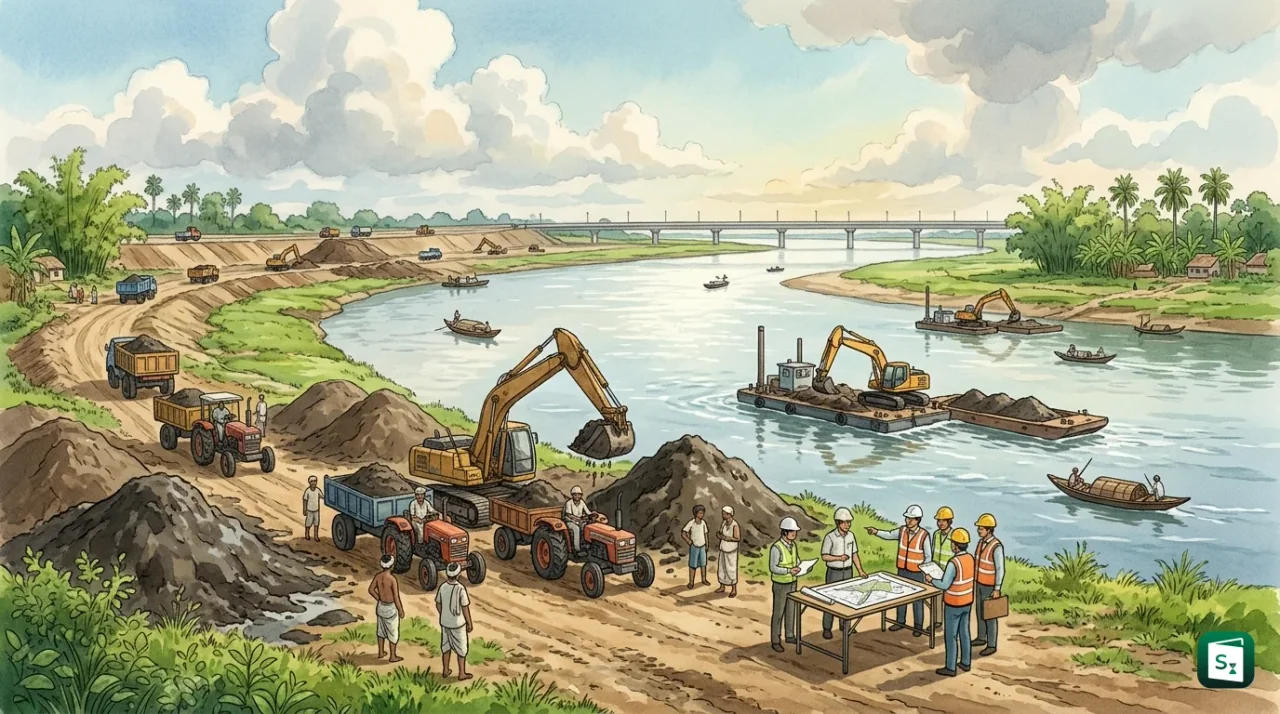
Bihar has become the first state in India to notify a comprehensive silt management policy, the Bihar Water Sources Restoration and Silt Management Policy, 2026. The state cabinet approved it on 15 September 2026 and notified it on 17 September 2026. On 3 November 2026, Bihar signed an agreement with the Ministry of Road Transport and Highways (MoRTH) to desilt rivers scientifically and use the excavated silt in highway construction under the Nadi Sanjeevani initiative.
What Is Silt, Siltation and Desilting?
Silt is very fine mineral material carried by flowing water and deposited as sediment when the current slows down. Siltation is the build up of this material on riverbeds, lake beds and reservoir floors. Desilting is the controlled removal of that deposited material to restore the original water holding and carrying capacity.
Silt sits between sand and clay in particle size. Sand particles are the largest and feel gritty. Clay particles are the smallest and feel sticky when wet. Silt particles feel smooth and powdery, almost like flour. The Bureau of Indian Standards classifies fine sediment as particles smaller than 0.062 mm and medium sediment as 0.062 mm to 0.25 mm.
Siltation and sedimentation are closely related but not identical. Sedimentation is the general process by which all transported material, including boulders, sand, silt and clay, settles down. Siltation refers specifically to the accumulation of fine particles such as silt and clay at places where it is not wanted, such as navigation channels, irrigation canals and reservoir beds.
Rivers in Bihar face severe siltation because Himalayan rivers carry a heavy load of eroded rock and soil. When these rivers enter the flat plains of Bihar, their speed drops sharply. The slower water cannot carry the load further, so silt settles on the bed and raises it year after year.
Why Bihar Faces Severe Floods Every Year?
Bihar is India’s most flood prone state. About three-fourths of its area is classified as flood prone, and about 76 percent of people in north Bihar live under recurring flood threat. Seven major Himalayan rivers enter Bihar from Nepal and join the Ganga. They bring huge volumes of water and silt during every monsoon.
The state’s geography makes the problem worse. Rivers like the Kosi, Gandak, Bagmati, Kamla-Balan, Mahananda and Ghaghra drop from steep Himalayan slopes to the extremely flat plains of Bihar. Their speed falls and they deposit silt.
Riverbeds rise above the surrounding land. Even normal monsoon flows then spill over banks.
| River | Origin | Flood Impact in Bihar |
|---|---|---|
| Kosi, known as the Sorrow of Bihar | Himalayas in Nepal | Shifts course often, floods Supaul, Saharsa and Khagaria |
| Gandak | Nepal and Tibet region | High silt load, floods Gopalganj and Saran |
| Bagmati | Nepal | Heavy siltation, floods Sitamarhi and Darbhanga |
| Mahananda | Himalayan foothills | Floods Kishanganj and Purnia |
| Ghaghra | Tibetan plateau | Floods western districts like Siwan and Saran |
| Ganga | Gangotri in Uttarakhand, enters Bihar at Buxar | Receives all northern rivers, floods Patna, Bhagalpur and Katihar |
Water from outside Bihar drives most floods. State officials noted that in 2026 Bihar had a 32 percent rainfall deficit, yet flood levels touched record highs in three major rivers. Rain in Nepal, in Uttar Pradesh around Allahabad and Varanasi, and releases from Nepal barrages raised the Ganga and its tributaries inside Bihar.
How Siltation Causes Flooding
Siltation causes flooding by reducing the space available for water. As silt piles up, the riverbed rises and the channel becomes shallow. A shallow channel carries less water. During heavy inflow, water has no room inside the banks and spreads into farms and towns.
Two Bihar specific factors deepen this effect. First, the state has built more than 3,730 km of embankments to confine rivers. The confined silt cannot spread across a wide floodplain and settles inside the embanked channel.
Second, when the Ganga runs high, its tributaries cannot drain into it. This backwater effect flooded the Gandak and Punpun regions in September 2026 even after upstream discharges had started to fall.
What Is the Bihar Silt Management Policy 2026?
The Bihar Water Sources Restoration and Silt Management Policy, 2026 is a structured framework to restore water bodies and manage accumulated silt. The state cabinet approved it on 15 September 2026. The Water Resources Department notified it on 17 September 2026 through Notification No. 803. Bihar is the first state in India to adopt such a comprehensive state level policy for silt.
The policy covers rivers, barrages, reservoirs, canals and other water bodies across the state. Its core task is measurement, removal, transport and safe reuse of silt as one connected process. Desilting will start only after technical assessment of each site. The policy also covers sand and silt that floods deposit on farmland.
Its main objectives are clear. Restore the water carrying and water storing capacity of rivers and reservoirs. Cut flood risk by clearing silt from critical stretches. Reuse technically suitable silt in roads, highways and other works.
Other goals are to reduce the use of fertile farm topsoil as fill material, improve water availability for irrigation and daily supply, and keep all extraction within environmental limits.
The policy offers relief for silt hit farms. Financial assistance of ₹20,000 per two hectares is provided to affected farmers for removal of deposited sand and silt. This step protects cultivable land and helps farmers bring fields back into production faster.
The move fits into a larger national direction. The Centre published the National Framework on Sediment Management in October 2022 through the Department of Water Resources, River Development and Ganga Rejuvenation under the Ministry of Jal Shakti. That framework asks states to reduce silt generation at source and handle removal with scientific study. Bihar had long demanded a national silt policy, citing heavy deposits upstream of the Farakka Barrage on the Ganga. Its state policy also responds to the Vikasit Bharat 2047 water reform agenda, which asks states to complete technical and policy preparation for water body restoration by December 2026.
How Nadi Sanjeevani Links River Restoration With Highways
Nadi Sanjeevani is the implementation arm of the silt policy. The name means restoring life to rivers. On 3 November 2026, the Ministry of Road Transport and Highways and the Government of Bihar signed a memorandum of understanding in New Delhi for this initiative. Union Minister Nitin Gadkari and Bihar Chief Minister Samrat Choudhary were present at the signing.
Under the agreement, the highway agencies will desilt identified rivers and water bodies at their own cost and use suitable excavated material in national highway projects. Bihar will not bear the desilting cost. Contractors will carry out the work. The state will facilitate approvals and mining licences under existing rules.
The National Highways Authority of India (NHAI) has identified large material needs in Bihar. About 243 lakh cubic metres of suitable silt will go to 16 ongoing projects. Another 835 lakh cubic metres is proposed for 27 future projects, subject to quality tests and approvals. Together this is 1,078 lakh cubic metres of silt planned for reuse.
The scale of highway work explains the demand. NHAI now has 39 projects covering about 1,561 km under construction in Bihar at a cost of about ₹58,340 crore. Another 11 projects covering about 1,982 km with an investment of about ₹1,85,200 crore are proposed. Silt from nearby rivers will be used as earth and fill material to raise road levels and strengthen embankments.
The model solves two problems together. Rivers regain depth and flow. Highway builders get fill material close to the site instead of digging farmland or hauling soil from distant areas.
NHAI officials said delays in earth supply can push civil costs up by about ₹2,000 crore in a year and cause toll losses of about ₹2,800 crore. Local silt supply can cut transport cost, speed up work and reduce damage from digging agricultural and upland soil.
How Desilting Will Be Done With Safeguards
The Road Construction Department (RCD) of Bihar will act as the nodal department. A state level coordination committee will examine proposals, speed up approvals, track progress and resolve operational issues. Desilting will follow the state silt policy and all applicable environmental and statutory provisions.
Work will start only after detailed technical assessment of each water body. Extraction will be allowed only at approved locations and within fixed technical limits. The rules aim to protect river ecosystems, riverbanks, embankments, bridges and other structures. No work can disturb the natural course in a way that harms stability or safety.
Quality control is mandatory. The suitability of excavated silt for highway use will be tested under MoRTH specifications and Indian Roads Congress (IRC) codes. Fine silt has poor load bearing strength in its raw form and may need treatment or mixing before use. Only material that passes tests will go into road works. Rivers covered in early plans include the Ganga, Kosi, Gandak, Son, Ghaghra, Falgu and Bagmati.
Transparency measures are built into the agreement. Agencies will conduct joint measurement of extracted, transported and used quantities. Digital record keeping, regular monitoring and periodic reconciliation will check the figures. This system is meant to stop over extraction and illegal diversion.
Experts have flagged caution alongside support. Unscientific digging can destabilise beds and banks, harm aquatic habitats and alter downstream sediment flow. Private contractors may prefer easy digging near banks and barrage sides, which can change channel shape. Central guidance, including the national sediment framework, also warns that desilting of large rivers gives only limited and short term flood relief unless catchment treatment, floodplain protection and continuous monitoring go with it.
Desilting Versus Dredging: What Is the Difference?
Desilting and dredging are often used as synonyms, but they mean different operations. Desilting is the removal of settled silt and sand from a canal, tank, lake or river stretch to restore its earlier holding capacity. Dredging is the excavation of material from below the waterline to deepen or widen a channel, harbour or reservoir, often with floating dredgers or suction pumps.
| Aspect | Desilting | Dredging |
|---|---|---|
| Purpose | Restore lost capacity and flow | Deepen or widen for navigation or new capacity |
| Location | Tanks, canals, lakes, selected river stretches | Ports, harbours, navigation channels, deep reservoirs |
| Equipment | Excavators from banks in dry or shallow stretches | Suction dredgers, cutter dredgers, pontoon machines |
| Effect | Brings back earlier depth | Creates new depth beyond the earlier level |
India’s main dredging body is the Dredging Corporation of India Limited (DCI). It was incorporated on 29 March 1976 under the Companies Act and is headquartered at Visakhapatnam in Andhra Pradesh. It functions under a consortium of four major ports, the Visakhapatnam, Paradip, Jawaharlal Nehru and Deendayal port authorities. DCI handles nearly 80 percent of maintenance dredging at major Indian ports and also takes up capital dredging, land reclamation and beach nourishment.
Excavated silt has several tested uses when quality permits. Coarse sand and gravel go into concrete and road works. Treated silt can serve as fill for embankments and land levelling.
Silt rich in organic matter can improve farm soil, though silt mixed with industrial waste must be kept out of the food chain. For construction sand, engineers check silt content through the silt content test under IS 2386, since excess silt weakens concrete and plaster.
Key Takeaways
- Bihar notified the Bihar Water Sources Restoration and Silt Management Policy, 2026 on 17 September 2026, becoming the first state with a comprehensive silt policy.
- The Nadi Sanjeevani agreement signed on 3 November 2026 links scientific desilting with highway building by MoRTH and the Bihar government.
- About 243 lakh cubic metres of silt will be used in 16 ongoing highway projects and 835 lakh cubic metres is proposed for 27 future projects.
- The Bihar Road Construction Department is the nodal agency, with testing under MoRTH and IRC codes and monitoring through joint measurement and digital records.
- The Dredging Corporation of India, set up in 1976 and headquartered at Visakhapatnam, handles nearly 80 percent of maintenance dredging at major ports.