

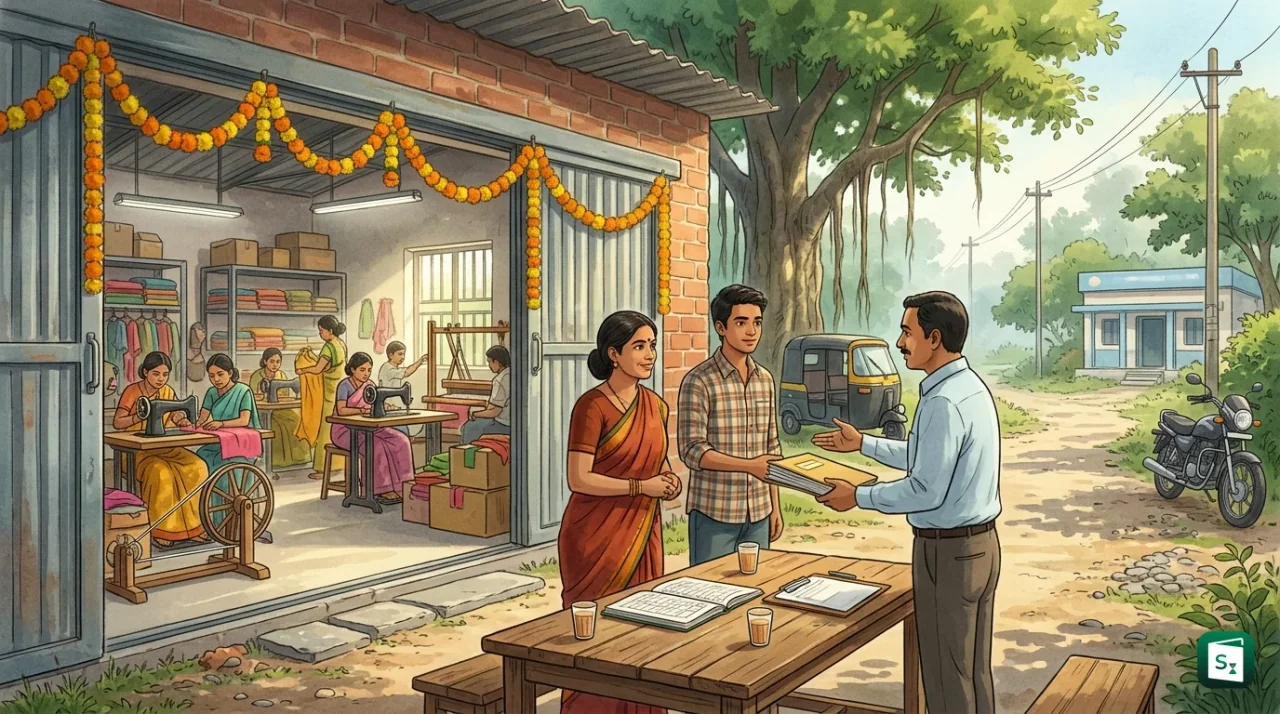
The Union Cabinet chaired by Prime Minister Narendra Modi on 11 November 2026 extended the Stand-Up India Scheme for five years till 31 March 2031. The extension targets financial assistance to an additional 2.5 lakh women, Scheduled Caste and Scheduled Tribe entrepreneurs. It is backed by a Rs 4111 crore credit guarantee corpus to keep bank lending flowing to first time business owners.
What Is the Stand-Up India Scheme?
The Stand-Up India Scheme is a central government credit programme that helps women and members of Scheduled Castes (SCs) and Scheduled Tribes (STs) start new businesses with bank loans. The government launched the scheme on 5 April 2016 to open formal credit to groups that often face hurdles in getting loans, advice and mentorship. It supports first time ventures, known as greenfield enterprises, which are businesses set up for the first time by the borrower from the ground up.
The original design asked every branch of a Scheduled Commercial Bank to lend to at least one SC or ST borrower and at least one woman borrower for a greenfield unit. Eligible activities are manufacturing, services, trading and activities allied to agriculture such as dairy, poultry, fishery, beekeeping, food processing and agri clinics. Crop loans and land improvement works like canals and wells are not covered. In case of a company or partnership firm, at least 51 percent of the shareholding and control must rest with an SC, ST or woman entrepreneur.
Which Ministry Runs the Stand-Up India Scheme?
The Department of Financial Services under the Ministry of Finance is the nodal authority for the Stand-Up India Scheme. The department frames the guidelines, reviews progress with banks and places proposals for continuation before the Union Cabinet. Day to day implementation rests with Scheduled Commercial Banks across India, which appraise, sanction and disburse the loans.
The Small Industries Development Bank of India (SIDBI) provides technology and handholding backbone for the scheme. SIDBI, set up in 1990 and headquartered in Lucknow, developed the StandUpMitra portal (standupmitra.in) for the programme. The portal guides applicants from training to loan application, connects them to bank branches, Lead District Managers and support agencies, and tracks applications. Applicants can also apply through the JanSamarth portal or directly at a bank branch.
What the Cabinet Extension Till FY31 Provides
The Union Cabinet on 11 November 2026 approved continuation of the scheme for five years till 31 March 2031. The decision was announced by Information and Broadcasting Minister Ashwini Vaishnaw after the Cabinet meeting chaired by the Prime Minister. The previous operational period had run till 31 March 2025 in line with the Fifteenth Finance Commission cycle.
The extended phase aims to assist a minimum of 2.5 lakh additional entrepreneurs in five years. Since launch, the scheme has facilitated loans to more than 2.75 lakh women, SC and ST entrepreneurs. Government data placed total sanctions at 2,75,291 accounts involving about Rs 62791 crore by 2025, with disbursement of over Rs 41517 crore reported till June 2026. The government expects the fresh target to bring another large cohort of first generation entrepreneurs into formal credit and enterprise creation.
| Cabinet decision of 11 November 2026 | Detail |
|---|---|
| Extended period | Five years till 31 March 2031 |
| New beneficiary target | At least 2.5 lakh additional entrepreneurs |
| Beneficiary groups | Women, SCs and STs |
| Credit guarantee corpus approved | Rs 4111 crore |
| Guarantee cover | 85 percent of loan amount |
| Guarantee fee | 0.50 percent standard fee |
Who Can Apply and What Loan Support Is Offered
The scheme is open to SC, ST or women entrepreneurs above 18 years of age who plan a greenfield project. The borrower must not be a defaulter to any bank or financial institution. The venture must fall under manufacturing, services, trading or activities allied to agriculture.
Financial support is given as a loan of above Rs 10 lakh and up to Rs 1 crore. It can cover up to 85 percent of the project cost. The borrower must bring at least 10 percent of the cost as own contribution. The balance margin of up to 15 percent can be tied up through convergence with eligible central or state schemes.
How the Composite Loan and Repayment Work
The loan can be a composite loan or a term loan. A composite loan combines a term loan for fixed assets such as plant and machinery with working capital for daily operations. A term loan is used only for fixed assets. This structure helps a new unit buy equipment and also manage cash flow in early months.
Repayment is allowed up to seven years with a moratorium of up to 18 months. The interest rate is the lowest applicable rate of the bank for that borrower category. It cannot exceed the base rate or Marginal Cost of Funds based Lending Rate plus 3 percent plus tenor premium. Working capital up to Rs 10 lakh can be drawn as an overdraft with a RuPay debit card, while larger working capital is given as cash credit.
How Credit Guarantee Cover and StandUpMitra Support Work
The Credit Guarantee Fund for Stand-Up India (CGFSI), also referred to as the Credit Guarantee Scheme for Stand-Up India (CGSSI), backs eligible loans against default. The fund is operated through the National Credit Guarantee Trustee Company Ltd (NCGTC), which was set up on 28 March 2014 to manage central credit guarantee funds. Under the extended framework, guarantee cover is 85 percent of the loan amount for all eligible loan sizes. The standard guarantee fee is 0.50 percent per annum, with no extra risk premium announced in the Cabinet decision.
This cover matters because first generation borrowers often lack collateral or long credit histories. The guarantee lowers the risk for banks and improves the flow of collateral free lending. The lending bank pays the fee to NCGTC and may recover it from the borrower as per their agreement.
Credit alone is not enough for a new entrepreneur. The StandUpMitra portal therefore links applicants to training, skill development, project report preparation, help with application forms, work shed identification, raw material sourcing and marketing support. District level officials including the Lead District Manager, along with offices of SIDBI and NABARD, act as connect centres to solve bottlenecks. NABARD, the National Bank for Agriculture and Rural Development established in 1982 and headquartered in Mumbai, supports this outreach in rural and farm allied activities.
How Stand-Up India Differs From Startup India and MUDRA Loans
Readers often mix Stand-Up India with Startup India and MUDRA because all three support new businesses. The three programmes differ in target group, loan size and type of support.
Startup India, launched on 16 January 2016 by the Department for Promotion of Industry and Internal Trade, supports innovation led startups across all social groups. It offers recognition, tax holiday, easier compliance, patent fee rebate, fund of funds support and a startup hub for mentorship. It is not limited to SC, ST and women borrowers and does not itself give a fixed bank loan slab.
The Pradhan Mantri MUDRA Yojana (PMMY), launched on 8 April 2015, gives collateral free micro loans to non corporate, non farm micro units through banks, non banking finance companies and micro finance institutions. Its categories are Shishu up to Rs 50000, Kishore above Rs 50000 to Rs 5 lakh, Tarun above Rs 5 lakh to Rs 10 lakh, and Tarun Plus above Rs 10 lakh to Rs 20 lakh for eligible repeat borrowers. MUDRA covers both new and existing units, while Stand-Up India covers only greenfield ventures within a higher slab.
| Feature | Stand-Up India | Startup India | MUDRA |
|---|---|---|---|
| Main beneficiaries | Women, SC and ST first time entrepreneurs | Innovative startups of any background | Micro units, new and existing |
| Loan or support size | Above Rs 10 lakh to Rs 1 crore | No fixed loan slab, support through funds, tax and compliance benefits | Up to Rs 20 lakh across four categories |
| Enterprise type | Greenfield only in manufacturing, services, trading and agri allied work | Any innovative product, process or service | Non corporate, non farm income activity |
| Nodal body | Department of Financial Services, Ministry of Finance | Department for Promotion of Industry and Internal Trade | Department of Financial Services with MUDRA Ltd refinancing |
Why the Scheme Matters for Inclusive Growth
The scheme directly expands access to institutional credit for women and SC and ST communities. Government data show about 75 percent of sanctioned loans have gone to women borrowers outside SC and ST categories, with SC and ST borrowers accounting for about 25 percent. Women within SC and ST groups form a smaller share, which points to a need for deeper outreach.
An independent evaluation through NITI Aayog during 2024-25 found average employment of 4 persons per enterprise. That link between credit and jobs is central to the extension. New units in manufacturing, food processing, services and trading can create local jobs and supply chains.
Challenges remain. Disbursements have lagged sanctions in some years, with a dip reported in 2023-24. First generation applicants often face documentation demands, viability checks and caution from branches. The 85 percent guarantee, the standard 0.50 percent fee and the handholding network are meant to reduce that hesitation. The Union Budget for 2025-26 also proposed a new scheme for 5 lakh first time women, SC and ST entrepreneurs with term loans up to Rs 2 crore over five years, drawing lessons from Stand-Up India. The present five year extension keeps the existing framework running while that larger design is finalised.
Key Takeaways
- The Union Cabinet on 11 November 2026 extended the Stand-Up India Scheme for five years till 31 March 2031.
- The extended scheme targets financial assistance to an additional 2.5 lakh women, SC and ST entrepreneurs.
- The scheme was launched on 5 April 2016 and is run by the Department of Financial Services under the Ministry of Finance.
- Eligible borrowers can get a composite or term loan of above Rs 10 lakh to Rs 1 crore covering up to 85 percent of project cost.
- The Cabinet approved a Rs 4111 crore credit guarantee corpus with 85 percent cover and a standard fee of 0.50 percent.