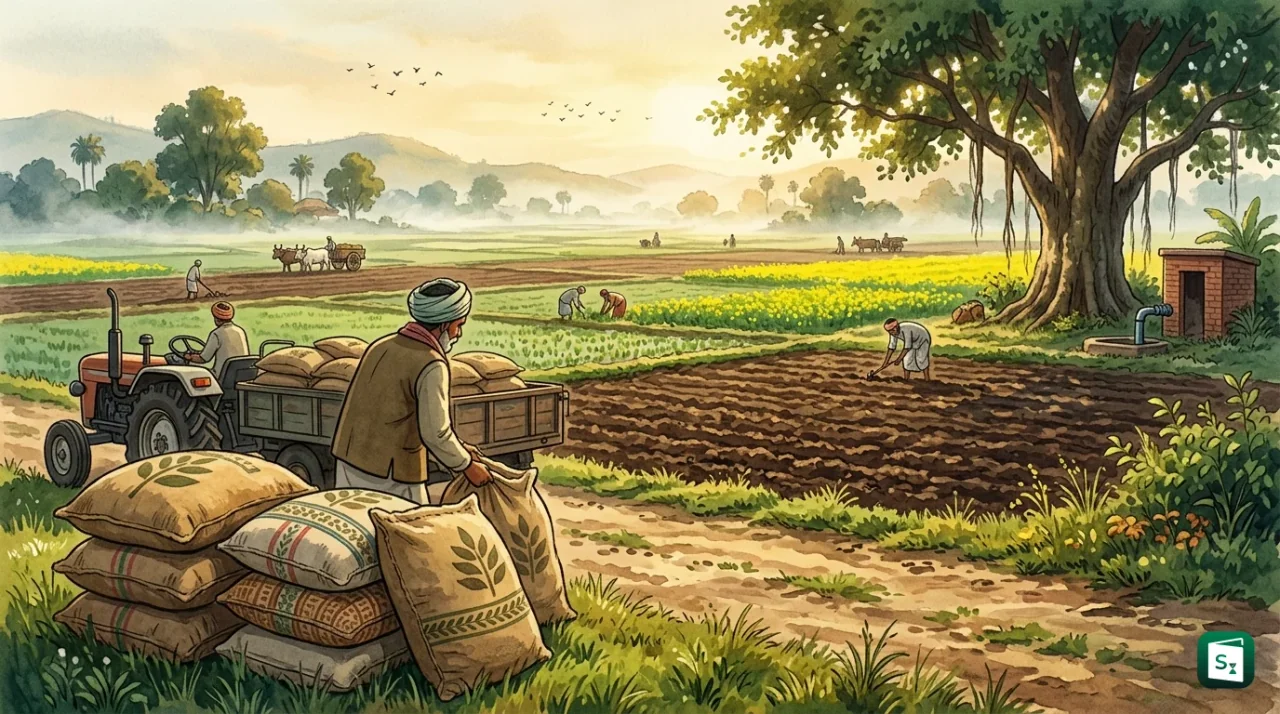
The Union Cabinet on 11 November 2026 approved Nutrient Based Subsidy Scheme rates for phosphatic and potassic fertilizers for Rabi 2026-27. The rates apply from 1 October 2026 to 31 March 2027 with a tentative outlay of ₹62,370.02 crore. The move shields winter crop farmers from high global fertilizer prices.
What Is the Nutrient Based Subsidy Scheme?
The Nutrient Based Subsidy (NBS) Scheme is the central policy that fixes fertilizer subsidy on the basis of nutrient content rather than the price of each product. NBS is short for Nutrient Based Subsidy. It covers phosphatic and potassic fertilizers, which are together called P and K fertilizers.
The Department of Fertilizers under the Ministry of Chemicals and Fertilizers runs the scheme. The scheme started on 1 April 2010, with Single Super Phosphate included from 1 May 2010. It replaced the earlier Concession Scheme for decontrolled P and K fertilizers that ran from 1992 to 2010.
Under NBS, the government announces a fixed subsidy per kg for four nutrients in every season. These are nitrogen (N), phosphorus (P), potash (K) and sulphur (S). The per kg rate is then converted into a per tonne subsidy for each fertilizer grade based on its nutrient mix.
At present, 28 grades of P and K fertilizers are covered. The list includes Di Ammonium Phosphate (DAP), Muriate of Potash (MOP), Mono Ammonium Phosphate (MAP), Triple Super Phosphate (TSP), Single Super Phosphate (SSP), ammonium sulphate and 21 grades of NPKS complex fertilizers. Grades fortified with boron or zinc get a small extra subsidy of ₹300 per tonne for boron and ₹500 per tonne for zinc.
An Inter Ministerial Committee chaired by the Secretary, Department of Fertilizers recommends the per kg rates before each season. The committee includes representatives from agriculture, expenditure, NITI Aayog and farm research bodies. The committee looks at global prices of urea, DAP, MOP and sulphur, currency changes, stocks and farm needs.
The subsidy does not go to farmers as cash. Farmers buy fertilizers from retailers at a printed retail price that is lower than the full market cost. The government pays the difference to fertilizer companies after the sale is recorded on a Point of Sale machine linked to the e-Urvarak portal and the Integrated Fertilizer Management System. Sale is verified with Aadhaar authentication, and the company claim is settled weekly.
What Is Fertilizer Subsidy in India?
Fertilizer subsidy in India is indirect support that lowers the retail price of fertilizers for farmers. The government pays fertilizer makers and importers the gap between their supply cost and the price farmers pay at the shop. Farmers are the final beneficiaries, but companies receive the payment.
India runs two parallel subsidy tracks. Phosphatic and potassic fertilizers get support under NBS with a fixed per kg rate and broadly decontrolled retail prices. Urea stays outside NBS. Urea has a statutorily fixed retail price, and the government reimburses the full cost gap to each plant under the Urea Subsidy Scheme.
| Feature | NBS for P and K Fertilizers | Urea Subsidy |
|---|---|---|
| Covered products | DAP, MOP, MAP, TSP, SSP, NPKS complexes | Indigenous and imported urea |
| Subsidy method | Fixed per kg rate for N, P, K, S | Cost gap over fixed retail price |
| Retail price | Fixed by companies at reasonable level, printed on bag | Fixed by government at ₹242 per 45 kg bag |
| Started | 1 April 2010 | Long standing price control regime |
| Payment route | Through e-Urvarak after PoS sale | Through companies after supply and sale |
The fertilizer subsidy is one of the largest central subsidies. In Budget 2026-27, the Centre allocated ₹1,70,799 crore for fertilizer subsidy, with ₹1,16,799 crore for urea and ₹54,000 crore for NBS fertilizers. Revised estimates for 2025-26 were higher at ₹1,86,460 crore because global input costs rose sharply. Parliamentary panels have noted that cheap urea pushes farmers to apply excess nitrogen and neglect phosphorus and potash, which harms soil health over time.
NBS Rates Approved for Rabi 2026-27
The Union Cabinet fixed fresh per kg rates for the six month Rabi season from 1 October 2026 to 31 March 2027. The tentative budgetary requirement for the season is ₹62,370.02 crore. This is ₹24,417.73 crore higher than the ₹37,952.29 crore provided for Rabi 2025-26, a rise of about 64 percent.
The Cabinet cited recent trends in global prices of urea, DAP, MOP and sulphur. Supply disruptions linked to the West Asia crisis raised raw material and finished fertilizer costs. The higher rates aim to keep retail prices stable for farmers while letting companies continue imports and domestic production.
| Nutrient | Rabi 2025-26 rate per kg | Kharif 2026 rate per kg | Rabi 2026-27 rate per kg |
|---|---|---|---|
| Nitrogen (N) | ₹43.02 | ₹47.32 | ₹94.21 |
| Phosphorus (P) | ₹47.96 | ₹52.76 | ₹66.11 |
| Potash (K) | ₹2.38 | ₹2.38 | ₹2.38 |
| Sulphur (S) | ₹2.87 | ₹3.16 | ₹10.42 |
The jump is sharp for nitrogen and sulphur. Nitrogen subsidy has more than doubled from the previous Rabi season. Sulphur support has risen nearly three and a half times. Phosphorus support is up about 38 percent. Potash support is unchanged.
How Subsidy Is Calculated for Each Fertilizer Grade
The Department of Fertilizers converts the per kg nutrient rates into a per tonne subsidy for each of the 28 grades. A grade with more phosphorus or nitrogen earns a higher total subsidy. For example, DAP with 18 percent nitrogen and 46 percent phosphorus attracts a large combined subsidy under the new rates. The subsidy amount and the retail price must be printed clearly on every bag. Sale above the printed price is punishable under the Essential Commodities Act.
Why DAP Price Stays at ₹1350 per Bag
Di Ammonium Phosphate, commonly called DAP, is the most widely used phosphatic fertilizer in India. DAP is short for Di Ammonium Phosphate. Farmers closely track the DAP fertilizer price because Rabi crops such as wheat, mustard and gram need phosphorus at sowing time. A 50 kg bag of DAP will continue to sell at ₹1350 during Rabi 2026-27.
Global DAP prices have risen sharply since the Covid years. Under pure NBS math, the retail price would have to rise. The government has therefore added special support over and above NBS to hold the line. This approach started in earlier seasons and continues now.
The Rabi 2026-27 package includes four such supports. Special assistance for DAP keeps its retail price fixed. The same benefit is extended to imported and domestic Triple Super Phosphate (TSP) and imported Mono Ammonium Phosphate (MAP) to widen supply options. Freight subsidy for Single Super Phosphate (SSP) continues to promote SSP as a cheaper domestic alternative to DAP. Subsidy on imported and domestic ammonium sulphate also continues.
In a move to cut import dependence, the Cabinet approved a sulphur package for domestic makers. Companies will get 20 percent of the actual sulphur procurement cost, subject to a floor price of $800 per tonne for sulphur and $266.67 per tonne for sulphuric acid. The Department of Fertilizers will issue detailed guidelines. The aim is to support local production of sulphuric acid and finished fertilizers when global supply routes face stress.
Rabi Season and Kharif Season: Why Subsidy Rates Change Every Season
The Rabi season runs from October to March. Rabi crops are winter crops sown after the monsoon and harvested in spring. Key Rabi crops include wheat, barley, mustard, gram and peas. The Kharif season covers the monsoon period from April to September for subsidy notifications, while field sowing peaks from June to October. Key Kharif crops include paddy, maize, cotton, soybean and groundnut.
Fertilizer demand shifts with these seasons. Rabi demand centers on DAP and NPKS complexes at sowing time in October and November. Kharif demand spreads across urea, DAP and complexes for paddy and cotton belts. The government therefore notifies NBS rates twice a year, once for Kharif and once for Rabi.
Global input costs also shift between seasons. Freight rates, ammonia prices, phosphoric acid prices and currency values can move sharply within six months. A fixed annual rate would either leave companies with losses or push retail prices too high. Biannual revision lets the subsidy absorb part of the shock. Rabi 2026-27 is a clear case. Rates rose steeply over Kharif 2026 because nitrogen and sulphur costs spiked after fresh supply disruptions.
Key Takeaways
- The Union Cabinet approved NBS rates for Rabi 2026-27 on 11 November 2026 for the period from 1 October 2026 to 31 March 2027.
- The tentative Rabi outlay is ₹62,370.02 crore, which is ₹24,417.73 crore higher than the ₹37,952.29 crore for Rabi 2025-26.
- New per kg rates are ₹94.21 for nitrogen, ₹66.11 for phosphorus, ₹2.38 for potash and ₹10.42 for sulphur.
- The NBS Scheme, run by the Department of Fertilizers since 1 April 2010, covers 28 grades including DAP, MOP, MAP, TSP and SSP.
- DAP will continue to sell at ₹1350 per 50 kg bag through special assistance beyond NBS, with similar support for TSP, MAP, SSP freight and ammonium sulphate.