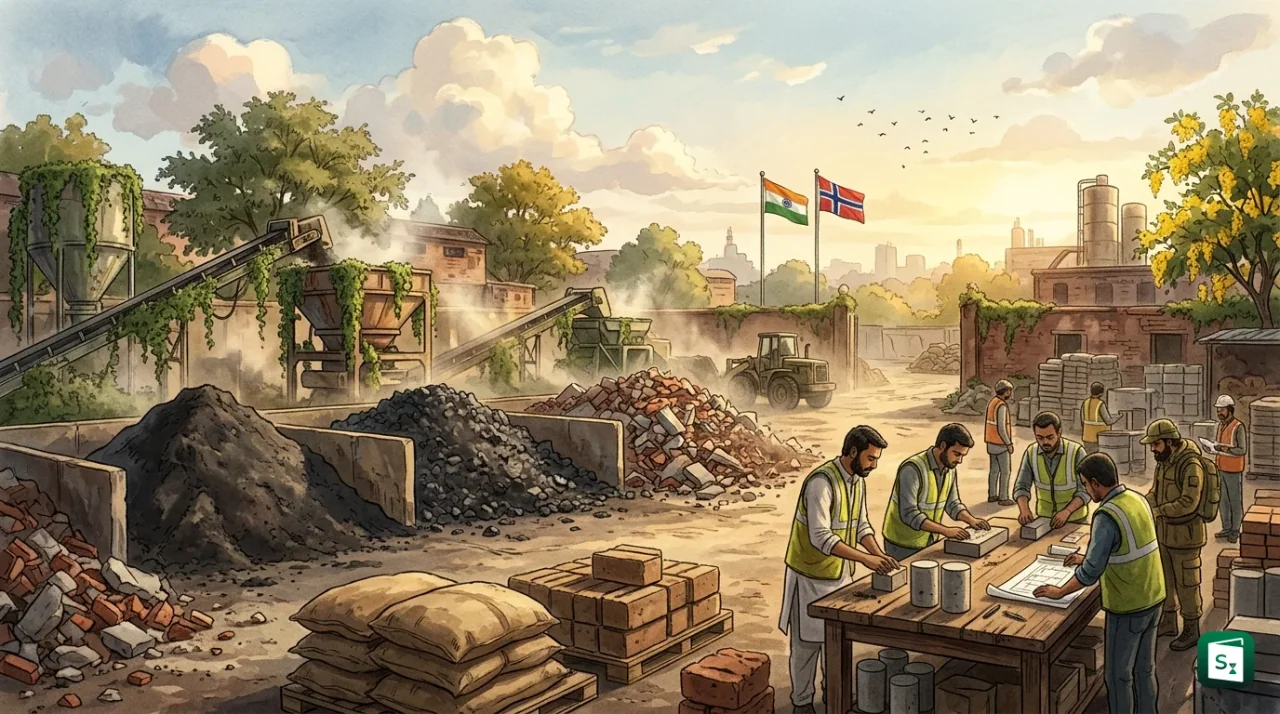
The Council of Scientific and Industrial Research (CSIR), together with Norway’s SINTEF and the Research Council of Norway, held the India Norway Dialogue on Waste to Resource Solutions in the Cement and Construction Sector on 10 November 2026 at the India Habitat Centre in New Delhi. Regulators, scientists and cement and construction companies joined the meeting to discuss how to turn fly ash, steel slag and construction waste into useful building materials. The dialogue puts the May 2026 Green Strategic Partnership into action by linking waste reuse with cleaner cement and roads.
What Happened at the India Norway Dialogue in New Delhi
The India Norway Dialogue took place on 10 November 2026 at the India Habitat Centre in New Delhi. The Council of Scientific and Industrial Research (CSIR), which is India’s largest public research network with 37 national laboratories and headquarters in New Delhi, organised it with SINTEF and the Research Council of Norway.
SINTEF is one of Europe’s largest independent research groups. It was set up in 1950 and is based in Trondheim, Norway. The Research Council of Norway is the country’s main public body for funding research and innovation.
The meeting brought together scientists from CSIR institutes, SINTEF experts, pollution regulators and firms from the cement and construction industry. Prof. S. K. Singh of CSIR Central Building Research Institute (CSIR-CBRI) welcomed the participants. CBRI was set up in 1947 in Roorkee and works on building materials and housing.
The opening session was addressed by Dr. Rama Swami Bansal, Head of the International Science and Technology Affairs Directorate at CSIR headquarters, Dr. Arvinn Gadgil of the Royal Norwegian Embassy in New Delhi, Dr. Kare Helge Karstensen, Chief Scientist at SINTEF, and Prof. R. Pradeep Kumar, Director of CSIR-CBRI. The speakers agreed that joint projects must move from papers to pilot plants and market use, with CSIR labs, SINTEF and industry working as partners.
Why the Green Strategic Partnership Frames This Dialogue
The dialogue draws directly from the Green Strategic Partnership that India and Norway launched in May 2026. Prime Minister Narendra Modi visited Norway on 18 May 2026, the first visit by an Indian Prime Minister in more than 40 years. He met Prime Minister Jonas Gahr Store, and the two sides raised the relationship to a green partnership centred on circular economy, clean technology and research.
The visit also built on the India European Free Trade Association Trade and Economic Partnership Agreement (TEPA). That pact, signed with Switzerland, Norway, Iceland and Liechtenstein, came into force on 1 October 2025. It aims to bring $100 billion in investment to India and create one million jobs in 15 years.
Five science agreements were signed in Oslo during the visit. They included a memorandum between CSIR and the Research Council of Norway for joint workshops, staff exchanges and projects on climate, clean energy, oceans and health. A second pact linked CSIR and SINTEF for 2026 to 2029, building on a cooperation framework from 2014, to work on bio based materials, ocean energy including offshore wind, carbon capture and waste valorisation. A project pact on ocean and offshore wind involves CSIR Structural Engineering Research Centre, CSIR National Aerospace Laboratories, CSIR National Institute of Oceanography and CSIR Fourth Paradigm Institute, with CSIR support of about ₹3.41 crore.
What Is Circular Economy and Why Does Cement Need It
The circular economy is a system where materials never become waste. Products and materials stay in use through reuse, repair, refurbishment, recycling and composting, while nature is allowed to regrow. It cuts waste, saves raw materials and lowers pollution and carbon emissions.
The present system is a linear economy of take, make and throw away. Raw stone, sand and fuel are mined, used once in buildings, and dumped as rubble. This model consumes large amounts of natural resources and fills landfills in crowded cities.
Cement and construction need a circular shift for clear reasons. India is the second largest cement producer in the world after China, and cement making releases large amounts of carbon dioxide from limestone heating and fuel burning. At the same time, thermal power plants, steel plants and demolition sites produce millions of tonnes of ash, slag and rubble every year. If those residues replace limestone, coal and sand, the sector saves resources, cuts emissions and solves a disposal problem.
| Linear Economy | Circular Economy |
|---|---|
| Take raw materials, make products, throw waste | Keep materials in use through reuse and recycling |
| Value ends when building is demolished | Demolished concrete becomes aggregate for new construction |
| Waste from one plant goes to landfill | Waste from one plant becomes input for another, a practice called industrial symbiosis |
A circular business model in this sector earns from recycled aggregates, waste derived fuels and low carbon cement blends instead of paying for dumping and mining fresh stone.
How Fly Ash, Steel Slag and Other Residues Replace Natural Materials
Fly ash is a fine grey powder left after coal is burned in thermal power plants. It contains silica, alumina and iron. When mixed with lime and water, it forms a binding compound like cement. In cement plants, fly ash replaces a part of clinker, which is the heated mix of limestone and minerals that gives cement its strength. This use, called fly ash in cement, lowers coal use and carbon emissions.
India produced 340.11 million tonnes of fly ash in 2024-25 and used 332.63 million tonnes of it. About 32 percent went to roads and flyovers, 27 percent to cement, 14 percent to bricks and tiles, with the rest used in backfilling and mine filling. Policy now requires fly ash in cement, bricks and road work near power plants.
Steel slag is the stony residue left after iron is separated from ore in steel furnaces. For every tonne of steel, about 200 kg of slag is formed. India makes about 19 million tonnes of steel slag each year, a figure that may rise to 60 million tonnes by 2030. Blast furnace slag already goes fully to cement as a clinker substitute. Steel slag was hard to use because it expands and holds phosphorus, but ageing and steam treatment now make it stable.
Steel slag used in road construction has shown strong results. CSIR Central Road Research Institute (CSIR-CRRI), set up in 1952 in New Delhi, built a six lane steel slag road to Hazira port in Surat in 2022 with ArcelorMittal Nippon Steel. The stretch used about one lakh tonnes of processed slag instead of natural stone and proved 30 percent thinner yet durable under heavy trucks. The same method was tested on National Highway 66 between Mumbai and Goa and on a Border Roads Organisation stretch in Arunachal Pradesh.
Research teams at CSIR-CRRI and CSIR Advanced Materials and Processes Research Institute (CSIR-AMPRI) in Bhopal showed wider options at the dialogue:
| Residue | What It Is | Proven Use in Construction |
|---|---|---|
| Fly ash | Powder from coal power plants | Portland Pozzolana Cement, fly ash bricks, road fill |
| Steel slag and copper slag | Heavy residue from metal making | Road aggregate, railway ballast, paver blocks, Tata Aggreto |
| Red mud | Alkaline waste from aluminium refining | Cement additive, bricks, geopolymer concrete |
| Plastic waste and steel grit | Factory and consumer scrap | Modified bitumen roads, abrasion resistant concrete |
Geopolymer concrete is a cement free concrete that uses fly ash or slag activated by chemicals instead of ordinary cement. It can cut carbon sharply and was highlighted as a value added product along with specialised aggregates and pre cast blocks.
How Cement Kilns Can Destroy Hazardous Waste Safely
The most technical session looked at cement kiln co-processing for hazardous waste. Co-processing means waste is fed into a cement kiln along with normal fuel and raw mix. The kiln runs near 1,450 degrees Celsius, which breaks down complex organic poisons while the mineral ash becomes part of clinker. This also replaces a share of coal with waste derived fuel.
The session was led by Dr. Kare Helge Karstensen of SINTEF and Dr. Ramesh Kumar, Chief Scientist at CSIR National Environmental Engineering Research Institute (CSIR-NEERI). NEERI, set up in 1958 in Nagpur, is India’s lead lab for air, water and hazardous waste studies.
The focus was Persistent Organic Pollutants (POPs), a group of toxic chemicals that stay in soil and water for years, travel long distances, build up in fat tissue and harm people and wildlife. The Stockholm Convention, adopted in May 2001 and in force from 17 May 2004, asks countries to end or restrict these chemicals. India signed the treaty in 2002 and ratified it on 13 January 2006. The list began with 12 chemicals and now covers 37, including pesticides like DDT, industrial oils like polychlorinated biphenyls (PCBs) and smoke byproducts like dioxins and furans.
CSIR-NEERI presented India’s National Implementation Plan, first filed in 2011 and now being updated with Global Environment Facility support to cover the full list. The plan maps stocks of DDT and PCB equipment, old dump sites and unintentional releases from burning plastic and medical waste. SINTEF shared experience from Norway and other countries where cement kilns destroyed concentrated pesticides and PCB oils under controlled conditions.
Both sides stressed safeguards. Kilns need clear technical protocols, controlled trial burns, continuous emission checks for dust and dioxins, and permits under hazardous waste rules. Only suitable wastes can be co-processed, and each trial must prove complete destruction without harm to workers or nearby residents.
How Construction and Demolition Waste Recycling Works in India
Construction and demolition waste includes concrete, bricks, plaster, stone, timber, steel, glass and plastic from building, repair and pulling down work. When dumped on roadsides and riverbeds, it blocks drains, raises dust and wastes stone and sand that could be reused.
A dedicated session led by Dr. Christian John Engelsen of SINTEF reviewed global practice. Norway began strict sorting and recycling of this stream in the late 1990s. Good plants crush concrete to make recycled concrete aggregates in sizes such as 5 to 10 mm and 10 to 20 mm, wash out soil and wood, and use magnets to pull steel. Mobile recycling units that work at the demolition site cut transport cost. Finished goods include pavers, kerb stones, drain covers, hollow blocks and manufactured soil for parks.
Prof. S. K. Singh of CSIR-CBRI presented work on using slags and other byproducts in construction. His talk showed how treated slag, fly ash and crushed rubble can go into structural concrete, road bases and low cost housing without loss of strength, if quality tests are followed.
India has tightened the law to force this change. The Construction and Demolition Waste Management Rules, 2016, issued on 29 March 2016, asked cities to set up collection and processing centres. The Environment (Construction and Demolition) Waste Management Rules, 2025, notified on 2 April 2025, replace them from 1 April 2026 and add circular economy tools:
| Rule Feature | 2016 Rules | 2025 Rules |
|---|---|---|
| Core duty | Segregate, store and hand over waste to collection points | Same duties plus Extended Producer Responsibility targets |
| Recycling target for builders | No fixed percent | 25 percent in 2025-26 rising to 100 percent from 2028-29 |
| Use of recycled products | Encouraged in public works | Mandatory 5 to 25 percent in large buildings and 5 to 15 percent in roads by 2030-31 |
| Tracking | Paper reports to city bodies | Online portal run by the Central Pollution Control Board (CPCB) with tradable certificates |
| Penalty | Action by local bodies | Environmental compensation for non compliance, with refund if backlog is cleared in three years |
CPCB, set up in 1974 under the Water Act and operating under the Environment Protection Act of 1986, will register producers, storage operators and recyclers and audit the material balance each financial year.
What Happens Next for India Norway Research Cooperation
The dialogue closed with a short list of joint tasks. The two sides will prepare two to three joint research proposals with CSIR labs, SINTEF and company partners. The aim is technology that can be tested at scale, not laboratory studies alone.
Pilot scale demonstration plants for hazardous waste treatment are a priority. These pilots will test cement kiln handling of DDT and PCB stocks and produce technical guidelines for safe disposal. A second track will advance waste derived materials for roads and housing, with agreed test methods, certification of recycled aggregates and life cycle data on carbon savings.
The programme also calls for stronger industry and academic links, building on the Indo Norwegian construction waste project run with the Central Public Works Department and the Goa Waste Management Corporation from 2023 to 2026. That project shared Norwegian sorting practice with Indian builders such as L and T Construction and Godrej Construction. The new phase extends the same approach to cement, steel and power residues, so that waste to resource becomes a regular part of sustainable construction.
Key Takeaways
- The India Norway Dialogue was held on 10 November 2026 at the India Habitat Centre, New Delhi by CSIR, SINTEF and the Research Council of Norway.
- The dialogue works under the Green Strategic Partnership launched during the Prime Minister’s Norway visit in May 2026.
- India generated 340.11 million tonnes of fly ash in 2024-25 and used about 27 percent of it in cement and 32 percent in roads and flyovers.
- India produces about 19 million tonnes of steel slag yearly, and CSIR-CRRI’s Hazira steel slag road showed durable low cost use in place of stone.
- The Environment (Construction and Demolition) Waste Management Rules, 2025 take effect from 1 April 2026 with recycling targets rising to 100 percent from 2028-29.