

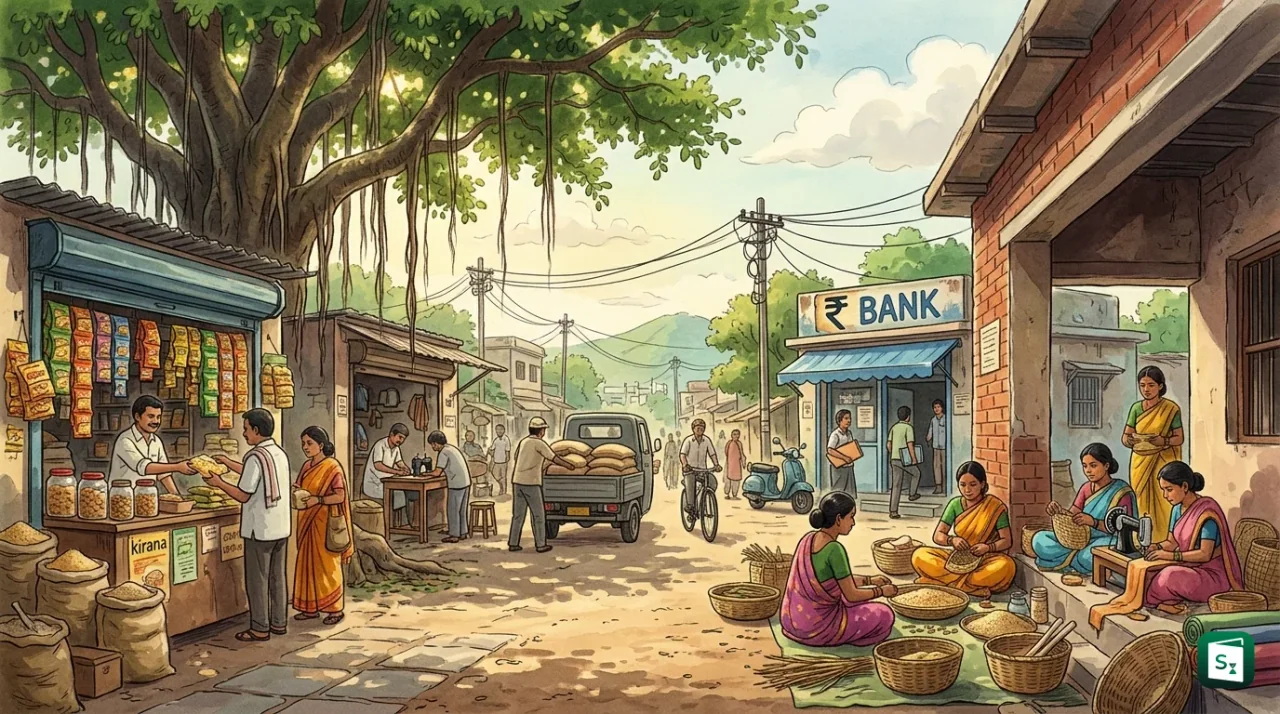
The Union Cabinet on 11 November 2026 continued the Credit Guarantee Fund for Micro Units till 31 March 2031 with a ₹5,000 crore corpus. The fund protects lenders against default on collateral free Mudra loans. The CGFMU fee falls to 0.75 percent to support ₹12.6 lakh crore in fresh lending.
What Is CGFMU and How Does It Work?
The Credit Guarantee Fund for Micro Units (CGFMU) is a trust fund set up by the central government to assure lenders against default on small collateral free loans. The National Credit Guarantee Trustee Company Ltd (NCGTC) manages the fund as trustee. Banks and other lenders pay a fee for this cover and can lend without asking borrowers for security.
NCGTC was incorporated on 28 March 2014 under the Companies Act, 1956. It was set up by the Department of Financial Services under the Ministry of Finance as a wholly owned government company. Its registered office is in Mumbai. It acts as a common trustee for several credit guarantee funds, including funds for education loans, skill development, factoring, micro units and Stand Up India.
CGFMU was launched in January 2016 to back loans given under the Pradhan Mantri Mudra Yojana (PMMY). It works as a portfolio guarantee, not a loan by loan insurance. A lender groups all eligible Mudra loans given in a year into one portfolio and registers it on the NCGTC online portal SURGE. Cover starts from the date the fee is paid and must be renewed each year.
When defaults happen, loss sharing follows a clear order. The lender absorbs the first 3 percent of the amount in default. On the balance, the fund pays 75 percent on a pro rata basis. Total payout in a portfolio is capped at 15 percent of the crystallised portfolio value. Claims can be raised after one year from crystallisation, at the end of each financial year.
What the Cabinet Approved for FY27 to FY31
The Union Cabinet, chaired by the Prime Minister, approved the continuation of CGFMU for five years till 31 March 2031 at its meeting on 11 November 2026. The decision was briefed by Information and Broadcasting Minister Ashwini Vaishnaw. It aligns the scheme with the Sixteenth Finance Commission cycle, which runs from FY27 to FY31.
The Cabinet approved a corpus of ₹5,000 crore for the fund. This corpus will anchor guarantees for an estimated ₹12.6 lakh crore in Mudra lending over the next five years. In simple terms, a relatively small public fund unlocks very large bank lending because banks feel safe from total loss.
The continued scheme will apply to all eligible loans extended under PMMY during FY27 to FY31. The government also promised a stronger claim process for lenders. Lower cost and faster settlement are meant to keep banks willing to lend to first time borrowers with no credit history.
Which Loans Get Guarantee Coverage Under CGFMU?
CGFMU covers three types of credit facilities given by Lending Institutions (LIs). LIs include public sector banks, private banks, foreign banks, regional rural banks, small finance banks, Non Banking Financial Companies (NBFCs), Micro Finance Institutions (MFIs) and other approved intermediaries. The borrower does not apply to NCGTC directly. The lender seeks cover at its own choice.
| Facility | Limit | Key condition |
|---|---|---|
| Micro enterprise loans under PMMY | Up to ₹20 lakh | Manufacturing, services including retail trade, and allied agriculture such as poultry, dairy and beekeeping. Loans above ₹10 lakh to ₹20 lakh are open only to borrowers who earlier took a Tarun loan and repaid it fully |
| Overdraft under Pradhan Mantri Jan Dhan Yojana (PMJDY) accounts | Up to ₹10,000 | One account per household, after satisfactory operation. PMJDY was launched on 28 August 2014 and now has more than 59 crore accounts |
| Loans to Self Help Groups (SHGs) | ₹10 lakh to ₹20 lakh portfolio | Collateral free loans given on or after 1 April 2020. Group guarantee of members does not block cover |
Coverage reflects real risk. For working capital limits, it is linked to the disbursed amount. For term loans, it is linked to the outstanding amount. For SHG loans between ₹10 lakh and ₹20 lakh, the fund covers 75 percent of the amount in default with no first loss to be borne by the lender.
What Is the CGFMU Guarantee Fee After the Revision?
The CGFMU fee is the annual charge a lender pays to NCGTC for guarantee cover. It is calculated on the sanctioned amount in the base year and on the outstanding amount in later years. For working capital accounts, it stays linked to the sanctioned amount. The lender may recover it from the borrower, but in practice micro borrowers pay no separate fee.
The Cabinet has cut the standard fee from 1 percent per annum to 0.75 percent per annum. This applies to micro loans under PMMY. The cut lowers the cost of offering small loans and should push banks to cover a larger share of their Mudra portfolio.
The fee for SHG loans stays unchanged. SHGs continue to pay 0.25 percent in the first year and 0.50 percent in later years on the outstanding balance. Earlier, loans in aspirational districts enjoyed a concessional 0.5 percent fee for FY21 and FY22 portfolios. That concession was later withdrawn. A risk based fee can also apply based on the risk profile of the lender.
Pradhan Mantri Mudra Yojana Categories Behind the Guarantee
Pradhan Mantri Mudra Yojana (PMMY) was launched on 8 April 2015 with the slogan Funding the Unfunded. It gives collateral free institutional credit to non corporate, non farm micro units. The Micro Units Development and Refinance Agency (MUDRA) supports the scheme for refinance and monitoring. Lending is done by member banks, NBFCs and MFIs.
Loans fall into four slabs based on business stage. The slab also decides CGFMU eligibility for higher value loans.
| Category | Loan range | Who it suits |
|---|---|---|
| Shishu | Up to ₹50,000 | Very small or new ventures with no credit history, such as repair shops and tiny retail units |
| Kishore | Above ₹50,000 to ₹5 lakh | Units that need working capital or modest expansion after starting operations |
| Tarun | Above ₹5 lakh to ₹10 lakh | Growing units buying equipment or raising capacity |
| Tarun Plus | Above ₹10 lakh to ₹20 lakh | Only borrowers who took a Tarun loan and repaid it successfully. Introduced with effect from 24 October 2024 |
Scale explains why the guarantee matters. As of September 2026, lenders had sanctioned more than 60.36 crore loans worth ₹43.34 lakh crore since launch. By June 2026 the count was 59.14 crore loans. Women hold more than 65 percent of accounts in some recent counts, and about half the accounts belong to Scheduled Caste, Scheduled Tribe and Other Backward Class borrowers. Around 12 crore accounts belong to new entrepreneurs entering formal credit for the first time.
CGFMU vs CGTMSE: How the Two Guarantee Funds Differ
The Credit Guarantee Fund Trust for Micro and Small Enterprises (CGTMSE) is often mixed up with CGFMU. CGTMSE was set up in August 2000 jointly by the Ministry of Micro, Small and Medium Enterprises and the Small Industries Development Bank of India (SIDBI). It covers all eligible collateral free loans to micro and small enterprises, whether or not they are Mudra loans. CGFMU covers only Mudra linked micro loans, Jan Dhan overdrafts and specified SHG loans.
| Feature | CGFMU | CGTMSE |
|---|---|---|
| Managed by | NCGTC under the Ministry of Finance | CGTMSE Trust with SIDBI and the Ministry of MSME |
| Started in | 2016 | 2000 |
| Covers | Micro units under PMMY up to ₹20 lakh | Micro and small enterprises up to ₹10 crore per borrower from 1 April 2025 |
| Guarantee model | Portfolio guarantee with 15 percent portfolio cap | Individual loan guarantee with no portfolio cap |
| Cover level | 75 percent of amount in default after 3 percent first loss | 75 percent to 90 percent based on category and size |
A single facility cannot carry both covers at once. A borrower can still use each scheme for different loans. A small shop can have an ₹8 lakh Mudra working capital line under CGFMU and later take a ₹25 lakh machinery term loan under CGTMSE. Lenders choose the scheme that fits the loan size and enterprise type.
Why the Continuation Matters for Micro Enterprises
Micro units employ close to 10 crore people after agriculture, yet many cannot offer collateral. Without a guarantee, banks hesitate to lend to street vendors, tiny manufacturers, service repair units and allied farm activities like dairy and poultry. CGFMU removes that block by sharing the loss.
The fee cut directly improves lender economics on small ticket loans. A lower annual charge makes it viable to keep Shishu and Kishore accounts on the books and to graduate good borrowers to Tarun and Tarun Plus. Better claim settlement also lifts the quality of lender portfolios.
The wider effect is inclusion. Collateral free Mudra credit has let first generation entrepreneurs borrow, repay, build a credit record and borrow larger sums. SHG coverage between ₹10 lakh and ₹20 lakh supports collective rural enterprises, while the ₹10,000 Jan Dhan overdraft gives poor households a first entry into formal credit. The five year window to FY31 gives lenders the certainty to plan such lending at scale.
Key Takeaways
- The Union Cabinet on 11 November 2026 continued CGFMU till 31 March 2031 with a ₹5,000 crore corpus to support ₹12.6 lakh crore in Mudra loans.
- CGFMU, launched in January 2016, is managed by NCGTC, incorporated on 28 March 2014 under the Ministry of Finance.
- The fund covers PMMY loans up to ₹20 lakh, PMJDY overdrafts up to ₹10,000 and SHG loans from ₹10 lakh to ₹20 lakh.
- The standard CGFMU guarantee fee was cut from 1 percent to 0.75 percent per annum, while SHG fee stays at 0.25 percent in year one and 0.50 percent after that.
- As of September 2026, lenders had sanctioned 60.36 crore Mudra loans worth ₹43.34 lakh crore since PMMY launch on 8 April 2015.