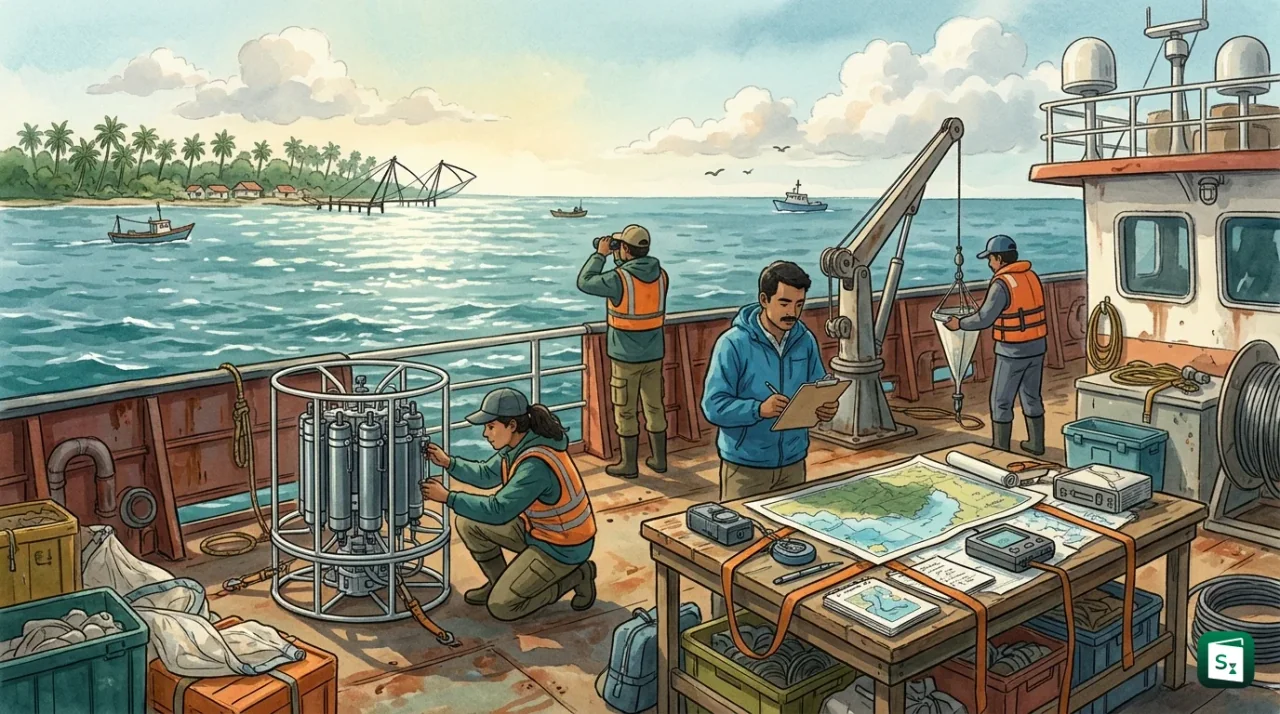
India, Sri Lanka, Bangladesh and the Maldives launched the Bay of Bengal Network of Ocean Researchers for Fisheries (BOB-NOR) on 3 November 2026 at ICAR-CMFRI in Kochi. The network will combine ocean observations, climate information and fisheries data to support climate resilient fisheries in the Bay of Bengal. It will work alongside the existing Bay of Bengal Stock Assessment Network (BOBSAN) to improve science based fisheries management.
What Is BOB-NOR and Why Was It Launched in Kochi?
The Bay of Bengal Network of Ocean Researchers for Fisheries (BOB-NOR) is a Regional Research Network that brings ocean researchers and fisheries scientists onto a common platform. The BOB-NOR launch workshop took place on 3 November 2026 at the ICAR-Central Marine Fisheries Research Institute (ICAR-CMFRI) in Kochi, Kerala. ICAR-CMFRI, established on 3 February 1947 and headquartered in Kochi since 1971, works under the Indian Council of Agricultural Research (ICAR) and is a leading institute for tropical marine fisheries research.
The Kochi meeting was held as a side event of the TREVOR-SAFARI Symposium 2026, which ran from 4 to 6 November 2026 at the same institute. TREVOR-SAFARI stands for Societal Applications in Fisheries and Aquaculture using Remote sensing Imagery, and the 2026 edition focused on aquatic ecosystems in a changing world. The symposium was jointly organised by the Trevor Platt Science Foundation, the Department of Chemical Oceanography of the Cochin University of Science and Technology (CUSAT), ICAR-CMFRI and the Marine Biological Association of India. More than 300 participants from about 30 countries attended, including experts in fisheries, climate science, ocean observation and satellite remote sensing.
BOB-NOR was proposed after a London workshop in April 2026 of GEO Blue Planet noted that raw ocean data alone was not changing fisheries decisions. Fisheries departments and ocean science groups often work under separate mandates and data systems. BOB-NOR fills that gap. Its goal is to promote systematic use of ocean information in fisheries research, climate adaptation and fishing operations. The workshop also discussed a Kochi Declaration on Mainstreaming Ocean Data in Fisheries Management and a roadmap for future joint work.
How Will BOB-NOR Link Ocean Data to Fisheries Management?
BOB-NOR will combine satellite observations, ocean surveys, climate indicators and fisheries data into a single advisory system. Satellite remote sensing is the use of space based sensors to measure ocean colour, temperature and productivity from orbit. Oceanographic observations include ship based measurements of sea surface temperature (SST), salinity, currents and chlorophyll-a, which is a green pigment in tiny marine plants and a marker of food available for fish.
The network will study how changes in sea temperature, monsoon patterns, salinity, ocean productivity and currents affect fish distribution, migration, recruitment and abundance. Recruitment means the number of young fish that enter the fishable stock each year. When the sea warms or the monsoon shifts, plankton growth changes and fish move to new grounds. BOB-NOR aims to track these shifts early and give predictive advice, instead of relying only on past catch records.
India already runs such a system through the Indian National Centre for Ocean Information Services (INCOIS), set up in 1999 at Hyderabad under the Ministry of Earth Sciences. INCOIS issues daily Potential Fishing Zone (PFZ) advisories for about 586 landing centres using SST and chlorophyll data. Its newer Hilsa Fishery Advisory (HiFA) uses machine learning with SST, salinity and current data to predict hilsa availability off West Bengal during the June to September season. BOB-NOR plans to extend this type of science to the whole Bay, with pilot studies, shared data standards and training for fisheries staff to read and use ocean data.
What Is BOBSAN and How Will BOB-NOR Complement It?
The Bay of Bengal Stock Assessment Network (BOBSAN) is an informal virtual network of government nominated fish stock assessment practitioners from the Bay region. Fish stock assessment is the scientific study that estimates how many fish of a species remain in the sea and whether current fishing is sustainable. BOBSAN traces its origin to a Food and Agriculture Organization (FAO) regional workshop in Bangkok in January 2023, where the Bay of Bengal Programme Inter-Governmental Organisation (BOBP-IGO) called for closer coordination among rim countries.
BOBP-IGO acts as the nodal point for BOBSAN. BOBSAN members share methods for data collection, catch analysis and modelling, and meet about once in six months. Its second regional dialogue was held in Kochi in April 2024 alongside an FAO validation workshop for stocks in FAO Fishing Area 57, which covers the Bay of Bengal and nearby waters. A global Scientific Advisory Committee guides BOBSAN, with experts from institutions such as the University of Washington, FAO Rome and Australian research agencies.
BOB-NOR will supplement BOBSAN by adding the ocean and climate side of the picture. The table below shows the division of work.
| Feature | BOBSAN | BOB-NOR |
|---|---|---|
| Full form | Bay of Bengal Stock Assessment Network | Bay of Bengal Network of Ocean Researchers for Fisheries |
| Main focus | Fish stock size, recruitment, fishing mortality and catch data | Ocean temperature, salinity, currents, monsoon and climate links to fish |
| Members | Stock assessment scientists nominated by governments | Ocean researchers in satellite oceanography, climate modelling and ocean science |
| Nodal body | BOBP-IGO | BOBP-IGO as secretariat, with scientific guidance from GEO Blue Planet and partner institutes |
| Outcome | Harmonised catch sampling and regional stock models | Predictive, climate informed advisories for management and fishing operations |
Fishing mortality means deaths caused by fishing, while recruitment and catch per unit effort show whether a stock is renewing itself. By linking these catch based indicators with ocean conditions, managers can understand why a stock rises or falls and plan seasonal measures with greater care.
Who Coordinates BOB-NOR and Who Joined the Launch?
The Bay of Bengal Programme Inter-Governmental Organisation (BOBP-IGO) will serve as the secretariat for BOB-NOR. BOBP-IGO was set up in 2003 and is headquartered in Chennai, Tamil Nadu. It grew out of the Bay of Bengal Programme of the FAO, which worked from 1979 to 2000. Its contracting parties are Bangladesh, India, Maldives and Sri Lanka, while Indonesia, Malaysia, Myanmar and Thailand cooperate as non contracting parties. The Department of Fisheries is the nodal agency for India.
Under the plan, each BOBP-IGO member country will nominate three to four researchers from academic or national institutes who work on satellite oceanography, climate modelling or related ocean science. These national teams will work with BOBSAN experts and a Scientific Advisory Committee of specialists in oceanography, climate science, remote sensing and data applications. Support comes through GEO Blue Planet, the EU4OceanObs project funded by the European Union and implemented by Mercator Ocean International, along with the Trevor Platt Science Foundation, Plymouth Marine Laboratory, INCOIS and ICAR-CMFRI.
The Kochi launch brought together representatives of the four member countries and oceanographers and marine scientists from the United States, Brazil, Chile, Portugal, the United Kingdom and Greece. Officials said the initiative could become a global model for linking ocean data to fisheries decisions.
Why Climate Resilient Fisheries Matter for the Bay of Bengal
The Bay of Bengal covers less than one percent of the global ocean but supplies nearly eight percent of world fishery production. The Bay of Bengal Large Marine Ecosystem spans about 6.2 million sq km, with nearly 450 million people living along its coasts. The Bay accounts for about six percent of the world fish catch, and more than one third of the world fishing fleet operates in these waters. For India, marine fish landings reached 3.57 million tonnes in 2025, with Tamil Nadu as the leading state. India is the second largest fish producer in the world, with total fish production of 197.75 lakh tonnes in 2024-25 and seafood exports worth ₹62,408 crore.
Climate pressure on this resource is rising. The sea surface temperature of the tropical Indian Ocean rose by about 1 degree Celsius during 1951 to 2015, faster than the global average. Warmer water, marine heatwaves, coral bleaching and harmful algal blooms shift where fish live and feed. Indian studies show that oil sardine and Indian mackerel, once limited to waters between 8 degrees North and 14 degrees North off the southwest coast, are now found further north as northern waters warm. Very weak and very strong monsoons both cut marine productivity in the past by reducing nutrient mixing, and models warn of more variable monsoons ahead. About seven percent of global cyclonic events occur in this region, which adds risk for small scale fishers.
Climate resilient fisheries management means using ocean and climate information to adjust fishing in advance and protect both stocks and livelihoods. India supports this shift through the Pradhan Mantri Matsya Sampada Yojana (PMMSY), a flagship scheme approved with an outlay of ₹20,050 crore for 2020-21 to 2024-25 and extended to 2025-26. The scheme funds harbours, cold chains, Recirculatory Aquaculture Systems and artificial reefs, and is developing 100 Coastal Fishermen Villages as Climate Resilient Coastal Fishermen Villages with central support of ₹200 lakh per village. BOB-NOR adds the regional science layer to such efforts by helping four sharing countries watch the same ocean signals and act on shared stocks together.
Key Takeaways
- BOB-NOR was launched on 3 November 2026 at ICAR-CMFRI, Kochi by India, Sri Lanka, Bangladesh and the Maldives.
- BOB-NOR stands for Bay of Bengal Network of Ocean Researchers for Fisheries and aims to build climate resilient fisheries by linking ocean, climate and fisheries data.
- The network will use satellite observations, SST, salinity, currents and chlorophyll-a to track fish distribution, migration, recruitment and abundance.
- BOB-NOR will complement BOBSAN, the Bay of Bengal Stock Assessment Network focused on stock assessment, fishing mortality and catch data.
- BOBP-IGO, set up in 2003 and headquartered in Chennai, will serve as the secretariat for BOB-NOR.