The first BIMSTEC Health Ministers Meeting was held in Colombo on 11 November 2026. Ministers from all seven member countries adopted a Joint Ministerial Statement and the Revised Plan of Action on Public Health (2026-2030). India agreed to host the regional Centre of Excellence in Traditional Medicine at Jamnagar in Gujarat.
What Is BIMSTEC?
BIMSTEC stands for the Bay of Bengal Initiative for Multi-Sectoral Technical and Economic Cooperation. It is a regional grouping that links South Asia with Southeast Asia and works on economic and technical cooperation around the Bay of Bengal.
BIMSTEC was formed on 6 June 1997 with the signing of the Bangkok Declaration. Bangladesh, India, Sri Lanka and Thailand signed the declaration in Bangkok. The group was first called BIST-EC. Myanmar joined in December 1997. Bhutan and Nepal joined in February 2004. The name then changed to BIMSTEC.
BIMSTEC has seven member countries. Five are from South Asia and two are from Southeast Asia.
| Member Country | Region |
|---|---|
| Bangladesh | South Asia |
| Bhutan | South Asia |
| India | South Asia |
| Nepal | South Asia |
| Sri Lanka | South Asia |
| Myanmar | Southeast Asia |
| Thailand | Southeast Asia |
The BIMSTEC Secretariat is located in Dhaka, Bangladesh. The Secretariat was set up in 2014 and inaugurated on 13 September 2014. The current Secretary General is Indra Mani Pandey of India, who took charge in January 2024 as the fourth Secretary General.
BIMSTEC adopted its Charter at the Fifth Summit in Colombo on 30 March 2022. The Charter came into force on 20 May 2024. It gave BIMSTEC a legal personality. This means BIMSTEC can now admit new members and observers and sign formal agreements with other organisations.
The BIMSTEC Summit is the top decision making body. It includes the heads of state or government of all members. Summits are held once every two years. Six summits have taken place so far in Bangkok in 2004, New Delhi in 2008, Nay Pyi Taw in 2014, Kathmandu in 2018, Colombo in 2022 and Bangkok in April 2025. Bangladesh took over as chair after the Sixth Summit. The grouping covers about 1.8 billion people and a combined GDP of about $4.5 trillion.
What Happened at the First BIMSTEC Health Ministers Meeting in Colombo?
The first BIMSTEC Health Ministers Meeting took place in Colombo, Sri Lanka, on 11 November 2026. Sri Lanka’s Minister of Health and Mass Media Nalinda Jayatissa chaired the meeting. Union Minister of Health and Family Welfare Jagat Prakash Nadda represented India.
Health ministers and senior officials from Bangladesh, Bhutan, India, Myanmar, Nepal, Sri Lanka and Thailand took part. The Senior Officials Meeting on Health met a day earlier on 10 November 2026. Officials reviewed work on public health, traditional medicine, cancer care and disease tracking. They finalised the draft Joint Statement and agenda for the ministers.
The ministers meeting flows from a decision taken at the Sixth BIMSTEC Summit in Bangkok in April 2025. BIMSTEC leaders agreed at that summit to create a regular health ministers mechanism. Sri Lanka, as the lead country for the health sub-sector, hosted the first edition.
The ministers agreed to meet every two years. Senior officials will also meet every two years. Thailand offered to host the second Health Ministers Meeting in 2028.
On the sidelines, Nadda held bilateral talks with Jayatissa and with Nepal’s Health Minister Neesha Mehta. He also met members of the Indian community in Colombo.
What the Joint Statement and Public Health Plan 2026 to 2030 Cover
The Colombo meeting adopted two main outcome documents. The first is the Joint Ministerial Statement. The second is the Revised BIMSTEC Plan of Action on Public Health (2026-2030). Both were adopted unanimously.
The Joint Statement commits BIMSTEC countries to Universal Health Coverage and Sustainable Development Goal 3, which calls for healthy lives and well being for all. It sets a shared goal of affordable and quality health care. It also seeks stronger public health security across the Bay of Bengal region.
The Plan of Action gives a five year road map for joint work. It builds on the earlier plan for 2023 to 2025. It focuses on practical cooperation, training and regular review of progress.
| Priority Area | What It Involves |
|---|---|
| Disease tracking and early warning | Better detection, reporting and sharing of outbreak data |
| Pandemic readiness and emergency response | Joint planning, technical support and stronger health systems |
| Antimicrobial resistance | Joint action against infections that do not respond to medicines |
| Digital health | Telemedicine, linked health records and use of artificial intelligence in diagnosis and disease modelling |
| One Health | Joint work on human, animal and environmental health |
| Traditional medicine | Joint research, training and quality standards |
| Climate linked health risks | Preparing health systems for climate change effects |
| Health workers and capacity | Training, knowledge sharing and research partnerships |
The ministers agreed to study a BIMSTEC Digital Health Framework. The framework would support online consultations across borders. It would help make electronic health records work across countries. It would also promote the use of artificial intelligence in diagnosis and disease forecasting.
The meeting welcomed several regional proposals. Bangladesh proposed a Regional Zoonotic Disease Observatory and Early Warning System to track diseases that pass from animals to humans. Sri Lanka proposed a Regional Centre of Excellence for Public Health. Thailand’s Centre of Excellence on Tropical Medicine, set up on 4 April 2025 at Mahidol University, was noted as the first such centre already working. India’s traditional medicine centre was welcomed as well.
The ministers also called for a regional plan on antimicrobial resistance. They backed the One Health approach. One Health means that human health, animal health and the health of the environment are linked. This idea matches India’s stated vision of One Earth, One Family, One Future.
India to Host BIMSTEC Centre of Excellence in Traditional Medicine in Jamnagar
The Colombo meeting agreed that India will host the BIMSTEC Centre of Excellence in Traditional Medicine. The centre will come up at the Institute of Teaching and Research in Ayurveda (ITRA) in Jamnagar, Gujarat. Prime Minister Narendra Modi had first announced the centre at the Sixth BIMSTEC Summit in Bangkok in April 2025. Nadda confirmed India’s commitment at Colombo.
ITRA works under the Ministry of Ayush. Parliament has given ITRA the status of an Institution of National Importance. ITRA is also a World Health Organization Collaborating Centre for Ayurveda. Students from more than 60 countries have studied at ITRA.
The new BIMSTEC centre will act as a regional platform. It will support joint research and academic exchanges. It will build links between institutions. It will train health workers and teachers. It will help member countries share knowledge on traditional systems such as Ayurveda, Siddha and Unani in India and indigenous medicine in Sri Lanka and other members.
The centre will also push for evidence based methods. It will work on quality and safety standards for traditional products and practices. It will support careful documentation and protection of traditional knowledge.
India’s proposal to host the next meeting of the BIMSTEC Task Force on Traditional Medicine was also welcomed. The Task Force coordinates traditional medicine work under BIMSTEC. It has held seven meetings so far. The last meeting took place in Colombo on 26 and 27 November 2025.
Jamnagar is already a hub for traditional medicine. The WHO Global Traditional Medicine Centre is also coming up in Jamnagar. India has provided 35 acres of land and about $250 million for that WHO centre. The interim WHO office works from ITRA. The new BIMSTEC centre will add a regional layer to this hub.
India Sri Lanka Health Partnership: 100 Ambulances and 50 Health ATMs
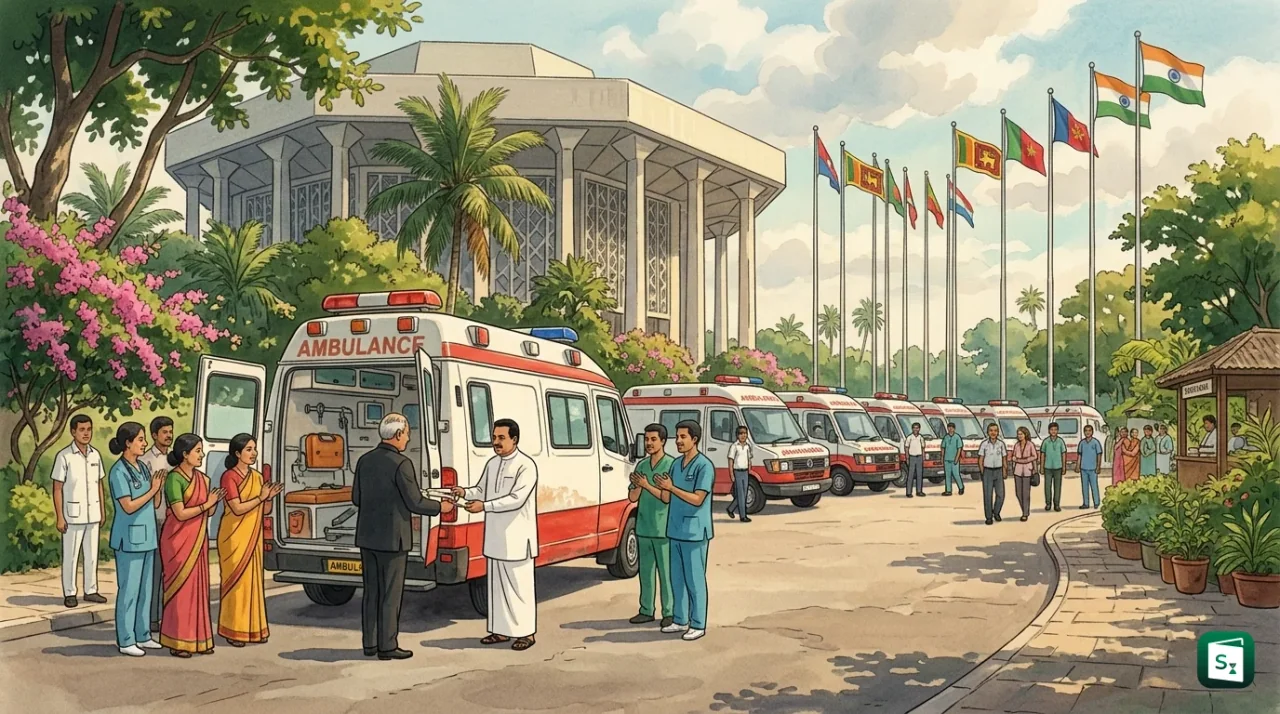
India and Sri Lanka exchanged a Memorandum of Understanding (MoU) in Colombo on 11 November 2026 for 100 additional fully equipped ambulances. Indian High Commissioner Santosh Jha and Sri Lankan Health Secretary Anil Jasinghe signed the MoU. Nadda and Jayatissa witnessed the exchange.
India will fund the ambulances through a grant of SLR 1,725.73 million, or about $5.28 million. Tenders will be called through competitive bidding. The ambulances will strengthen the 1990 Suwa Seriya national emergency service. The service is free and runs round the clock in all districts. It now has 322 ambulances. It handles 1,000 to 1,200 calls every day. The new fleet aims to cut emergency response time to less than 10 minutes.
India has supported Suwa Seriya since its start.
| Year | Indian Support |
|---|---|
| 2016 | $7.5 million grant for 88 ambulances in Western and Southern provinces, operating costs for one year and an emergency response centre |
| 2018 | $15.02 million grant for island wide expansion with 209 ambulances, operating costs and training, launched by Prime Minister Modi and then Sri Lankan Prime Minister Ranil Wickremesinghe |
| 2026 | $5.28 million grant for 100 more ambulances |
India also announced support for 50 Medical Kiosks, also called Health ATMs. India will provide grant aid of up to SLR 225 million for the kiosks. The kiosks will be placed at Arogya Primary Health Centres in Sri Lanka. They will offer point of care tests linked to telemedicine. This will improve basic health services at the local level.
The kiosk support is part of the $450 million rehabilitation package India announced after Cyclone Ditwah, which hit Sri Lanka in November and December 2025. India’s wider health work in Sri Lanka includes the Dickoya Hospital, upgrades to the Jaffna Teaching Hospital and hospitals in Kilinochchi and Vavuniya, and a new surgical unit at Batticaloa Teaching Hospital.
Why BIMSTEC Is Important for India
BIMSTEC sits at the meeting point of India’s Neighbourhood First and Act East policies. It is the only grouping that joins South Asia with Southeast Asia around the Bay of Bengal. For India, it opens a direct path to Myanmar and Thailand and to the wider Southeast Asian region.
BIMSTEC has gained weight because the South Asian Association for Regional Cooperation (SAARC) has been stalled. The last SAARC summit took place in Kathmandu in 2014. The 2016 summit planned in Islamabad did not take place after the Uri attack. BIMSTEC does not include Pakistan. Decisions there move faster.
The grouping also matters for India’s Northeast. Better links with Myanmar, Bangladesh and Thailand can bring trade and jobs to landlocked border states. The Bay of Bengal focus also fits India’s maritime interests. About a fifth of the world’s people live in BIMSTEC countries.
At the Sixth Summit, leaders adopted the Bangkok Vision 2030. The vision aims for a Prosperous, Resilient and Open BIMSTEC by 2030. Health security is a core part of the resilient pillar. Health is now a sub-sector under the Science, Technology and Innovation sector. Sri Lanka leads this sector. Other sectors are led by other members. Bangladesh leads trade, investment and development. India leads security. Myanmar leads agriculture and food security. Nepal leads people to people contact. Thailand leads connectivity.
Nadda used the Colombo stage to share India’s experience. He pointed to more than 1.85 lakh Ayushman Arogya Mandirs for primary care. He cited the Ayushman Bharat Pradhan Mantri Jan Arogya Yojana, one of the world’s largest public health cover schemes. He offered to share Indian skills in primary health care, digital health and public health systems.
How BIMSTEC Differs from SAARC
Readers often mix BIMSTEC with SAARC. The two groupings share five members but differ in purpose and shape.
SAARC stands for the South Asian Association for Regional Cooperation. It was formed in 1985. It has eight members: Afghanistan, Bangladesh, Bhutan, India, Maldives, Nepal, Pakistan and Sri Lanka. BIMSTEC was formed in 1997. It has seven members: Bangladesh, Bhutan, India, Myanmar, Nepal, Sri Lanka and Thailand.
| Feature | BIMSTEC | SAARC |
|---|---|---|
| Full name | Bay of Bengal Initiative for Multi-Sectoral Technical and Economic Cooperation | South Asian Association for Regional Cooperation |
| Formed in | 1997 through the Bangkok Declaration | 1985 |
| Members | 7 | 8 |
| Common members | Bangladesh, Bhutan, India, Nepal, Sri Lanka | Bangladesh, Bhutan, India, Nepal, Sri Lanka |
| Unique members | Myanmar, Thailand | Afghanistan, Maldives, Pakistan |
| Headquarters | Dhaka, Bangladesh | Kathmandu, Nepal |
| Links | Bridges South Asia and Southeast Asia | Limited to South Asia |
| Working method | Sector driven, each member leads a sector | Consensus based cooperation across many areas |
| Recent summits | Sixth Summit in Bangkok in April 2025 | Last summit in Kathmandu in 2014 |
BIMSTEC is sector driven. Each country leads one area of work. SAARC covers South Asia alone and has been held back by India Pakistan tensions. India sees BIMSTEC as a complement to SAARC, not a full replacement. Both aim for growth and peace. BIMSTEC at present offers a more active path for trade, connectivity and health work around the Bay of Bengal.
Key Takeaways
- The first BIMSTEC Health Ministers Meeting was held in Colombo on 11 November 2026 under the chairmanship of Nalinda Jayatissa.
- The meeting adopted the Joint Ministerial Statement and the Revised Plan of Action on Public Health (2026-2030).
- India will host the BIMSTEC Centre of Excellence in Traditional Medicine at ITRA, Jamnagar in Gujarat.
- India signed an MoU to give 100 fully equipped ambulances to Sri Lanka’s 1990 Suwa Seriya service with a grant of SLR 1.73 billion.
- India will also support 50 Health ATMs in Sri Lanka with a grant of up to SLR 225 million.
- Thailand will host the second BIMSTEC Health Ministers Meeting in 2028, with ministerial meetings to be held every two years.