The 9th High Level Meeting between the Indian Coast Guard and the Sri Lanka Coast Guard was held on 3 November 2026 at Mirissa in southern Sri Lanka. The Indian delegation was led by Director General Paramesh Sivamani, while the Sri Lankan delegation was headed by Rear Admiral Ruwan Rupasena. The two sides agreed to deepen cooperation in marine pollution response, maritime search and rescue and maritime law enforcement across their shared waters.
What Did the Two Coast Guards Decide in Mirissa?
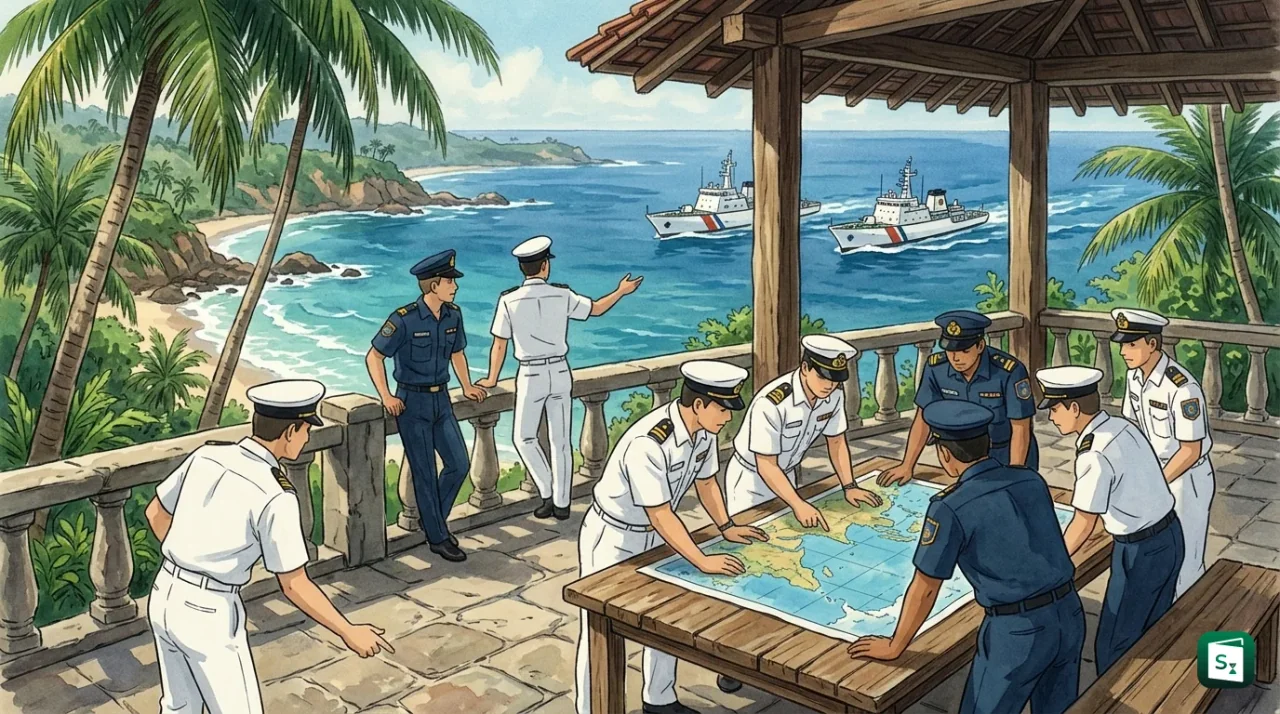
The Indian Coast Guard and the Sri Lanka Coast Guard held the 9th High Level Meeting at the Sri Lanka Coast Guard headquarters in Mirissa on 3 November 2026. Director General Paramesh Sivamani led the Indian side. Rear Admiral Ruwan Rupasena, Director General of the Sri Lanka Coast Guard, led the Sri Lankan side.
The meeting focused on three operational areas. The first was Marine Pollution Response, which covers joint readiness for oil spills and chemical spills from ships. The second was Maritime Search and Rescue (SAR), which means finding and saving people from vessels in distress at sea. The third was Maritime Law Enforcement, which includes action against smuggling, drug trafficking, illegal fishing and human trafficking by sea.
Both sides also discussed capacity building and technical assistance. This includes professional training, exchange of experts and best practices, and support for equipment maintenance. They agreed to improve information sharing, Maritime Domain Awareness (MDA) and common communication procedures between rescue centres. MDA means continuous tracking and understanding of ship movements to spot threats early.
What Is the Indian Coast Guard and Which Ministry Controls It?
The Indian Coast Guard (ICG) is the maritime law enforcement and search and rescue agency of India. It functions under the Ministry of Defence and is headquartered in New Delhi. It is headed by the Director General, an officer of Vice Admiral rank.
The force was raised as an interim service on 1 February 1977 with two corvettes and five patrol boats transferred from the Navy. It was formally established as an independent armed force under the Coast Guard Act, 1978, and inaugurated by Prime Minister Morarji Desai on 19 August 1978. The idea came from the Rustamji Committee, set up in 1974 under K. F. Rustamji to study sea borne smuggling and recommend a separate sea policing force.
The motto of the Indian Coast Guard is Vayam Rakshamah, a Sanskrit phrase that means We Protect. Its core duties include protection of offshore installations, safety of fishermen, anti smuggling and anti poaching patrols, marine environment protection and search and rescue at sea. The service guards Indian waters including the territorial sea, contiguous zone and Exclusive Economic Zone (EEZ), the 200 nautical mile zone where India has exclusive rights to marine resources. It celebrated its 49th Raising Day on 1 February 2025, by which time it had grown to about 151 ships and 76 aircraft.
How Is the Coast Guard Different From the Navy?
The Coast Guard is not part of the Navy, though it works closely with the Indian Navy. The Navy is a combat force built for war fighting, sea control and power projection. The Coast Guard is a law enforcement and rescue force built for policing, safety and environmental protection in peacetime.
Its ships are lightly armed and painted with a distinct orange and blue stripe. In war, it supports the Navy. In peace, it leads on tasks such as catching smugglers, stopping poachers, rescuing fishermen and cleaning oil spills. This division lets costly warships focus on defence while the Coast Guard handles daily policing of the coast.
What Is the Sri Lanka Coast Guard?
The Sri Lanka Coast Guard (SLCG) is the maritime law enforcement agency of Sri Lanka. It functions under the Ministry of Defence of Sri Lanka and its headquarters is at Mirissa in Matara district. Every officer of the service is treated as a peace officer with powers to search, arrest and start legal action against offenders at sea.
A coast guard was first started in 1999 under the fisheries ministry but was wound up in 2002. The present service was approved by the Cabinet in 2008 and legally created through the Department of Coast Guard Act No. 41 of 2009. Parliament passed the Act on 9 July 2009. Operations began ceremonially on 4 March 2010 at Galle, and the service marked 15 years of service in March 2025.
Its legal duties include securing coastal areas and territorial waters, stopping illegal entry and exit, seizing narcotics, contraband and weapons, helping ships in distress, ensuring safety of sea traffic and protecting the marine environment. The fleet includes offshore patrol vessels, fast patrol boats and inshore craft to guard the island coast and respond to disasters.
Why Maritime Cooperation Matters for India and Sri Lanka
India and Sri Lanka share a narrow sea front in the Palk Strait, the Gulf of Mannar and the Bay of Bengal. Only about 30 km of sea separates Dhanushkodi in Tamil Nadu from Talaimannar in Sri Lanka. Fishing boats, ferries and merchant ships cross these waters every day. Close coordination between the two coast guards helps save lives and keeps trade routes safe.
The boundary in these waters was fixed by agreements signed in 1974 and 1976. The 1974 agreement drew the line in historic waters from the Palk Strait to Adam Bridge and placed Katchatheevu island on the Sri Lankan side, while allowing Indian fishermen and pilgrims to visit the island without travel papers. The 1976 agreement drew the boundary in the Gulf of Mannar and the Bay of Bengal and recognised Indian sovereign rights over the rich fishing ground called the Wadge Bank south of Kanyakumari.
Three shared risks make joint work urgent. The first is the fishermen issue. Boats from both sides often cross the International Maritime Boundary Line (IMBL), which leads to arrests, seizure of trawlers and occasional clashes at sea. The second is transnational crime. The Palk Bay route is used for narcotics smuggling, arms movement and irregular migration. The third is pollution and accidents. Heavy tanker traffic passes south of Sri Lanka, and the MV X Press Pearl container ship fire off Colombo in 2021 showed how a single accident can damage coasts in both countries.
| Shared Challenge | Why It Needs Joint Action |
|---|---|
| Fishermen crossing the IMBL | Quick rescue, humane handling and hotline contact between rescue centres reduce loss of life |
| Drug trafficking and smuggling | Shared intelligence and coordinated patrols help intercept boats before they reach shore |
| Oil spills and ship accidents | Joint pollution response drills and common procedures speed up containment |
| Search and rescue in rough seas | Linked Maritime Rescue Coordination Centres (MRCCs) in Chennai and Colombo improve distress alerts |
How the 2018 MoU Shapes Annual High Level Meetings
The Mirissa talks sit within a formal pact. India and Sri Lanka signed a Memorandum of Understanding (MoU) on coast guard cooperation on 9 May 2018. The MoU calls for joint action against transnational crime at sea and for steady growth in regional cooperation. Under it, the two services hold a High Level Meeting every year, hosted in turn by India and Sri Lanka.
The 7th meeting was held in Colombo in November 2024. The 8th meeting was held in New Delhi in August 2025. The 9th meeting in Mirissa reviewed past decisions and set tasks for the next year. This regular cycle keeps contact alive even when political relations face strain over fishing or other disputes.
The partnership goes beyond meetings. India has given Sri Lanka patrol craft, safety gear and training support. In April 2026, India handed over personal watercraft and rescue equipment to the Sri Lanka Coast Guard to strengthen near shore rescue. Indian training institutions such as the Coast Guard academy at Azhikode train Sri Lankan personnel in law enforcement, rescue and pollution control. The two sides also take part with Maldives in the biennial Exercise Dosti, which started in 1991 and added Sri Lanka in 2012, to practise joint rescue and anti crime drills.
Key Takeaways
- The 9th High Level Meeting between the Indian Coast Guard and Sri Lanka Coast Guard was held on 3 November 2026 at Mirissa.
- The Indian side was led by Paramesh Sivamani and the Sri Lankan side by Rear Admiral Ruwan Rupasena.
- The talks covered Marine Pollution Response, Maritime Search and Rescue and Maritime Law Enforcement plus capacity building.
- The Indian Coast Guard, under the Ministry of Defence, was established under the Coast Guard Act, 1978 with the motto Vayam Rakshamah.
- The Sri Lanka Coast Guard, headquartered at Mirissa, was created under the Department of Coast Guard Act No. 41 of 2009 and began operations on 4 March 2010.