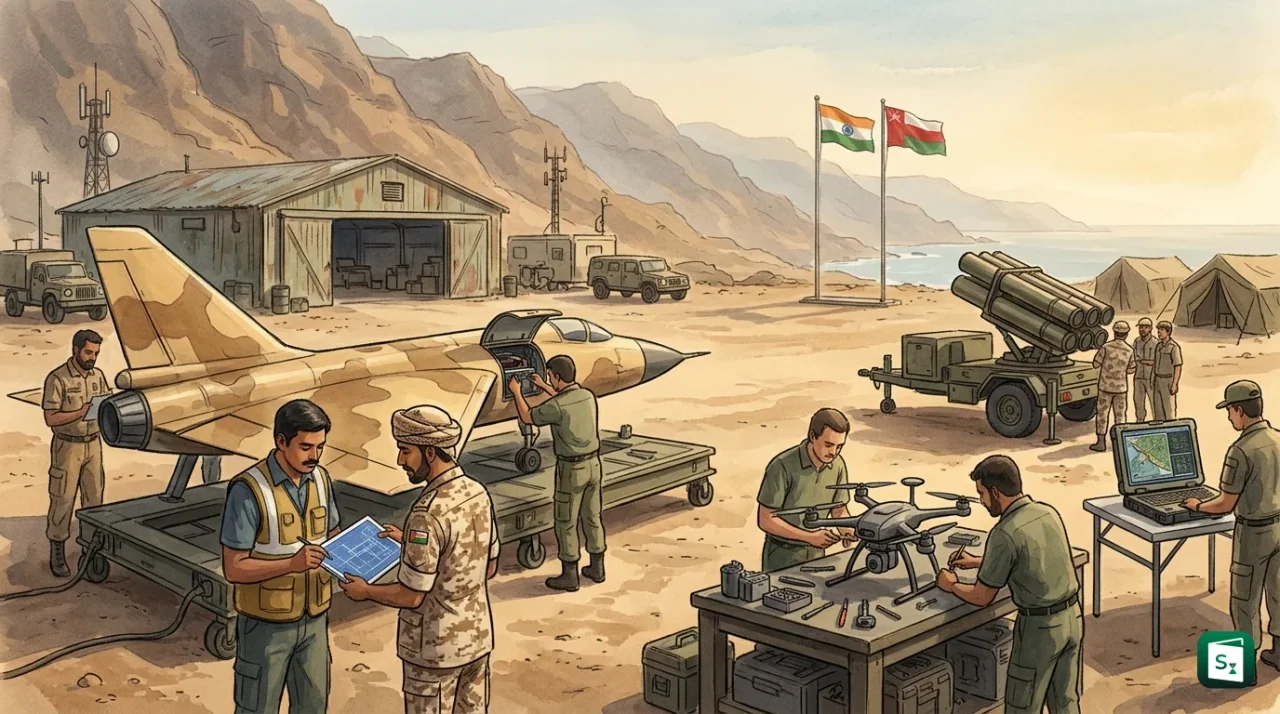
Noida based IG Defence has signed a Memorandum of Understanding (MoU) with Oman based MSA Global LLC to explore co-development and local manufacturing of advanced defence systems for Oman and the wider Gulf Cooperation Council (GCC) region. The MoU was exchanged in Muscat on the sidelines of the second India Oman Defence Industry Cooperation Seminar held on 26 and 27 October 2026. It covers three indigenous IG Defence platforms, KAL, BAJ and JWALA, along with GRID, the company’s AI powered battle management system.
What Did IG Defence and MSA Global Agree On?
IG Defence is a Noida based private defence technology company led by founder and Chief Executive Officer Bodhisattwa Sanghapriya. MSA Global LLC is an Oman based company chaired by Col M S Atwal (Retd). The two companies signed the MoU to study the possibility of joint development and localisation of defence systems in Oman for sale in Oman and across the GCC.
The MoU is exploratory in nature. It does not announce a manufacturing contract, a purchase order from the Government of Oman, an investment amount, a factory location or a production timeline. Any future export of systems or parts from India will need approval under India’s defence export rules.
The documents were exchanged between Sanghapriya and Atwal at the India Oman Defence Industry Seminar in Muscat. The event was facilitated by the Department of Defence Production (DDP) under the Ministry of Defence, in association with the Federation of Indian Chambers of Commerce and Industry (FICCI). India’s Ambassador to Oman, Prashant Pise, defence officials from both countries and industry representatives were present.
The second edition of the seminar was held on 26 and 27 October 2026 and brought together more than 125 participants. The Indian delegation included 24 representatives from 16 companies working in unmanned platforms, robotics, sensors, artificial intelligence (AI), maritime security, communications and shipbuilding. The Indian Embassy in Muscat later confirmed that IG Defence and MSA Global had signed an MoU on drone and counter drone solutions on the sidelines.
IG Defence has said the intellectual property and core technology will remain Indian owned and India designed. Oman is being explored as a base for local manufacturing, assembly and long term industrial cooperation. Sanghapriya described the approach with the line, Designed in India, Made in Oman, Built for the World.
What Are KAL, BAJ and JWALA?
The MoU names three platforms. All three have been designed and developed in India by IG Defence. Their stated capabilities are based on company disclosures and have not been independently verified for Omani conditions.
KAL is a long range, one way attack unmanned aerial system. One way means the drone flies to its target and strikes it, and does not return. Such systems are also called loitering munitions. IG Defence calls KAL India’s first long range one way attack drone in the private sector. The company says KAL completed a flight test at the Pokhran Field Firing Range in Rajasthan in September 2026.
BAJ is an unmanned aerial interceptor built for counter unmanned aircraft system (C-UAS) tasks. C-UAS means systems that detect and stop hostile drones. BAJ is designed to take off vertically, chase a hostile drone and neutralise it in the air.
JWALA is a short range micro missile being developed as a hard kill counter drone weapon. Hard kill means physical destruction of the target, while soft kill means jamming or disrupting signals without firing. IG Defence is projecting JWALA as India’s first private sector micro missile. The solid rocket motors have cleared test firings, and the full system is now moving toward its first experimental trial.
The table below summarises the key features shared by the company.
| Platform | Role | Key Stated Features |
|---|---|---|
| KAL | Long range one way attack drone | Range up to 1,000 km, endurance 7 to 8 hours, take off weight 200 kg, payload 50 kg high explosive warhead, speed up to 200 km per hour, ceiling up to 5,000 metres, guidance through multi band satellite navigation with inertial navigation system, encrypted radio link with satellite communication option for beyond line of sight control |
| BAJ MK1 | Vertical take off interceptor for hostile drones | Take off weight 5 kg, warhead 1 kg, range 5 km, endurance 20 minutes, speed 180 to 250 km per hour, AI based target locking, autonomous and semi autonomous modes, impact and proximity detonation, deployment in under 2 minutes, day and night operation |
| JWALA | Truck launched micro missile for counter drone tasks | Strike range 2 to 5 km, engagement envelope from 50 metres to 5,000 metres, dual pulse solid rocket motor with fin control, 0.5 to 1.5 kg pre fragmented warhead with proximity fuze, accuracy within 2 metres at full range, reaction time of less than 7 seconds from detection to launch, multi canister launcher on a truck for mobility |
JWALA is meant to give troops a low cost option against small drones. Small drones are hard to stop with costly air defence missiles, so armies want cheaper interceptors that can be fired in numbers from mobile launchers.
What Is GRID, the AI Powered Battle Management System?
GRID, also described by the company as GRID Defend, is IG Defence’s AI powered battle management system. A battle management system is a network that links sensors, command posts and weapons into one common picture so that commanders can take faster decisions.
GRID is designed to collect inputs from radars and other sensors, build a common operational picture, identify and track aerial threats, assess which threat is most urgent and help assign the right weapon for the response. An authorised operator clears the final engagement. The system does not launch weapons on its own without approval.
In this design, JWALA acts as the hard kill part that physically hits the drone. GRID acts as the brain that manages the mission from detection to engagement. The same architecture also supports soft kill tools. An example is T-SHUL BEAM, a portable system that disrupts drone control and navigation links. IG Defence demonstrated this system at the Indian Air Force’s Dronathon 2026 exercise in Pokhran.
Battle management systems are now central to modern air defence because drone attacks often come in groups and at low height. A single radar or gun cannot handle such attacks alone. A network that fuses data from many sensors and connects guns, missiles, jammers and interceptors gives a faster and more layered response.
Why Oman and the GCC Need Drones and Counter Drone Systems
The Gulf Cooperation Council (GCC) is a regional bloc of six Arab states, Bahrain, Kuwait, Oman, Qatar, Saudi Arabia and the United Arab Emirates. It was formed in 1981 and is headquartered in Riyadh in Saudi Arabia. Its members share oil and gas assets, shipping lanes and airspace, so a drone or missile attack on one member can affect energy supplies and civil aviation across the region.
The GCC has built a joint security structure over four decades. A Peninsula Shield Force was raised in 1984 as a joint military arm. Members signed a Joint Defence Agreement in 2000 in Manama which states that aggression against one member is aggression against all. A Unified Military Command was created in 2013 to improve joint planning. In September 2025, after a strike in Doha, the GCC held an extraordinary defence meeting and decided to speed up intelligence sharing, air picture linking, ballistic missile early warning and joint air defence drills.
Drones have changed this security picture. Small, low cost drones can target airports, refineries, power plants and military bases. Long range one way attack drones extend strike ranges to hundreds of kilometres. This has raised demand for two types of tools, long range precision drones for deterrence and layered counter drone systems that combine detection, jamming and low cost interception.
Oman sits at the mouth of the Strait of Hormuz and overlooks key lanes in the western Indian Ocean. Its ports support naval deployments and trade flows between the Gulf, South Asia and East Africa. For a manufacturer, Oman offers industrial land, ports and access to GCC markets. For Gulf buyers, local production promises faster supply, maintenance within the region and training of local staff.
How the Pact Fits Into India Oman Defence Cooperation
Oman is one of India’s closest defence partners in West Asia. India has signed more defence related memorandums with Oman than with any other country in the region. Defence cooperation now forms a key pillar of the India Oman strategic partnership.
The two countries hold regular staff talks and an annual high level meeting between the Indian Coast Guard and the Royal Oman Police Coast Guard. The Joint Military Cooperation Committee (JMCC) reviews the full agenda. The 13th JMCC met in New Delhi on 24 November 2025 and stressed joint development, technology sharing and expanded production partnerships.
Oman is the only Gulf country with which all three Indian services hold biennial exercises. These are the naval exercise Naseem Al Bahr, the air force exercise Eastern Bridge and the army exercise Al Najah. The 14th Naseem Al Bahr was held off Goa in October 2024, the 7th Eastern Bridge was held at Masirah in Oman in September 2024 and the 5th Al Najah was held in Oman in September 2024. The next rounds were planned for late 2026. Ports in Oman regularly support Indian Navy ships on operational turnarounds in the western Indian Ocean.
On the industrial side, the first India Oman Defence Industrial Seminar was held in Muscat in September 2023. The second edition in October 2026 marked a shift from exercises and port calls to co-development, co-production and technology cooperation. The two sides also work in shipbuilding and in maintenance, repair and overhaul. A Comprehensive Economic Partnership Agreement (CEPA) and a Joint Maritime Vision Document, signed during the Prime Minister’s visit to Oman in December 2025, provide the wider trade and maritime frame for such deals.
How the Pact Supports India’s Defence Export Push
India’s defence exports touched a record ₹38,424 crore in financial year 2025-26, up 62.66 percent from ₹23,622 crore in 2024-25. Exports have grown from ₹686 crore in 2013-14, a rise of more than 55 times in 12 years. Indian systems now reach more than 80 countries, and the number of exporters has risen to 145 firms.
Defence public sector undertakings contributed ₹21,071 crore, or 54.84 percent, of the 2025-26 total, while private companies contributed ₹17,353 crore, or 45.16 percent. Domestic defence production also hit a record ₹1.78 lakh crore in 2025-26, with the private sector accounting for 24 percent. The government has set targets of ₹3 lakh crore in annual production and ₹50,000 crore in exports by 2029 under the Make in India and Atmanirbhar Bharat programmes.
The IG Defence proposal shows how private firms are trying to join this push. The model keeps design and intellectual property in India while using a partner country for assembly, testing and regional sales. This can lower costs, meet local content rules in Gulf states and open doors to six GCC markets from one base. The test will be whether the MoU moves to firm orders, certified production lines and service networks, since Gulf buyers weigh flight proof, after sales support and financing along with price.
Key Takeaways
- IG Defence signed an MoU with Oman’s MSA Global LLC at the India Oman Defence Industry Seminar in Muscat on 26 and 27 October 2026 to explore co-development in Oman for the GCC.
- KAL is a long range one way attack drone with a stated range of up to 1,000 km, endurance of 7 to 8 hours and a 50 kg warhead.
- BAJ MK1 is a 5 kg vertical take off interceptor with a 5 km range, while JWALA is a 2 to 5 km truck launched micro missile with a reaction time of less than 7 seconds.
- GRID Defend is IG Defence’s AI powered battle management system that links sensors, command systems and weapons into a common operational picture.
- India’s defence exports hit a record ₹38,424 crore in 2025-26, with private firms contributing 45.16 percent and exports reaching over 80 countries.