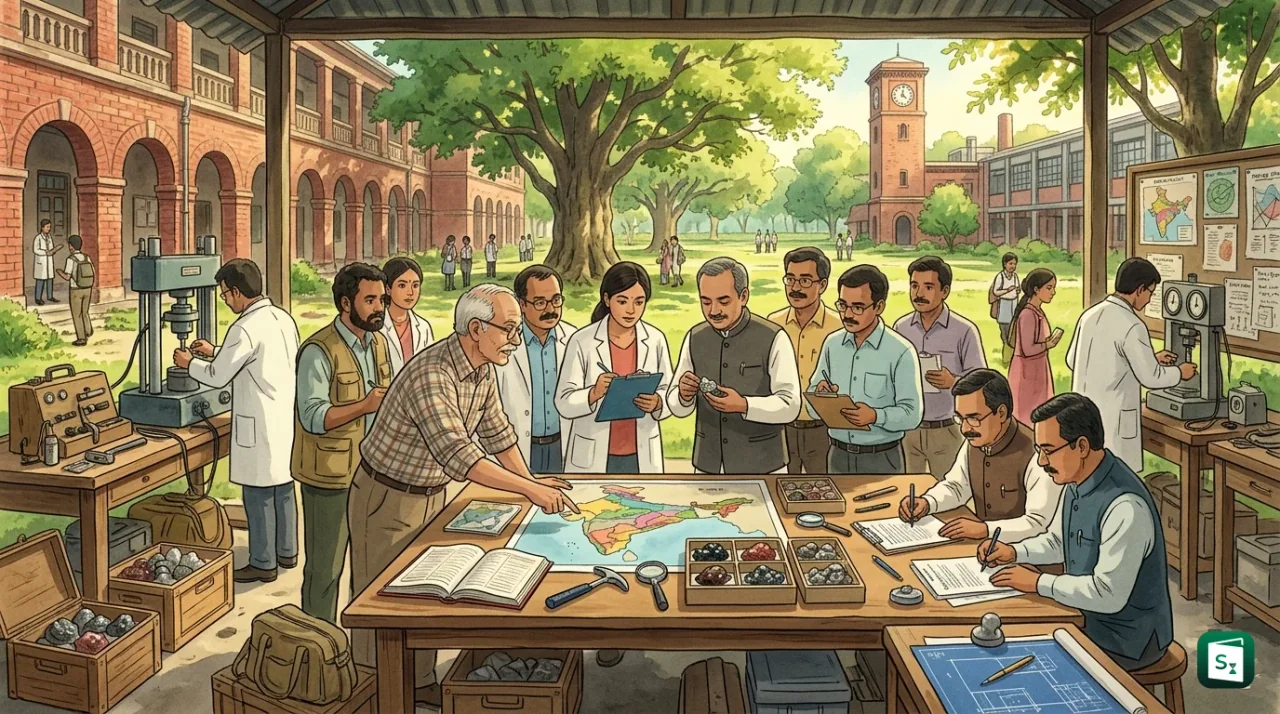
NITI Aayog signed a Joint Statement of Intent with the Technology Translation Research Park (TEXMiN) on 3 November 2026 to strengthen cooperation in critical and strategic minerals. TEXMiN is an initiative of the Department of Science and Technology hosted at IIT Indian School of Mines Dhanbad. The pact aims to build home grown technology and resilient, sustainable mineral value chains in line with the National Critical Mineral Mission and the vision of Viksit Bharat 2047.
What Did NITI Aayog and TEXMiN Agree To Do
NITI Aayog member Prof. Gobardhan Das signed the Joint Statement of Intent during his visit to IIT Indian School of Mines Dhanbad. He was at the institute to open the National Symposium on Critical Minerals and Rare Earths (CMRE 2026) on 31 October 2026. The symposium formed part of the 45th Annual National Conference of the Indian Council of Chemists and brought together policy makers, researchers, technology developers and industry representatives.
The SoI lists cooperation in four areas. These areas show a shift from only mining to a complete chain from discovery to reuse.
| Area of Cooperation | What It Covers |
|---|---|
| Collaborative research and technology development | Joint work on exploration, extraction, processing and refining tools suited to Indian deposits |
| Technical and strategic studies | Studies on mineral availability, demand, supply risks and value chain gaps |
| Policy and institutional support | Scientific inputs for central and state decisions, schemes and faster project approvals |
| Capacity building and knowledge exchange | Training, researcher exchange and closer links among government, academia and industry |
NITI Aayog said the work will help turn laboratory research into commercially usable technologies. Prof. Das stressed recovery of minerals from secondary sources such as coal fly ash, red mud, mine tailings and electronic waste. Such recovery can cut import dependence and improve resource use. The partnership also aims to promote sustainable practices across exploration, processing, advanced materials and recycling.
What Is NITI Aayog and How Does It Function
NITI Aayog is the apex policy think tank of the Government of India. The full form of NITI Aayog is the National Institution for Transforming India. The Union Cabinet set it up through a resolution on 1 January 2015. It replaced the Planning Commission, which had worked since 1950.
NITI Aayog is neither a constitutional body nor a statutory body. A constitutional body is created by the Constitution, while a statutory body is created by an Act of Parliament. NITI Aayog was created by an executive decision of the Cabinet, so it is an executive body and an advisory think tank. It has no power to allocate funds to states, unlike the old Planning Commission.
The Prime Minister chairs NITI Aayog. The current chairperson is Prime Minister Narendra Modi. The vice chairperson is Ashok Kumar Lahiri, appointed in April 2026. The chief executive officer is Anurag Jain, a 1989 batch officer who took charge in August 2026. Prof. Gobardhan Das serves as a full time member. The Governing Council includes chief ministers of all states and lieutenant governors of union territories. NITI Aayog works from NITI Bhavan on Sansad Marg in New Delhi.
NITI Aayog gives strategic and technical advice to the Centre, states and union territories. It designs long term policy frameworks and tracks their progress. It promotes cooperative federalism, where the Centre and states plan together, and competitive federalism, where states compete on good practices. Its work spans four broad heads: policy and programme design, cooperation with states, monitoring and evaluation, and knowledge and innovation support. It also runs the Atal Innovation Mission and is supported by the Development Monitoring and Evaluation Organisation.
What Is TEXMiN and Why Is It Based at IIT ISM Dhanbad
TEXMiN stands for the Technology Innovation in Exploration and Mining Foundation. It is registered as a Section 8 company, which means it works on a not for profit basis. The Department of Science and Technology (DST) set it up at IIT Indian School of Mines Dhanbad under the National Mission on Interdisciplinary Cyber Physical Systems.
In 2025 the Department recognised TEXMiN as one of four Technology Translation Research Parks in India. A translation park takes laboratory ideas and turns them into products that industry can use. TEXMiN focuses on mining and exploration. It works on remote sensing, drones, robotics, artificial intelligence, Internet of Things sensors and satellite images to make mines safe, smart and green. Its current mandate covers digital twins of mines, search for critical minerals and rare earths, and technologies for future mining.
The host, IIT Indian School of Mines Dhanbad, sits in the coal belt of Jharkhand. The British government opened it as the Indian School of Mines and Applied Geology on 9 December 1926 with support from Lord Irwin, the then Viceroy. It started with mining engineering and applied geology on the model of the Royal School of Mines in London. It gained deemed university status in 1967 and became an Indian Institute of Technology in 2016 through an amendment to the Institutes of Technology Act, 1961. Today the institute trains engineers for mining, petroleum, earth sciences and allied fields, which makes it a natural home for critical mineral research.
What Are Critical Minerals and Why Do They Matter for India
Critical minerals are minerals that are vital for economic growth and national security, but face a high risk of supply disruption. A mineral becomes critical when it is hard to replace, has few suppliers, and is needed for key industries. The European method, which India studied, judges criticality on two tests: economic importance and supply risk.
The Ministry of Mines set up a seven member committee in November 2022 to identify such minerals for India. After studying the lists of Australia, the United States, Canada, Japan and others, and after talks with power, atomic energy, renewable energy, fertiliser, electronics and science departments, the committee notified 30 critical minerals in 2023. They are antimony, beryllium, bismuth, cadmium, cobalt, copper, gallium, germanium, graphite, hafnium, indium, lithium, molybdenum, niobium, nickel, platinum group elements, phosphorus, potash, rare earth elements, rhenium, selenium, silicon, strontium, tantalum, tellurium, tin, titanium, tungsten, vanadium and zirconium.
These minerals power modern tools. Lithium, nickel, cobalt and graphite store charge in batteries for electric vehicles and phones. Gallium and germanium make semiconductors, LEDs and optical fibre. Rare earth elements such as neodymium and dysprosium make strong magnets for wind turbines, fighter jets and missile guidance. Titanium and tungsten give strength to aircraft and defence equipment. Phosphorus and potash support fertilisers for farming.
India depends on imports for most of these inputs. That dependence creates a risk if a few countries control mining or processing. China refines a large share of rare earths and graphite. India found lithium deposits in Jammu and Kashmir, but commercial mining is still at an early stage. Recycling from scrap, batteries and waste can add supply, and the new pact puts special stress on that route.
How the Pact Supports the National Critical Mineral Mission
The National Critical Mineral Mission (NCMM) is the parent scheme for this pact. The Finance Minister proposed the mission in the Union Budget for 2024-25. The Union Cabinet approved it on 29 January 2025 with an outlay of ₹16,300 crore over seven years from 2024-25 to 2030-31. Public sector units are expected to add ₹18,000 crore in investment. The total plan size is thus ₹34,300 crore. The Ministry of Mines runs the mission.
The mission covers the full chain from survey to reuse. It plans 1,200 domestic exploration projects, support for buying mineral assets abroad, four mineral processing parks, three centres of excellence, 1,000 patents, training for 10,000 workers, and a strategic stockpile. The Geological Survey of India has already taken up more than 500 exploration projects since April 2024. The government has auctioned 59 critical mineral blocks in phases and amended the Mines and Minerals Development and Regulation Act, 1957 in 2023 to allow faster leases.
Two arms of the mission link directly to the SoI. One arm funds research and pilot projects to recover minerals from overburden, tailings, fly ash and red mud, with ₹100 crore set aside for pilots. The other arm offers ₹1,500 crore for recycling plants to recover minerals from end of life batteries and scrap. A separate incentive scheme for recycling was cleared by the Cabinet on 3 September 2025 and rolled out on 2 October 2025. For overseas supply, Khanij Bidesh India Ltd (KABIL), a joint venture of the Ministry of Mines, has taken lithium ground in Catamarca province in Argentina and is studying lithium and cobalt assets in Australia.
The NITI Aayog and TEXMiN SoI fits into the research, skilling and policy parts of this design. It will feed technical studies into policy, help build a mineral database, and speed the move from lab proof to plant use.
How NITI Aayog Differs from the Planning Commission
NITI Aayog replaced the Planning Commission in 2015. The table below gives a direct comparison.
| Feature | Planning Commission (1950 to 2014) | NITI Aayog (from 2015) |
|---|---|---|
| Legal nature | Executive body set up by a 1950 Cabinet resolution | Executive body set up by a 2015 Cabinet resolution, works as an advisory think tank |
| Head | Prime Minister as chairperson | Prime Minister as chairperson |
| Core job | Made Five Year Plans and allocated funds to states and ministries | Gives policy advice, builds long term strategy and monitors schemes, but does not allocate funds |
| Relation with states | Top down plan targets sent to states | Cooperative model with chief ministers in the Governing Council and regional councils for shared issues |
| Financial power | Had a role in plan grants through the Gadgil formula | Has no fund allocation role, funds flow through the Finance Ministry and Finance Commission |
The change reflects a move from centralised planning to a market friendly and state led approach. The Finance Commission, a constitutional body under Article 280, now handles tax sharing between the Centre and states. NITI Aayog handles ideas, data and best practices.
Key Takeaways
- NITI Aayog and TEXMiN signed a Joint Statement of Intent on 3 November 2026 to build resilient value chains for critical and strategic minerals.
- TEXMiN is a Department of Science and Technology initiative hosted at IIT ISM Dhanbad and recognised as a Technology Translation Research Park.
- The SoI covers four areas: joint research, strategic studies, policy support, and capacity building, with focus on recovery from fly ash, red mud, tailings and e-waste.
- NITI Aayog, the National Institution for Transforming India, was set up on 1 January 2015 and is neither a constitutional nor a statutory body.
- The National Critical Mineral Mission, approved on 29 January 2025 with ₹16,300 crore plus ₹18,000 crore expected investment, covers 30 critical minerals including lithium, cobalt and rare earth elements.