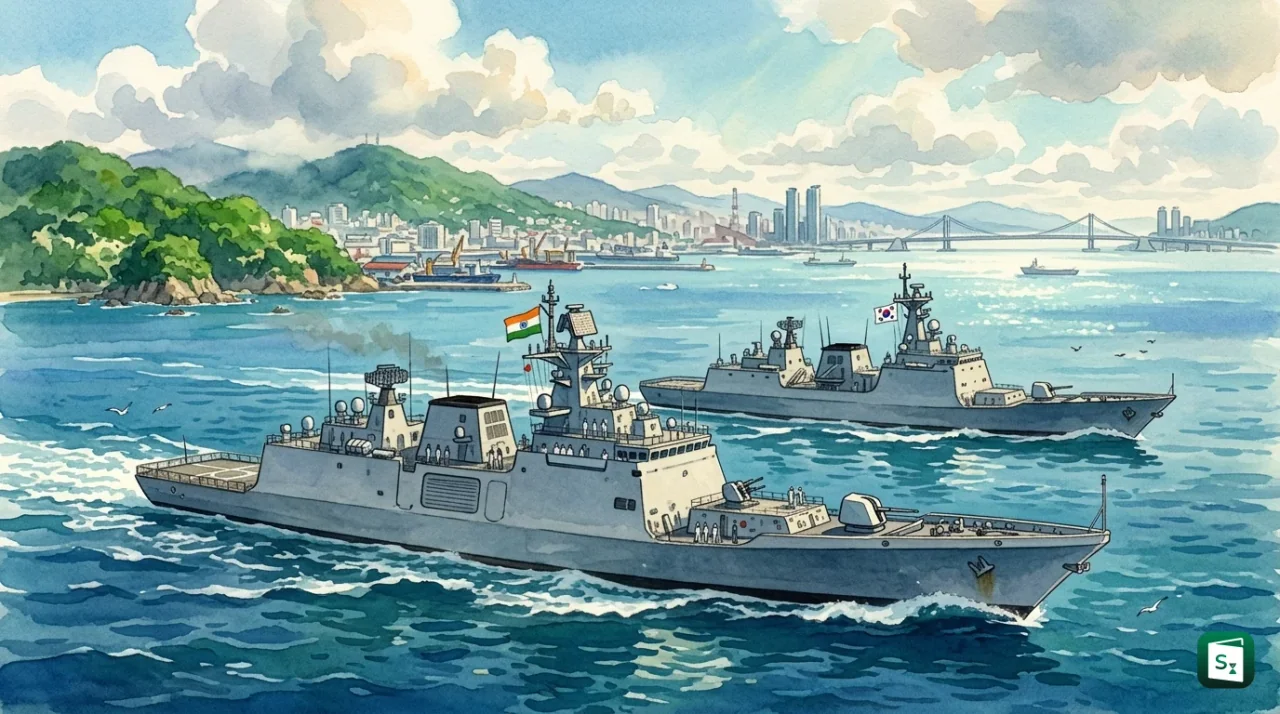
Indian Naval Ship Sahyadri completed the second edition of the Indian Navy and Republic of Korea Navy bilateral exercise off Busan on 29 October 2026. The Shivalik-class stealth frigate, numbered F49, exercised at sea with the South Korean destroyer ROKS Munmu the Great after a three day harbour phase in Busan. The drill is part of a steady rise in maritime cooperation between the two navies in the Indo-Pacific.
What Is INS Sahyadri and Which Class Does It Belong To?
INS Sahyadri (F49) is a guided missile stealth frigate of the Indian Navy. A frigate is a medium sized warship built for speed and versatility, and a stealth frigate uses shaped hulls and special coatings to reduce its radar signature. Sahyadri belongs to the Shivalik class, the first class of stealth frigates designed and built in India under Project 17.
The ship was built by Mazagon Dock Limited (MDL) in Mumbai and commissioned on 21 July 2012. It is the third and last ship of its class, after INS Shivalik (F47) and INS Satpura (F48). The class is named after Indian hill ranges, and Sahyadri is named after the Sahyadri hills, better known as the Western Ghats. The ship serves with the Eastern Fleet under the Eastern Naval Command, which is headquartered at Visakhapatnam.
Sahyadri is about 142.5 metres long with a full load displacement of about 6,200 tonnes. It uses a combined diesel or gas propulsion system, which pairs two diesel engines for cruising with two gas turbines for high speed. The ship can reach about 32 knots and carries a crew of 257 personnel, including 35 officers.
| Feature | Detail |
|---|---|
| Pennant number | F49 |
| Builder | Mazagon Dock Limited, Mumbai |
| Commissioned | 21 July 2012 |
| Base | Visakhapatnam, Eastern Naval Command |
| Displacement | About 6,200 tonnes at full load |
| Aircraft | Up to 2 HAL Dhruv or Sea King helicopters |
The frigate carries a mix of Indian, Russian and Israeli weapons. Its main strike weapon is the BrahMos supersonic cruise missile, fired from eight vertical launch cells. Air defence is provided by the Shtil-1 medium range missile system and the Barak point defence system. For close action it has a 76 mm Oto Melara gun, two AK-630 rapid fire guns, torpedo tubes and two RBU-6000 anti-submarine rocket launchers.
Sahyadri is seen as an early symbol of self reliance in warship building. It has taken part in several major deployments, including Malabar 2025 near Guam with the navies of the United States, Japan and Australia, and AUSINDEX 2025 with Australia in the Northern Pacific. It also exercised with the Philippine Navy before calling at Manila in late 2025.
What Happened During the IN-RoKN Bilateral Exercise Off Busan?
The second edition of the IN-RoKN Bilateral Exercise took place at Busan in South Korea in late October 2026. IN stands for Indian Navy and RoKN stands for Republic of Korea Navy, the official name of the South Korean Navy. Busan is South Korea’s largest port city and the home of its main naval operations hub on the southeastern coast.
INS Sahyadri reached Busan Naval Harbour on 26 October 2026 to take part in the exercise. The Republic of Korea Navy gave the ship a warm welcome. The Commanding Officer at the time was Captain Vikas Jha, who called on senior Korean naval officials and attended an onboard reception with India’s Ambassador to South Korea, Gourangalal Das.
Harbour Phase in Busan From 26 to 29 October
The harbour phase ran from 26 to 29 October 2026. Crews of both navies held professional discussions and operational briefings. They also conducted cross deck visits, where sailors visit each other’s ships to study layout, systems and operating methods.
Subject matter expert exchanges covered seamanship, communication procedures and helicopter operations. The programme also included sports fixtures and cultural events. These informal contacts build trust between crews before they operate together at sea.
Sea Phase With ROKS Munmu the Great
Sahyadri sailed out of Busan on 29 October 2026 for the sea phase with ROKS Munmu the Great. The sea phase was held off the coast of Busan and concluded on the same day. At sea, the two ships practised coordinated navigation, which means sailing in formation while maintaining safe distances and common speed.
They also practised helicopter cross deck landings, search and rescue drills and joint manoeuvres. Cross deck landing means a helicopter from one navy lands on the deck of the other navy’s ship. Such drills test communication links and common procedures. After the exercise, Sahyadri set sail for its next mission.
Who Is ROKS Munmu the Great?
ROKS Munmu the Great (DDH-976) is a guided missile destroyer of the Republic of Korea Navy. ROKS stands for Republic of Korea Ship. A destroyer is larger and more heavily armed than a frigate and is built for area air defence, anti-submarine warfare and long range strike.
The ship belongs to the Chungmugong Yi Sun-sin class, also called the KDX-II class. It was built by Hyundai Heavy Industries in Ulsan, launched on 11 April 2003 and commissioned on 30 September 2004. The class is named after Admiral Yi Sun-sin, the famed Korean naval commander, while this ship is named after King Munmu of Silla, the 7th century ruler who unified the Korean kingdoms.
Munmu the Great displaces about 5,520 tonnes at full load and is 150 metres long. It can reach 30 knots and has a range of about 5,500 nautical miles. The ship carries a crew of about 200 and can operate two Super Lynx helicopters.
Its weapons include a 5 inch Mk 45 gun, a Goalkeeper close in weapon system, 64 vertical launch cells, Rolling Airframe Missiles for close air defence, Harpoon anti-ship missiles and lightweight torpedoes. The ship took part in the sea phase as the Korean counterpart to Sahyadri, allowing both sides to compare procedures for navigation, helicopter control and tactical communication.
Why the Second Edition Matters for India and South Korea Defence Ties
This was only the second time the two navies have held a dedicated bilateral exercise. The first edition was held off Busan from 13 to 16 October 2025, also with INS Sahyadri taking part. In 2025 the Korean partner ship was a frigate, while in 2026 the partner was the destroyer Munmu the Great. The repeat engagement within a year shows that the format is now a regular feature.
The exercise sits inside a wider defence relationship. India and South Korea established diplomatic ties on 10 December 1973. Ties were raised to a Strategic Partnership in 2010 and to a Special Strategic Partnership in 2015 during the visit of Prime Minister Narendra Modi to Seoul. The partnership links India’s Act East Policy with South Korea’s outreach to the south and both countries’ shared interest in a free and open Indo-Pacific.
Defence cooperation rests on several agreements. A memorandum on defence industry and logistics cooperation was signed in 2005, followed by pacts on defence research in 2010 and a roadmap for defence industry cooperation in 2019. A well known project is the K-9 Vajra self propelled howitzer, produced in India by Larsen and Toubro with technology from South Korea’s Samsung Techwin. Regular navy staff talks, coast guard meetings and port visits keep the maritime link active.
For India, regular drills with South Korea add a key East Asian partner to its Indo-Pacific presence. They improve the ability to operate far from home ports, secure sea lanes and respond to humanitarian needs. For South Korea, the drill builds familiarity with a navy that operates across the Indian Ocean, a region vital for Korean trade and energy imports.
How IN-RoKN Fits Into India’s Network of Naval Exercises
India holds regular naval drills with many partners. Bilateral drills build interoperability, which means the ability of two navies to communicate, share data and operate ships and aircraft together. Multilateral drills add more partners and more complex operations.
The table below places the Korea drill in that wider network.
| Exercise | Partner Country | Type |
|---|---|---|
| IN-RoKN Bilateral Exercise | South Korea | Bilateral, started 2025 |
| Varuna | France | Bilateral |
| JIMEX | Japan | Bilateral |
| INDRA Navy | Russia | Bilateral |
| AUSINDEX | Australia | Bilateral, Sahyadri took part in 2025 |
| SIMBEX | Singapore | Bilateral |
| Malabar | United States, Japan, Australia | Multilateral, Sahyadri took part in 2025 off Guam |
INS Sahyadri itself shows how one ship can link many of these formats. In its 2025 Indo-Pacific deployment it took part in Malabar, AUSINDEX, JIMEX with Japan and the maiden IN-RoKN exercise. That pattern reflects India’s approach of using long deployments to train with several friendly navies in one voyage and strengthen collective ability to keep the Indo-Pacific stable.
Key Takeaways
- INS Sahyadri (F49) concluded the second IN-RoKN Bilateral Exercise off Busan on 29 October 2026.
- Sahyadri is the third Shivalik-class stealth frigate, built by Mazagon Dock Limited and commissioned on 21 July 2012.
- The harbour phase in Busan ran from 26 to 29 October 2026 with cross deck visits and expert exchanges.
- The sea phase partner was the South Korean destroyer ROKS Munmu the Great (DDH-976) of the Chungmugong Yi Sun-sin class.
- The first IN-RoKN exercise was held off Busan from 13 to 16 October 2025, also with INS Sahyadri.