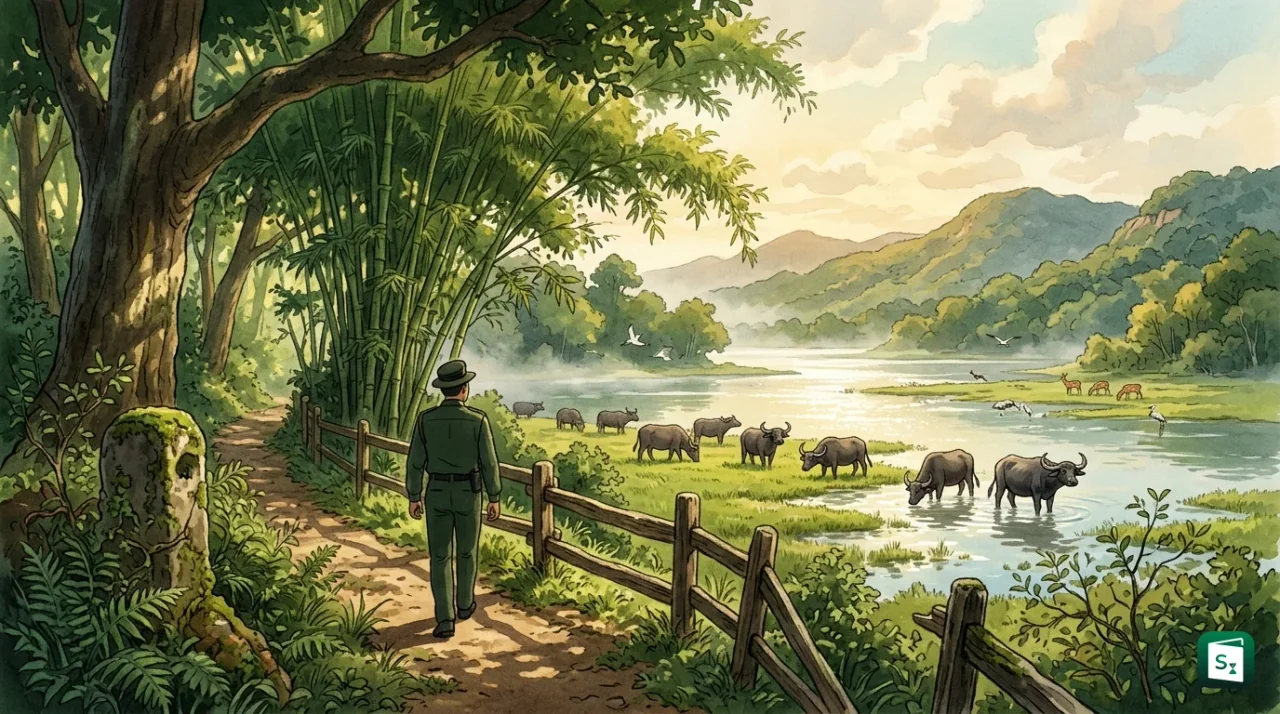
The Maharashtra State Board for Wildlife approved sanctuary status for the Kolamarka Conservation Reserve in Gadchiroli and the Expanded Tansa Wildlife Sanctuary in Thane and Palghar on 26 October 2026. The Board, chaired by Chief Minister Devendra Fadnavis, also cleared 14 new conservation reserves across seven districts. The move strengthens protection for Central India’s rare wild buffaloes and the forests that supply drinking water to Mumbai.
What Did the Maharashtra Wildlife Board Approve on 26 October 2026?
The Maharashtra State Board for Wildlife took the decisions at its 26th meeting in Mumbai on 26 October 2026. The meeting was chaired by Chief Minister Devendra Fadnavis, who heads the Board. Forest Minister Ganesh Naik and senior forest officers attended the meeting.
The Board cleared four sets of proposals. First, it approved the upgrade of the Kolamarka Conservation Reserve in Gadchiroli district to a wildlife sanctuary. Second, it approved sanctuary status for the newly expanded area adjoining the existing Tansa Wildlife Sanctuary in Thane and Palghar districts.
Third, it approved 14 new conservation reserves in Pune, Raigad, Nashik, Nandurbar, Thane, Palghar and Chandrapur districts. Fourth, it approved the marking of 100.139 sq km in the Koka Wildlife Sanctuary and 255.79 sq km in the Jayakwadi Bird Sanctuary as critical wildlife habitats.
These are approvals in principle. Final legal notification as sanctuaries and reserves will follow after the due process of settling rights and issuing notifications under the Wild Life (Protection) Act, 1972.
Where Is Kolamarka and Why Does Its Wild Buffalo Population Matter?
The Kolamarka Conservation Reserve lies in the Sironcha forest division of Gadchiroli district in eastern Maharashtra, close to the border with Chhattisgarh. It covers about 180.72 sq km and was declared a conservation reserve on 8 January 2013. The reserve sits in the Pranhita and Indravati river landscape and shares animals with the adjoining Indravati Tiger Reserve in Chhattisgarh.
Kolamarka is known for the Asiatic wild water buffalo, with the scientific name Bubalus arnee. This animal is listed as endangered on the global Red List of the International Union for Conservation of Nature (IUCN), which tracks the risk faced by species. It is also placed in Schedule I of the Wild Life (Protection) Act, 1972, which gives it the highest level of legal protection in India.
The importance is genetic. The buffaloes that move between Indravati and Kolamarka are seen as one of the last genetically pure herds of wild buffalo in Central India. Buffaloes in Assam and other areas have mixed with domestic buffaloes over time. The Central Indian herd has remained largely pure because the forests stayed isolated for long years.
Numbers remain small. Forest staff recorded around 16 animals in 2015, about 30 in 2017 and about 35 in 2018. Recent field reports place 20 to 25 animals in three herds in Kolamarka, with some males moving across the state border. The total Central Indian population across Indravati and Kolamarka is estimated at 40 to 80 animals. The world population of wild water buffaloes is estimated at less than 4,000, with about 3,500 in India, mainly in Assam, Chhattisgarh, Madhya Pradesh and Maharashtra.
The habitat is dry deciduous forest with bamboo thickets and open grasslands. These wet grasslands, marshes and riverbanks suit buffaloes, which feed on grass and wallow in water. Sanctuary status will bring stricter control on cattle grazing, tendu leaf collection and forest fires. This matters because grazing spreads disease from domestic cattle and tendu season fires disturb the habitat.
What Is the Expanded Tansa Wildlife Sanctuary?
Tansa Wildlife Sanctuary Location, District and Map Position
The sanctuary lies in Thane district and Palghar district of Maharashtra, about 90 km northeast of Mumbai in the foothills of the Western Ghats. It spreads across Shahapur and Bhiwandi talukas of Thane and Wada taluka of Palghar. On a map, it sits between longitudes 73 degrees 10 minutes to 73 degrees 25 minutes east and latitudes 19 degrees 25 minutes to 19 degrees 50 minutes north.
The original sanctuary was notified on 12 February 1970. It covers about 304.81 sq km, often rounded to 320 sq km. It forms the catchment of Tansa Lake and the surrounding forests of Shahapur, Khardi, Vaitarna and Wada ranges. The Tansa, Vaitarna and Modak Sagar reservoirs inside and around the sanctuary are major sources of drinking water for Mumbai, Thane and Bhiwandi. The Tansa river divides the sanctuary into two parts.
The Board has now approved sanctuary status for the newly expanded area next to this existing sanctuary. The expansion adds 588.767 hectares of revenue and private land from six villages. The villages are Ogda, Khodde, Tirmal, Pachghar, Phanasad and Amle. The stated aim is to make the sanctuary free of human habitation by including these lands and settling rights through due process.
Tansa Wildlife Sanctuary Animals and Forest Type
The forest is mainly southern tropical moist deciduous forest, with teak, khair, hed, ain, kalamb, bibla and bamboo in patches. Forest density ranges from 0.5 to 0.8.
Tansa Wildlife Sanctuary animals include about 54 species of mammals and more than 250 species of birds. The leopard is a key predator here. Other mammals include sloth bear, barking deer, mouse deer, sambar, four horned antelope, wild boar, jackal, hyena and porcupine. Smaller carnivores include the rusty spotted cat, jungle cat, small Indian civet and common palm civet. Reptiles include the Indian rock python, Indian cobra, Russell’s viper and common monitor lizard.
Bird life is rich. The sanctuary hosts owls, hornbills, woodpeckers, orioles, bulbuls, egrets, paradise flycatchers and crested serpent eagles. It also shelters the endangered forest owlet and two critically endangered Gyps vultures, along with the vulnerable Pallas’s fish eagle. Tansa Lake, an artificial lake on the Tansa river, supports water birds and supplies water to both wildlife and cities.
Fourteen New Conservation Reserves Across Seven Districts
The Board approved 14 conservation reserves in seven districts. A conservation reserve is a protected area declared on government land, often next to sanctuaries or on corridors that link one protected area with another. Local communities are consulted before notification.
| District | New Conservation Reserves Cleared |
|---|---|
| Nashik | Dindori, Surgana, Taharabad |
| Palghar | Jawhar, Asherigad, Dhamani |
| Raigad | Alibag, Ghera Manikgad |
| Pune | Bhor Girgad |
| Thane | Ghumtara |
| Nandurbar | Chinchpada |
| Chandrapur | Ekara |
| Pune and Raigad (shared) | Velhe Mulshi, Lonavala |
These sites add up to 14 reserves. Velhe Mulshi and Lonavala fall in both Pune and Raigad districts, so they are counted once each. Together, the list covers the northern Western Ghats, coastal Raigad forests and the forested belts of Nashik, Nandurbar, Thane, Palghar and Chandrapur.
The choice of places links habitats. The Western Ghats patches around Lonavala, Bhor, Velhe Mulshi and Surgana support corridors for leopards and other mammals. The Palghar and Thane reserves sit near the Tansa landscape. Ekara in Chandrapur lies in the tiger rich central Indian belt near Tadoba and Koka.
What Is a Wildlife Sanctuary and How Is It Different From a Conservation Reserve?
What Is a Wildlife Sanctuary
A wildlife sanctuary is a protected area where hunting, poaching and capture of wild animals are banned. Some regulated human uses, like grazing or collection of forest produce by local people, can continue if the Chief Wildlife Warden permits them and if rights have been settled.
The Wild Life (Protection) Act, 1972 is India’s main law for protecting wild animals, birds and plants. It lists species in schedules according to the level of protection. Sanctuary declaration starts with a notification of intent under Section 18, followed by settlement of rights of people in the area under Sections 19 to 25, and final notification under Section 26A. No change in sanctuary boundaries is allowed without approval linked to the National Board for Wildlife.
India has 574 wildlife sanctuaries covering 1,27,241.24 sq km, as per the Wildlife Institute of India database and the Union Environment Ministry report of March 2026. Maharashtra has 52 wildlife sanctuaries, the highest among states. The Andaman and Nicobar Islands have 96, the highest among states and Union Territories taken together. The largest sanctuary in Maharashtra is Melghat at 788.75 sq km. The smallest is Deulgaon Rehekuri at 2.17 sq km. The oldest is Radhanagari, notified in 1958.
Conservation Reserve vs Wildlife Sanctuary
Both categories were added by the 2002 amendment to the Wild Life (Protection) Act, 1972. Conservation reserves are governed by Sections 36A and 36B. Community reserves are governed by Sections 36C and 36D.
| Feature | Wildlife Sanctuary | Conservation Reserve |
|---|---|---|
| Legal provision | Sections 18 to 26A of the 1972 Act | Sections 36A and 36B of the 1972 Act |
| Land type | Area of ecological value outside reserve forests and territorial waters | Government land, often adjoining sanctuaries and national parks or linking two protected areas |
| Community role | Rights of local people are inquired into and settled by the Collector | Declared after consultation with local communities, with a management committee that includes village panchayat members |
| Level of protection | Strong. Entry, grazing and use of resources need permits | Lighter than a sanctuary but stronger than unprotected forest. Selected provisions on entry and offences apply |
| Example in this news | Kolamarka and Expanded Tansa | Velhe Mulshi, Jawhar, Ekara and 11 others |
A sanctuary differs from a national park in the level of restriction. A national park, declared under Section 35, has the strictest protection. No grazing, no private rights and no removal of wildlife or forest produce except by special permit for better management. A sanctuary allows some regulated human activity after rights are settled. A tiger reserve and a biosphere reserve are wider management concepts that can include sanctuaries and national parks within them.
Critical Wildlife Habitats Cleared in Koka and Jayakwadi
A critical wildlife habitat is an area identified under the Forest Rights Act, 2006 as vital for wildlife, including highly vulnerable species, after recognising the rights of forest dwelling Scheduled Tribes and other traditional forest dwellers. The Board approved 100.139 sq km in Koka Wildlife Sanctuary in Bhandara district and 255.79 sq km in Jayakwadi Bird Sanctuary in Chhatrapati Sambhajinagar and Jalna districts for this tag. Koka, notified in 2013, is part of the central Indian tiger corridor. Jayakwadi, notified in 1986 around the Nath Sagar reservoir, is a major water bird habitat.
Key Takeaways
- The Maharashtra State Board for Wildlife approved sanctuary status for Kolamarka and Expanded Tansa at its 26th meeting on 26 October 2026.
- Kolamarka, spread over 180.72 sq km in Gadchiroli and declared a conservation reserve in 2013, protects a genetically pure herd of Asiatic wild water buffalo.
- The Expanded Tansa Wildlife Sanctuary adds 588.767 hectares from six villages in Thane and Palghar to the Tansa sanctuary notified in 1970.
- The Board cleared 14 conservation reserves across seven districts, including Velhe Mulshi, Lonavala, Dindori, Jawhar and Ekara.
- India has 574 wildlife sanctuaries and Maharashtra has 52, the highest count among states.