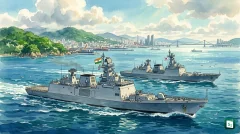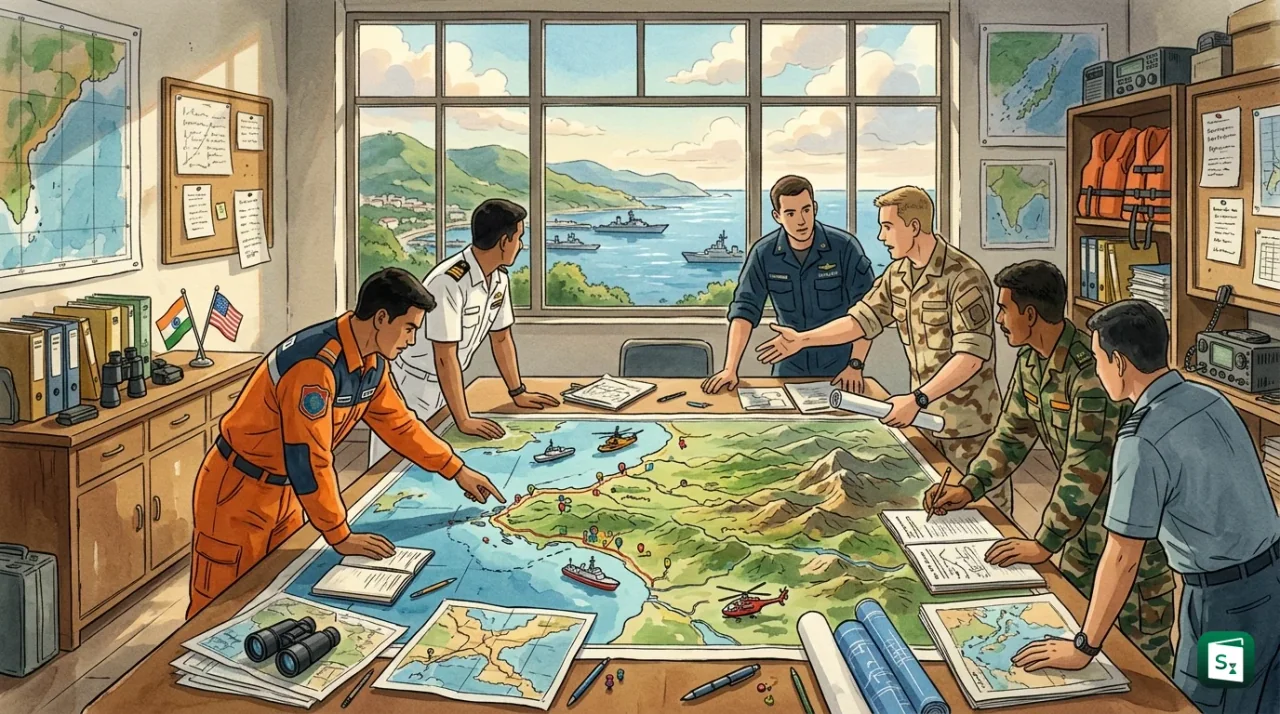
The 5th edition of Tiger Triumph 2026, the India US bilateral tri-service Humanitarian Assistance and Disaster Relief exercise, opened on 2 November 2026 at the Maritime Warfare Centre in Visakhapatnam. The 2026 edition is being held as a Tabletop Exercise for joint planning of large scale disaster relief operations. A National Disaster Response Force team is participating for the first time.
What Is Tiger Triumph Exercise?
Tiger Triumph is the bilateral tri-service Humanitarian Assistance and Disaster Relief exercise of India and the United States. HADR expands to Humanitarian Assistance and Disaster Relief, which covers rescue, medical aid, evacuation and supply delivery after natural disasters. Tri-service means the Army, Navy and Air Force train together in one exercise.
The exercise began in 2019 and is held on alternate planning and field models. It is the first tri-service exercise between India and the US. India otherwise holds a tri-service exercise only with Russia, named Indra. Tiger Triumph focuses on disasters, not combat. The aim is to build common procedures so both militaries can respond together when a cyclone, tsunami or earthquake hits the region.
A Tabletop Exercise (TTX) is a simulation in a conference room. Officers discuss a fictional disaster on maps and computers. No ships sail and no troops land on beaches during a TTX. The value lies in joint planning, clear communication lines and faster decisions during a real crisis.
Tiger Triumph Exercise Between Which Countries?
Tiger Triumph is held between India and the United States. It is a bilateral exercise, which means only these two countries take part. Both sides field their Army, Navy and Air Force elements, so it is called tri-service and combined joint in military terms.
The partnership has grown steadily since the first edition in 2019. India now holds more military exercises with the US than with any other country. Tiger Triumph supports the shared goal of a free and open Indo-Pacific. It also builds on foundational pacts such as the Logistics Exchange Memorandum of Agreement (LEMOA), signed in 2016, which lets both militaries share logistics support during exercises and operations.
What Happened at Tiger Triumph 2026 in Visakhapatnam?
Tiger Triumph 2026 opened on 2 November 2026 at the Maritime Warfare Centre (MWC) in Visakhapatnam, Andhra Pradesh. The 2026 edition is a Tabletop Exercise. Staff officers will work through large scale HADR scenarios, refine joint plans and test multi-domain command and control.
The focus this year is planning and coordination for Combined Joint All-Domain Operations. That term covers land, sea, air, space, cyber and electromagnetic actions run together under one command design. Sessions include staff planning, all-domain tabletop drills and specialist work on command, control, cyber and space synchronisation. Subject matter expert exchanges, community outreach and cultural events will run alongside the planning work.
Opening Ceremony Led By Eastern Fleet and US Pacific Fleet
The opening ceremony was presided over by Rear Admiral Vishal Bishnoi, Flag Officer Commanding Eastern Fleet, and Rear Admiral Joaquin J Martinez de Pinillos, Vice Commander of the US Pacific Fleet. The Eastern Fleet is the operational fleet of the Eastern Naval Command, which is headquartered in Visakhapatnam and looks after the Bay of Bengal and eastern Indian Ocean.
MWC Visakhapatnam functions under the Eastern Naval Command. It is a Category A training establishment of the Indian Navy. The centre conducts computer based wargames, validates naval tactics and trains command teams before they deploy at sea. Holding a planning heavy exercise at MWC allows both sides to use its simulation and debrief systems.
Who Is Participating From India and the US
The Indian side includes specialists from all maritime domains of the Indian Navy, ground forces from the Indian Army and representatives from Indian Air Force units. Special Forces personnel from all three services are also part of the group. A team from the National Disaster Response Force (NDRF) has joined the exercise.
The US Joint Force includes representatives from the US Army, Navy, Air Force and Marine Corps. It also includes specialists in space, cyber, medical support and Explosive Ordnance Disposal (EOD), the branch that handles unexploded bombs and devices. This mix shows how modern relief work depends on doctors, engineers, cyber teams and satellite support, along with ships and aircraft.
Why First Time NDRF Participation Matters
The entry of the NDRF is the main new feature of the 2026 edition. The force brings civilian disaster response skills into a drill that was earlier limited to the armed forces. That shift links military lift and planning capacity with on ground rescue experience.
The National Disaster Response Force was constituted under Section 44 of the Disaster Management Act, 2005. It was raised on 19 January 2006 and functions under the Ministry of Home Affairs. The force started with 8 battalions and now has 16 battalions, each with 1,149 personnel. Battalions are drawn from central forces such as the BSF, CRPF, CISF, ITBP, SSB and Assam Rifles. Each battalion has specialist search and rescue teams with engineers, paramedics, canine units and communication staff. Its motto is Aapda Seva Sadaiv Sarvatra, which means service during disasters, always and everywhere. The NDRF Academy is located in Nagpur.
NDRF teams handle collapsed building rescue, flood rescue, cyclone response, medical emergencies and Chemical, Biological, Radiological and Nuclear contingencies. In a real disaster, the armed forces provide ships, aircraft, field hospitals and command networks. NDRF provides close quarter rescue and relief camp management. Joint tabletop planning helps both sides agree on who does what, how information flows and how a combined coordination centre will run when time is short.
How Tiger Triumph Has Evolved Since 2019
Tiger Triumph was first announced in September 2019 and the maiden exercise ran on the eastern seaboard in November 2019. The series has moved between field drills and planning drills. Amphibious landings at Kakinada were central in several editions. The 2022 and 2026 editions used the tabletop format to sharpen planning and coordination.
| Edition | Dates and Venue | Format and Main Features |
|---|---|---|
| 1st, 2019 | 13 to 21 November 2019, Visakhapatnam and Kakinada | Harbour phase at Visakhapatnam and sea phase at Kakinada. About 1,200 Indian and 500 US personnel took part. Indian ships INS Jalashwa, INS Airavat and INS Sandhayak joined USS Germantown. Focus on ship to shore relief, field hospital and evacuation drills. |
| 2nd, 2022 | Concluded on 20 October 2022, Visakhapatnam | Tabletop exercise with about 50 participants. Scenario covered a super cyclone in a notional third country and a joint diplomatic and military response. |
| 3rd, 2024 | 18 to 31 March 2024, Visakhapatnam and Kakinada | Harbour phase from 18 to 25 March and sea phase from 26 March. Cross deck flying by UH-3H, CH-53E and MH-60R helicopters. Troops landed at Kakinada to set up a joint command centre and a joint relief and medical camp. Closing ceremony on board USS Somerset. |
| 4th, 2025 | 1 to 11 April 2025, Visakhapatnam and Kakinada | Harbour phase from 1 to 7 April and sea phase from 8 April. Work on a standard operating procedure for a Combined Coordination Centre. Distinguished Visitors Day at Kakinada on 11 April with beaching, slithering by special forces, Mi-17 V5 helicopters and C-130 aircraft. US Space Force took part with Indian counterparts for the first time. |
| 5th, 2026 | Opened on 2 November 2026, MWC Visakhapatnam | Tabletop Exercise focused on Combined Joint All-Domain Operations. NDRF joined for the first time. Cyber, space, medical and EOD specialists included. |
Why Tiger Triumph Matters for India US Defence Cooperation
The Indian Ocean region faces frequent cyclones, floods, tsunamis and earthquakes. Both India and the US deploy ships, aircraft and medical teams when such disasters strike partner countries. Common procedures cut delay. Tiger Triumph builds those procedures in peacetime.
The exercise also strengthens day to day military trust. Joint planning improves communication between headquarters, standardises relief camp and hospital routines and tests command networks that include space and cyber inputs. Faster joint response raises both countries’ standing as reliable first responders in the Indo-Pacific.
Tiger Triumph is one of five major bilateral exercises between the two countries. Each covers a different service or task.
| Exercise | Service and Focus |
|---|---|
| Yudh Abhyas | Army exercise held since 2004. Focus on conventional operations, peacekeeping and disaster relief. |
| Vajra Prahar | Army Special Forces exercise held since 2010. Focus on airborne, special and counter terror tasks. |
| Malabar | Naval exercise started in 1992. Now a Quad naval drill with Japan and Australia. Focus on maritime security. |
| Cope India | Air Force exercise first held in 2004. Focus on fighter, transport and joint air tasks. |
| Tiger Triumph | Tri-service HADR exercise started in 2019. Focus on large scale humanitarian relief and joint planning. |
India and the US also train together in multilateral forums such as RIMPAC near Hawaii, Red Flag air combat drills in the US and Milan, the biennial naval gathering hosted by India at Visakhapatnam. Tiger Triumph is distinct because it is bilateral, tri-service and centred on relief work.
Key Takeaways
- The 5th edition of Tiger Triumph 2026 opened on 2 November 2026 at the Maritime Warfare Centre in Visakhapatnam.
- Tiger Triumph is the India US bilateral tri-service HADR exercise first held in 2019.
- The 2026 edition is a Tabletop Exercise focused on joint planning for Combined Joint All-Domain Operations.
- A team from the National Disaster Response Force, raised on 19 January 2006 under the Disaster Management Act, 2005, joined the exercise for the first time.
- The ceremony was led by Rear Admiral Vishal Bishnoi of the Eastern Fleet and Rear Admiral Joaquin J Martinez de Pinillos of the US Pacific Fleet.