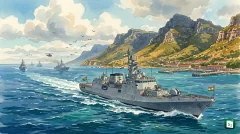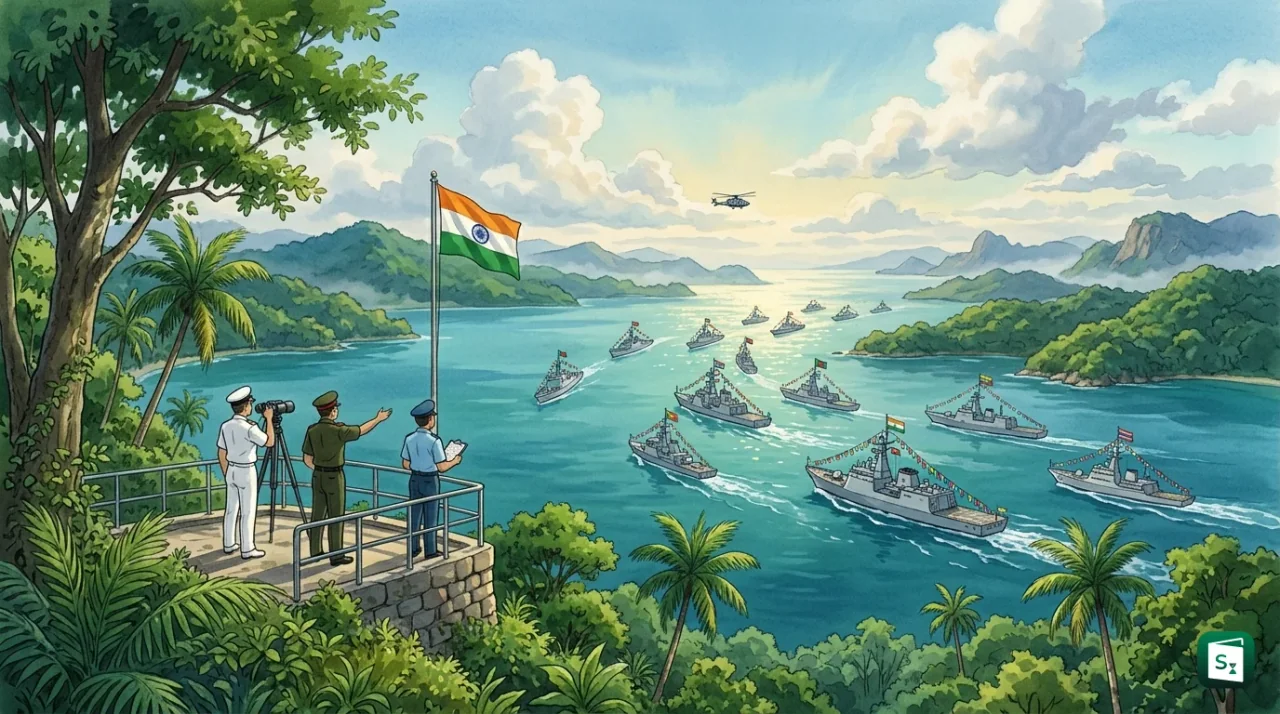
India is hosting the first ever BIMSTEC Maritime Security Exercise from 30 October to 3 November 2026 at Sri Vijaya Puram (Port Blair) in the Andaman and Nicobar Islands. All seven BIMSTEC member states are represented in the drill, which the Indian Navy and the Andaman and Nicobar Command (ANC) are conducting in harbour and sea phases. Held under the theme of shared seas, shared security and shared prosperity, the exercise turns the maritime promises made at the 6th BIMSTEC Summit into joint action at sea.
First BIMSTEC Maritime Security Exercise: Dates, Venue and Theme
The BIMSTEC Maritime Security Exercise is the first combined maritime drill of the Bay of Bengal grouping. The Ministry of External Affairs announced that India is hosting the maiden edition at Sri Vijaya Puram, the capital of the Union Territory of Andaman and Nicobar Islands. Sri Vijaya Puram was earlier known as Port Blair.
The exercise runs from 30 October to 3 November 2026. It began with three days of tabletop exercises, followed by a harbour phase and a sea phase around the islands. The harbour phase covers professional exchanges, safety briefings and operational planning. The sea phase tests coordination between ships at sea.
The Andaman and Nicobar Command inaugurated the exercise on 30 October. Vice Admiral Vineet McCarty, Commander in Chief of the Andaman and Nicobar Command, led the opening ceremony. Vice Admiral Biswajit Dasgupta, the National Maritime Security Coordinator, also attended with senior delegations from Bangladesh, Myanmar and Sri Lanka.
The drill carries the theme Translating Vision to Action, Shared Seas, Shared Security and Shared Prosperity. It is anchored in the Delhi Declaration and follows a key initiative announced by Prime Minister Narendra Modi at the 6th BIMSTEC Summit held in Bangkok, Thailand in April 2025. The Ministry of External Affairs has said the exercise will help build a safe, secure and stable maritime environment in the Bay of Bengal.
Which BIMSTEC Member Countries Are Participating?
All seven BIMSTEC member countries are represented in the exercise. The members are India, Bangladesh, Bhutan, Myanmar, Nepal, Sri Lanka and Thailand. Four of them have sent naval ships. Two landlocked members have sent official delegates.
| Participation Type | Countries | Details |
|---|---|---|
| Ships and naval assets | Bangladesh, Myanmar, Sri Lanka, Thailand | Warships and coast guard vessels joined harbour and sea phases |
| Official delegates | Bhutan, Nepal | Representatives joined tabletop discussions and planning |
| Host | India | Indian Navy organises the drill through the Andaman and Nicobar Command |
The Sri Lanka Navy ship SLNS Gajabahu reached Port Blair on 29 October and received a ceremonial welcome from the Indian Navy. The Myanmar Navy ship UMS King Aung Zeya also joined the exercise. Commanding officers and crews of the visiting ships were briefed on safety drills and planned operations during the harbour phase.
Bhutan and Nepal have no navies because they are landlocked. Their presence still matters. Both countries depend on the Bay of Bengal ports for their export and import trade, so stable sea routes and joint disaster response directly affect their economies.
What Is BIMSTEC?
BIMSTEC stands for the Bay of Bengal Initiative for Multi-Sectoral Technical and Economic Cooperation. It is a regional grouping of seven countries around the Bay of Bengal. It links five South Asian members, Bangladesh, Bhutan, India, Nepal and Sri Lanka, with two Southeast Asian members, Myanmar and Thailand.
BIMSTEC was formed through the Bangkok Declaration on 6 June 1997. It began as BIST-EC with four members, Bangladesh, India, Sri Lanka and Thailand. Myanmar joined in December 1997, after which it was called BIMST-EC. Nepal and Bhutan joined in 2004, and the grouping took its present name and seven member shape. The first BIMSTEC Summit was held in Bangkok in July 2004.
The BIMSTEC Secretariat is located in Dhaka, Bangladesh. The permanent secretariat was set up in 2014 after a decision at the Third BIMSTEC Summit. The current Secretary General is Indra Mani Pandey, who took charge in January 2024 as the fourth Secretary General.
BIMSTEC became a formal regional organisation with the BIMSTEC Charter. The Charter was signed on 30 March 2022 at the 5th Summit in Colombo, Sri Lanka. It came into force on 20 May 2024 after approval by all members. The Charter gives BIMSTEC a legal identity, a flag and an emblem, and lays down its goals, principles and decision making rules.
At the 5th Summit, members reorganised cooperation into seven pillars, with each member leading one pillar:
| Pillar | Lead Country |
|---|---|
| Security | India |
| Trade, Investment and Development | Bangladesh |
| Environment and Climate Change | Bhutan |
| People to People Contacts | Nepal |
| Agriculture and Food Security | Myanmar |
| Science, Technology and Innovation | Sri Lanka |
| Connectivity | Thailand |
India leads the security pillar, which covers counter terrorism and transnational crime, disaster management and energy security. The grouping has about 1.7 billion people, close to 22 percent of the world population, and a combined economy of about 4 trillion dollars.
The 6th BIMSTEC Summit was held on 4 April 2025 in Bangkok. Its theme was Prosperous, Resilient and Open BIMSTEC. The summit adopted the Bangkok Vision 2030, the first vision document of the grouping, along with the Summit Declaration and rules of procedure for BIMSTEC bodies. Leaders also signed the Agreement on Maritime Transport Cooperation to improve cargo and passenger movement, recognise certificates and support national treatment for vessels. Bangladesh took over as the next chair of BIMSTEC at the end of the summit.
Why the Andaman and Nicobar Command Is Central to the Exercise
The Andaman and Nicobar Command (ANC) is hosting and facilitating the exercise. The ANC is based at Port Blair, now called Sri Vijaya Puram. It is India’s first and only integrated tri-service command, which means the Army, Navy and Air Force work together under one commander. The Commander in Chief is a three star officer appointed in rotation from the three services.
The ANC was created on 8 October 2001 after the 1999 Kargil War showed the need for joint operations. Reforms suggested after the war led to a unified command for the islands. The command controls Army, Navy, Air Force and Coast Guard assets in the region.
The location gives the command special value. The Andaman and Nicobar Islands sit at the meeting point of the Bay of Bengal and the Andaman Sea, close to the Strait of Malacca. A large share of world trade and energy shipments passes through this strait. The islands also guard India’s vast Exclusive Economic Zone of about 600,000 square kilometres in the region. Key bases under the command include INS Utkrosh at Port Blair, INS Baaz at Campbell Bay, INS Kohassa in North Andaman and INS Kardip at Kamorta, along with the Car Nicobar air base.
The command already handles maritime surveillance, anti piracy patrols, coordinated patrols with Thailand and Indonesia, the biennial Milan naval exercise and humanitarian assistance and disaster relief. Its position near vital sea lanes makes it the natural venue for a Bay of Bengal maritime drill.
What Is Maritime Security and What the Drill Will Practise
Maritime security means protecting sea routes, ports, ships, crews and marine resources from threats. These threats include piracy, terrorism, smuggling of drugs and arms, human trafficking, illegal fishing and marine pollution. Maritime security is important because the Bay of Bengal carries major trade, energy and food shipments between South and Southeast Asia.
A key idea in the exercise is Maritime Domain Awareness (MDA). MDA means building a clear picture of everything happening at sea, such as ship movements, suspicious vessels and emergencies, by sharing information and tracking data. Better awareness helps navies spot trafficking, illegal fishing and other cross border crimes early.
The exercise focuses on five practical areas:
- Stronger MDA through shared information on vessels and incidents
- Better operational coordination and interoperability, so navies and coast guards can communicate and work together smoothly
- Humanitarian Assistance and Disaster Relief (HADR), including search and rescue after cyclones, floods and accidents at sea
- Joint action against cross border maritime crimes and terrorism
- Coordinated response to marine pollution from oil and hazardous material spills
This work builds on steps BIMSTEC has already taken. The BIMSTEC Expert Group on Maritime Security Cooperation has finalised guidelines for maritime law enforcement agencies to coordinate during meetings at sea. India will soon share a draft of the proposed BIMSTEC White Shipping Agreement to improve sharing of commercial ship data. The grouping has also finalised regional oil spill response guidelines, a contingency plan, standard emergency steps and guidelines for the maritime part of HADR. Four BIMSTEC Disaster Management Exercises have already been held, and India has proposed a BIMSTEC Disaster Management Centre. The grouping also works with the United Nations Office for Disaster Risk Reduction and the Coalition for Disaster Resilient Infrastructure.
All cooperation at sea follows the United Nations Convention on the Law of the Sea (UNCLOS). The Convention protects freedom of navigation and the right of transit passage through straits used for international shipping.
Why the Exercise Matters for India and the Bay of Bengal
The Bay of Bengal connects South Asia with Southeast Asia. It supports trade, energy flows, fishing and jobs for coastal people. Secure seas keep costs low and supply chains steady. For landlocked Bhutan and Nepal, safe access to ports decides the cost of their exports and imports.
For India, the drill supports three policy goals at once. It strengthens the Neighbourhood First approach by building practical security ties with close neighbours. It advances the Act East policy by deepening operational links with Myanmar and Thailand. It also fits the MAHASAGAR vision for security and growth across regions, which presents India as a trusted security partner in the Indian Ocean Region.
The exercise also shows why BIMSTEC has gained weight at a time when SAARC has slowed down:
| Feature | BIMSTEC | SAARC |
|---|---|---|
| Members | 7, includes Myanmar and Thailand, excludes Pakistan and Afghanistan | 8, includes Pakistan and Afghanistan |
| Headquarters | Dhaka, Bangladesh | Kathmandu, Nepal |
| Formed | 1997 through Bangkok Declaration | 1985 |
| Working style | Active summit cycle, seven pillars with lead countries, Charter in force since 2024 | Summits stalled since 2016 |
| Focus | Bridge between South and Southeast Asia, trade, connectivity, security | South Asia only |
As a combined exercise, the drill lets forces from different countries practise together. In military terms, a joint exercise involves different arms of one country, while a combined exercise involves forces of more than one country. The tabletop talks build trust. The harbour phase aligns plans. The sea phase tests real coordination. Together, they create common procedures for rescue, pollution control and crime response that can save lives during the next cyclone, oil spill or trafficking alert.
Key Takeaways
- India is hosting the first BIMSTEC Maritime Security Exercise from 30 October to 3 November 2026 at Sri Vijaya Puram (Port Blair) in the Andaman and Nicobar Islands.
- All seven BIMSTEC members, Bangladesh, Bhutan, India, Myanmar, Nepal, Sri Lanka and Thailand, are represented, with four navies sending ships and Bhutan and Nepal sending delegates.
- The Andaman and Nicobar Command, created on 8 October 2001, is India’s first and only integrated tri-service command and the host of the drill.
- BIMSTEC was formed through the Bangkok Declaration on 6 June 1997 and its Secretariat is located in Dhaka, with its Charter coming into force on 20 May 2024.
- India leads the security pillar under the seven pillar system, and the 6th Summit in Bangkok adopted the Bangkok Vision 2030 and the Agreement on Maritime Transport Cooperation.