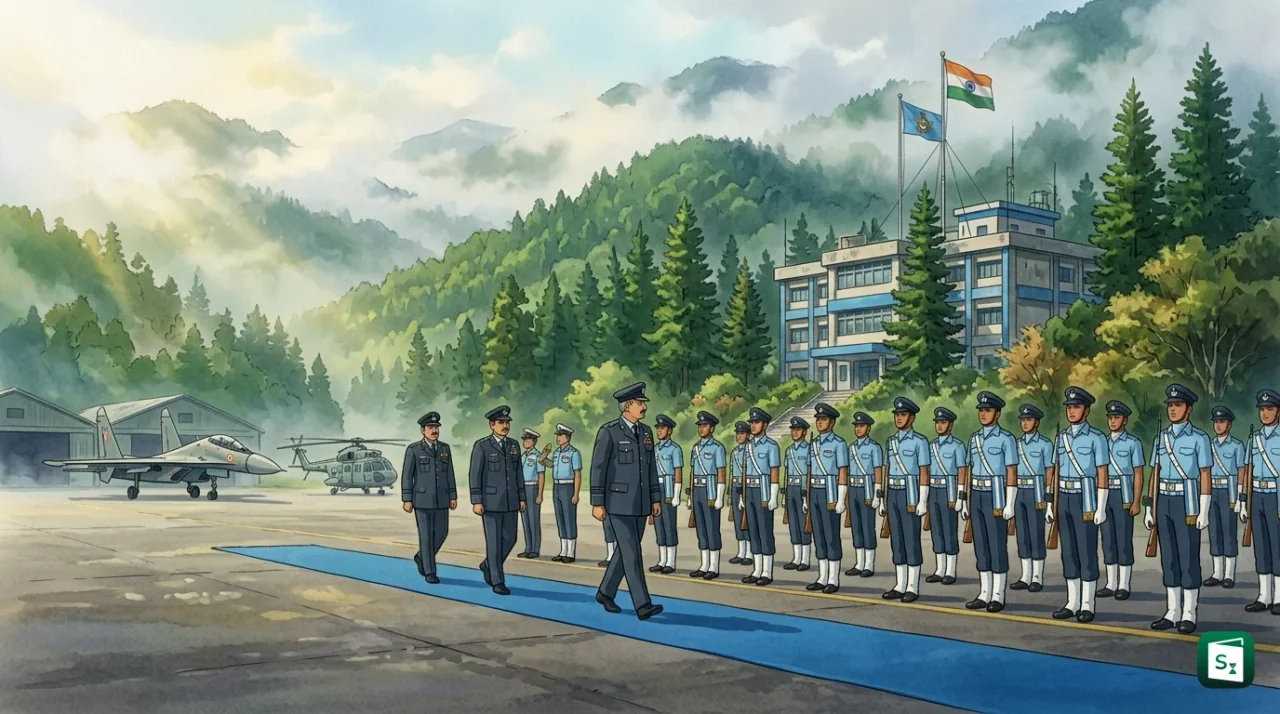
Air Marshal Mehtab Singh Deswal assumed charge as the Air Officer Commanding-in-Chief of the Eastern Air Command of the Indian Air Force on 1 November 2026 at Shillong. He succeeds Air Marshal Inderpal Singh Walia, who has moved to Air Headquarters as the Vice Chief of the Air Staff. The appointment is part of a top level change in the Air Force that also saw Air Chief Marshal Ashutosh Dixit take over as the 29th Chief of the Air Staff.
Who Is Air Marshal Mehtab Singh Deswal?
Air Marshal Mehtab Singh Deswal is a fighter pilot with more than 37 years of service in the Indian Air Force. He is an alumnus of the National Defence Academy (NDA) at Khadakwasla and the National Defence College (NDC) at New Delhi. NDA is the joint training academy for the Army, Navy and Air Force, while NDC is the senior strategic studies institution for senior officers.
Deswal was commissioned into the fighter stream of the Air Force on 14 June 1989. He has flown more than 3,200 hours on various fighter aircraft, including the Hunter, Jaguar, Su-30K and Su-30MKI. He is a specialist in strike aircraft and air defence roles and a qualified Pilot Attack Instructor. A Pilot Attack Instructor is a senior pilot trained to teach air to ground weapon delivery and attack tactics.
His command record includes leadership of a frontline Su-30 squadron and two premier air bases. He served as Air Officer Commanding of No. 45 Wing at Sirsa from June 2017 to December 2018 and No. 33 Wing at Jamnagar from January 2020. He was part of the core team inducted onto the Su-30K in 1997 and later re equipped his squadron with the Su-30MKI. Under his command, the squadron achieved full operational readiness of its aircrew within four months and won the Team Event Bombing Trophy during Exercise Eklavya in 2009 to 2010.
Before taking over the Eastern Air Command, Deswal served as the Senior Air Staff Officer (SASO) at the headquarters of the South Western Air Command at Gandhinagar. SASO is the senior staff officer who assists the commander in planning and running air operations. He earlier served as Director General (Weapon Systems) at Air Headquarters in New Delhi and as Assistant Chief of the Air Staff (Inspection) from August 2022 to July 2024. His career also includes a diplomatic posting as Air Attache at the Embassy of India in Pakistan. For distinguished service, he has received the Ati Vishisht Seva Medal (AVSM) and the Vayu Sena Medal (VM).
What Changed in the Eastern Air Command Leadership?
Air Marshal Deswal succeeds Air Marshal Inderpal Singh Walia as head of the Eastern Air Command. Walia had taken charge of the command on 1 February 2026 after the retirement of Air Marshal Surat Singh. After about nine months in Shillong, Walia has now moved to New Delhi as the Vice Chief of the Air Staff with effect from 1 November 2026.
The Vice Chief is the second highest officer in the Air Force and assists the Chief in running the service. Walia succeeds Air Marshal Ashutosh Dixit in that post. Dixit served as Vice Chief from 1 July 2026 and then took charge as the 29th Chief of the Air Staff on 31 October 2026.
Dixit succeeded Air Chief Marshal Amar Preet Singh, who retired after more than 42 years of service. Singh had served as the 28th Chief from 30 September 2024 to 31 October 2026. Walia himself is a fighter pilot commissioned on 11 June 1988 with more than 3,200 hours of accident free flying. He has commanded a MiG-27 squadron, the Tactics and Air Combat Development Establishment and a frontline base, and has served as Defence Attache in Japan and South Korea.
Where Is the Eastern Air Command and Why Does It Matter?
The Eastern Air Command is headquartered at Shillong in Meghalaya. Shillong is often called the Scotland of the East. The command controls air operations over a vast area covering 12 states, including the seven northeastern states, West Bengal, Bihar, and parts of Odisha and Jharkhand. The area spans more than three lakh square kilometres.
The command is responsible for a 6,300 km long international boundary with China, Nepal, Bhutan, Myanmar and Bangladesh. This includes the eastern sector of the Line of Actual Control (LAC) in Sikkim and Arunachal Pradesh. The LAC is the unsettled border between India and China, divided into western, central and eastern sectors. The Eastern Air Command looks after the eastern sector. It also covers the sensitive Siliguri Corridor, the narrow stretch that links mainland India with the Northeast.
The command began as No. 1 Operational Group on 27 May 1958 at Ranikutir in Kolkata. It was upgraded to a Command on 1 December 1959 at Fort William in Kolkata, with Air Vice Marshal K. L. Sondhi as the first head. After the 1962 war with China, the headquarters was moved to Shillong on 10 June 1963 for better control over the northeastern theatre. Its motto is Samareshu Parakramah, which means valour in battle.
The command has permanent airbases at Chabua, Guwahati, Bagdogra, Barrackpore, Hasimara, Jorhat, Kalaikunda and Tezpur. It also uses forward bases at Agartala, Kolkata, Panagarh and Shillong. Fighter bases such as Tezpur, Chabua and Hasimara house Su-30MKI squadrons, while the command also operates transport aircraft, helicopters and air defence units. Its roles include air defence, offensive air operations, ground support and relief work during natural disasters.
How Is the Indian Air Force Organised Into Seven Commands?
The Indian Air Force was established on 8 October 1932. It is headed by the Chief of the Air Staff, a four star officer in the rank of Air Chief Marshal, based at Air Headquarters (Vayu Bhawan) in New Delhi. The Chief is assisted by the Vice Chief of the Air Staff. The motto of the Air Force is Nabhah Sparsham Deeptam, taken from the Bhagavad Gita, which means Touch the Sky with Glory.
The force is organised into seven commands. Each command is headed by an Air Officer Commanding-in-Chief (AOC-in-C) in the rank of Air Marshal. Five are operational commands that control fighter, transport and helicopter units in their region. Two are functional commands for training and maintenance.
| Command | Headquarters | Type and Role |
|---|---|---|
| Western Air Command | New Delhi | Operational, guards northern and western borders including Ladakh and Rajasthan |
| Eastern Air Command | Shillong, Meghalaya | Operational, guards Northeast and eastern LAC with China, Myanmar and Bangladesh |
| Central Air Command | Prayagraj, Uttar Pradesh | Operational, covers central India and provides transport and refuelling depth |
| South Western Air Command | Gandhinagar, Gujarat | Operational, covers desert sector of Rajasthan and Gujarat |
| Southern Air Command | Thiruvananthapuram, Kerala | Operational, covers peninsular India and Indian Ocean including island territories |
| Training Command | Bengaluru, Karnataka | Functional, runs flying and ground training |
| Maintenance Command | Nagpur, Maharashtra | Functional, handles repair, overhaul and logistics |
The Western Air Command is the largest and busiest operational command. The South Western Air Command was carved out of the Western Air Command and became a separate command in 1980, with headquarters later moved to Gandhinagar.
Is Air Marshal a High Rank in the Indian Air Force?
Yes. Air Marshal is a three star rank and the second highest active rank in the Indian Air Force. It stands above the two star rank of Air Vice Marshal and below the four star rank of Air Chief Marshal, which is held by the Chief of the Air Staff. The highest ceremonial rank is Marshal of the Indian Air Force, a five star honour held only once, by Arjan Singh in 2002.
An Air Marshal is equivalent to Lieutenant General in the Indian Army and Vice Admiral in the Indian Navy. An Air Vice Marshal is equivalent to Major General and Rear Admiral. An Air Commodore, the one star rank, is equivalent to Brigadier and Commodore.
Senior Air Marshals hold a higher grade within the same rank called the Commander in Chief grade. Officers in this grade wear collar tabs with a wreath design and hold the most senior three star posts. These posts include the Vice Chief of the Air Staff and the heads of all seven air commands as AOC-in-C. Other Air Marshals serve as Deputy Chiefs, Directors General and senior staff officers at Air Headquarters. In general, about 12 to 15 officers hold the rank of Air Marshal at any time.
Who Heads the Indian Air Force in 2026?
The head of the Indian Air Force is the Chief of the Air Staff. As of 1 November 2026, the Chief is Air Chief Marshal Ashutosh Dixit, the 29th Chief of the Air Staff. He took charge on 31 October 2026 and will remain in office till 31 December 2028. He succeeded Air Chief Marshal Amar Preet Singh, the 28th Chief, who served from 30 September 2024 to 31 October 2026 and retired after more than four decades of service.
Dixit was commissioned into the fighter stream on 6 December 1986. He is an experimental test pilot with more than 3,500 hours of flying. He has commanded a Mirage 2000 squadron and frontline bases and has served as AOC-in-C of the Central Air Command and as Chief of Integrated Defence Staff. He had also served as Vice Chief from 1 July 2026 before becoming Chief.
Key Takeaways
- Air Marshal Mehtab Singh Deswal took charge as AOC-in-Chief of the Eastern Air Command on 1 November 2026 at Shillong.
- Deswal was commissioned on 14 June 1989 and has more than 3,200 hours of fighter flying with the AVSM and VM for distinguished service.
- He succeeds Air Marshal Inderpal Singh Walia, who became the Vice Chief of the Air Staff on 1 November 2026.
- The Eastern Air Command, headquartered at Shillong, guards a 6,300 km border with China, Nepal, Bhutan, Myanmar and Bangladesh.
- The current Chief of the Air Staff is Air Chief Marshal Ashutosh Dixit, the 29th Chief, who took charge on 31 October 2026.