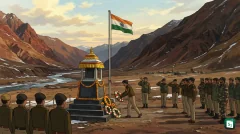
The Indo-Tibetan Border Police (ITBP) observed its 65th Raising Day on 24 October 2026, marking its establishment on 24 October 1962 after the India China war. The force, popularly called Himveers, guards the 3,488 km India China frontier from Ladakh to Arunachal Pradesh. The anniversary honours its service in extreme Himalayan conditions and its wider roles in disaster relief and internal security.
What Is the ITBP Force?
The ITBP is a Central Armed Police Force under the Ministry of Home Affairs. The full form of ITBP is Indo-Tibetan Border Police. It is a specialised mountain force trained for high altitude guarding, not a part of the Indian Army.
The force has its headquarters in New Delhi. It is headed by a Director General, an officer of the Indian Police Service. In January 2026, Shatrujeet Singh Kapoor, a 1990 batch Haryana cadre officer, took charge as Director General. His tenure ends with retirement on 31 October 2026.
The motto of the ITBP is Shaurya Dridhata Karm Nishtha, which means valour, steadfastness and devotion to duty. Personnel are widely known as Himveers, or snow warriors, for their deployment in icy Himalayan posts. Women personnel also serve in the force, including at high altitude border outposts.
The ITBP has a sanctioned strength of about 89,432 personnel. Its present structure includes around 60 service battalions, 4 specialist battalions, 17 training centres and 7 logistics establishments. Two of its battalions are deputed to the National Disaster Response Force (NDRF).
Why Was the ITBP Formed in 1962?
The ITBP was raised on 24 October 1962 during the Sino-Indian War with China. The war exposed gaps in frontier intelligence and security along the unmanned Himalayan border. The government needed a dedicated force that could live, move and fight in high mountains.
The force began with only 4 battalions under the Central Reserve Police Force Act. Its early tasks were border vigil, intelligence collection and building communication links in Himachal Pradesh and present day Uttarakhand. Local hill personnel were recruited because they could better bear extreme cold and altitude.
The timeline below traces how the force gained legal and operational shape.
| Year | Development |
|---|---|
| 1962 | Raised on 24 October with 4 battalions under the CRPF Act |
| 1978 | Restructured with service battalions, specialist units and training centres |
| 1992 | Parliament passed the Indo-Tibetan Border Police Force Act, 1992 |
| 1994 | ITBPF Rules framed, giving the force independent statutory status |
| 2004 | Assigned the full 3,488 km India China border under One Border One Force |
The One Border One Force principle came from recommendations made after the 1999 Kargil War. It says a single force should guard one national border for clear responsibility. In 2004 the ITBP replaced the Assam Rifles in Sikkim and Arunachal Pradesh and became the sole guarding force on the China frontier.
What Mandate Does the ITBP Guard on the China Border?
The ITBP guards the 3,488 km Line of Actual Control (LAC) with China. The line runs from the Karakoram Pass in Ladakh in the west to Jachep La in Arunachal Pradesh in the east. It passes through Ladakh, Himachal Pradesh, Uttarakhand, Sikkim and Arunachal Pradesh.
Most border outposts stand between 9,000 feet and 18,800 feet. Winter temperatures at these posts can fall to minus 45 degrees Celsius. Many posts remain cut off by road for months. Troops conduct long range and short range patrols in unmanned passes and valleys.
Because the LAC is neither fully demarcated nor fenced, the ITBP acts as the eyes and ears on the frontier. It reports movements and transgressions and works in coordination with the Indian Army at selected locations. Its core border duties are clear and limited.
- Keep vigil on the northern borders and prevent border violations
- Build a sense of security among Himalayan border villages
- Check illegal immigration, smuggling and trans border crime
- Guard sensitive installations when assigned and help restore order during disturbances
Training matches this terrain. Recruits train in mountaineering, skiing and high altitude survival. The ITBP Academy at Mussoorie, the basic training centre at Bhanu and the mountaineering and skiing institute at Auli prepare troops for ice, avalanche and low oxygen conditions.
What Roles Does the ITBP Play Beyond Border Guarding?
The ITBP is a multi role force. Its mountain skills make it the first responder for Himalayan disasters. It set up regional response centres in Himachal Pradesh, Uttarakhand and the northeast and now runs eight such centres.
The force has led hundreds of search, rescue and relief operations in floods, earthquakes, avalanches and landslides. In the 2013 Uttarakhand floods it helped save about 30,000 pilgrims on the Char Dham routes. It also trains other police personnel in search and rescue at its national centre at Bhanu in Haryana.
Other duties include internal security and national support tasks.
- Deployment in counter insurgency and anti Naxal operations in Jammu and Kashmir, Chhattisgarh and other affected areas
- Election security, riot control and maintenance of public order when called by the government
- Security to sensitive installations, banks and protected persons
- Security cover, communication and medical support to pilgrims during the annual Kailash Mansarovar Yatra since 1981
Abroad, ITBP contingents have served in United Nations peacekeeping missions in Angola, Namibia, Cambodia, Bosnia and Herzegovina, Mozambique, Kosovo, Sudan and Congo. Its commando units have also guarded Indian missions in Afghanistan. Mountaineering is another hallmark, with ITBP teams scaling Mount Everest four times and winning honours in skiing and river rafting.
How the 65th ITBP Raising Day Was Observed in 2026
The 65th Raising Day fell on 24 October 2026, a Saturday. The main ceremonial event was held at the Central Training College in Alwar, Rajasthan, with a Director General parade. Parades, cultural programmes and tributes were also held at the force headquarters in New Delhi and at formations across Ladakh, Uttarakhand, Sikkim, Arunachal Pradesh and other stations.
At New Delhi, Director General Shatrujeet Singh Kapoor took the salute, paid homage to fallen personnel and greeted all Himveers, Himveeranganas and families. At Alwar, the Himveer Samman Samaroh honoured personnel with the Director General Commendation Disc for distinguished service. The force restated its commitment to national service in line with its motto of valour, steadfastness and dedication.
National leaders greeted the force. The Prime Minister praised the courage, determination and selfless service of Himveers in harsh climates. The Home Minister saluted their record of courage in merciless terrain. The Defence Minister noted their role in guarding the frontier and their contribution to internal security, including operations against Left Wing Extremism. The Lieutenant Governor of Jammu and Kashmir also conveyed greetings to all ranks and families.
Is the ITBP Part of the Indian Army?
The ITBP is not part of the Indian Army. It is one of the Central Armed Police Forces (CAPFs) under the Ministry of Home Affairs. The Army functions under the Ministry of Defence for external defence, while the ITBP guards the border in peacetime as an armed police force led by IPS officers.
The term paramilitary is often used in common speech for such forces. In official classification since 2011, the ITBP is listed as a Central Armed Police Force, along with six other forces. Of these, four are designated border guarding forces.
| Force | Border Guarded | Year Raised |
|---|---|---|
| ITBP | India China border, 3,488 km | 1962 |
| BSF | India Pakistan and India Bangladesh borders | 1965 |
| SSB | India Nepal and India Bhutan borders | 1963 |
| Assam Rifles | India Myanmar border, under MHA with Army operational control | 1835 |
This division explains the One Border One Force idea. Each frontier has one lead guarding force for clear accountability. The ITBP holds that charge on the China frontier, while the BSF holds the Pakistan and Bangladesh frontiers and the SSB holds the Nepal and Bhutan frontiers.
Key Takeaways
- The 65th ITBP Raising Day was observed on 24 October 2026, marking the raising of the force on 24 October 1962.
- ITBP stands for Indo-Tibetan Border Police and functions as a Central Armed Police Force under the Ministry of Home Affairs with headquarters in New Delhi.
- The force motto is Shaurya Dridhata Karm Nishtha, meaning valour, steadfastness and devotion to duty, and its personnel are called Himveers.
- The ITBP guards the 3,488 km India China border from the Karakoram Pass in Ladakh to Jachep La in Arunachal Pradesh under One Border One Force since 2004.
- Parliament gave the force independent statutory status through the ITBP Act, 1992, with rules framed in 1994.