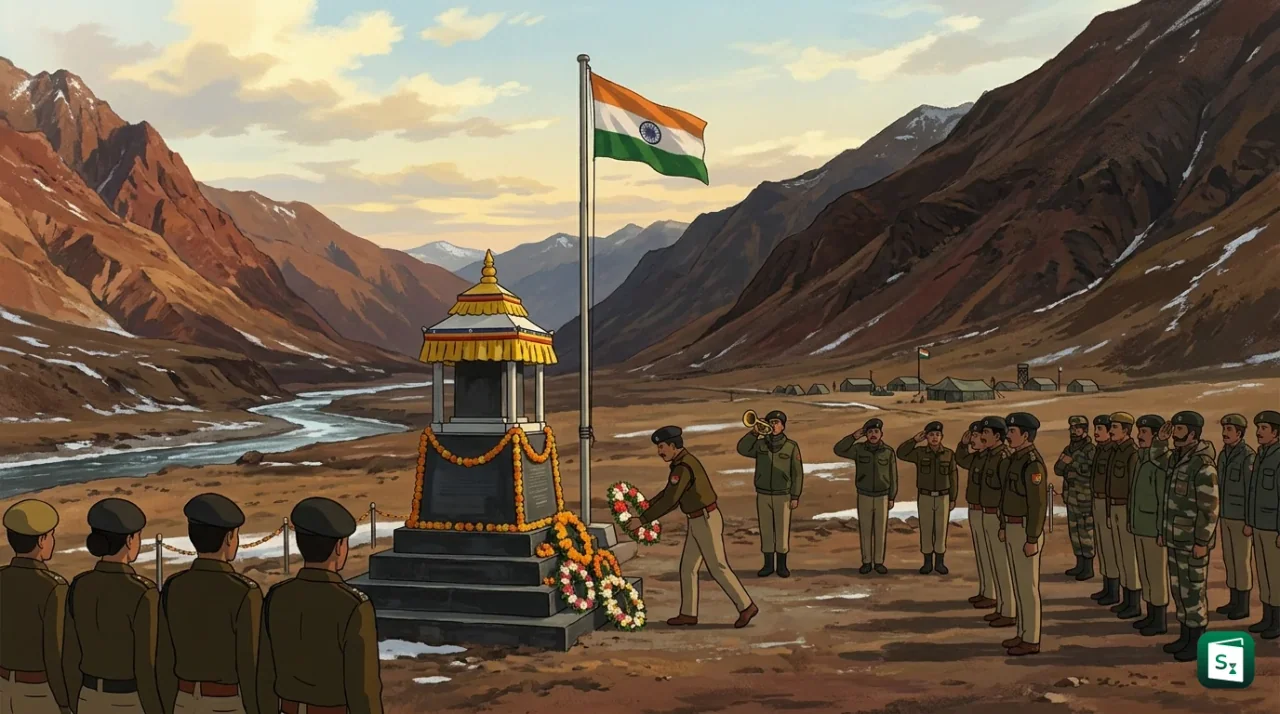
India observes Police Commemoration Day every year on October 21 to honour police personnel who died in the line of duty. The date marks the killing of 10 Indian policemen by Chinese troops at Hot Springs in Ladakh on 21 October 1959. The main national ceremony is held at the National Police Memorial in New Delhi, while state police forces hold parades and wreath laying across the country.
What Is Police Commemoration Day?
Police Commemoration Day is a national observance held in India every year on 21 October to remember police personnel who died in the line of duty. It is also called Police Martyrs Day and honours the 10 policemen killed at Hot Springs in 1959.
The Police Commemoration Day ceremonies are held by all state police forces, Central Armed Police Forces (CAPFs) and Central Police Organisations. The names of personnel who died between 1 September of the previous year and 31 August of the current year are read out as the Roll of Honour. In 2026, the Roll of Honour listed 154 personnel, including three from the Delhi Police, who died between 1 September 2025 and 31 August 2026.
What Happened at Hot Springs on October 21, 1959?
The Hot Springs incident was an armed clash between an Indian police patrol and Chinese troops at Hot Springs in North Eastern Ladakh on 21 October 1959. Hot Springs lies at a height of about 15,000 to 16,000 feet near the Indo Tibet border in the Aksai Chin area. Until the autumn of 1959, Indian police personnel guarded the 2,500 mile long border between India and Tibet.
On 20 October 1959, three reconnaissance parties set out from Hot Springs to prepare for the further movement of an Indian expedition towards Lanak La. The parties belonged to the Central Reserve Police Force (CRPF) and the Intelligence Bureau. Two parties returned by the afternoon, but the third party of two police constables and a porter did not return.
On the morning of 21 October, a search party of about 20 personnel led by Deputy Central Intelligence Officer Karam Singh went out to find the missing men. Around midday, the search party spotted Chinese soldiers on a hillock. The Chinese troops opened fire and threw grenades. The Indian party had almost no cover on the open hillside.
Ten Indian policemen were killed and seven others were injured and taken prisoner by the Chinese side. The remaining personnel managed to escape. The bodies of the 10 dead were handed back only on 13 November 1959, about three weeks after the clash, and were cremated with full police honours at Hot Springs. A memorial was later raised at Hot Springs, and police teams from across India still trek there every year to pay homage.
Why Police Commemoration Day Is Celebrated on October 21
Police Commemoration Day is celebrated on 21 October because that is the date of the Hot Springs sacrifice in 1959. The Annual Conference of Inspectors General of Police in January 1960 decided that 21 October would be observed every year as Commemoration Day in all police lines.
The decision stated that the day would mark the memory of the 10 men killed in Ladakh and of all other police personnel killed on duty during the year. The observance was therefore widened from a single incident to an annual tribute to every policeman and policewoman who dies while maintaining law and order, fighting crime and terrorism, guarding borders, and helping during disasters. Since 2012, the day has been marked as a nationwide event with the main parade and wreath laying at the memorial in Chanakyapuri in New Delhi.
How Police Commemoration Day Is Observed
Police forces across India mark 21 October with parades, wreath laying and roll calls at police memorials, headquarters, training academies and district lines. The rituals are similar everywhere. Arms are reversed in mourning, two minutes of silence are observed, the names of the personnel who died in the previous year are read out, and three volleys are fired as a mark of respect.
National Ceremony at the National Police Memorial
The main national ceremony takes place at the National Police Memorial (NPM) at Chanakyapuri in New Delhi. The programme includes a joint parade by the Central Armed Police Forces and the Delhi Police. The Union Home Minister, senior police chiefs and heads of Central Police Organisations lay wreaths at the memorial. In 2026, Union Home Minister Amit Shah led the tribute and recalled the 1959 Hot Springs resistance.
States hold parallel events. In 2026, the Delhi Police held its parade at the Parade Ground in New Police Lines at Kingsway Camp, Nagaland Police held its parade at the Police Headquarters in Kohima, and Goa Police held its parade at the Police Headquarters Ground in Panaji. Special events are also organised around the day, such as the Run for Martyrs from Nehru Park to the National Police Memorial in Delhi and an anti drug motorcycle rally flagged off from Delhi with about 90 riders heading towards Gujarat.
What Is the National Police Memorial and Museum?
The National Police Memorial in New Delhi is the central site of remembrance for police personnel who have died since Independence in 1947. The memorial stands on a 6.12 acre plot at Chanakyapuri on Shantipath in New Delhi. Prime Minister Narendra Modi dedicated the rebuilt memorial to the nation on 21 October 2018, which was Police Commemoration Day that year.
The idea of a national memorial was first proposed in 1984. The foundation stone was laid by then Home Minister L. K. Advani on 13 December 2002 when Atal Bihari Vajpayee was Prime Minister. An earlier 150 foot steel structure was taken down in 2008 after the Delhi High Court found that it affected the symmetry of the Lutyens Zone and the view of the Rashtrapati Bhavan dome. Funds of ₹50 crore were provided in the Budget of 2014-15, and the National Buildings Construction Corporation (NBCC) completed the new complex in October 2018.
| Feature | Detail |
|---|---|
| Central sculpture | A 30 foot tall, 238 tonne pillar of black granite from Khammam in Telangana, which stands for the strength and solemnity of supreme sacrifice |
| Wall of Valour | Granite walls carrying the names of police personnel who died on duty since 1947, numbering 34,844 at the time of dedication and now more than 36,000 |
| Museum | An underground museum, the first police museum of its kind in India, spread over about 1,600 square metres with five galleries |
The museum traces more than 2,000 years of policing starting from the system of law and order described by Kautilya in about 310 BCE. It explains police ranks from constable to Director General of Police, the roles of state police forces and Central Armed Police Forces such as the Border Security Force and the CRPF, and the work of agencies such as the Intelligence Bureau, the Central Bureau of Investigation, the National Investigation Agency, the National Security Guard and the Special Protection Group. The martyrdom gallery presents operations including Hot Springs in Ladakh in 1959, the Akshardham response in 2002, the killing of forest brigand Veerappan in 2004, the Maoist attack in Dantewada in 2010, the Uttarakhand flood rescue in 2013, the 26/11 Mumbai response, and the story of Vandana Malik, the first woman Indian Police Service officer killed on duty in 1989.
Key Takeaways
- Police Commemoration Day is observed every year on 21 October and is also called Police Martyrs Day.
- The day commemorates 10 policemen killed by Chinese troops at Hot Springs in Ladakh on 21 October 1959.
- The search party at Hot Springs was led by Karam Singh, and the dead were cremated with full police honours on 13 November 1959.
- The date was fixed by the Annual Conference of Inspectors General of Police in January 1960 and has been observed since 1960.
- The National Police Memorial at Chanakyapuri in New Delhi was dedicated to the nation on 21 October 2018 and holds a 30 foot, 238 tonne central sculpture and the Wall of Valour.