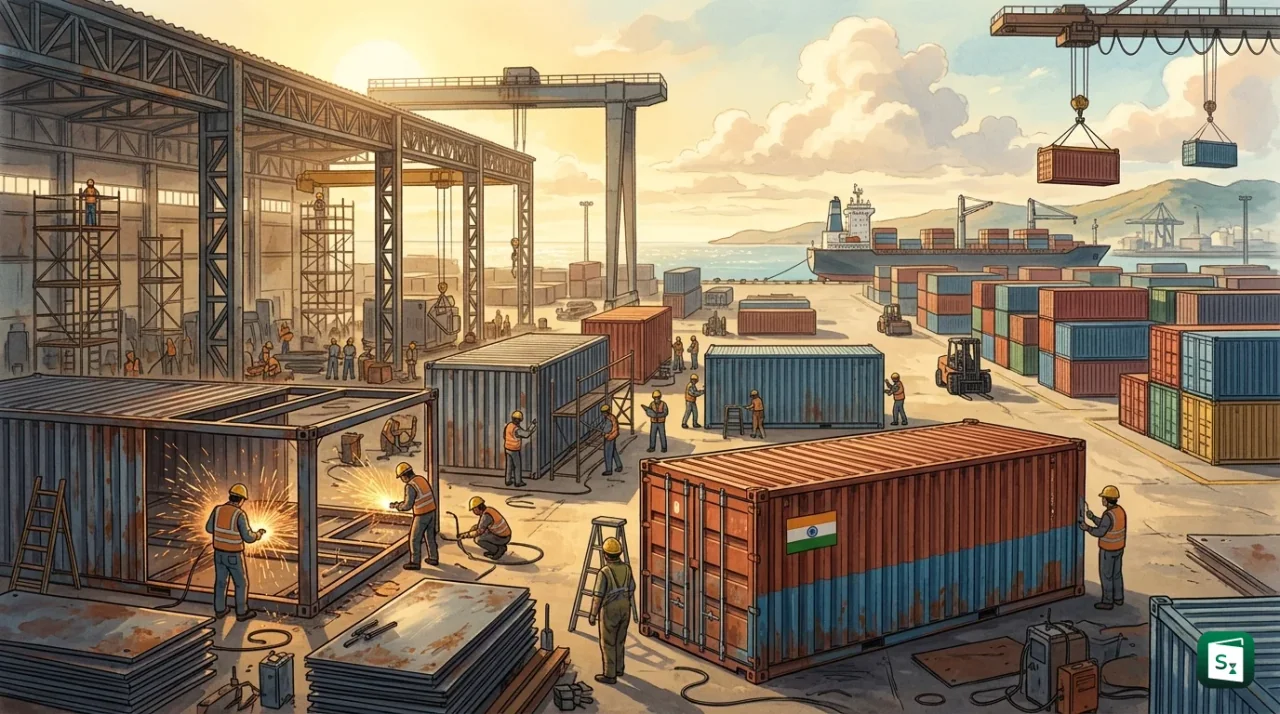
On 28 October 2026, the Union Cabinet chaired by Prime Minister Narendra Modi approved the Container Manufacturing Promotion Scheme (CMPS) with a ₹10,000 crore outlay up to FY40. The scheme aims to raise India’s annual container manufacturing capacity nearly tenfold to 7.5 lakh Twenty-Foot Equivalent Units (TEUs) and cut dependence on imports. It combines cheaper loans, per-box support and shared testing labs to make Indian boxes price competitive with China.
What Is the Container Manufacturing Promotion Scheme?
The Container Manufacturing Promotion Scheme (CMPS) is a central sector initiative of the Ministry of Ports, Shipping and Waterways to create a full container making ecosystem inside India. The scheme supports both new greenfield factories and expansion of existing brownfield units. It also supports testing labs, skills and capacity building across the value chain.
The Finance Minister announced the scheme in the Union Budget 2026-27 with a provision of ₹10,000 crore. The Union Cabinet gave final approval on 28 October 2026 for implementation from FY27 to FY40. The long window gives industry time to buy land, install machinery, train workers and reach scale.
The stated goals are clear. India wants a globally competitive production base, lower import dependence and stronger supply chain resilience. The scheme also aims to turn India into an export hub for quality shipping containers that meet global shipping standards.
Three Pillars of Support Under CMPS
The Ministry of Ports, Shipping and Waterways will run CMPS through three linked forms of help. The first lowers the cost of setting up a plant. The second lowers the cost of each box sold. The third creates shared facilities to prove that Indian boxes meet world standards.
| Component | Outlay | What It Supports |
|---|---|---|
| Interest Subvention Assistance (ISA) | ₹859 crore | 3% per year relief on eligible term loans for greenfield plants and brownfield expansion |
| Operational Expenditure Assistance (OEA) | ₹8,891 crore | Cash support for every container made to global standards and sold by eligible makers |
| Testing and Certification Assistance | ₹150 crore | Common facilities such as dynamic longitudinal impact testing and certification labs |
The OEA share is the largest because it directly bridges the price gap with imported boxes. Indian makers face higher steel and input costs and smaller plant sizes. Regular support per box helps them quote lower prices while they scale up. Reports before Cabinet approval also indicated a minimum group capacity of 1 lakh TEUs for eligibility and an operating grant of around ₹49,500 per container, which keeps support focused on serious, large plants.
What Is Interest Subvention?
Interest subvention means the government pays a part of the interest on a loan so the borrower pays less. Under CMPS, the government will give 3% annual relief on eligible capital loans taken to build or expand container factories. The maker repays the bank at a lower effective rate, which cuts project cost and monthly burden.
This tool is widely used in India for exporters and small enterprises to improve access to credit. For containers, it matters because a new plant needs heavy machines, cranes, welding lines and large yards. Lower interest makes such long term investment viable.
What Is TEU in Shipping?
TEU stands for Twenty-Foot Equivalent Unit. It is the standard measure of container capacity based on a box that is 20 feet long, 8 feet wide and 8 feet 6 inches high. One 20-foot box equals 1 TEU, while one 40-foot box equals 2 TEUs under the related unit called FEU or Forty-Foot Equivalent Unit.
Ports, ships and factories all report output in TEUs so capacity can be compared. When CMPS targets 7.5 lakh TEUs, it means output equal to 7.5 lakh standard 20-foot boxes in a year. A 40-foot box counts as two units toward that total.
Why India Needs Domestic Containers Now
The world makes almost all its boxes in one country. China holds around 95% to 97% of global container production. Industry estimates place China’s output at about 60 lakh units a year, while India makes only about 30,000 units a year. This gap leaves Indian exporters exposed whenever global shipping is disrupted.
The shortage became visible during the pandemic, when exporters and importers struggled to find empty boxes. It returned to focus in 2026 when conflicts around key sea routes forced ships to take longer voyages and freight rates turned volatile. India imports nearly 20 lakh empty containers a year to meet domestic demand and repositioning needs.
Price is the second pressure. Boxes made in India cost 30% to 40% more than boxes made in China due to higher material costs and small production runs. A standard box made in China costs less than $2,000, with Indian makers reporting a gap of $700 to $800 per box. Indian buyers often check the shipping container price in India for 20-foot and 40-foot units before sourcing, and that comparison usually favours imports without support.
Domestic making also decides logistics strength. Containers are the physical backbone of trade. Without local supply, port handling, freight planning and export schedules depend on foreign factories and lease terms. The government wants local supply to protect trade during shocks and to keep value addition inside the country.
From Budget Announcement to Cabinet Approval
The container plan moved from promise to project in less than nine months. The sequence shows how the Ministry of Ports, Shipping and Waterways tested industry response before seeking Cabinet clearance.
| Date | Milestone |
|---|---|
| 1 February 2026 | Finance Minister Nirmala Sitharaman announced a ₹10,000 crore scheme for container manufacturing in the Union Budget 2026-27, along with new waterways and coastal shipping steps |
| 3 July 2026 | Union Minister Sarbananda Sonowal unveiled India’s first domestically made EXIM shipping container for A.P. Moller-Maersk at the Maersk and Container Corporation of India (CONCOR) Inland Container Depot in Dadri, Uttar Pradesh |
| July 2026 | Maersk placed an order for 1,000 additional India-made containers with the DCM Shriram Group, signalling buyer confidence |
| 11 August 2026 | The government released a detailed backgrounder on the proposal, then called the Container Manufacturing Assistance Scheme (CMAS), with a target of 7.5 lakh TEUs and large investment and market potential |
| 28 October 2026 | The Union Cabinet approved the scheme as the Container Manufacturing Promotion Scheme (CMPS) with the same ₹10,000 crore envelope up to FY40 |
The Dadri event was the turning point. The first box was built after a 16-month effort that began when Maersk leaders met the Prime Minister in February 2025. Global lines such as MSC and Maersk, along with Indian groups such as Adani and JM Baxi, have shown interest in making or buying Indian boxes. The Cabinet approval now gives that interest a clear policy and funding base.
Significance for Trade, Jobs and Self-Reliance
The immediate gain is capacity. CMPS aims to lift annual domestic output by around ten times to 7.5 lakh TEUs. That scale allows Indian ports and shipping lines to source boxes at home instead of waiting for imported empties. It also helps India handle sudden demand during festival exports, harvest movement and global rerouting.
The second gain is cost strength. Operational help per box and 3% loan relief reduce the landed price of Indian containers. As plants grow to 1 lakh TEU scale, steel buying, paint shops, flooring and fitting lines become cheaper per unit. Shared testing centres for impact strength and certification remove the need for each small maker to build its own costly lab. Boxes that pass global shipping standards can then compete in India and abroad.
Jobs and ancillary growth form the third gain. The government estimates 3,000 direct jobs and more than 50,000 indirect jobs across steel, timber frames, paints, corner castings, door hardware, tracking devices and repair services. Clusters in states such as Gujarat, Tamil Nadu and Maharashtra can feed ports with local supply. Over time, container parks, leasing firms and repair yards grow around factories.
The larger frame is maritime self-reliance. The Ministry of Ports, Shipping and Waterways pursues the Maritime Amrit Kaal Vision 2047 to make India a leading maritime nation by 2047, with bigger ports, a larger national fleet and stronger shipbuilding. CMPS fits that plan along with the Sagarmala programme for port-led development and shipbuilding support. Together, Indian ships, Indian boxes and modern terminals can cut freight risk and keep trade moving during global shocks.
Key Takeaways
- The Container Manufacturing Promotion Scheme (CMPS) was approved by the Union Cabinet on 28 October 2026 with an outlay of ₹10,000 crore up to FY40.
- Interest Subvention Assistance (ISA) of ₹859 crore provides 3% annual relief on eligible capital loans for greenfield and brownfield container plants.
- Operational Expenditure Assistance (OEA) of ₹8,891 crore supports containers made to global standards, while ₹150 crore funds common testing and certification facilities.
- CMPS targets annual domestic capacity of 7.5 lakh TEUs, nearly ten times current output, with an estimated 3,000 direct and 50,000 indirect jobs.
- TEU means Twenty-Foot Equivalent Unit, where one 20-foot box equals 1 TEU and one 40-foot box equals 2 TEUs.
- India’s first domestic EXIM container for A.P. Moller-Maersk was unveiled at Dadri, Uttar Pradesh on 3 July 2026, followed by an order for 1,000 more boxes.