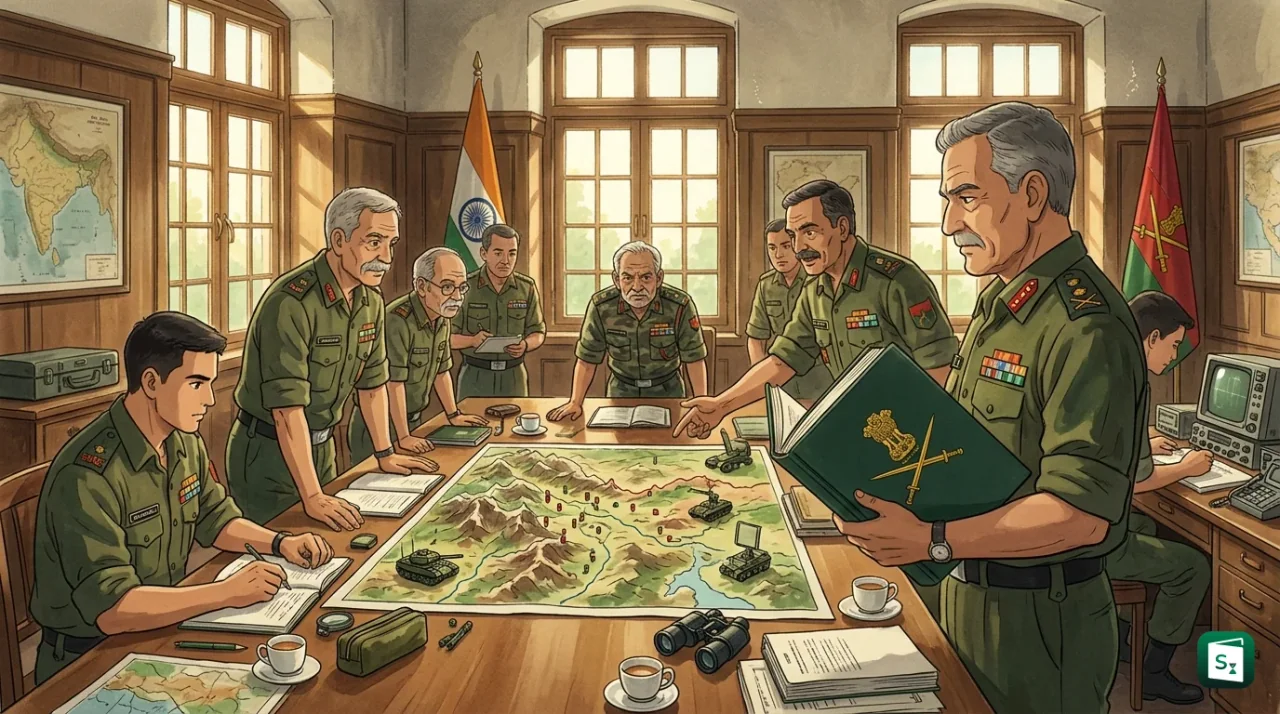
Defence Minister Rajnath Singh released the Indian Army Land Warfare Doctrine 2026 on 23 October 2026 on the final day of the Army Commanders Conference in New Delhi. The revised doctrine replaces the December 2018 version and gives the 1.2 million strong force an overarching framework for future wars shaped by drones, artificial intelligence (AI) and precision strikes. It draws direct lessons from Operation Sindoor and recent conflicts like the Russia-Ukraine war to make the Army technology enabled, joint and ready for multi-domain operations.
What Is Land Warfare?
Land warfare means combat and security operations conducted on land to capture, hold or defend territory and achieve political goals. The Indian Army leads land warfare for India, supported by the Air Force and Navy. Infantry, tanks, artillery, helicopters, drones and satellites work together in such operations.
Defence Minister Rajnath Singh underlined this point at the release event. Despite the growing importance of air, maritime, space and cyber challenges, land warfare and ground forces remain indispensable. Wars are finally decided on the ground, where soldiers take and hold territory and assure citizens of control.
Modern land warfare looks very different from the past. The Indian Army notes that unmanned systems, persistent surveillance, contested communications and information warfare have become critical factors on the battlefield. Small, low cost drones now track every movement. Loitering munitions wait in the sky and strike at the right moment. Precision strikes hit targets from long distances. At the same time, both sides try to jam radios, blind satellites and spread false information to confuse the enemy.
What Is Army Doctrine?
An army doctrine is the fundamental set of principles that guides how an army prepares for, plans and conducts operations. The Indian Army doctrine covers force development, training, leadership, logistics and use of technology. It does not give daily orders but tells commanders how to think and decide.
The Indian Army sits within a clear doctrine hierarchy. At the top is the Joint Doctrine of the Indian Armed Forces, released in April 2017 by the Headquarters Integrated Defence Staff. This joint doctrine sets common principles for the Army, Navy and Air Force to fight together. Below it, each service writes its own doctrine. The Land Warfare Doctrine is the Indian Army version. Earlier Army doctrines were published in 1998, 2004 and December 2018. The 2026 release is the first revision in nearly eight years.
The 2018 Land Warfare Doctrine had covered the geostrategic environment, hybrid warfare, multi-front operations, surveillance, precision strikes, information warfare, space warfare and special forces. It also gave the basis for planning for the northern front with China and the western front with Pakistan. The new doctrine builds on this base but updates it for drones, AI and multi-domain operations.
Release at the Army Commanders Conference in New Delhi
The Indian Army released the Land Warfare Doctrine 2026 during the Army Commanders Conference held in New Delhi from 21 to 23 October 2026. The Army Commanders Conference is the apex level biannual forum of the Indian Army. It brings together senior commanders to review operational readiness, capability development and transformation plans.
General Dhiraj Seth chaired the October 2026 conference as the 31st Chief of the Army Staff. General Seth took charge on 30 June 2026 after General Upendra Dwivedi retired. An alumnus of the National Defence Academy, Khadakwasla, General Seth was commissioned into the Armoured Corps in December 1986 and later commanded the Sudarshan Chakra Corps. The Chief of Defence Staff General N S Raja Subramani, Minister of State for Defence Sanjay Seth and Defence Secretary Rajesh Kumar Singh were present at the release.
Defence Minister Rajnath Singh addressed the commanders on the final day. He asked the senior leadership to closely watch geopolitical and regional developments and operate with a long term strategic vision for the next 20 to 30 years. He also asked them to stay equally prepared for immediate threats. Strategies must remain dynamic and flexible to adjust quickly to changing conditions, he said.
The Defence Minister praised Operation Sindoor for innovative thinking, close synergy and superior coordination backed by advanced weapons. Operation Sindoor was launched in May 2025 after the 22 April 2025 terror attack in Pahalgam and showed the value of indigenous unmanned aerial vehicles and counter drone systems. He also highlighted defence production of ₹1.78 lakh crore in 2025-26 and defence exports of about ₹38,000 crore, both record highs, as proof of progress under Atmanirbharta, which means self reliance in defence. On the occasion, the Defence Minister also unveiled the annual United Nations Journal and felicitated Army personnel who served as UN peacekeepers.
What Is New in the Land Warfare Doctrine 2026?
The Land Warfare Doctrine 2026 gives a roadmap to turn the Indian Army into a future ready, technology enabled and adaptable force. The Indian Army describes the doctrine as aligned with Defence Forces Vision 2047. The goal is to fight and win across the full spectrum of conflict, from counter insurgency and limited actions to full scale conventional war. The focus is on jointness among the three services, integration of capabilities across domains and the continued centrality of land power in achieving decisive military and political results.
The doctrine draws lessons from contemporary conflicts where unmanned systems, persistent surveillance, contested communications and information warfare shaped outcomes. These include the Russia-Ukraine war, conflicts in West Asia and Operation Sindoor against Pakistan. The message is clear. Future wars will be more distributed, faster and technology intensive. Success will depend on networked forces that can see first, decide fast and strike with precision even when the enemy tries to jam or disrupt links.
Technology Integration at Every Level
The Indian Army has placed advanced technology at the centre of the 2026 doctrine. Priority areas named by the Defence Minister include artificial intelligence (AI), autonomous systems, data analytics, cyber security and secure communication networks. AI is software that can analyse large data, spot patterns and help in faster decisions. Autonomous systems are machines like drones that can carry out tasks with limited human control.
The doctrine pushes man-unmanned teaming. This means soldiers and machines work as one team. Drones carry out surveillance and strikes while soldiers take decisions and hold ground. The Indian Army will make drone operations a secondary skill across the 1.2 million strong force. Officers will get specialised training in using AI as a decision aid. A three-level AI skill development programme and a five-year roadmap for multi-domain operations training will support this shift. The plan also stresses resilient logistics, which means steady supply of arms, ammunition, vehicles, food and water even under attack, and the ability to keep fighting in technologically contested environments where signals are jammed.
Jointness and Atmanirbharta
The Indian Army has linked future success to jointness and self reliance. Jointness means the Army, Navy and Air Force plan and fight together with shared networks and common procedures. Multi-domain capabilities mean using land, air, sea, space, cyber and information tools in one integrated operation. The doctrine gives field commanders flexibility to change their approach based on threat, terrain and mission needs.
A second pillar is Atmanirbharta and a whole-of-nation approach. The doctrine recognises that future wars will need indigenous weapons, national infrastructure and support from institutions beyond the military. This includes defence industry, startups, research labs, transport and communication networks. The Defence Ministry has declared 2025 as the Year of Reforms to speed up such changes. Field trials, modular designs and faster induction of unmanned aerial systems and counter unmanned aerial systems form part of this effort.
| Area of Change | What the 2026 Doctrine Pushes |
|---|---|
| Surveillance and strike | Persistent drone watch, loitering munitions, precision targeting |
| Decision making | AI tools, data analytics, three-level AI training for officers |
| Skills across ranks | Drone operation as secondary skill for all arms, five-year multi-domain training roadmap |
| Joint operations | Army, Navy and Air Force coordination, seamless action across land, air, sea, space and cyber |
| Self reliance | Indigenous drones, counter drone systems, industry and startup linkages under Atmanirbharta |
How Does the 2026 Doctrine Differ From the 2018 Version?
The December 2018 Land Warfare Doctrine had set the base for modernisation after the April 2017 joint doctrine. It explained hybrid warfare, which mixes conventional attacks with cyber strikes, propaganda and proxy fighters. It also covered multi-front planning for the northern and western borders, surveillance, precision strikes, information warfare, space use and special forces. At that time, drones and AI were seen as specialist tools.
The situation has changed sharply since 2018. The Indian Army faced a prolonged standoff with China along the Line of Actual Control (LAC) in Ladakh after 2020. The Russia-Ukraine war showed how cheap drones, missiles and electronic warfare can shape battles. Operation Sindoor in May 2025 confirmed the same lesson for India, with unmanned aerial vehicles and counter drone systems playing a central role.
| Feature | Land Warfare Doctrine 2018 | Land Warfare Doctrine 2026 |
|---|---|---|
| Core context | Post 2017 joint doctrine, hybrid and multi-front focus | Post Sindoor and Ukraine lessons, technology intensive war focus |
| Drones and AI | Specialist capabilities | Core skill at every level, AI aided decisions and man-unmanned teams |
| Domains | Land focus with air and information support | Full multi-domain approach across land, air, sea, space, cyber and information |
| Industry link | Limited mention of modernisation | Strong Atmanirbharta push, whole-of-nation use of infrastructure and industry |
| Command approach | Structured operational guidance | More flexibility to commanders for threat, terrain and mission based action |
What Is the Cold Start Doctrine Link?
Cold Start is a limited war concept for quick, shallow offensives by integrated battle groups within 72 to 96 hours of authorisation without waiting for mobilisation. The Indian Army developed the concept after mobilisation during Operation Parakram in 2001-02 to punish border attacks while staying below the nuclear threshold.
The Indian Army unveiled the Cold Start thinking to commanders in April 2004. The plan called for eight to ten Integrated Battle Groups (IBGs), which are compact combined arms formations with infantry, armour, artillery and air support, to launch multiple thrusts and seize limited territory as a bargaining tool. Former Army Chief General Bipin Rawat publicly acknowledged the concept in January 2017. The 2026 Land Warfare Doctrine does not repeat Cold Start as a separate plan but absorbs its logic. Fast mobilisation, integrated battle groups, network centric action and joint firepower are now part of the wider framework for future conflict with Pakistan and China.
Research support for such doctrines comes partly from the Centre for Land Warfare Studies (CLAWS). CLAWS is an autonomous think tank on strategic studies and land warfare based in New Delhi. CLAWS was established in 2004 and is registered under the Societies Registration Act, 1860. CLAWS works under the aegis of the Indian Army and studies conventional operations, sub conventional conflict and regional military developments.
The Way Forward Under Defence Forces Vision 2047
The Indian Army has presented the 2026 doctrine as a living guide rather than a fixed rulebook. The immediate task is training. The five-year multi-domain training roadmap and the three-level AI programme will decide how fast units absorb new tools. Drone practice as a secondary skill will test whether every infantry, artillery and armoured unit can operate its own eyes in the sky and defend against enemy drones.
The second task is implementation of reforms. The Defence Minister has said reform is a continuous process and must show results in operational capability. Commanders will have to carry the changes into their commands, improve manpower management and expand participation of women in the force. Stronger cyber security, secure communication networks and resilient supply chains will need steady funding and close work with industry.
The long term direction is set by Defence Forces Vision 2047, which aims for a progressive, adaptive and self reliant force by the centenary of independence. If the doctrine succeeds, the Indian Army will fight as part of a joint network where soldiers remain central but machines extend their reach. Ground forces will still take and hold land, while space, cyber and information tools shape the battle before the first shot.
Key Takeaways
- Defence Minister Rajnath Singh released the Land Warfare Doctrine 2026 on 23 October 2026 at the Army Commanders Conference in New Delhi.
- The 2026 doctrine replaces the December 2018 Land Warfare Doctrine and is the first revision in nearly eight years.
- The doctrine is aligned with Defence Forces Vision 2047 and stresses jointness, multi-domain operations and centrality of land power.
- The Indian Army will run a three-level AI programme for officers and make drone operations a secondary skill across the force with a five-year training roadmap.
- The 31st Army Chief General Dhiraj Seth, who took charge on 30 June 2026, chaired the 21 to 23 October 2026 conference.
- The Centre for Land Warfare Studies (CLAWS), established in 2004 in New Delhi, is the Army linked think tank for land warfare studies.