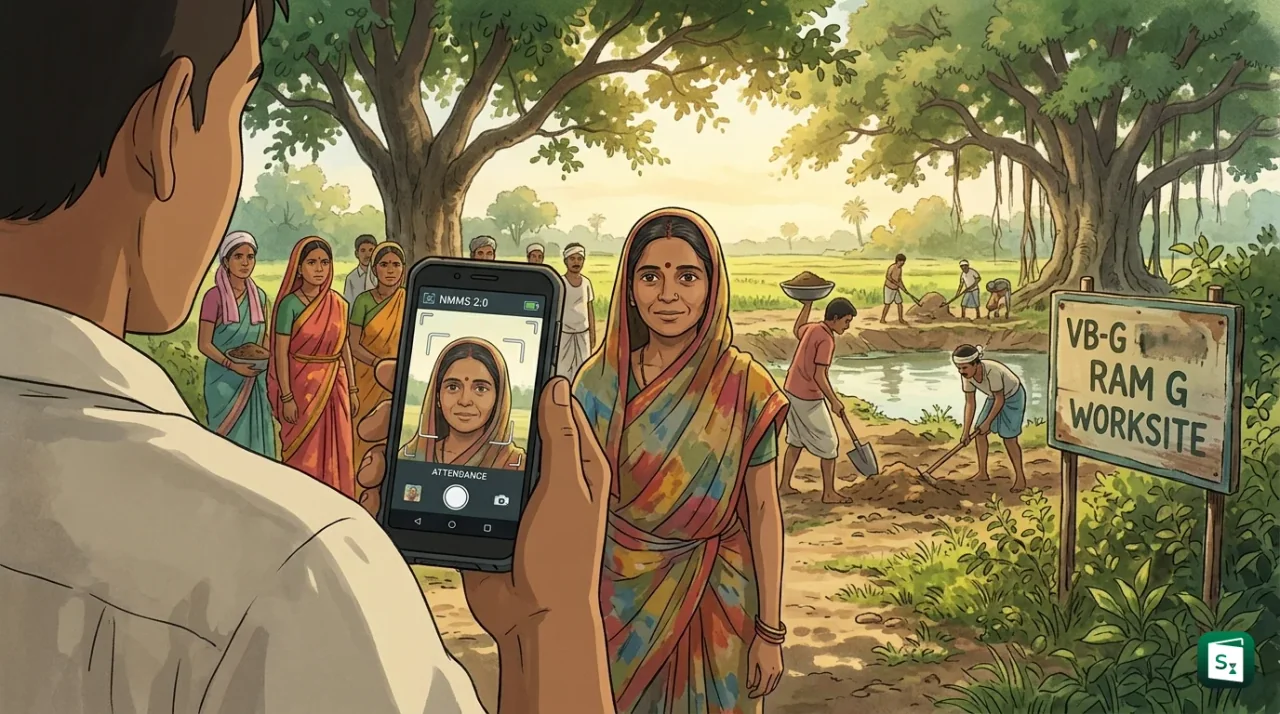
Union Rural Development Minister Shivraj Singh Chouhan launched the upgraded NMMS 2.0 app on 23 October 2026 in New Delhi to record daily attendance of workers under the Viksit Bharat Guarantee for Rozgar and Ajeevika Mission Gramin (VB-G RAM G). The Ministry of Rural Development developed the new National Mobile Monitoring System version with technical support from IIT Madras to stop fake attendance and protect wages. It adds AI based face verification, offline recording and stronger phone security checks while ensuring genuine workers are not denied pay due to network failure.
What Is the National Mobile Monitoring System?
The National Mobile Monitoring System (NMMS) is a mobile application of the Ministry of Rural Development that records daily attendance of rural wage workers using geo tagged and time stamped photographs. Field supervisors capture two photos daily at the worksite and upload them to the Management Information System for transparency.
The National Mobile Monitoring System is an initiative of the Ministry of Rural Development, the central ministry responsible for rural jobs, housing and roads. The Ministry, formed on 20 January 1980 and headquartered at Krishi Bhavan in New Delhi, launched the NMMS app on 21 May 2021 for the Mahatma Gandhi National Rural Employment Guarantee Scheme. The goal was simple. Attendance should be marked at the worksite itself, with proof of location and time, so that ghost entries in paper muster rolls could be reduced.
The system became compulsory in stages. From 16 May 2022, the Ministry required NMMS attendance at worksites with muster rolls for 20 or more workers. From 1 January 2023, the Ministry extended the rule to all works except individual beneficiary works. A mate or gram rozgar sahayak captures attendance through the app. The phone must be within about 10 metres of the worksite coordinates recorded under GeoMGNREGA, the geo tagging system for rural assets. The two daily photographs and attendance data appear in the public domain, which allows citizens, panchayats and officials to check records.
The Ministry has kept an offline option from the start to deal with weak mobile signals. The morning attendance with the first photo and the second photo, taken four hours later, can be saved offline and uploaded once the device returns to network coverage. For rare cases where upload is still not possible, an exception provision exists with approval at the district and now block level. The app is available in English, Hindi, Tamil, Telugu and Malayalam to help field staff across states.
What Is New in the Upgraded NMMS 2.0 App?
The upgraded NMMS 2.0 app, launched on 23 October 2026 by Union Minister Shivraj Singh Chouhan, adds device level security, AI face verification with liveness detection and offline attendance capture. The Ministry of Rural Development built it with IIT Madras support to block cloning and fake attendance.
Face authentication was first added to NMMS in March 2026 after complaints that wages were claimed in the names of other people. A security update followed in the last week of September 2026. The October upgrade builds on both steps. It checks the phone itself before allowing login. It verifies that the face in front of the camera is a live person and not a printed photo or recorded video. It also applies Google Play Integrity checks that detect rooted devices, duplicate app installs and altered software. These layers aim to stop the same photo being reused across musters and the same worker being shown at two sites.
The new version also improves access in low network areas, a long standing demand from states. Attendance can now be recorded fully offline at the worksite and uploaded after the muster roll is closed once connectivity returns. An exception mechanism covers elderly workers, persons with disabilities and workers who face genuine difficulty with mobile based verification. In such cases, the prescribed manual process can be used so that entitled wages are not blocked.
| Feature in NMMS 2.0 | What It Does | Why It Matters |
|---|---|---|
| AI based face verification | Matches the worker face with the database record | Stops proxy attendance in another worker name |
| Liveness detection | Confirms a live person is present during capture | Blocks use of printed photos or screen images |
| Device security and Play Integrity checks | Flags rooted, cloned or tampered devices | Prevents app manipulation and fake location data |
| AI photo de duplication | Flags repeated or suspicious photos before payment | Holds wage lists and Fund Transfer Orders till records are cleared |
| Offline capture and delayed upload | Saves attendance without network, uploads later | Protects workers in remote and hilly worksites |
VB-G RAM G: The Rural Employment Scheme Behind the App
The Viksit Bharat Guarantee for Rozgar and Ajeevika Mission Gramin (VB-G RAM G) is the rural wage employment scheme for which NMMS 2.0 records attendance. The VB-G RAM G Act, 2025 received Presidential assent on 20 December 2025 and came into force across rural India on 1 July 2026. It replaces the Mahatma Gandhi National Rural Employment Guarantee Act, 2005. The Ministry of Rural Development is the nodal ministry for its implementation.
The core change is the size of the legal guarantee. While MGNREGA promised 100 days of unskilled manual work per rural household in a year, VB-G RAM G promises 125 days. The Act also strengthens worker rights. It provides unemployment allowance if work is not given on time and compensation for delay in wage payment. Wages are paid weekly or within a fortnight and are transferred directly to bank accounts through the DBT SPARSH platform. Direct Benefit Transfer, started on 1 January 2013, sends government payments straight to verified bank accounts to reduce leakage and duplication.
Funding follows a Centrally Sponsored Scheme pattern. The Centre and states share costs in a 60:40 ratio for most states and 90:10 for North Eastern states, Himalayan states and the Union Territory of Jammu and Kashmir. For 2026-27, the Centre has provided ₹95,692.31 crore, the largest budget stage allocation for rural employment. With state shares, the total outlay is expected to cross ₹1.51 lakh crore. Ongoing MGNREGA works have been carried forward. Existing e-KYC verified job cards remain valid till new Gramin Rozgar Guarantee Cards are issued.
Planning under the Act is more technology driven. Works must flow from Viksit Gram Panchayat Plans linked to the PM Gati Shakti National Master Plan and grouped into a Viksit Bharat National Rural Infrastructure Stack. The stack focuses on water security, core rural infrastructure, livelihood related infrastructure and protection from extreme weather. States must also notify an aggregate 60 days in a year as peak sowing and harvesting periods when scheme works pause, so that farm labour remains available to cultivators.
| Feature | MGNREGA (2005 to 30 June 2026) | VB-G RAM G (from 1 July 2026) |
|---|---|---|
| Legal guarantee | 100 days per rural household per year | 125 days per rural household per year |
| Nodal law | MGNREGA Act, 2005 | VB-G RAM G Act, 2025 (No. 36 of 2025) |
| Fund sharing | Largely Centre funded wage cost | 60:40 for most states, 90:10 for North Eastern and Himalayan regions |
| Attendance tool | NMMS app from 2021, mandatory from 2023 | Upgraded NMMS 2.0 app with AI verification |
| Payment system | Direct Benefit Transfer to bank accounts | DBT SPARSH platform with electronic muster and measurement books |
How Daily Attendance Is Recorded and Verified
The Ministry of Rural Development treats NMMS attendance as the first check in the payment chain, not the final proof for wages. A mate or supervisor downloads the issued muster roll in the NMMS app and marks attendance at the worksite itself. The morning attendance is taken with the first geo tagged photo. The second photo is taken four hours later. In earlier instructions, the two timings were described as one photo on or before 11 am and the second after 2 pm. Both records carry latitude, longitude, date and time. Citizens can view the uploaded attendance and photos through the Management Information System and the NMMS daily attendance report section.
The app download and login system is role based. The NMMS 2.0 app, published by the Department of Rural Development, is available free on Google Play for Android devices. Field functionaries log in with credentials linked to the panchayat, block or programme officer level. An OTP validation secures first time ID creation. Inside the app, staff can view downloaded muster rolls, check attendance uploaded in the panchayat during the past month and create a PDF of captured data when technical faults prevent direct upload to the block office.
Verification now has three layers. The first layer is at capture, through face match and liveness checks. The second layer is automated photo screening. An AI based de duplication system scans for the same image reused across days or sites and marks suspicious entries. The third layer is physical and financial. Technical engineers measure the work done and record it in electronic measurement books. Only cleared entries move to wage lists and Fund Transfer Orders. If a photo is flagged, the related wage list is held back till the record is corrected and verified. This design separates presence from output. A worker may be present but wages depend on measured work.
Accountability does not end with the app. The VB-G RAM G framework provides social audits, inspections and a time bound grievance system at block and district levels. Workers can also raise complaints through the CPGRAM portal, the ombudsperson and the complaint register at the gram panchayat level. National Informatics Centre supported tools such as GeoMGNREGA for asset geo tagging and Yuktadhara, the geospatial planning portal built by the National Remote Sensing Centre of ISRO and launched on 23 August 2021, further link attendance data with asset creation on the ground.
| Stage | Action by Field Staff | System Check |
|---|---|---|
| Start of day | Download e-muster roll, mark morning attendance with first geo tagged photo | Location must match worksite coordinates, face match completed |
| After four hours | Capture second geo tagged photo with updated headcount | AI checks for liveness, cloning and time gap |
| End of day | Upload data, or save offline and upload after muster closure | Reports updated in MIS for public viewing |
| Before payment | Engineer records work in electronic measurement book | De duplication scan clears or holds Fund Transfer Order |
Scale of Implementation So Far
The Ministry of Rural Development has reported rapid uptake of the scheme and the attendance system since VB-G RAM G began on 1 July 2026. Nearly 46 crore person-days were generated across rural areas in less than four months. Employment reached more than 3.65 crore workers from 2.89 crore rural households. Work was carried out at 31.23 lakh sites across more than 2.41 lakh gram panchayats. About 40 crore person-days were recorded through face authentication. Nine states recorded full coverage through the system. These are Andhra Pradesh, Karnataka, Kerala, Odisha, Tamil Nadu, Telangana, Chhattisgarh, Rajasthan and Uttarakhand.
The numbers continue a trend seen under the earlier system. In 2024-25, NMMS captured 95.21 percent of attendance in the first fortnight and 96.37 percent in the second fortnight. Officials link this to faster generation of Fund Transfer Orders on the same day and more timely wage payments. IIT Madras, which provided technical support for the upgrade, is one of the oldest Indian Institutes of Technology. Established in 1959 in Chennai, it works closely with central ministries on digital governance, cyber security and AI tools.
At the launch in New Delhi, the Minister said technology must raise accountability without blocking genuine entitlements. Secretary of the Department of Rural Development Rohit Kansal, Joint Secretary Rohini R Bhajibhakre and other officials attended the event. The Minister also said 10.997 crore Farmer IDs had been created nationwide, leaving a gap of only about 30,000 to reach the target of 11 crore IDs by December 2027. This ID drive is separate from VB-G RAM G but forms part of the wider effort to build verified digital records for rural beneficiaries.
Key Takeaways
- The NMMS 2.0 app was launched on 23 October 2026 by Union Minister Shivraj Singh Chouhan for VB-G RAM G worker attendance.
- NMMS stands for the National Mobile Monitoring System, an initiative of the Ministry of Rural Development launched on 21 May 2021.
- The upgrade adds AI face verification, liveness detection, Play Integrity checks and offline capture with technical support from IIT Madras.
- VB-G RAM G came into force on 1 July 2026 and guarantees 125 days of wage work, replacing the 100 day MGNREGA guarantee.
- Nearly 46 crore person-days and work for 3.65 crore workers were recorded under VB-G RAM G within months of rollout.
- The Central share for VB-G RAM G in 2026-27 is ₹95,692.31 crore, with total outlay expected to exceed ₹1.51 lakh crore.